

News
Dozens of cyclists and pedestrians are killed each year in Philly − an injury epidemiologist explains how to better protect bike lanes, slow drivers down and reduce collisions

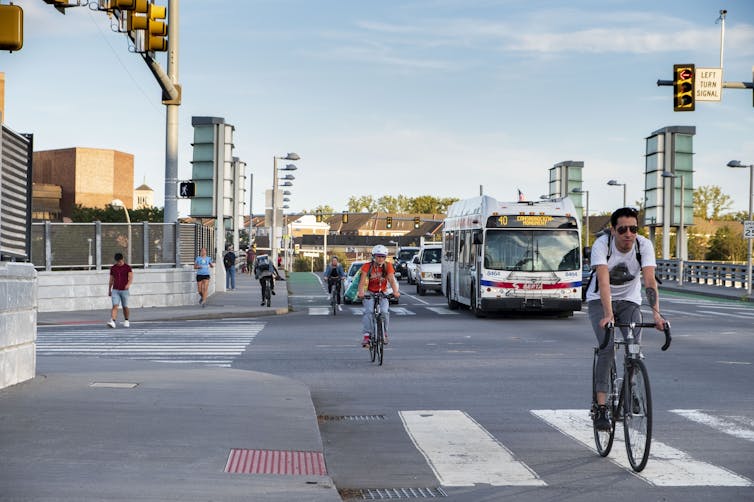
D. Alex Quistberg, Drexel University
Over 60 pedestrians and cyclists have been killed each year in Philadelphia in recent years.
Compared with other big cities, Philadelphia’s death rate for both pedestrians and cyclists is higher than New York and Chicago but lower than Los Angeles and Houston.
Across the U.S., more pedestrians and bicyclists are killed or seriously injured today than any time over the past 40 years. Over 7,500 pedestrians and over 1,100 bicyclists died in traffic collisions in 2022, the most recent year with available data, according to the National Highway Traffic Safety Administration.
As an injury epidemiologist in Philadelphia who studies pedestrian and bicyclist injuries in the U.S. and Latin America, I want to share several evidence-based ways that Philadelphia can make walking, biking and getting around the city safer for everyone.
Protect bike lanes
Protected bike lanes have physical barriers that prevent drivers from entering the bike lane to park or pass other drivers.
They are particularly useful on high-volume cycling corridors and offer cyclists much more protection than lanes that are merely painted but have no physical barriers or lanes with flexible posts that can be driven over.
Flexible posts, for example, were unable to block the collision that killed Barbara Friedes, chief pediatric resident at Children’s Hospital of Philadelphia, in Center City in July 2024 when a drunk driver sped through the bike lane where Friedes was bicycling.
Research suggests protected bike lanes can improve safety for pedestrians and drivers too. This is likely because they tend to cause drivers to slow down.
The Bicycle Coalition of Greater Philadelphia and other local bike safety advocacy groups have called for the city to replace unprotected lanes with protected lanes and also add protected bike lanes to more roadways that currently don’t have any.
In October 2024, the city announced it will install concrete barriers to protect the bike lanes on Spruce and Pine streets in Center City, including where Friedes was killed. That same month, the City Council unanimously passed a “Get Out the Bike Lane” bill that increases the fines for drivers who stop or park in a bike lane.

Slow drivers down
Traffic-calming measures are engineering and road design strategies that slow vehicles down, make pedestrians more visible to motorists and provide safer crossing areas.
They include speed humps, curb extensions and protected intersections, as well as 20 mph speed zones.
Automated speed enforcement, which involves cameras that capture the license plates of drivers who are speeding, has led to major reductions in speeding and serious collisions on Roosevelt Boulevard. The street, which runs through North and northeast Philadelphia, has been named one of most dangerous roads in the country in various analyses by news and transportation organizations. Due to this success, the city plans to expand automated speed enforcement to Broad Street in 2025 and potentially other locations in the future.
Traffic-calming measures can benefit all road users by reducing traffic congestion so drivers and public transit riders face fewer delays. They can also boost nearby businesses by increasing foot traffic and making business corridors more pleasant for shoppers.
Encourage fewer cars on the road
Philadelphia can adopt more policies that promote walking or biking over driving. These include open streets or ciclovías, where streets are closed down to motor vehicle traffic and opened to cyclists and pedestrians. Philadelphia occasionally does this on stretches of 18th Street and Walnut Street in Center City.
Increasing parking fees can also reduce traffic congestion. Parking fees generally do not reflect the true cost of driving in cities, which includes maintaining parking spaces and infrastructure. The low cost of parking is essentially a subsidy to drivers. While there are fears that reduced parking hurts business owners, substantial evidence indicates businesses benefit from increased foot and bicycle traffic.
The city could also reduce the number of parking spaces and implement congestion pricing, which involves charging fees to drive in certain areas of a city to reduce traffic congestion.
This may be a challenge, considering the recent experience of New York City, which spent decades preparing for congestion pricing only to have it blocked by the governor, though it seems it now has a chance of being implemented. How much success New York has with congestion pricing will likely determine the feasibility in Philadelphia and other U.S. cities.
Improve public transportation
Expanding public transportation and lowering or eliminating fares can also help protect pedestrians and cyclists by reducing car use. I believe these measures could help ensure the other policies mentioned above are effective.
However, Philadelphia’s public transportation is currently in a critical state. Facing funding shortfalls due to years of declining ridership, the Southeastern Pennsylvania Transportation Authority has proposed service cuts and significant fare increases beginning Jan. 1, 2025. Gov. Josh Shapiro has spared the system from these cuts for now by flexing federal highway funds, but long-term solutions are needed to ensure the survival and revival of public transportation in Philadelphia.
Addressing gun violence, drug use and other crimes may also make public transportation in Philadelphia safer and more attractive. While violent crimes on Philadelphia’s public transportation have dropped dramatically in 2024, four people have lost their lives on SEPTA vehicles so far this year.
Collect better data
Considering the increase in road traffic deaths in Philly since the start of the COVID-19 pandemic, substantial efforts are needed to reach the city’s Vision Zero goal of reducing road traffic deaths to zero by 2030.
In my view, this includes better data on transportation use and which interventions and policies are working and which are not.
Road safety surveillance could be improved in Philadelphia and across Pennsylvania by linking crash records to other data, such as hospital and clinical data of crash victims, as well as insurance costs to better understand the burden of road traffic injuries on the city and the state.
Data is also key to ensuring public policies are implemented equitably. The Vision Zero plan includes a focus on lower-income neighborhoods and those with higher proportions of racial and ethnic minorities. Those areas have three times as many serious injuries and deaths as other neighborhoods, and road traffic injury and deaths rates are 30% higher among people of color compared with white residents.
D. Alex Quistberg, Associate Research Professor, Urban Health Collaborative, Drexel University
This article is republished from The Conversation under a Creative Commons license. Read the original article.
The Bridge is a section of the STM Daily News Blog meant for diversity, offering real news stories about bona fide community efforts to perpetuate a greater good. The purpose of The Bridge is to connect the divides that separate us, fostering understanding and empathy among different groups. By highlighting positive initiatives and inspirational actions, The Bridge aims to create a sense of unity and shared purpose. This section brings to light stories of individuals and organizations working tirelessly to promote inclusivity, equality, and mutual respect. Through these narratives, readers are encouraged to appreciate the richness of diverse perspectives and to participate actively in building stronger, more cohesive communities.
https://stmdailynews.com/the-bridge
Author

Discover more from Daily News
Subscribe to get the latest posts sent to your email.


Last Updated on March 8, 2026 by Daily News Staff
Jay L. Zagorsky, Boston University
With the Olympic torch extinguished in Paris, all eyes are turning to Los Angeles for the 2028 Olympics.
The host city has promised that the next Summer Games will be “car-free.”
For people who know Los Angeles, this seems overly optimistic. The car remains king in LA, despite growing public transit options.
When LA hosted the Games in 1932, it had an extensive public transportation system, with buses and an extensive network of electric streetcars. Today, the trolleys are long gone; riders say city buses don’t come on schedule, and bus stops are dirty. What happened?
This question fascinates me because I am a business professor who studies why society abandons and then sometimes returns to certain technologies, such as vinyl records, landline phones and metal coins. The demise of electric streetcars in Los Angeles and attempts to bring them back today vividly demonstrate the costs and challenges of such revivals. https://www.youtube.com/embed/9X78ZqGyc5o?wmode=transparent&start=0 The 2028 Olympic Games will be held in existing sports venues around Los Angeles and are expected to host 15,000 athletes and over 1 million spectators.
Riding the Red and Yellow Cars
Transportation is a critical priority in any city, but especially so in Los Angeles, which has been a sprawling metropolis from the start.
In the early 1900s, railroad magnate Henry Huntington, who owned vast tracts of land around LA, started subdividing his holdings into small plots and building homes. In order to attract buyers, he also built a trolley system that whisked residents from outlying areas to jobs and shopping downtown.
By the 1930s, Los Angeles had a vibrant public transportation network, with over 1,000 miles of electric streetcar routes, operated by two companies: Pacific Electric Railway, with its “Red Cars,” and Los Angeles Railway, with its “Yellow Cars.”
The system wasn’t perfect by any means. Many people felt that streetcars were inconvenient and also unhealthy when they were jammed with riders. Moreover, streetcars were slow because they had to share the road with automobiles. As auto usage climbed and roads became congested, travel times increased.
Nonetheless, many Angelenos rode the streetcars – especially during World War II, when gasoline was rationed and automobile plants shifted to producing military vehicles. https://www.youtube.com/embed/AwKv3_WwD4o?wmode=transparent&start=0 In 1910, Los Angeles had a widely used local rail network, with over 1,200 miles (1,930 kilometers) of track. What happened?
Demise of public transit
The end of the war marked the end of the line for streetcars. The war effort had transformed oil, tire and car companies into behemoths, and these industries needed new buyers for goods from the massive factories they had built for military production. Civilians and returning soldiers were tired of rationing and war privations, and they wanted to spend money on goods such as cars.
After years of heavy usage during the war, Los Angeles’ streetcar system needed an expensive capital upgrade. But in the mid-1940s, most of the system was sold to a company called National City Lines, which was partly owned by the carmaker General Motors, the oil companies Standard Oil of California and Phillips Petroleum, and the Firestone tire company.
These powerful forces had no incentive to maintain or improve the old electric streetcar system. National City ripped up tracks and replaced the streetcars with buses that were built by General Motors, used Firestone tires and ran on gasoline.
There is a long-running academic debate over whether self-serving corporate interests purposely killed LA’s streetcar system. Some researchers argue that the system would have died on its own, like many other streetcar networks around the world.
The controversy even spilled over into pop culture in the 1988 movie “Who Framed Roger Rabbit,” which came down firmly on the conspiracy side.
What’s undisputed is that, starting in the mid-1940s, powerful social forces transformed Los Angeles so that commuters had only two choices: drive or take a public bus. As a result, LA became so choked with traffic that it often took hours to cross the city.
In 1990, the Los Angeles Times reported that people were putting refrigerators, desks and televisions in their cars to cope with getting stuck in horrendous traffic. A swath of movies, from “Falling Down” to “Clueless” to “La La Land,” have featured the next-level challenge of driving in LA.
Traffic was also a concern when LA hosted the 1984 Summer Games, but the Games went off smoothly. Organizers convinced over 1 million people to ride buses, and they got many trucks to drive during off-peak hours. The 2028 games, however, will have roughly 50% more athletes competing, which means thousands more coaches, family, friends and spectators. So simply dusting off plans from 40 years ago won’t work.
Olympic transportation plans
Today, Los Angeles is slowly rebuilding a more robust public transportation system. In addition to buses, it now has four light-rail lines – the new name for electric streetcars – and two subways. Many follow the same routes that electric trolleys once traveled. Rebuilding this network is costing the public billions, since the old system was completely dismantled.
Three key improvements are planned for the Olympics. First, LA’s airport terminals will be connected to the rail system. Second, the Los Angeles organizing committee is planning heavily on using buses to move people. It will do this by reassigning some lanes away from cars and making them available for 3,000 more buses, which will be borrowed from other locales.
Finally, there are plans to permanently increase bicycle lanes around the city. However, one major initiative, a bike path along the Los Angeles River, is still under an environmental review that may not be completed by 2028.
Car-free for 17 days
I expect that organizers will pull off a car-free Olympics, simply by making driving and parking conditions so awful during the Games that people are forced to take public transportation to sports venues around the city. After the Games end, however, most of LA is likely to quickly revert to its car-centric ways.
As Casey Wasserman, chair of the LA 2028 organizing committee, recently put it: “The unique thing about Olympic Games is for 17 days you can fix a lot of problems when you can set the rules – for traffic, for fans, for commerce – than you do on a normal day in Los Angeles.”
This article has been updated to indicate that Los Angeles has four light-rail lines.
Jay L. Zagorsky, Associate Professor of Markets, Public Policy and Law, Boston University
This article is republished from The Conversation under a Creative Commons license. Read the original article.
Dive into “The Knowledge,” where curiosity meets clarity. This playlist, in collaboration with STMDailyNews.com, is designed for viewers who value historical accuracy and insightful learning. Our short videos, ranging from 30 seconds to a minute and a half, make complex subjects easy to grasp in no time. Covering everything from historical events to contemporary processes and entertainment, “The Knowledge” bridges the past with the present. In a world where information is abundant yet often misused, our series aims to guide you through the noise, preserving vital knowledge and truths that shape our lives today. Perfect for curious minds eager to discover the ‘why’ and ‘how’ of everything around us. Subscribe and join in as we explore the facts that matter. https://stmdailynews.com/the-knowledge/
Discover more from Daily News
Subscribe to get the latest posts sent to your email.
The Bridge
Celebrating International Women’s Day!
International Women’s Day is celebrated globally on March 8th to honor women’s achievements and promote gender equality, originating from a 1908 march in New York for better rights.

Last Updated on March 7, 2026 by Daily News Staff
International Women’s Day is a global celebration that honors the achievements of women and highlights the progress still to be made in the fight for gender equality. On this day, people around the world come together to recognize the amazing contributions of women everywhere and to rally for greater gender equity in all areas of life.
The origins of International Women’s Day can be traced back to 1908, when 15,000 women marched through the streets of New York City to demand better working conditions and the right to vote. Since then, the celebration has grown to be an international event, with more than 100 countries recognizing the day. The United Nations even declared March 8th as International Women’s Day in 1975, to honor the struggles of women around the world.
This year’s International Women’s Day theme is #ChooseToChallenge, meaning that everyone is encouraged to call out gender bias and inequality when they see it. We’re also encouraged to celebrate women’s achievements, support each other, and take action for equality.
It’s important to recognize the progress we’ve made in terms of gender equality, but we still have a long way to go. International Women’s Day serves as a reminder that we must continue to fight for gender equality in all areas of life. Let’s use this day to honor the contributions of women around the world, and to continue the fight for a more equitable world.
https://www.internationalwomensday.com/
https://stmdailynews.com/category/science/
Author

Discover more from Daily News
Subscribe to get the latest posts sent to your email.
Entertainment
Byron Allen’s Starz Stake Signals Bigger Moves in the Streaming Industry
Byron Allen’s Starz: Byron Allen has acquired a 10.7% stake in Starz Entertainment for approximately $25 million, signaling his long-term media strategy amidst industry consolidation. This investment positions him influentially in the evolving streaming market despite intense competition.


Byron Allen’s Starz investment
Media entrepreneur Byron Allen has taken another step toward expanding his growing media empire. Through his family office, Allen recently acquired a 10.7% stake in Starz Entertainment, purchasing the shares from a fund managed by former U.S. Treasury Secretary Steven Mnuchin.
The transaction, valued at approximately $25 million, gives Allen a significant minority position in the premium cable and streaming platform. While the investment itself may seem modest compared to the billion-dollar deals common in Hollywood, analysts say the move could signal a larger strategy unfolding in the rapidly evolving streaming industry.
Why the Starz Deal Matters
The shares were sold by Mnuchin’s Liberty 77 Capital fund, which previously invested in the company when Starz was still connected to its former parent, Lionsgate.
In 2025, Lionsgate completed a corporate restructuring that separated its operations into two distinct companies:
- Lionsgate Studios – responsible for film and television production
- Starz – focused on premium cable and streaming services
Following the spin-off, Starz became an independent publicly traded company. As a result, investors are still determining the platform’s long-term value in an increasingly crowded streaming marketplace.
A Streaming Platform With Loyal Audiences
Despite facing intense competition from larger platforms such as Netflix, Disney+, and Amazon Prime Video, Starz continues to maintain a strong subscriber base and recognizable content franchises.
- Outlander – historical drama series
- The Power franchise created by Courtney A. Kemp and executive produced by 50 Cent
Byron Allen’s Long-Term Media Strategy
Allen’s investment strategy has long focused on owning media distribution and infrastructure rather than simply producing content.
- The Weather Channel
- Dozens of local television stations across the United States
- Multiple niche cable networks and digital platforms
Over the past several years, Allen has also pursued larger acquisitions, reportedly exploring deals involving companies such as Paramount Global and BET Media Group. While those deals did not materialize, they signaled his ambition to expand Allen Media Group into a major force in global media ownership.
The Bigger Picture: Industry Consolidation
Allen’s investment arrives during a time of significant disruption in the entertainment business. Traditional cable television continues to decline as audiences migrate toward streaming platforms. At the same time, major studios and media companies are struggling to make streaming services consistently profitable.
Industry observers believe these pressures could lead to a new wave of consolidation across Hollywood and the streaming sector. Smaller platforms like Starz could become attractive acquisition targets for larger companies seeking additional subscribers and content libraries.
A Potential Hidden Opportunity
For now, Allen’s 10.7% stake does not give him control of Starz. However, it does provide influence as one of the company’s larger shareholders and leaves open the possibility of increasing his ownership in the future.
If consolidation accelerates and streaming platforms begin merging or forming partnerships, assets like Starz could become significantly more valuable. For Byron Allen—whose career began as a stand-up comedian before evolving into one of the most prominent independent media owners in America—the investment may represent another calculated step in a decades-long strategy built around media ownership and long-term growth.
Related Coverage
- Byron Allen Acquires Stake in Starz – Hollywood Reporter
- Starz Spin-Off from Lionsgate: What It Means for Streaming – Variety
- Byron Allen’s Media Acquisitions: Building a Modern Empire – Forbes
- Starz in the Streaming Wars: How It Compares – CNBC
- Why Byron Allen is Betting on Streaming Platforms – Deadline
Dive into “The Knowledge,” where curiosity meets clarity. This playlist, in collaboration with STMDailyNews.com, is designed for viewers who value historical accuracy and insightful learning. Our short videos, ranging from 30 seconds to a minute and a half, make complex subjects easy to grasp in no time. Covering everything from historical events to contemporary processes and entertainment, “The Knowledge” bridges the past with the present. In a world where information is abundant yet often misused, our series aims to guide you through the noise, preserving vital knowledge and truths that shape our lives today. Perfect for curious minds eager to discover the ‘why’ and ‘how’ of everything around us. Subscribe and join in as we explore the facts that matter. https://stmdailynews.com/the-knowledge/
Discover more from Daily News
Subscribe to get the latest posts sent to your email.





