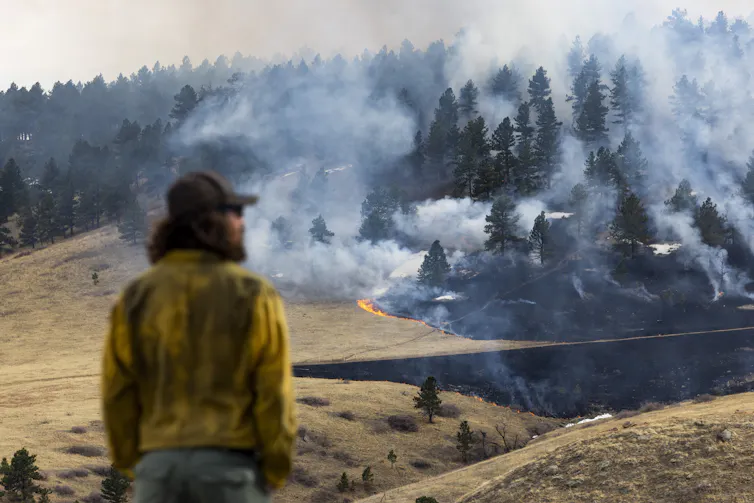
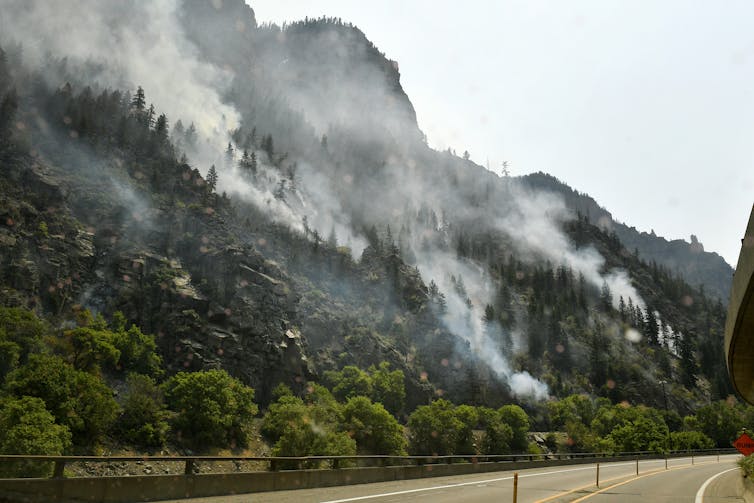
Alerts are complex. They can come from a variety of official sources, including 911 centers, weather forecast centers and others. Alerts can also come in many forms, ranging from emails and texts to sirens and radio broadcasts. Our study, mandated and funded by Colorado House Bill 23-1237, focused on understanding alert systems in Colorado after the Grizzly Creek Fire in 2020 and the Marshall Fire in 2021.The Grizzly Creek Fire burns down hillsides along I-70 in Glenwood Canyon on Aug. 17, 2020, near Glenwood Springs, Colo.Helen H. Richardson/MediaNews Group/The Denver Post via Getty Images These fires were destructive and highlighted issues related to emergency alerting. Alerts about the fires and calls to evacuate were delayed and inconsistently received. Most were only available in Englishdespite census data that shows 1 in 10 residents of Eagle and Garfield counties speak Spanish at home and only “speak English less than ‘very well.’” The resulting legislation focused on how to make emergency alerts in Colorado accessible to all, but especially those with disabilities and with limited-English proficiency. As social scientists who study disasters, we know that hazards, like earthquakes and wildfires, reveal inequities and that certain groups fare worse and take longer to recover. People with disabilities have higher rates of death from disasters. This is not because these populations are inherently less able to respond, but because emergency planning and systems may not account for their specific needs. Our Colorado study used interviews and a statewide survey of 222 officials that send alerts to better understand the challenges of providing alerts across the state and reaching at-risk populations.
A patchwork system
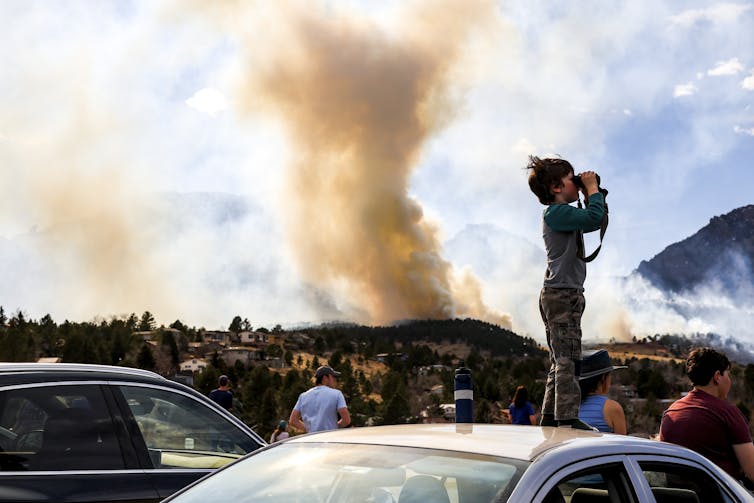
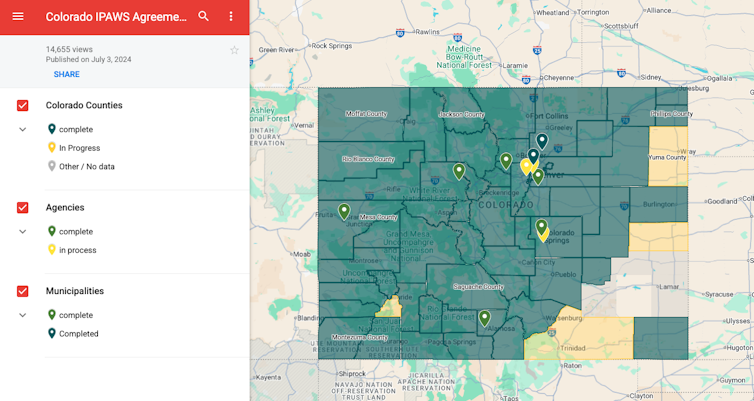
The state of Colorado does not have a uniform alert system. Local areas determine the alert systems they will use. Some alerts get sent through systems that require people to opt in. This means that people sign up and choose to receive notifications. Neighboring counties often use different opt-in alert systems, meaning individuals who travel to different counties for work or recreation may need to register for multiple systems. Examples of these systems include Everbridge, used by Boulder County, and CodeRed, used by Adams and Park counties.Amitai Beh, 6, watches the NCAR Fire on March 26, 2022 in Boulder, Colo..Michael Ciaglo/Stringer via Getty Images The success of these systems in an emergency relies on the community signing up for alerts. We found that registering for alert systems was a barrier for everyone, but especially those with limited-English proficiency and with disabilities. This is because they may not be aware of the systems that are accessible to them or they are wary of providing personal information, and depending on their location, alerts may only be offered in English.The current status of Integrated Public Alert and Warning System alerting entities across Colorado. Green means there’s an approved alerting authority, yellow indicates the region is in the process of becoming an alerting authority, and gray means the area has not begun the process.Colorado Division of Homeland Security & Emergency Management, CC BY-ND Another system is “opt out,” meaning people will receive alerts by default unless they turn them off. These include Wireless Emergency Alerts, or WEAs. These messages get broadcast through cellphone towers to phones in a specific geographic area. So if you have a cellphone in a WEA alert boundary, you will get an alert. WEAs are used in Colorado to target specific regions in danger, such as an area that needs to evacuate or for an Amber Alert. There is no national standard or guidance for opt-in or opt-out systems, which can lead to inconsistencies in how people get alerts.
Lack of resources limits alerting authorities
We found that though authorities often want to provide alerts in other languages and accessible formats, they have significant resource constraints. Time, staff, money or training can all limit the level of accessibility they can provide. Sixty-four percent of the authorities we surveyed said they lacked funding to make alerts more inclusive. More than a third of our respondents didn’t know if their systems could provide alerts in languages other than English or for people with disabilities. This speaks to a need for better training on how these systems work and how to use them effectively. An alert is complete if it includes information about the source, hazard, location and time. Recently, researchers found that fewer than 10% of all Nationwide Wireless Emergency Alerts issued from 2012 to 2022 were complete. One of us – Micki Olson – worked with the federal government to develop the Message Design Dashboard to help alerting authorities craft clear and comprehensive emergency messages. Fifty-six out of 64 counties in Colorado are an Integrated Public Alert and Warning System authority, which means they can send alerts across multiple platforms at once. This can improve alert access since it broadens who alerts reach. Not all counties have this option, and even the ones who do, don’t always use it. In our study, authorities noted limited staff capacity, funds and lack of time prevents them from getting or using the IPAWS system. “We simply do not have the resources, both financial and people, to deploy all of these systems,” a survey respondent from Gunnison County said.
Alert systems were not built to be accessible
The final issue we identified is that alert systems were not developed with accessible options and functionality like video or image options. For example, people who are blind or have low vision won’t have access to a message unless they enable text-speech features on their phone in advance. The WEA system only allows alerts to be sent in English or Spanish. Characters like accents and tildes cannot be included. Expansion of language options was planned but is now on hold for unclear reasons. Some counties have the resources to make alerts available in additional languages, but most do not. Almost 900,000 Coloradans speak a language other than English. According to the Migration Policy Institute, more than 230,000 Coloradans have difficulty comprehending and communicating in English.
Where do we go from here?
Recent events, including the Palisades and Eaton fires in California and the devastating floods in Kerr County, Texas, demonstrate how critical it is that timely and accessible emergency alerts reach everyone, but especially the most vulnerable individuals. However, these systems are complex, and everyone from individuals to local government can play a part in improving them.
Federal and local governments can allocate funds to update and standardize systems. They can also implement training and procedures to ensure alerts are effective and inclusive.
Authorities that send alerts can partner more closely with trusted community organizations and networks to reach diverse audiences.
Researchers can identify how to better tailor systems to meet community needs.
Individuals can learn about and sign up for alerts. To do so, visit local government websites or enter “emergency alerts” and the name of your county or city in an online search.
The Unfavorable Semicircle Mystery: The YouTube Channel That Uploaded Tens of Thousands of Cryptic Videos
In 2015, the YouTube channel Unfavorable Semicircle gained attention for its enigmatic and abundant video uploads, totaling over 70,000 before its deletion in 2016. Theories about its purpose vary, from automated content generation to digital art experimentation, leaving its intent unresolved.
In the vast digital landscape of the internet, strange phenomena occasionally emerge that leave investigators, tech enthusiasts, and everyday viewers scratching their heads. One of the most puzzling cases appeared in 2015, when a mysterious YouTube channel called Unfavorable Semicircle began uploading an astonishing number of cryptic videos.
Within months, the channel had published tens of thousands of bizarre clips, many of which seemed random, incomprehensible, and visually chaotic. But as internet detectives began analyzing the content more closely, they discovered that these videos might not have been random at all.
The Sudden Appearance of an Internet Mystery
The Unfavorable Semicircle channel reportedly appeared in March 2015, with its first uploads arriving in early April.
Almost immediately, the channel began publishing videos at an incredible pace. Observers estimated that the account uploaded thousands of videos per week, sometimes multiple videos per minute. By the time the channel disappeared in early 2016, researchers believed it had uploaded well over 70,000 videos, possibly far more.
The scale alone made the project seem impossible for a human to manage manually.
Most of the videos shared similar characteristics:
Extremely short or very long runtime
Abstract visuals such as flashing colors, static, or distorted imagery
Little or no audio, or heavily distorted sounds
Titles made of random characters, symbols, or numbers
To casual viewers, the videos looked like pure digital noise. However, online investigators suspected something more deliberate was happening.
Hidden Images Discovered
The mystery deepened when researchers began extracting individual frames from some videos.
When thousands of frames from certain clips were stitched together, the results sometimes formed coherent images. One of the most famous examples involved a video titled “LOCK.” While the footage appeared chaotic at first, combining the frames revealed a recognizable composite image.
This discovery suggested the videos were carefully constructed rather than random uploads.
Theories About the Channel’s Purpose
Because the creator never explained the project, several theories emerged across Reddit, YouTube, and internet forums.
Automated Experiment Many believe the channel was created using automated software that generated and uploaded content at scale.
Alternate Reality Game (ARG) Some viewers suspected the channel might be part of a hidden puzzle or digital scavenger hunt.
Advertisement
Encrypted Communication Others compared the channel to Cold War “numbers stations,” suggesting the videos could contain coded messages.
Digital Art Project Another theory suggests the channel was an experimental art project exploring algorithms, data, and visual noise.
Despite years of investigation, no single explanation has been confirmed.
Why the Channel Disappeared
In February 2016, YouTube removed the channel, reportedly due to spam or automated activity violations.
By that time, the channel had already become a minor internet legend. Fortunately, some researchers managed to archive a large portion of the videos before they disappeared.
Even today, archived clips continue to circulate online as investigators attempt to decode them.
Unfavorable Semicircle: The Most Bizarre YouTube Mystery
Other Mysterious YouTube Channels
The Unfavorable Semicircle mystery is not the only strange case on YouTube.
One well-known example is Webdriver Torso, a channel that uploaded hundreds of thousands of videos showing red and blue rectangles with simple beeping sounds. Internet speculation ran wild before Google eventually confirmed it was an internal YouTube testing account.
Another example is AETBX, which posts distorted visuals and unusual audio that some viewers believe contain hidden patterns or encoded information.
These cases highlight how automation, experimentation, and creativity can sometimes blur the line between technology and mystery.
Advertisement
A Digital Mystery That Remains Unsolved
Nearly a decade later, the true purpose behind Unfavorable Semicircle remains unknown.
Was it a sophisticated experiment? A piece of algorithmic art? Or simply an automated test that accidentally captured the internet’s imagination?
Whatever the explanation, the channel stands as a reminder that even in a world filled with billions of videos and endless information, the internet can still produce mysteries that challenge our understanding of technology.
Why Internet Mysteries Still Fascinate Us
Stories like Unfavorable Semicircle capture attention because they combine technology, creativity, and the unknown. They invite people from around the world to collaborate, analyze patterns, and search for meaning hidden in the noise.
And sometimes, the most intriguing part of the mystery is that the answer may never fully be known.
Dive into “The Knowledge,” where curiosity meets clarity. This playlist, in collaboration with STMDailyNews.com, is designed for viewers who value historical accuracy and insightful learning. Our short videos, ranging from 30 seconds to a minute and a half, make complex subjects easy to grasp in no time. Covering everything from historical events to contemporary processes and entertainment, “The Knowledge” bridges the past with the present. In a world where information is abundant yet often misused, our series aims to guide you through the noise, preserving vital knowledge and truths that shape our lives today. Perfect for curious minds eager to discover the ‘why’ and ‘how’ of everything around us. Subscribe and join in as we explore the facts that matter. https://stmdailynews.com/the-knowledge/
International Women’s Day is celebrated globally on March 8th to honor women’s achievements and promote gender equality, originating from a 1908 march in New York for better rights.
International Women’s Day is a global celebration that honors the achievements of women and highlights the progress still to be made in the fight for gender equality. On this day, people around the world come together to recognize the amazing contributions of women everywhere and to rally for greater gender equity in all areas of life.
The origins of International Women’s Day can be traced back to 1908, when 15,000 women marched through the streets of New York City to demand better working conditions and the right to vote. Since then, the celebration has grown to be an international event, with more than 100 countries recognizing the day. The United Nations even declared March 8th as International Women’s Day in 1975, to honor the struggles of women around the world.
This year’s International Women’s Day theme is #ChooseToChallenge, meaning that everyone is encouraged to call out gender bias and inequality when they see it. We’re also encouraged to celebrate women’s achievements, support each other, and take action for equality.
It’s important to recognize the progress we’ve made in terms of gender equality, but we still have a long way to go. International Women’s Day serves as a reminder that we must continue to fight for gender equality in all areas of life. Let’s use this day to honor the contributions of women around the world, and to continue the fight for a more equitable world.
Rebecca Jo is a mother of four and is a creative soul from Phoenix, Arizona, who also enjoys new adventures. Rebecca Jo has a passion for the outdoors and indulges in activities like camping, fishing, hunting and riding roller coasters. She is married to Rod Washington
Byron Allen’s Starz Stake Signals Bigger Moves in the Streaming Industry
Byron Allen’s Starz: Byron Allen has acquired a 10.7% stake in Starz Entertainment for approximately $25 million, signaling his long-term media strategy amidst industry consolidation. This investment positions him influentially in the evolving streaming market despite intense competition.
Byron Allen — Founder/Chairman/CEO of Allen Media Group
Byron Allen’s Starz investment
Media entrepreneur Byron Allen has taken another step toward expanding his growing media empire. Through his family office, Allen recently acquired a 10.7% stake in Starz Entertainment, purchasing the shares from a fund managed by former U.S. Treasury Secretary Steven Mnuchin.
The transaction, valued at approximately $25 million, gives Allen a significant minority position in the premium cable and streaming platform. While the investment itself may seem modest compared to the billion-dollar deals common in Hollywood, analysts say the move could signal a larger strategy unfolding in the rapidly evolving streaming industry.
Why the Starz Deal Matters
The shares were sold by Mnuchin’s Liberty 77 Capital fund, which previously invested in the company when Starz was still connected to its former parent, Lionsgate.
In 2025, Lionsgate completed a corporate restructuring that separated its operations into two distinct companies:
Lionsgate Studios – responsible for film and television production
Starz – focused on premium cable and streaming services
Following the spin-off, Starz became an independent publicly traded company. As a result, investors are still determining the platform’s long-term value in an increasingly crowded streaming marketplace.
Despite facing intense competition from larger platforms such as Netflix, Disney+, and Amazon Prime Video, Starz continues to maintain a strong subscriber base and recognizable content franchises.
Outlander – historical drama series
The Power franchise created by Courtney A. Kemp and executive produced by 50 Cent
Byron Allen’s Long-Term Media Strategy
Allen’s investment strategy has long focused on owning media distribution and infrastructure rather than simply producing content.
The Weather Channel
Dozens of local television stations across the United States
Multiple niche cable networks and digital platforms
Over the past several years, Allen has also pursued larger acquisitions, reportedly exploring deals involving companies such as Paramount Global and BET Media Group. While those deals did not materialize, they signaled his ambition to expand Allen Media Group into a major force in global media ownership.
The Bigger Picture: Industry Consolidation
Allen’s investment arrives during a time of significant disruption in the entertainment business. Traditional cable television continues to decline as audiences migrate toward streaming platforms. At the same time, major studios and media companies are struggling to make streaming services consistently profitable.
Industry observers believe these pressures could lead to a new wave of consolidation across Hollywood and the streaming sector. Smaller platforms like Starz could become attractive acquisition targets for larger companies seeking additional subscribers and content libraries.
A Potential Hidden Opportunity
For now, Allen’s 10.7% stake does not give him control of Starz. However, it does provide influence as one of the company’s larger shareholders and leaves open the possibility of increasing his ownership in the future.
If consolidation accelerates and streaming platforms begin merging or forming partnerships, assets like Starz could become significantly more valuable. For Byron Allen—whose career began as a stand-up comedian before evolving into one of the most prominent independent media owners in America—the investment may represent another calculated step in a decades-long strategy built around media ownership and long-term growth.
Dive into “The Knowledge,” where curiosity meets clarity. This playlist, in collaboration with STMDailyNews.com, is designed for viewers who value historical accuracy and insightful learning. Our short videos, ranging from 30 seconds to a minute and a half, make complex subjects easy to grasp in no time. Covering everything from historical events to contemporary processes and entertainment, “The Knowledge” bridges the past with the present. In a world where information is abundant yet often misused, our series aims to guide you through the noise, preserving vital knowledge and truths that shape our lives today. Perfect for curious minds eager to discover the ‘why’ and ‘how’ of everything around us. Subscribe and join in as we explore the facts that matter. https://stmdailynews.com/the-knowledge/