Connect with us

Nature

For birds, flocks promise safety – especially if you’re faster than your neighbor

Published

on

flocks promise safety
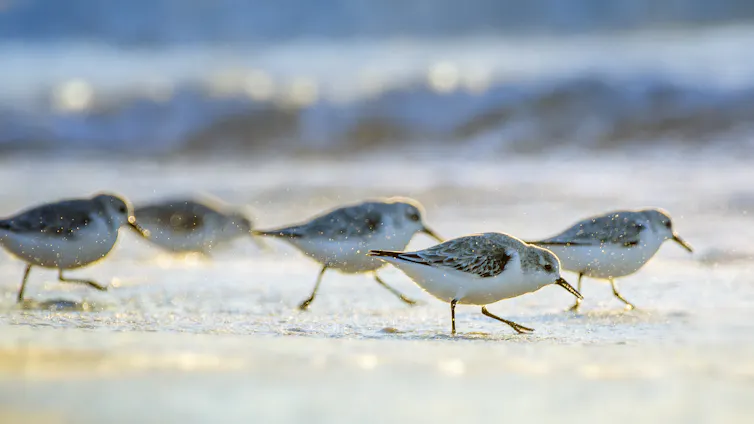
Sanderlings run in groups as they hunt for food in the sand on Long Beach Island, N.J.
Vicki Jauron, Babylon and Beyond Photography/Moment via Getty Images

For birds, flocks promise safety – especially if you’re faster than your neighbor

Joan Strassmann, Washington University in St. Louis

As I walked along Bolivar Flats, just across from Galveston Island in Texas, I watched flocks of sanderlings forage along the frothy wavefront as it surged and retreated. Nearby, Caspian terns, American avocets, and black skimmers rested on the beach, each in its own group.

The birds rose simultaneously as I drew near, and then settled farther down the beach, clearly fearing me.

As an evolutionary biologist and author of the new book “The Social Lives of Birds,” I’m fascinated by how social behavior has evolved in birds. Why is it ever worth being with others that not only compete for food but may pass on diseases or even mate with your partner?

A tern with a bright orange beak carries a small fish as tiny tern chick eats parts of it. Another tern keeps a tiny tern chick warm.
A pair of Caspian terns, with other terns around them, feed their chicks on a beach.
US Environmental Protection Agency

Safety in numbers

The late Oxford University biologist William D. Hamilton discussed the advantages of flocking with his landmark 1971 paper “Geometry for the Selfish Herd.” He theorized that individuals in a flock stay because each benefits from the shelter of the group. At the time, a prevailing belief was that animals moved in groups for the benefit of the group, not the individual.

Groups provide some safety because they’re harder to attack, they’re more likely to provide warnings of approaching danger, and they have an ability to respond together if threatened.

But everyone in the group does not necessarily benefit equally.

A flock of seagulls takes off as a child runs down a beach into the group.
When a threat approaches, a bird in a flock is harder to target.
Ed Schipul via Wikimedia Commons, CC BY-SA

The best position is one that puts another bird between oneself and a predator, making your neighbor the more likely target. This keeps birds in a group close together as each tries for living shelter. It is a kind of movement you’ll also see in schools of fish or great herds of ungulates in Africa, like wildebeests.

The peril of being the lone bird

Shorebirds, similar to those I saw in Texas, might be the easiest to study, particularly where the predator can come from a forest that borders the shore.

One of the best-studied flocking shorebirds is the common redshank, Tringa tetanus, often seen feeding on mudflats and saltmarshes in Britain. Redshanks are sandpipers very closely related to the greater and lesser yellowlegs I see in Texas, but with red legs rather than yellow.

Two small birds on a rock with red legs that appear long for their small bodies.
Two noisy redshanks in the Shetland Islands.
Mike Pennington via Wikimedia, CC BY

The predator that redshanks have most reason to fear is the Eurasian sparrowhawk, which watches foraging redshanks from the trees bordering the saltmarsh. When a sparrowhawk picks its prey, it flies fast and hard toward a single predetermined target, grabbing the hapless redshank with its talons.

Evolutionary biologist Will Cresswell studied the redshank’s flocking behavior on the chilly Tyninghame Estuary and found that sparrowhawks were most successful in catching lone birds and those in smaller flocks.

A hawk carries a smaller bird in its talons as it flies.
Why shorebirds have reason to fear Eurasian sparrowhawks and look for safety in numbers.
Janne Passi via Wikimedia, CC BY-SA

The closer a bird was to a neighbor, the less likely it was to be targeted and caught. That reminds me of that old trope about how fast you have to run from a lion: just faster than your neighbor.

Large flocks have downsides, too

One downside to being in a large redshank flock is that these birds have to take more steps to get food because they have more competition.

With other flock members probing the sand, and the sand shrimp and other invertebrates fleeing this probing, the redshanks spend more time foraging when they are in larger flocks.

Advertisement
Get More From A Face Cleanser And Spa-like Massage
More than a dozen red birds flutter around a backyard bird feeder trying to get close enough to grab some seeds.
A flock of purple finches competes for space at a feeder. While flocks provide safety, they also mean more competition for food.
ImagePerson via Wikimedia Commons, CC BY

Canadian ornithologist Guy Beauchamp compared closely related species on islands where there were fewer predators with those on the mainland where predators were common. Flocks were smaller on islands, allowing the birds to forage with less competition.

Fantastic flying flocks

Flying in flocks can also help birds avoid predators.

Evolutionary biologist Daniel Sankey and his colleagues separated the behavior of predator and prey by using an artificial predator, the ingeniously engineered flying robot falcon. Its behavior could be mechanically controlled as it approached a flock of homing pigeons, all labeled with GPS tags that allowed precise measurements of how the birds’ positions changed.

The team compared pigeon flight with and without attacks by the robot falcon and found that when the pigeons noticed the robot falcon, they turned sharply away from it, following the direction their nearest neighbor was turning and did not cluster more tightly.

A murmuration of starlings in flight. National Geographic.

More spectacular but harder to study are the mesmerizing flocks of European starlings as they circle and swerve, avoiding predators before settling for the night. These flocks of thousands are called murmurations and are fantastic to watch, and likely frustrating for predators that would struggle to grab a single bird from the swirling scene.

Italian physicist Michele Ballerini figured out that this magnificent visual concert was the result of birds simply keeping track of six nearest neighbors, turning and moving when they did.

Beyond flocks: Roosts and supersociality

Birds are social in other ways, too.

Some sleep together in roosts, nest near each other in colonies, or show off together, carrying out mating dances in what is known as lekking to attract females. They may actively help each other in rearing the young, typically if they are related to the breeders, or anticipate inheriting the breeding position or territory.

Male sage grouse strut their stuff during lekking. National Geographic.

Take time to watch the behavior of the birds around you, and you’ll start to notice social behaviors everywhere, from the ducks in a city pond to the chickadees hunting for insects deep in winter. I hope you’ll watch them with more understanding of their social lives, and with a little bit more wonder.

Joan Strassmann, Professor of Biology, Washington University in St. Louis

This article is republished from The Conversation under a Creative Commons license. Read the original article.

Advertisement
Get More From A Face Cleanser And Spa-like Massage

Continue Reading
Advertisement SodaStream USA, inc

News Brief

Earthquake Swarm Shakes Southern California Near Salton Sea

Earthquake Swarm: A swarm of earthquakes near California’s Salton Sea and Brawley area has prompted increased monitoring by seismologists as hundreds of tremors shake the region.

Published

on

Salton Sea earthquake swarm

A swarm of earthquakes has been rattling Southern California near the Salton Sea, drawing attention from residents and seismologists across the region.

Salton Sea earthquake swarm?

The activity is centered near Brawley in Imperial County, an area known for frequent seismic movement due to its location within the Brawley Seismic Zone. According to the U.S. Geological Survey, hundreds of small earthquakes have been recorded over the past several days, with the strongest reaching a magnitude of approximately 4.7.

Residents throughout Imperial Valley, parts of Riverside County, and even portions of Arizona reported feeling shaking from several of the larger quakes. Minor incidents such as falling objects and brief power disruptions were also reported, though no major injuries or widespread structural damage have been confirmed at this time.

The region sits near the southern end of the San Andreas Fault and is considered one of California’s most geologically active areas. Scientists say earthquake swarms are relatively common near the Salton Sea because of the interaction between tectonic fault systems and geothermal activity beneath the surface.

While experts continue to monitor the situation closely, they emphasize that earthquake swarms do not necessarily indicate that a larger earthquake is imminent. However, officials encourage residents to review emergency preparedness plans, secure heavy furniture, and keep emergency supplies ready.

The Salton Sea region has experienced similar seismic swarms in the past, making it an important area of study for earthquake researchers and emergency management agencies.

For continued updates on this developing story and other regional news, visit STM Daily News.

Related External Links

Stay informed with the latest breaking news, trending stories, and real-time updates from around the world on STM Daily News. Visit our Stories This Moment page for continuously updated coverage on major events, technology, transportation, science, entertainment, and more.

Authors

  • Rod Washington

    Rod: A creative force, blending words, images, and flavors. Blogger, writer, filmmaker, and photographer. Cooking enthusiast with a sci-fi vision. Passionate about his upcoming series and dedicated to TNC Network. Partnered with Rebecca Washington for a shared journey of love and art.

    View all posts

Want more stories 👋
“Your morning jolt of Inspiring & Interesting Stories!”

Sign up to receive awesome articles directly to your inbox.

STM Coffee Newsletter 1

We don’t spam! Read our privacy policy for more info.

Advertisement
Get More From A Face Cleanser And Spa-like Massage
Continue Reading

health and wellness

Warmer temps bring soaring tick populations – here’s how to stay safe from Lyme disease

Tick bites are rising in 2026. Learn where Lyme disease is spreading, early symptoms like the bull’s-eye rash, treatment options, and practical ways to prevent tick bites.

Published

on

file 20260428 85 68li0w.jpg?ixlib=rb 4.1
Exposure to ticks can be a downside to spending time in the woods. skaman306/Moment via Getty Images

Lakshmi Chauhan, University of Colorado Anschutz

Spring’s warmer weather lures people outdoors – and into possible contact with ticks that spread Lyme disease.

Already, the 2026 tick season is booming. On April 23, the Centers for Disease Control and Prevention warned that emergency room visits due to tick bites are at their highest level since 2017. That may portend an especially severe season for Lyme disease and other tick-borne illnesses.

State health departments reported more than 89,000 cases of Lyme disease in 2023, the last year for which data is available. But public health experts believe that close to 500,000 people in the U.S. get Lyme disease every year.

As an infectious disease doctor with experience treating some of this infection’s long-term outcomes, I know that Lyme disease can be tricky because people often don’t notice tick bites and may overlook early symptoms of an infection. But left untreated, the infection can cause serious lingering – and even permanent – health issues.

Here’s what you need to know about Lyme disease to stay safe this season:

What causes Lyme disease?

Lyme disease, named after the Connecticut town where the disease was first identified in 1975, is caused by a group of bacteria called Borrelia – most often, the species Borrelia burgdorferi.

Deer ticks – also called black-legged ticks, and members of a group called Ixodes – transmit the disease after feeding on an infected animal, usually a bird, mouse or deer. When they then bite a person, they can transmit the bacteria into the person’s bloodstream.
Usually, the tick must attach for 24-48 hours to transmit the bacteria causing Lyme disease.

Where and when does Lyme disease occur?

Lyme disease can occur in most regions where deer ticks live.

These ticks are most active in late spring, summer and fall – usually April to November in most regions. They emerge when the temperature is above freezing. In years when winter is shorter, ticks can emerge earlier. And they may be active year-round in regions where freezing temperatures are rare.

Approximately 90% of U.S. cases are reported from states in the Northeast, mid-Atlantic from Virginia to eastern Canada, and Upper Midwest regions including Wisconsin, Michigan and Minnesota. A few cases occasionally pop up in California, Oregon and Washington.

Advertisement
Get More From A Face Cleanser And Spa-like Massage
Map of the U.S. showing lots of Lyme disease incidence in the Northeast and in Upper Midwest states, plus a smattering elsewhere in the country
Northeast and Upper Midwest states have the highest incidence of Lyme disease, according to the Centers for Disease Control and Prevention in 2023. Centers for Disease Control and Prevention

Since 1995, the incidence of Lyme disease in the U.S. has almost doubled.

Warmer weather and changes in rainfall patterns now allow ticks to survive in new regions of the country – and for longer periods. But even in regions where ticks lived before, Lyme disease has become more common due to increases in deer populations. As woodland areas are increasingly being developed, it may be bringing the habitat of deer and mice closer to people, increasing the risk of transmission.

Lyme disease symptoms to watch for

Early symptoms of Lyme disease – fever, muscle aches and fatigue – generally emerge within three to 30 days after a tick bite. Another classic symptom in the first month is a target or bull’s eye rash at the site of tick bite, which occurs in about 70% to 80% of cases.

Other rashes following a tick bite can also occur. Some may be due to irritation from the bite, and not necessarily an infection.

If you know you’ve had a tick bite and experience flu-like symptoms – or if you see a bull’s-eye rash, whether you know you were bitten or not – it’s important to check with your healthcare provider about whether you should be treated with antibiotics.

A blood test for antibodies can help confirm the infection, but it can sometimes yield a false negative result, particularly in the first couple of weeks of the disease.

Deer ticks at four stages of development, from larva to adult
In the larval stage, deer ticks can be tiny – and difficult to spot on your body. Centers for Disease Control and Prevention

In most people, the rash goes away on its own. However, treatment may shorten its duration and is important for preventing other symptoms. A two- to four-week course of antibiotics can generally treat Lyme disease. Severe cases might require intravenous antibiotics.

A promising new vaccine for Lyme disease is currently being tested. In March 2026, Pfizer, the pharmaceutical company developing it, announced that in a late-stage study, the vaccine prevented the disease in 70% of people who received it.

Later Lyme symptoms

If left untreated, the bacteria that causes Lyme can spread, potentially causing longer-term symptoms. About 60% of people who get Lyme disease and don’t treat it can develop arthritis.

In rare cases, Lyme disease can also affect the heart and the nervous system. Inflammation in the brain or the tissues surrounding it, called meninges, can cause headaches and neck pain, as well as balance issues and memory and behavior changes. It can also cause nerve damage that results in numbness, tingling and muscle weakness.

These symptoms can appear right away or much later – sometimes months to years after infection. And in cases where the disease wasn’t promptly treated, late-stage symptoms can linger even after antibiotics kill the bacteria.

Scientists don’t fully understand why, but one intriguing study found that some particles from the bacteria’s cell wall leak into the joints and can persist after treatment, spurring ongoing inflammation and arthritis symptoms.

Advertisement
Get More From A Face Cleanser And Spa-like Massage

Another reason for Lyme’s long-term effects is that it can trigger autoimmune disease, which is when the immune system attacks its own cells. What’s more, because the nervous system may be particularly sensitive to damage caused by the bacteria and related inflammation, it may take an especially long time to heal. In some situations, the damage could be permanent.

Preventing Lyme disease

Until a vaccine becomes available, there are steps you and your family can take to help protect against Lyme disease:

  • Use tick and insect repellents such as DEET and picaridin, which can be applied to skin, and permethrin, which is sprayed onto clothing, to keep ticks at bay. Treating clothing with permethrin may be especially beneficial, since the substance withstands several washes.
  • Wear long-sleeve shirts and pants while you are gardening, hiking or walking through grass or woods to prevent tick bites. Wearing light-colored clothes makes ticks more visible, and tucking your pants into your socks can also prevent the little buggers from traveling from your pants, shoes and socks onto your legs.
  • Remove your outdoor clothes immediately. Washing and drying clothes at high temperature can help kill any ticks that managed to hitch a ride. And a quick shower immediately after spending time outdoors can wash ticks off the skin before they have a chance to attach.
  • If you spend time outdoors, perform daily tick checks, paying special attention to warm areas like your armpits, neck, ears and underwear line. If you find a tick attached, pull it off with tweezers, holding them perpendicular to the skin.
  • If you find a tick that may have been on the skin for more than 36 hours, ask your healthcare provider whether a dose of preventive antibiotics – generally given within 72 hours of the bite – would be appropriate.

Lakshmi Chauhan, Associate Professor of Infectious Disease Medicine, University of Colorado Anschutz

This article is republished from The Conversation under a Creative Commons license. Read the original article.

Continue Reading

The Earth

Restore Our Earth: Celebrating Earth Day and Taking Action for a Sustainable Future

Published

on

Last Updated on April 17, 2026 by Daily News Staff

Earth Day is celebrated annually on April 22nd, and it serves as a reminder of the importance of taking care of our planet. It’s a day to reflect on our impact on the environment and to take action to create a better future for our planet.

The first Earth Day was celebrated in 1970, and it marked the beginning of the environmental movement. Since then, Earth Day has grown into an international event, with millions of people around the world participating in activities and events to raise awareness about environmental issues.

One of the main goals of Earth Day is to encourage people to take action to reduce their impact on the environment. This can include simple actions like recycling, conserving energy, and reducing waste. It can also involve more significant actions like advocating for environmental policies and supporting sustainable businesses.

Another important aspect of Earth Day is education. It’s a time to learn about environmental issues and to understand how our actions can impact the planet. Many schools and organizations use Earth Day as an opportunity to teach children about the importance of taking care of the environment.

This year’s Earth Day theme is “Restore Our Earth”, and it focuses on the idea that we can all play a role in restoring the planet’s ecosystems. This can include actions like planting trees, reducing plastic waste, and supporting sustainable agriculture.

Earth Day is an important reminder of the impact that we have on the environment and the importance of taking action to create a better future for our planet. By working together and taking small steps, we can make a big difference in protecting the planet and ensuring that it remains healthy and beautiful for generations to come.

Earth Day – April 22

https://nationaltoday.com/earth-day/

https://stmdailynews.com/category/science/

Advertisement
Get More From A Face Cleanser And Spa-like Massage

Author

  • Rod Washington

    Rod: A creative force, blending words, images, and flavors. Blogger, writer, filmmaker, and photographer. Cooking enthusiast with a sci-fi vision. Passionate about his upcoming series and dedicated to TNC Network. Partnered with Rebecca Washington for a shared journey of love and art.

    View all posts
Continue Reading

Trending