Hulk Hogan and the unraveling of worker solidarity
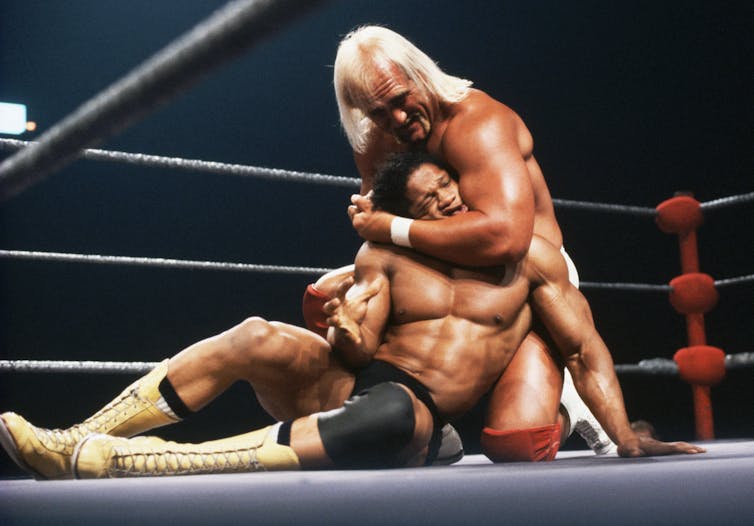
Brian Jansen, University of Maine Hulk Hogan’s death by heart attack at age 71 came as a shock to many fans of the larger-than-life wrestler who’d earned the nickname “The Immortal.” But in many respects, the real surprise was that Hogan, born Terry Gene Bollea, lived as long a life as he did. Despite the staged nature of its combat, professional wrestling is a notoriously dangerous career. Studies rank it among the riskiest professions. Wikipedia even maintains a comprehensive list of premature wrestler deaths. The reasons for professional wrestling’s dangers are largely tied up in the industry’s working conditions. And part of Hogan’s legacy may be his complicity in those conditions. In 1986, he allegedly played a key role in undercutting a unionization effort – arguably the closest pro wrestling has come to unionizing.
‘The Body’ sticks his neck out
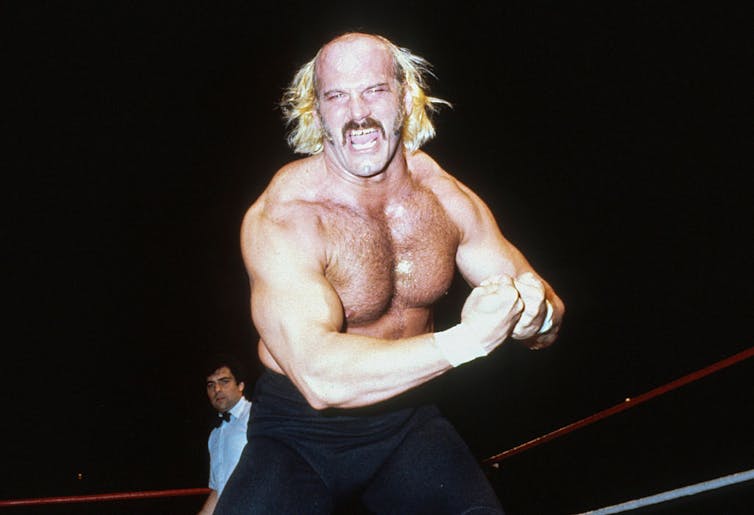
WWE’s first WrestleMania was held in 1985. The pay-per-view event was enormously successful and established the company – then known as WWF – as the nation’s preeminent wrestling promotion. During the buildup to WrestleMania 2 the following year, wrestler Jesse “The Body” Ventura understood that performers had more leverage than they’d ever had. He began advocating behind the scenes for a wrestling union. The story, as recounted by Ventura, goes like this: An acquaintance of Ventura’s in the NFL encouraged him to start organizing behind the scenes. WWE was behind the ball: In 1956, the NFL became the first American pro sports league to have its union recognized. It was followed by the NBA in 1957, MLB in 1966 and the NHL in 1967. It helped that Ventura had little to lose. He’d be appearing in the forthcoming “Predator” film; should he get blackballed from wrestling for trying to form a union, he could probably earn a living as an actor. (Few could have predicted that he would go on to be elected governor of Minnesota in 1998.) As Ventura brought together his peers to hash out the details of what a pro wrestling union might look like, he also included the promotion’s reigning champion, Hogan, with the thinking that the support of the WWF’s biggest star would boost the cause and insulate others from retaliation. Instead, WWF owner Vince McMahon got wind of the effort and called his performers individually, threatening their jobs. The unionization effort sputtered, and McMahon eventually pushed Ventura out of wrestling.After Jesse ‘The Body’ Ventura tried to unionize his fellow wrestlers, WWE owner Vince McMahon caught wind of the effort – and nipped it in the bud.WWE/Getty Images Ventura went on to sue the WWF over unpaid royalties. During the discovery process, Ventura testified that he had learned it was Hulk Hogan who snitched to McMahon and effectively sabotaged the union drive. Hogan never publicly admitted to telling McMahon about the rumblings of a union. The WWE has never confirmed nor denied the series of events. Either way, there have been no unionization campaigns in professional wrestling since then.
‘Do the job’
Today’s WWE performers are legally classified as “independent contractors.” They’re responsible for their own travel, training, costuming and insurance, even as their employer owns their likeness and is indemnified from liability due to injury or death. One of pro wrestling’s paradoxes is that the top promotion’s wrestlers aren’t unionized, even as its audience has historically skewed low income and blue collar. Wrestling has long been a family business, and most wrestlers are part-timers working additional jobs – often in blue-collar, union positions. Many of them are truck drivers and warehouse employees, construction workers and bouncers. Wrestler-turned-scholar Laurence de Garis has written about how the language of wrestling is rich with references to labor. A “work” in wrestling is a staged storyline; to “do the job” is to lose a match. The goal of many performers is to be considered a “good worker” by peers, and WWE performers wrestle as many as 300 nights per year. The company has no offseason. The steroid, painkiller and alcohol abuse that has been endemic to the industry may well stem from pressures on wrestlers to perform night after night, even if they’re in pain, for fear of losing their position. In the 1990s, Hogan himself confessed to extensive steroid use, which is known to contribute to heart disease. You’d think that these harsh working conditions would make wrestlers ripe for a union. Why that hasn’t happened is up for debate. WWE bought out its competitionin the early 2000s; perhaps its status as the last remaining major wrestling promotion in the nation has weakened the leverage of wrestlers. Or maybe the testosterone-driven, masculine nature of the sport makes solidarity seem like weakness.
Workers left holding the bag
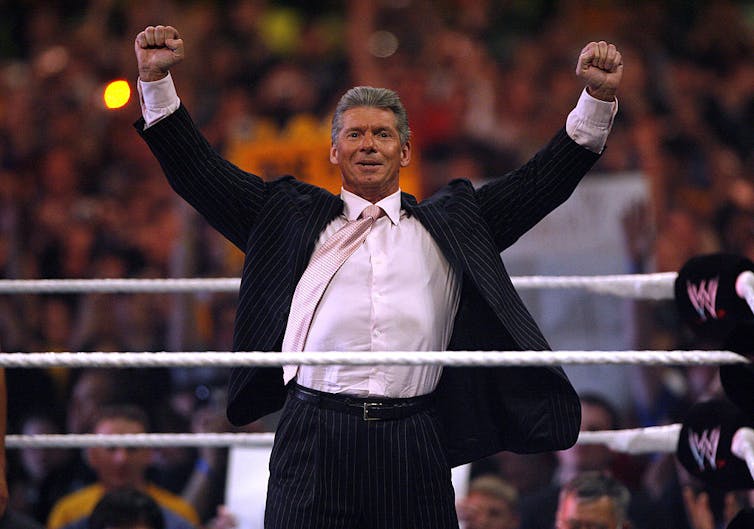
The story of Ventura’s failed unionization bid is a story of what could have been. But in some sense, I see the story of the WWE as part of a broader story of the U.S. economy. After a period of relative stability after World War II, American work since the 1980s has become dominated by mergers, buyouts, deregulation and financialization. Profits are increasingly generated by financial means such as interest and capital gains instead of through offering genuine goods or services. Layoffs and precarious work have become the norm. WWE’s profits exploded in the 1990s and 2000s. The company went public in 1999 – though the McMahon family retained majority control – and dipped its toes into film production, reality television and online streaming. In 2023, WWE merged with UFC’s parent company Endeavor to form TKO Group Holdings. TKO’s revenue was more than US$2.8 billion in 2024. Meanwhile, Endeavor has been spun off as a Hollywood talent agency and was acquired by a private equity firm. The fruits of these new revenue streams and mergers haven’t trickled down to its in-ring performers. So far in 2025, WWE has laid off or released more than 30 wrestlers and at least 10 employees from the company’s corporate wing.According to Forbes, Vince McMahon’s net worth is $3.1 billion.Leon Halip/WireImage via Getty Images Much as professional wrestlers have remained independent contractors, this arrangement has become normalized in the broader American economy, with more than 36% of Americans participating in the gig economy. In 2022, Stanford researchers identified gig work as a “social determinant of health,” since most gig workers lack employer-sponsored health care, paid time off or sick days.
All for one and none for all
In today’s economy, luck or happenstance, rather than merit, seem more likely to influence who achieves financial security and who scrapes by, living paycheck to paycheck. Hulk Hogan, as professional wrestling’s biggest star for 20 years, certainly believed he earned his place at the top of the industry. But without diminishing his talents, it’s worth noting he arrived at precisely the correct moment in history to become that star. For many years, a wrestler was expected to have “shoot” skills – that is, actual wrestling expertise – should an opponent ever go rogue and turn a staged performance into a real fight. But as McMahon’s power and influence expanded, the look, the sound and the character of the wrestler became most important. How well could a wrestler perform for the camera? How well could he sell T-shirts to young fans? Despite Hogan’s limitations as a technical in-ring performer, his mullet, mustache and “24-inch pythons” – the nickname given to his enormous biceps – made him the right person at the right time. Hogan also succeeded because his opponents in the ring were willing to make him look like a star. They were able to “do the job” and do it safely. Another paradox of professional wrestling is that it requires performers to appear as if they are hurting one another. But their primary goal, in fact, is keeping one another safe. To me, that sounds a lot like solidarity. Brian Jansen, Assistant Professor of English and Media Studies, University of Maine This article is republished from The Conversation under a Creative Commons license. Read the original article.
White Castle’s House of Crave: The Ultimate White Elephant Gift Guide for 2025
White Castle’s House of Crave has the ultimate White Elephant gifts for 2025—from viral Crocs to nostalgic plush dragons. Find steal-worthy, laugh-inducing gifts that’ll win your holiday exchange. Free shipping Dec 10!
White Castle crocs are just one of many items available at White Castle’s House of Crave online store. They make ideal white elephant gifts!
White Castle’s House of Crave: The Ultimate White Elephant Gift Guide for 2025
If you’ve ever been stuck staring at a gift table wondering which White Elephant present to steal, you know the struggle. The best gifts? They’re the ones that make people laugh, spark conversation, and get snatched up twice before the game even ends. This year, White Castle is stepping into the White Elephant arena with a lineup that’s equal parts hilarious and surprisingly practical. Their House of Crave online store is now stocked with holiday gifts that’ll have your friends and family fighting over who gets to take home the White Castle Crocs. Yes, you read that right. White Castle Crocs.
What Makes a Great White Elephant Gift?
Before we dive into White Castle’s offerings, let’s talk strategy. The best White Elephant gifts hit three key notes:
Unexpected: Nobody sees it coming, and that’s what makes it memorable
Conversation-starter: It gets people talking, laughing, or scratching their heads
Steal-worthy: It’s so good (or so ridiculous) that people actually want it
White Castle’s House of Crave nails all three. Whether you’re shopping for your office party, family gathering, or friend group exchange, these gifts deliver the perfect mix of quirky and functional.
Top White Elephant Picks from White Castle’s House of Crave
White Castle Crocs
Let’s start with the obvious winner. These aren’t just any Crocs—they’re White Castle Crocs. Cozy, comfortable, and guaranteed to turn heads at the grocery store or your next backyard BBQ. Perfect for the Craver in your life who takes their fast-food loyalty seriously. Why they’ll get stolen: They’re practical footwear with a sense of humor. Plus, Crocs are having a major moment right now.
Willis the Dragon Plush
If you grew up in the ’80s, you might remember Willis the Dragon from White Castle’s kids’ meals. This plush green dragon is pure nostalgia wrapped in soft, huggable fabric. It’s the kind of gift that makes millennials and Gen Xers feel all the feels. Why they’ll get stolen: Nostalgia is a powerful thing. Plus, who doesn’t love a cuddly dragon?
White Castle Craver Casserole Dish
Here’s where things get unexpectedly practical. This casserole dish is perfect for White Castle’s famous Slider-based stuffing (yes, that’s a thing), but it also works for any holiday meal. It’s functional, it’s branded, and it’s the kind of gift that’ll actually get used. Why they’ll get stolen: It’s useful and funny. The best White Elephant gifts walk that line perfectly.
Annual Holiday Mug
Classic, festive, and perfect for sipping cocoa while you munch on Sliders. This mug is a no-brainer for anyone who loves seasonal drinkware or just needs another vessel for their morning coffee. Why they’ll get stolen: Everyone needs mugs. Bonus points if it becomes a yearly tradition.
More White Elephant Gold from House of Crave
White Castle didn’t stop there. Their online store is packed with dozens of other gift-worthy items that fit perfectly into the White Elephant vibe:
Pickleball paddle set: For the competitive friend who’s always looking for their next match
Classic tin lunchbox: Retro, practical, and perfect for packing Sliders (or, you know, regular lunch)
Beanies, bucket hats, and T-shirts: Wearable Craver pride for the fashion-forward fast-food fan
Beach towels and bathing suits: Because White Castle goes to the beach, apparently
Pint glasses and tumblers: Perfect for toasting holiday cheer or your next Slider feast
Tote bags: Practical, portable, and proudly Crave-forward
Friendship bracelets: A sweet way to commemorate your fellow Cravers
Why White Castle’s White Elephant Strategy Works
Jamie Richardson, vice president at White Castle, put it perfectly: “White Elephant exchanges are where personality really shines. The House of Crave has dozens of items designed to bring a smile, spark a laugh or make someone feel like the Craver they truly are.” And that’s the secret sauce. White Castle isn’t just selling merchandise—they’re selling personality. These gifts work because they’re fun, affordable, and totally unexpected. Nobody walks into a White Elephant exchange expecting to leave with White Castle Crocs, but once they’re on the table? Game on.
How to Shop White Castle’s House of Crave
Ready to snag your White Elephant gift? Head over to White Castle’s House of Crave online store and browse the full collection. With dozens of items to choose from, you’ll find something that fits your budget and your sense of humor. Pro tip: White Castle is offering free shipping on all House of Crave merchandise on December 10. Mark your calendar and save on shipping while you stock up on gifts.
The Bottom Line: White Elephant Gifts That Actually Deliver
White Elephant exchanges are supposed to be fun, and White Castle’s House of Crave delivers exactly that. Whether you’re going for laughs, nostalgia, or something genuinely useful, this lineup has you covered. So skip the generic candles and boring gift cards. This year, bring the Crocs. Bring Willis the Dragon. Bring the casserole dish. Bring something that’ll make people smile, laugh, and fight over who gets to take it home. Ready to win your White Elephant exchange? Visit White Castle’s House of Crave and find your perfect gift today. Don’t forget—free shipping on December 10!About White Castle White Castle is America’s first fast-food hamburger chain, serving hot and tasty Sliders since 1921. Based in Columbus, Ohio, the family-owned business operates about 340 restaurants and has earned accolades including “Most Influential Burger of All Time” by Time magazine. Known for passionate fans (Cravers) and legendary team engagement, White Castle has been Great Place to Work® Certified for five consecutive
Get the latest updates and information on the rapidly growing sport of pickleball, specifically designed for the senior community aged 50+. Check out Sleeve’s Senior Pickleball Report on YouTube to stay informed and up-to-date with the ever-changing world of pickleball. Join the community and stay ahead of the game. https://stmdailynews.com/sleeves-senior-pickleball-report/
In September 2024, Miami Dolphins star Tyreek Hill found himself at the center of a controversy that spread across social media, sparked national debate, and triggered an internal investigation inside the Miami-Dade Police Department (MDPD). More than a year later, many fans still wonder what actually happened that day — and whether Hill ever moved forward with legal action. Here’s a clear breakdown of the incident and the current status of the case.
The Traffic Stop That Sparked Outrage
On the morning of September 8, 2024 — just hours before the Dolphins’ season opener — Hill was pulled over near Hard Rock Stadium for alleged careless driving and a seat-belt violation. What followed was a violent escalation that shocked fans and critics alike.
Body-cam and bystander video footage released shortly after the incident showed officers pulling Hill from his vehicle, forcing him to the ground, placing a knee on his back, and handcuffing him. Hill later said he complied with commands and didn’t understand why the encounter became so aggressive.
The videos went viral almost instantly, raising widespread concerns about excessive force, bias in traffic stops, and how police interact with high-profile Black athletes.
A Police Officer With a History of Complaints
The MDPD later identified the officer who forcibly removed Hill from the vehicle as Danny Torres — a 27-year veteran of the department. Records revealed Torres had a long disciplinary history, including multiple suspensions for issues such as improper procedures, force violations, discourtesy, and body-camera failures.
Following public backlash, MDPD placed Torres on administrative duty pending an internal-affairs investigation. As of the latest updates, the department has not released final findings or announced disciplinary action beyond that initial administrative reassignment.
Traffic Citations Dismissed — But Not Because Hill Was Innocent or Guilty
In November 2024, Hill’s traffic tickets were officially dismissed — not because the court ruled in Hill’s favor, but because the officers who issued the citations didn’t show up in court. Without the officers present to testify, the judge dropped the case due to “lack of prosecution.”
The dismissal frustrated Hill’s legal team, who argued it showed a lack of accountability within the department. The MDPD later stated that an officer’s absence from court “does not indicate the citation lacked merit.”
Did Tyreek Hill Sue the Miami-Dade Police Department?
Short answer: No — at least not yet, and not publicly.
Hill’s legal team has repeatedly said they were exploring “every legal remedy,” including a potential civil-rights lawsuit (often filed federally under Section 1983). But after extensive research through public court records and news archives, there is no evidence that Hill has filed a federal or state civil lawsuit against MDPD or any of its officers.
Advertisement
If a lawsuit had been filed, it likely would have generated major media coverage — especially given Hill’s profile and the viral nature of the incident. Instead, all reporting continues to describe Hill’s legal posture as “considering,” “evaluating,” or “preparing,” not filing.
Why the Case Remains Unresolved
Several factors may explain why the legal process remains in limbo:
Internal affairs reviews take time — and MDPD has not publicly concluded its investigation. Hill’s legal team may be waiting for the department’s findings before proceeding. Negotiations or private discussions between attorneys and the county may be occurring behind the scenes. A lawsuit could still be filed at any time if Hill’s team decides to move forward.
Without public filings, official disciplinary announcements, or new footage, the case remains in a holding pattern.
The Bigger Picture
The Tyreek Hill incident resurfaces bigger questions about policing, transparency, and accountability. The videos of Hill’s detainment reignited debates familiar to many Americans: When does a routine traffic stop become unnecessarily violent? Why aren’t officers held accountable when they fail to appear in court? And how do prior disciplinary issues go unaddressed for years?
While Hill returned to the field that same day — even mocking the handcuffs in a now-famous touchdown celebration — the impact of the incident still lingers in Miami and the NFL community.
What to Watch For Next
Here’s what could happen going forward:
MDPD may eventually release the internal-affairs findings. The county could impose discipline or policy changes based on the investigation. Hill’s legal team may file a civil-rights lawsuit. The case could appear in federal or state court if filings become public.
Until then, the situation remains officially unresolved, with more questions than answers.
For more information on the Tyreek Hill incident, see the following sources:
George Plimpton’s ‘Paper Lion’ Exposed the Brutal Reality of NFL Training Camp in 1966
How writer George Plimpton went undercover as a Detroit Lions quarterback in 1963 and created the sports journalism classic ‘Paper Lion.’ Discover the bruising truths he revealed about NFL training camp and what separates fans from players.
Green Bay Packers wide receiver Romeo Doubs (87) and Detroit Lions cornerback Terrion Arnold (6) show off their athleticism on Sept. 7, 2025. AP Photo/Matt Ludtke
George Plimpton’s 1966 nonfiction classic ‘Paper Lion’ revealed the bruising truths of Detroit Lions training camp
Stephen Siff, Miami University As the Detroit Lions barrel toward a Thanksgiving Day game with the Green Bay Packers, some die-hard fans may be fantasizing about what it would be like to be on the field themselves: calling plays from the Lions huddle, accepting the snap from between a crouching center’s thighs, and spinning to hand off the football before the defensive linemen come crashing down. In 1963, Lions head coach George Wilson allowed writer and Paris Review editor George Plimpton to enact that fantasy. With a Sports Illustrated contract in hand, Plimpton convinced Lions management to allow him to enter preseason training camp at Cranbrook, the private boys school in Bloomfield Hills, Michigan. His plan was to go undercover as a rookie quarterback for a magazine article that would reach dramatic culmination when he called a series of plays in a game of professional football. No one expected the amateur athlete to survive for long on a field with real-life Lions. But in writing about the experience, Plimpton turned off-field fandom and on-field bumbling into literary gold.Little, Brown reissued Paper Lion in 2016.Little, Brown His resulting 1966 book, “Paper Lion: Confessions of a Last-String Quarterback,” became a bestseller that was praised by The New York Times as “one of the greatest books written on sports, and the most thoroughly engaging book on any subject in recent memory.” A 1968 movie based on the book starred Alan Alda as Plimpton and members of the 1967 Lions team as themselves. Decades before I became a journalism professor at Miami University of Ohio, I discovered Plimpton’s sportswriting from reading the paperback versions I found on my parents’ bookshelves. Plimpton was a leading member of a mid-20th-century class of literary journalists, including Tom Wolfe, Truman Capote, Gay Talese and Norman Mailer, who were becoming known for applying novelistic techniques and sometimes personal, subjective perspectives to nonfiction. While the other literati tackled heavy topics, Plimpton’s engaging, conversational prose goofed around on the fringes of pro sports. Many of his books followed the same “participatory journalism” formula. He wrote about pitching against MLB all-stars, traveling with the PGA tour, boxing a bout against Archie Moore and playing with the Boston Bruins. Those were just the full-length books. Other television and magazine projects had Plimpton competing in tennis and bridge; performing stand-up comedy; acting in a Western; playing with the New York Philharmonic; and attempting to be an aerialist with the circus. However, he is best known for trying his hand quarterbacking for the Lions.
Posh writer meets the gridiron
In some ways, Plimpton seemed exactly the wrong person for this job. The possessor of a distinctively old money accent and patrician wealth and manners, he was founding editor of The Paris Review and in 1967 a mainstay of literary salons in Paris and New York. “Author, critic, interviewer, party-giver … friend of everybody, gifted, personable, energetic, bright, with-it, rich, a legend in his own time,” The New York Times gushed. Just the kind of person whom your average football fan might enjoy seeing knocked flat.American journalist and literary critic George Plimpton was no fan of pain, and that limited his ability on the football field.Evening Standard/Hulton Archive/Getty Images Plimpton joined a team he described as recovering from scandal. After ending the 1962 season with an 11-3 record and a Playoff Bowl victory for third place in the NFL, the NFL commissioner’s office fined six Lions for gambling on the championship game between Green Bay and New York. More significant on field, the commissioner suspended Lions great defensive tackle and future Pro Football Hall of Famer Alex Karras for one year. Without him, the Lions would end the 1963 season 5-8-1. Plimpton wrote his way onto the team by promising to “just hang around on the periphery of things and not bother anyone, just try to participate enough to get the feel of things.” Wilson agreed, and Plimpton arrived at training camp a few months later with his own football, purchased from an army-navy store in Times Square, and a “mild fiction” about having played quarterback at Harvard and for the nonexistent Newfoundland Newfs. Plimpton’s attempt at deception might raise ethical questions; however, the joke is always on him. The coaching staff seemed to have thought it would be hilarious if anyone on the team actually took the gangly 36-year-old with the nasal accent as a professional football player. It seems unlikely that anyone did. “I never had the temerity to pretend I was something that I wasn’t,” Plimpton wrote. “The team caught on quickly enough.” At camp, Plimpton hung around the dining hall and sat in the back of team meetings. A master of small talk, he lets the reader eavesdrop on conversations with Hall of Famers Karras, Dick “Night Train” Lane and Joe Schmidt. Plimpton takes us with him one night to a bar frequented by coaches, where we listen in rounds of liars’ poker with Wilson, Scooter McLean and Les Bingaman. We tag along as he chats with Karras at Lindell’s A.C., the bar the player owned in downtown Detroit at the time.
Lessons in grit
At training camp, Plimpton faced the teasing of players but earned respect by facing the brutality of sport and by persisting despite the inevitability of pain. He never played football in school, beyond a beery game between Harvard Crimson and Harvard Lampoon, and did not know the basics of playing quarterback. Several days into camp, he was allowed to participate in a play where, as quarterback, he was supposed to quickly hand off the ball to another player. “At ‘two’ the snap back came,” Plimpton wrote. “I began to turn without the proper grip on the ball, moving too nervously, and I fumbled the ball, gaping at it, mouth ajar, as it fell and bounced twice, once away from me, then back, and rocked back and forth gaily at my feet. I flung myself on it (…) and I heard the sharp strange whack of gear, the grunts, and then a quick sudden weight whooshed the air out of me.” The same thing happened when Plimpton was allowed to take the field in an annual intra-squad game played in Pontiac. Over his first three plays he lost 20 yards by falling down, getting knocked over by his own teammates and being literally picked from the ground by a zealous defender. On the bus ride home, Plimpton admitted to Wilson that he didn’t like being hit. The coach gently explained that “love of physical contact” was necessary to make it in pro football. “When kids, out in a park, chose of sides for tackle rather than touch, the guys that want to be ends and go out for the passes, or even quarterback, because they think subconsciously they can get rid of the ball before being hit, those guys don’t end up as football players,” Wilson mused. “They become great tennis players, or skiers, or high jumpers. It doesn’t mean they lack courage or competitiveness.” “But the guys who put up their hands to be tackles or guards, or fullbacks who run not for daylight but for trouble – those are the ones who will make it as football players.” This quality of great football players – an irrational enthusiasm for bruising physical contact – is celebrated by Plimpton in the veteran Lions who take him into their orbit. He becomes friends with Karras and offensive lineman John Gordy, in particular, and shoots the breeze on topics ranging from the NFL commissioner to Adolf Hitler. In a subsequent book, Plimpton goes with the pair to a madcap golf tournament and starts a ridiculous business venture, suggesting the on-field madness necessary to succeed in football bleeds into off-field life as well. But it is not Plimpton’s way to delve into the psychology of his idols. Rather, he listens as they spin tales that show how reckless the grown men who run toward trouble really are.Stephen Siff, Associate Professor of Journalism, Miami University
George Plimpton’s 1966 nonfiction classic ‘Paper Lion’ revealed the bruising truths of Detroit Lions training camp
The Sports section of STM Daily News is your ultimate destination for all things sports, catering to everyday fans and dedicated enthusiasts alike. We cover a wide range of topics, from the thrill of amateur competitions to the excitement of semi-professional and professional leagues. Our content delves into physical and mental fitness, providing insights and tips that help individuals elevate their performance, whether on the field or in their personal wellness journeys. Stay informed and inspired as we explore the dynamic world of sports, celebrating both the passion of the players and the joy of the fans.


