

documentaries
Invisible Warriors Brings 600,000 Untold Stories to the Screen for Black History Month
The documentary “Invisible Warriors” highlights the contributions of African American women during World War II, showcasing their roles on the home front while battling racism and sexism. Set for release on February 3, 2026, it emphasizes their significance in history and aims to correct the narrative surrounding their efforts and impact.

Black History Month is often a time for big names and headline moments—but some of the most powerful chapters in American history were written by people whose stories never made it into the spotlight. This February, a new documentary aims to change that.

Vision Films has announced the North American transactional VOD release of Invisible Warriors: African American Women in World War II, arriving February 3, 2026 across major streaming and cable platforms in the U.S. and Canada. The film is directed, written, and executive produced by Gregory S. Cooke, with executive producers Ethel “Becky” Cooke and Basil Spalding Jones, and associate producer Joyce Licorish.
At the center of the documentary: the 600,000 African American women who served on the home front—many as “Rosie the Riveters”—while fighting a second battle against racism and sexism at home.
A WWII story we rarely hear—told by the women who lived it
Invisible Warriors is built around first-person accounts and rare archival footage, giving audiences a direct line to the voices of women who stepped into factories, shipyards, and government offices at a time when opportunity was heavily gated by both race and gender.
These were not symbolic roles. These women helped power the war effort, kept industries moving, and proved—daily, publicly, and under pressure—that they belonged in spaces America had never intended to share with them.
The documentary frames their contributions as more than wartime necessity. It positions them as trailblazers whose work helped reshape what was possible for generations of Black women in industry, civil service, and beyond—opening doors that had been locked for decades.
Why this release hits differently in 2026
Vision Films Managing Director/CEO Lise Romanoff calls the documentary “an important” tribute that keeps alive the legacy of women who joined the war effort “despite racial, gender and societal obstacles,” adding that it celebrates heroines who paved the way for working women—and for those still fighting for racial and gender equality today.
Cooke, an educator and historian, puts it even more plainly—and personally. He describes these women as “arguably… the most significant group of Black women in the 20th Century,” noting that his own mother was also a Rosie. In his view, their story isn’t optional history—it’s foundational.
A film with a classroom mission baked in
This isn’t just a documentary release—it’s part of a larger educational push. Cooke’s nonprofit, The Basil and Becky Educational Foundation (BBEEF), has developed companion Social Studies and STEAM curricula tied to the film, targeting grades 8–12. The goal: move African American experiences from the margins to “the main pages” of history, and make that history relevant to students now.
That educational angle feels especially aligned with the film’s purpose: not simply to honor the past, but to make sure it’s taught accurately, widely, and with the context it deserves.
International recognition—and a long list of supporters
The film was originally co-sponsored by the Dutch government, which sought to honor African American women for their role in the WWII liberation of the Netherlands. Additional support came from organizations and foundations including Drexel Alumni, Better Angels/Lavine Fellowship, Gift of Life Donor Program, Always Best Care Senior Services, Darryl & Leslye Fraser Foundation, and CARIE: Center for Advocacy for the Rights and Interests of the Elderly.
That range of backing signals something important: this story resonates far beyond a single community or a single country. It’s a missing piece of WWII history—period.
Where to watch (and where to start)
Pre-orders are already live on:
- iTunes/Apple TV: https://bit.ly/4pJ6fXN
- Fandango at Home: https://bit.ly/4qUj0zU
For updates and more info, visit: https://invisiblewarriorsfilm.com
About BBEEF: https://bbeef.org
About Vision Films: https://www.visionfilms.net
The takeaway
Invisible Warriors isn’t positioned as a niche WWII documentary—it’s positioned as a correction. A long-overdue recognition of women who helped win a global war while being denied full equality at home, and who still showed up anyway.
If Black History Month is about remembering, this film is about restoring.
If you tell me where you’re publishing this (STM Daily News vs. Sleeves vs. TNC Network) and your preferred word count, I’ll tailor the headline, subheads, and meta description to match that outlet’s style.
Dive into “The Knowledge,” where curiosity meets clarity. This playlist, in collaboration with STMDailyNews.com, is designed for viewers who value historical accuracy and insightful learning. Our short videos, ranging from 30 seconds to a minute and a half, make complex subjects easy to grasp in no time. Covering everything from historical events to contemporary processes and entertainment, “The Knowledge” bridges the past with the present. In a world where information is abundant yet often misused, our series aims to guide you through the noise, preserving vital knowledge and truths that shape our lives today. Perfect for curious minds eager to discover the ‘why’ and ‘how’ of everything around us. Subscribe and join in as we explore the facts that matter. https://stmdailynews.com/the-knowledge/





documentaries
Former Homeless Veteran’s “The Gutter Gospel” Film Aims to Spotlight Global Mental Health Crisis
A new feature film in development is set to bring The Gutter Gospel—a story rooted in veteran homelessness, survival, and spiritual awakening—to a wider audience.
Announced March 5 via PRNewswire, the project will document the life of a former homeless veteran whose “Gutter Gospel” message has grown from the streets of North Dakota into what the release describes as a global ministry with reach in more than 200 countries. The film is framed as a response to what the announcement calls an “unprecedented mental health epidemic,” with a focus on depression, PTSD, and isolation—issues that continue to affect veterans and civilians alike.

From rock bottom to a “divine setup”
The narrative centers on a biographical turning point: after “hitting rock bottom in the streets of North Dakota,” the film’s subject describes discovering that his lowest point became a catalyst for a broader mission—feeding “the hungry and the hopeless” while sharing a faith-based message aimed at people who feel overlooked.
The release positions the story as both local and universal: Fargo is the backdrop, but the core struggle—searching for purpose in the middle of pain—is presented as a global experience.
Theology as the film’s engine: John 3:16 vs. Luke 16
According to the announcement, the film is built around what it calls a “Gospel of Contrast,” drawing a line between John 3:16 and Luke 16 (the parable of the Rich Man and Lazarus). The project’s messaging emphasizes the tension between hope and warning—an invitation to grace alongside a sobering depiction of spiritual consequence.
“Most people see the gutter as a dead end, but I found it was a sanctuary where God finally got my attention,” the film’s subject says in the release. “We are living in a Luke 16 world where people are chasing comfort while their souls are starving.”
“Forever Damned” chapter described as emotional core
A key segment of the film, titled “Forever Damned,” is described as the project’s emotional and spiritual center. The release says the chapter is designed to depict “the terrifying reality of spiritual isolation,” focusing on the moment when the “great gulf” referenced in Luke 16 becomes personal rather than symbolic.
The intent, according to the announcement, is to create a “power-punch” moment for viewers—pushing them to consider the weight of choices and the idea of urgency before opportunities for change pass.
A film designed to reach beyond traditional audiences
The project is positioned as an outreach effort aimed at meeting “the un-churched” outside of traditional religious settings. The release says the film seeks to:
- Address the mental health crisis by mirroring the experience of people living with “invisible wounds”
- Highlight efforts to feed the hungry through the ministry’s work
- Deliver a “final warning” message tied to the film’s “Forever Damned” segment
More information is available at https://theguttergospel.com/, with donations directed to https://theguttergospel.com/donate.
“The Gutter Gospel” Movie
SOURCE The Gutter Gospel
Looking for an entertainment experience that transcends the ordinary? Look no further than STM Daily News Blog’s vibrant Entertainment section. Immerse yourself in the captivating world of indie films, streaming and podcasts, movie reviews, music, expos, venues, and theme and amusement parks. Discover hidden cinematic gems, binge-worthy series and addictive podcasts, gain insights into the latest releases with our movie reviews, explore the latest trends in music, dive into the vibrant atmosphere of expos, and embark on thrilling adventures in breathtaking venues and theme parks. Join us at STM Entertainment and let your entertainment journey begin! https://stmdailynews.com/category/entertainment/
and let your entertainment journey begin!
Author

documentaries
EBONY Media Debuts EBONY Voices With Short Film “Standing in the Ashes,” Marking One Year Since the Altadena Fires
EBONY Media Group has launched EBONY Voices, a multimedia series highlighting human-interest stories. Its first release, “Standing in the Ashes: One Year After the Altadena Fires,” features three families affected by the 2024 Eaton wildfire, showcasing their journey of loss and resilience in their historically Black community.
LOS ANGELES — EBONY Media Group has launched EBONY Voices, a new multimedia series focused on human-interest stories aimed at connecting and uplifting communities. The debut release is a short film, “Standing in the Ashes: One Year After the Altadena Fires,” marking one year since the Eaton wildfire devastated parts of Los Angeles County in January 2024.
Film details
“Standing in the Ashes” is directed by Lyric Perez and produced by EBONY Media Owner and CEO Eden Bridgeman Sklenar and EVP of Editorial Content Cori Murray.
The film follows three long-time Altadena families as they navigate loss, rebuilding, and whether to remain in a historically Black community disproportionately impacted by the disaster:
- Staci and Thomas Andrews
- Ronda Carson and her mother, Barbara Carson
- Antoinette “Toni” Bailey-Raines, a community leader recognized as a 2025 EBONY Power 100 Community Crusader
Bailey-Raines co-hosts Altadena Talks, a grassroots radio show and podcast launched in response to the fires.
What EBONY is saying
“Standing in the Ashes reflects what EBONY Voices was created to do—center humanity, honor legacy, and ensure our communities are not reduced to statistics in moments of crisis,” Bridgeman Sklenar said in the release. “These families remind us that rebuilding is not just about homes, but about protecting history, culture, and the right to remain rooted where generations before them built a future.”
Impact of the Eaton wildfire
According to the release, the Eaton wildfire:
- Claimed 19 lives
- Destroyed or damaged 9,418 homes and buildings
The release also cites a UCLA Ralph J. Bunche Center for African American Studies data study indicating disproportionate impacts in Altadena:
- At least 60% of affected homes were Black households
- 61% of Black households were within the fire perimeter (vs. 50% of non-Black households)
- Nearly half of Black households experienced destruction or major damage
- A majority of Black homeowners in the area are over age 65
Where to watch
“Standing in the Ashes: One Year After the Altadena Fires” is available now as part of EBONY Voices:
About EBONY
For 80 years, EBONY has chronicled the Black American experience and has expanded into a multimedia brand spanning EBONY, EBONY Studios, and JET, with a stated mission to Move Black Forward.
Sources: https://www.prnewswire.com/news-releases/ebony-media-debuts-ebony-voices-with-short-film-standing-in-the-ashes-marking-one-year-since-altadena-fires-302656624.html , https://www.ebony.com/ebony-voices-remembering-altadena/
STM Daily News is a vibrant news blog dedicated to sharing the brighter side of human experiences. Emphasizing positive, uplifting stories, the site focuses on delivering inspiring, informative, and well-researched content. With a commitment to accurate, fair, and responsible journalism, STM Daily News aims to foster a community of readers passionate about positive change and engaged in meaningful conversations. Join the movement and explore stories that celebrate the positive impacts shaping our world.
Movies
A Palestinian-Israeli film just won an Oscar − so why is it so hard to see?
The Palestinian-Israeli film “No Other Land” won the 2025 Academy Award for best documentary but struggles to find a U.S. distributor due to its controversial subject matter around the Israeli-Palestinian conflict. Despite critical acclaim, it faces unique barriers compared to other independent films.

Last Updated on November 3, 2025 by Daily News Staff
A Palestinian-Israeli film just won an Oscar
Drew Paul, University of Tennessee
For many low-budget, independent films, an Oscar win is a golden ticket.
The publicity can translate into theatrical releases or rereleases, along with more on-demand rentals and sales.
However, for “No Other Land,” a Palestinian-Israeli film that just won best documentary feature at the 2025 Academy Awards, this exposure may not translate into commercial success in the U.S. That’s because the film has been unable to find a company to distribute it in America.
“No Other Land” chronicles the efforts of Palestinian townspeople to combat an Israeli plan to demolish their villages in the West Bank and use the area as a military training ground. It was directed by four Palestinian and Israeli activists and journalists: Basel Adra, who is a resident of the area facing demolition, Yuval Abraham, Hamdan Ballal and Rachel Szor. While the filmmakers have organized screenings in a number of U.S. cities, the lack of a national distributor makes a broader release unlikely.
Film distributors are a crucial but often unseen link in the chain that allows a film to reach cinemas and people’s living rooms. In recent years it has become more common for controversial award-winning films to run into issues finding a distributor. Palestinian films have encountered additional barriers.
As a scholar of Arabic who has written about Palestinian cinema, I’m disheartened by the difficulties “No Other Land” has faced. But I’m not surprised.
The role of film distributors
Distributors are often invisible to moviegoers. But without one, it can be difficult for a film to find an audience.
Distributors typically acquire rights to a film for a specific country or set of countries. They then market films to movie theaters, cinema chains and streaming platforms. As compensation, distributors receive a percentage of the revenue generated by theatrical and home releases.
The film “Soundtrack to a Coup D’Etat,” another finalist for best documentary, shows how this process typically works. It premiered at the Sundance Film Festival in January 2024 and was acquired for distribution just a few months later by Kino Lorber, a major U.S.-based distributor of independent films.
The inability to find a distributor is not itself noteworthy. No film is entitled to distribution, and most films by newer or unknown directors face long odds.
However, it is unusual for a film like “No Other Land,” which has garnered critical acclaim and has been recognized at various film festivals and award shows. Some have pegged it as a favorite to win best documentary at the Academy Awards. And “No Other Land” has been able to find distributors in Europe, where it’s easily accessible on multiple streaming platforms.
So why can’t “No Other Land” find a distributor in the U.S.?
There are a couple of factors at play.
Shying away from controversy
In recent years, film critics have noticed a trend: Documentaries on controversial topics have faced distribution difficulties. These include a film about a campaign by Amazon workers to unionize and a documentary about Adam Kinzinger, one of the few Republican congresspeople to vote to impeach Donald Trump in 2021.
The Israeli-Palestinian conflict, of course, has long stirred controversy. But the release of “No Other Land” comes at a time when the issue is particularly salient. The Hamas attacks of Oct. 7, 2023, and the ensuing Israeli bombardment and invasion of the Gaza Strip have become a polarizing issue in U.S. domestic politics, reflected in the campus protests and crackdowns in 2024. The filmmakers’ critical comments about the Israeli occupation of Palestine have also garnered backlash in Germany.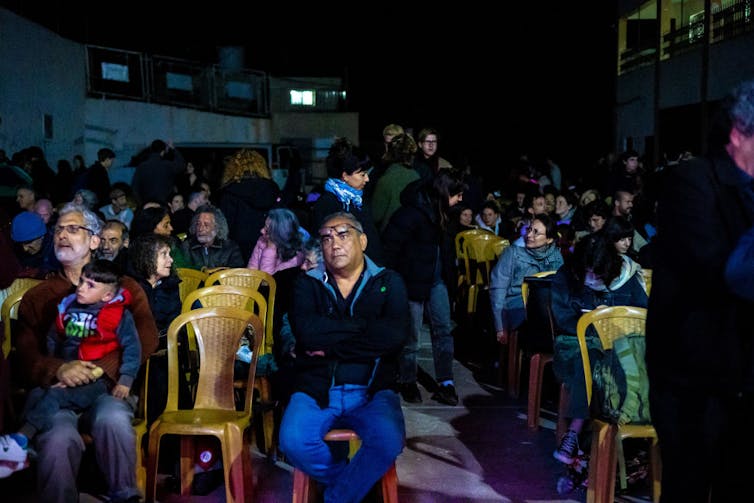
Yet the fact that this conflict has been in the news since October 2023 should also heighten audience interest in a film such as “No Other Land” – and, therefore, lead to increased sales, the metric that distributors care about the most.
Indeed, an earlier film that also documents Palestinian protests against Israeli land expropriation, “5 Broken Cameras,” was a finalist for best documentary at the 2013 Academy Awards. It was able to find a U.S. distributor. However, it had the support of a major European Union documentary development program called Greenhouse. The support of an organization like Greenhouse, which had ties to numerous production and distribution companies in Europe and the U.S., can facilitate the process of finding a distributor.
By contrast, “No Other Land,” although it has a Norwegian co-producer and received some funding from organizations in Europe and the U.S., was made primarily by a grassroots filmmaking collective.
Stages for protest
While distribution challenges may be recent, controversies surrounding Palestinian films are nothing new.
Many of them stem from the fact that the system of film festivals, awards and distribution is primarily based on a movie’s nation of origin. Since there is no sovereign Palestinian state – and many countries and organizations have not recognized the state of Palestine – the question of how to categorize Palestinian films has been hard to resolve.
In 2002, The Academy of Motion Picture Arts and Sciences rejected the first ever Palestinian film submitted to the best foreign language film category – Elia Suleiman’s “Divine Intervention” – because Palestine was not recognized as a country by the United Nations. The rules were changed for the following year’s awards ceremony.
In 2021, the cast of the film “Let It Be Morning,” which had an Israeli director but primarily Palestinian actors, boycotted the Cannes Film Festival in protest of the film’s categorization as an Israeli film rather than a Palestinian one.
Film festivals and other cultural venues have also become places to make statements about the Israeli-Palestinian conflict and engage in protest. For example, at the Cannes Film Festival in 2017, the right-wing Israeli culture minister wore a controversial – and meme-worthy – dress that featured the Jerusalem skyline in support of Israeli claims of sovereignty over the holy city, despite the unresolved status of Jerusalem under international law.
At the 2024 Academy Awards, a number of attendees, including Billie Eilish, Mark Ruffalo and Mahershala Ali, wore red pins in support of a ceasefire in Gaza, and pro-Palestine protesters delayed the start of the ceremonies.
As he accepted his award, “No Other Land” director Yuval Abraham called out “the foreign policy” of the U.S. for “helping to block” a path to peace.
Even though a film like “No Other Land” addresses a topic of clear interest to many Americans, I wonder if the quest to find a U.S. distributor just got even harder.
This article has been updated to clarify that the film was a collaborative effort between Palestinian and Israeli filmmakers. It has also been updated to reflect the film’s win at the 2025 Academy Awards.
Drew Paul, Associate Professor of Arabic, University of Tennessee
This article is republished from The Conversation under a Creative Commons license. Read the original article.





