

Urbanism
LA Metro: a decent system with room for improvement
The Los Angeles Metropolitan Transportation Authority (LA Metro) is the public transportation agency for the city of Los Angeles and its surrounding areas.

Last Updated on July 3, 2024 by Daily News Staff

The Los Angeles Metropolitan Transportation Authority (LA Metro) is the public transportation agency for the city of Los Angeles and its surrounding areas. Established in 1993, LA Metro provides over 1.5 million passenger trips each day, making it the largest public transportation system in the United States. The agency operates a wide range of services, including buses, light rail, and subway lines, as well as a growing network of express buses, paratransit vans, and shuttles.
LA Metro’s bus system consists of over 200 bus lines, which serve over 1,500 bus stops throughout the region. The bus lines cover a wide range of travel needs, including local trips within neighborhoods, connecting trips between neighborhoods and downtown, and trips to and from the region’s airports. The light rail system consists of four lines, which connect downtown Los Angeles to its surrounding communities. The subway system consists of two lines, which connect downtown Los Angeles to the San Fernando Valley and the San Gabriel Valley.
In addition to providing public transportation, LA Metro also works to promote a more sustainable future for the city of Los Angeles. The agency offers various programs to encourage the use of public transportation, such as discounted fares for students and seniors, special events, and bike share programs. LA Metro also works with local governments and businesses to improve public transportation infrastructure and services in the region.
LA Metro is constantly striving to improve public transportation in the city of Los Angeles and its surrounding areas. By providing safe, reliable, and efficient transportation, LA Metro is helping to make Los Angeles a more livable, sustainable, and vibrant city.
https://en.wikipedia.org/wiki/Los_Angeles_County_Metropolitan_Transportation_Authority
https://stmdailynews.com/category/the-bridge/urbanism
Author


LOS ANGELES — Century Boulevard is one of the most recognizable east–west corridors in South Los Angeles, stretching from Watts to Los Angeles International Airport (LAX). But despite its grand-sounding name, the origin of “Century” is surprisingly simple—and rooted in math.
The Meaning Behind “Century”
Century Boulevard sits roughly 100 blocks south of downtown Los Angeles, where the city’s street numbering system begins at 1st Street and Main Street. Instead of naming the road “100th Street,” city planners opted for a more distinctive and memorable name: Century Boulevard.
In this case, “Century” literally means 100.
Part of Los Angeles’ Grid System
Los Angeles was designed using a grid-based street layout, especially in its expanding southern neighborhoods during the early 20th century. Streets were often named or numbered based on their distance from downtown.
Century Boulevard aligns with what would have been the 100th Street corridor—making it a key reference point in the city’s geography.
A Street That Evolved Over Time
Before it became Century Boulevard, portions of the roadway were known by other names, including Pine Avenue and San Antonio Street. As the region developed and expanded, these segments were unified under a single name in the 1920s.
This consolidation helped streamline navigation and supported growing transportation needs.
From Local Road to Global Gateway
The importance of Century Boulevard grew significantly with the rise of Los Angeles International Airport (LAX). Today, it serves as a major gateway for millions of travelers entering the city.
The road connects diverse communities—from historic neighborhoods in South Los Angeles to the bustling airport corridor—making it both a local lifeline and an international entry point.
More Than Just a Name
Century Boulevard reflects a broader pattern in Los Angeles street naming:
- Some streets honor historical figures
- Others reflect geography or culture
- And some, like Century, are rooted in the city’s structured grid system
It’s a reminder that even the most ordinary street names can reveal deeper stories about how a city was built.
The Bottom Line
Century Boulevard isn’t named after an event—it’s named for its location. Positioned at the 100th Street line, it represents both the logic of Los Angeles’ design and the growth of the city over time.
Now you know.
Related External Links
- Century Boulevard – Overview and History
- Los Angeles International Airport (LAX) – Official Website
- Los Angeles City Planning Department
- Los Angeles Public Library: The Story Behind LA Street Names
- LA Metro – Transportation System Information
- Calisphere – Historical Images and Maps of Los Angeles
Dive into “The Knowledge,” where curiosity meets clarity. This playlist, in collaboration with STMDailyNews.com, is designed for viewers who value historical accuracy and insightful learning. Our short videos, ranging from 30 seconds to a minute and a half, make complex subjects easy to grasp in no time. Covering everything from historical events to contemporary processes and entertainment, “The Knowledge” bridges the past with the present. In a world where information is abundant yet often misused, our series aims to guide you through the noise, preserving vital knowledge and truths that shape our lives today. Perfect for curious minds eager to discover the ‘why’ and ‘how’ of everything around us. Subscribe and join in as we explore the facts that matter. https://stmdailynews.com/the-knowledge/

Last Updated on March 8, 2026 by Daily News Staff
Jay L. Zagorsky, Boston University
With the Olympic torch extinguished in Paris, all eyes are turning to Los Angeles for the 2028 Olympics.
The host city has promised that the next Summer Games will be “car-free.”
For people who know Los Angeles, this seems overly optimistic. The car remains king in LA, despite growing public transit options.
When LA hosted the Games in 1932, it had an extensive public transportation system, with buses and an extensive network of electric streetcars. Today, the trolleys are long gone; riders say city buses don’t come on schedule, and bus stops are dirty. What happened?
This question fascinates me because I am a business professor who studies why society abandons and then sometimes returns to certain technologies, such as vinyl records, landline phones and metal coins. The demise of electric streetcars in Los Angeles and attempts to bring them back today vividly demonstrate the costs and challenges of such revivals. https://www.youtube.com/embed/9X78ZqGyc5o?wmode=transparent&start=0 The 2028 Olympic Games will be held in existing sports venues around Los Angeles and are expected to host 15,000 athletes and over 1 million spectators.
Riding the Red and Yellow Cars
Transportation is a critical priority in any city, but especially so in Los Angeles, which has been a sprawling metropolis from the start.
In the early 1900s, railroad magnate Henry Huntington, who owned vast tracts of land around LA, started subdividing his holdings into small plots and building homes. In order to attract buyers, he also built a trolley system that whisked residents from outlying areas to jobs and shopping downtown.
By the 1930s, Los Angeles had a vibrant public transportation network, with over 1,000 miles of electric streetcar routes, operated by two companies: Pacific Electric Railway, with its “Red Cars,” and Los Angeles Railway, with its “Yellow Cars.”
The system wasn’t perfect by any means. Many people felt that streetcars were inconvenient and also unhealthy when they were jammed with riders. Moreover, streetcars were slow because they had to share the road with automobiles. As auto usage climbed and roads became congested, travel times increased.
Nonetheless, many Angelenos rode the streetcars – especially during World War II, when gasoline was rationed and automobile plants shifted to producing military vehicles. https://www.youtube.com/embed/AwKv3_WwD4o?wmode=transparent&start=0 In 1910, Los Angeles had a widely used local rail network, with over 1,200 miles (1,930 kilometers) of track. What happened?
Demise of public transit
The end of the war marked the end of the line for streetcars. The war effort had transformed oil, tire and car companies into behemoths, and these industries needed new buyers for goods from the massive factories they had built for military production. Civilians and returning soldiers were tired of rationing and war privations, and they wanted to spend money on goods such as cars.
After years of heavy usage during the war, Los Angeles’ streetcar system needed an expensive capital upgrade. But in the mid-1940s, most of the system was sold to a company called National City Lines, which was partly owned by the carmaker General Motors, the oil companies Standard Oil of California and Phillips Petroleum, and the Firestone tire company.
These powerful forces had no incentive to maintain or improve the old electric streetcar system. National City ripped up tracks and replaced the streetcars with buses that were built by General Motors, used Firestone tires and ran on gasoline.
There is a long-running academic debate over whether self-serving corporate interests purposely killed LA’s streetcar system. Some researchers argue that the system would have died on its own, like many other streetcar networks around the world.
The controversy even spilled over into pop culture in the 1988 movie “Who Framed Roger Rabbit,” which came down firmly on the conspiracy side.
What’s undisputed is that, starting in the mid-1940s, powerful social forces transformed Los Angeles so that commuters had only two choices: drive or take a public bus. As a result, LA became so choked with traffic that it often took hours to cross the city.
In 1990, the Los Angeles Times reported that people were putting refrigerators, desks and televisions in their cars to cope with getting stuck in horrendous traffic. A swath of movies, from “Falling Down” to “Clueless” to “La La Land,” have featured the next-level challenge of driving in LA.
Traffic was also a concern when LA hosted the 1984 Summer Games, but the Games went off smoothly. Organizers convinced over 1 million people to ride buses, and they got many trucks to drive during off-peak hours. The 2028 games, however, will have roughly 50% more athletes competing, which means thousands more coaches, family, friends and spectators. So simply dusting off plans from 40 years ago won’t work.
Olympic transportation plans
Today, Los Angeles is slowly rebuilding a more robust public transportation system. In addition to buses, it now has four light-rail lines – the new name for electric streetcars – and two subways. Many follow the same routes that electric trolleys once traveled. Rebuilding this network is costing the public billions, since the old system was completely dismantled.
Three key improvements are planned for the Olympics. First, LA’s airport terminals will be connected to the rail system. Second, the Los Angeles organizing committee is planning heavily on using buses to move people. It will do this by reassigning some lanes away from cars and making them available for 3,000 more buses, which will be borrowed from other locales.
Finally, there are plans to permanently increase bicycle lanes around the city. However, one major initiative, a bike path along the Los Angeles River, is still under an environmental review that may not be completed by 2028.
Car-free for 17 days
I expect that organizers will pull off a car-free Olympics, simply by making driving and parking conditions so awful during the Games that people are forced to take public transportation to sports venues around the city. After the Games end, however, most of LA is likely to quickly revert to its car-centric ways.
As Casey Wasserman, chair of the LA 2028 organizing committee, recently put it: “The unique thing about Olympic Games is for 17 days you can fix a lot of problems when you can set the rules – for traffic, for fans, for commerce – than you do on a normal day in Los Angeles.”
This article has been updated to indicate that Los Angeles has four light-rail lines.
Jay L. Zagorsky, Associate Professor of Markets, Public Policy and Law, Boston University
This article is republished from The Conversation under a Creative Commons license. Read the original article.
Dive into “The Knowledge,” where curiosity meets clarity. This playlist, in collaboration with STMDailyNews.com, is designed for viewers who value historical accuracy and insightful learning. Our short videos, ranging from 30 seconds to a minute and a half, make complex subjects easy to grasp in no time. Covering everything from historical events to contemporary processes and entertainment, “The Knowledge” bridges the past with the present. In a world where information is abundant yet often misused, our series aims to guide you through the noise, preserving vital knowledge and truths that shape our lives today. Perfect for curious minds eager to discover the ‘why’ and ‘how’ of everything around us. Subscribe and join in as we explore the facts that matter. https://stmdailynews.com/the-knowledge/
Urbanism
The Building That Proved Los Angeles Could Go Vertical
Los Angeles once banned skyscrapers, yet City Hall broke the height limit and proved high-rise buildings could be engineered safely in an earthquake zone.
Last Updated on February 19, 2026 by Daily News Staff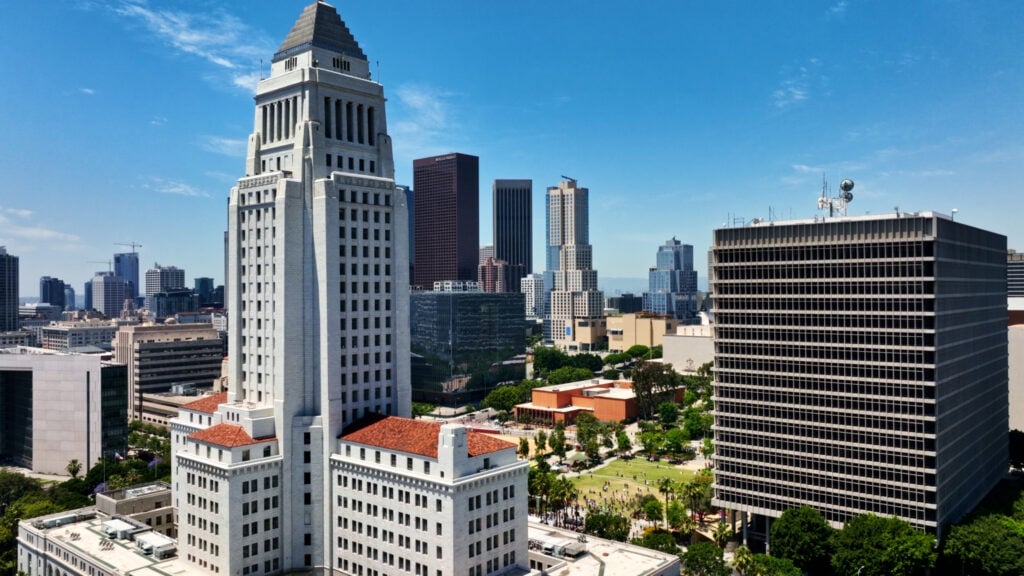
How City Hall Quietly Undermined LA’s Own Height Limits
The Knowledge Series | STM Daily News
For more than half a century, Los Angeles enforced one of the strictest building height limits in the United States. Beginning in 1905, most buildings were capped at 150 feet, shaping a city that grew outward rather than upward.
The goal was clear: avoid the congestion, shadows, and fire dangers associated with dense Eastern cities. Los Angeles sold itself as open, sunlit, and horizontal — a place where growth spread across land, not into the sky.
And yet, in 1928, Los Angeles City Hall rose to 454 feet, towering over the city like a contradiction in concrete.
It wasn’t built to spark a commercial skyscraper boom.
But it ended up proving that Los Angeles could safely build one.
A Rule Designed to Prevent a Manhattan-Style City
The original height restriction was rooted in early 20th-century fears:
- Limited firefighting capabilities
- Concerns over blocked sunlight and airflow
- Anxiety about congestion and overcrowding
- A strong desire not to resemble New York or Chicago
Los Angeles wanted prosperity — just not vertical density.
The height cap reinforced a development model where:
- Office districts stayed low-rise
- Growth moved outward
- Automobiles became essential
- Downtown never consolidated into a dense core
This philosophy held firm even as other American cities raced upward.
Why City Hall Was Never Meant to Change the Rules
City Hall was intentionally exempt from the height limit because the law applied primarily to private commercial buildings, not civic monuments.
But city leaders were explicit about one thing:
City Hall was not a precedent.
It was designed to:
- Serve as a symbolic seat of government
- Stand alone as a civic landmark
- Represent stability, authority, and modern governance
- Avoid competing with private office buildings
In effect, Los Angeles wanted a skyline icon — without a skyline.
Innovation Hidden in Plain Sight
What made City Hall truly significant wasn’t just its height — it was how it was built.
At a time when seismic science was still developing, City Hall incorporated advanced structural ideas for its era:
- A steel-frame skeleton designed for flexibility
- Reinforced concrete shear walls for lateral strength
- A tapered tower to reduce wind and seismic stress
- Thick structural cores that distributed force instead of resisting it rigidly
These choices weren’t about aesthetics — they were about survival.
The Earthquake That Changed the Conversation
In 1933, the Long Beach earthquake struck Southern California, causing widespread damage and reshaping building codes statewide.
Los Angeles City Hall survived with minimal structural damage.
This moment quietly reshaped the debate:
- A tall building had endured a major earthquake
- Structural engineering had proven effective
- Height alone was no longer the enemy — poor design was
City Hall didn’t just survive — it validated a new approach to vertical construction in seismic regions.
Proof Without Permission
Despite this success, Los Angeles did not rush to repeal its height limits.
Cultural resistance to density remained strong, and developers continued to build outward rather than upward. But the technical argument had already been settled.
City Hall stood as living proof that:
- High-rise buildings could be engineered safely in Los Angeles
- Earthquakes were a challenge, not a barrier
- Fire, structural, and seismic risks could be managed
The height restriction was no longer about safety — it was about philosophy.
The Ironic Legacy
When Los Angeles finally lifted its height limit in 1957, the city did not suddenly erupt into skyscrapers. The habit of building outward was already deeply entrenched.
The result:
- A skyline that arrived decades late
- Uneven density across the region
- Multiple business centers instead of one core
- Housing and transit challenges baked into the city’s growth pattern
City Hall never triggered a skyscraper boom — but it quietly made one possible.
Why This Still Matters
Today, Los Angeles continues to wrestle with:
- Housing shortages
- Transit-oriented development debates
- Height and zoning battles near rail corridors
- Resistance to density in a growing city
These debates didn’t begin recently.
They trace back to a single contradiction: a city that banned tall buildings — while proving they could be built safely all along.
Los Angeles City Hall wasn’t just a monument.
It was a test case — and it passed.
Further Reading & Sources
- Los Angeles Department of City Planning – History of Urban Planning in LA
- Los Angeles Conservancy – History & Architecture of LA City Hall
- Water and Power Associates – Early Los Angeles Buildings & Height Limits
- USGS – How Buildings Are Designed to Withstand Earthquakes
- Los Angeles Department of Building and Safety – Building Code History
More from The Knowledge Series on STM Daily News





