Connect with us

Science

Landing on the Moon is an incredibly difficult feat − 2025 has brought successes and shortfalls for companies and space agencies

Published

on

Moon
Several missions have already attempted to land on the lunar surface in 2025, with more to come. AP Photo
Zhenbo Wang, University of Tennessee Half a century after the Apollo astronauts left the last bootprints in lunar dust, the Moon has once again become a destination of fierce ambition and delicate engineering. This time, it’s not just superpowers racing to plant flags, but also private companies, multinational partnerships and robotic scouts aiming to unlock the Moon’s secrets and lay the groundwork for future human return. So far in 2025, lunar exploration has surged forward. Several notable missions have launched toward or landed on the Moon. Each has navigated the long journey through space and the even trickier descent to the Moon’s surface or into orbit with varying degrees of success. Together, these missions reflect both the promise and difficulty of returning to the Moon in this new space race defined by innovation, competition and collaboration. As an aerospace engineer specializing in guidance, navigation and control technologies, I’m deeply interested in how each mission – whether successful or not – adds to scientists’ collective understanding. These missions can help engineers learn to navigate the complexities of space, operate in hostile lunar environments and steadily advance toward a sustainable human presence on the Moon.

Why is landing on the Moon so hard?

Lunar exploration remains one of the most technically demanding frontiers in modern spaceflight. Choosing a landing site involves complex trade-offs between scientific interest, terrain safety and Sun exposure. The lunar south pole is an especially attractive area, as it could contain water in the form of ice in shadowed craters, a critical resource for future missions. Other sites may hold clues about volcanic activity on the Moon or the solar system’s early history. Each mission trajectory must be calculated with precision to make sure the craft arrives and descends at the right time and place. Engineers must account for the Moon’s constantly changing position in its orbit around Earth, the timing of launch windows and the gravitational forces acting on the spacecraft throughout its journey. They also need to carefully plan the spacecraft’s path so that it arrives at the right angle and speed for a safe approach. Even small miscalculations early on can lead to major errors in landing location – or a missed opportunity entirely. Once on the surface, the landers need to survive extreme swings in temperature – from highs over 250 degrees Fahrenheit (121 degrees Celsius) in daylight down to lows of -208 F (-133 C) at night – as well as dust, radiation and delayed communication with Earth. The spacecraft’s power systems, heat control, landing legs and communication links must all function perfectly. Meanwhile, these landers must avoid hazardous terrain and rely on sunlight to power their instruments and recharge their batteries. These challenges help explain why many landers have crashed or experienced partial failures, even though the technology has come a long way since the Apollo era. Commercial companies face the same technical hurdles as government agencies but often with tighter budgets, smaller teams and less heritage hardware. Unlike government missions, which can draw on decades of institutional experience and infrastructure, many commercial lunar efforts are navigating these challenges for the first time.

Successful landings and hard lessons for CLPS

Several lunar missions launched this year belong to NASA’s Commercial Lunar Payload Services program. CLPS is an initiative that contracts private companies to deliver science and technology payloads to the Moon. Its aim is to accelerate exploration while lowering costs and encouraging commercial innovation.
An illustration of a lander, which looks like a mechanical box with small suport legs, on the lunar surface.
An artist’s rendering of Firefly Aerospace’s Blue Ghost lander, which navigated and avoided hazards during its final descent to the surface. NASA/GSFC/Rani Gran/Wikimedia Commons
The first Moon mission of 2025, Firefly Aerospace’s Blue Ghost Mission 1, launched in January and successfully landed in early March. The lander survived the harsh lunar day and transmitted data for nearly two weeks before losing power during the freezing lunar night – a typical operational limit for most unheated lunar landers. Blue Ghost demonstrated how commercial landers can shoulder critical parts of NASA’s Artemis program, which aims to return astronauts to the Moon later this decade. The second CLPS launch of the year, Intuitive Machines’ IM-2 mission, launched in late February. It targeted a scientifically intriguing site near the Moon’s south pole region.
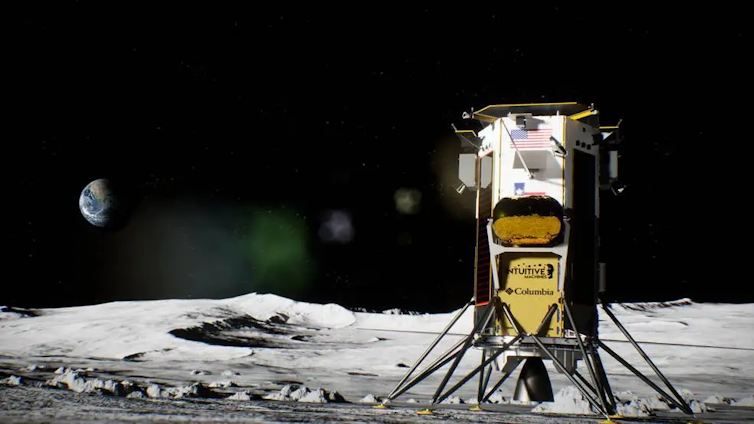
An illustration of a lander, a rectangular machine on triangular legs, on the lunar surface.
An artist’s rendering of Intuitive Machines’ IM-2 mission, which is scheduled to land near the lunar south pole for in-situ resource utilization demonstration on the Moon. NASA/Intuitive Machines
The Nova-C lander, named Athena, touched down on March 6 close to the south pole. However, during the landing process, Athena tipped over. Since it landed on its side in a crater with uneven terrain, it couldn’t deploy its solar panels to generate power, which ended the mission early. While Athena’s tipped-over landing meant it couldn’t do all the scientific explorations it had planned, the data it returned is still valuable for understanding how future landers can avoid similar fates on the rugged polar terrain. Not all lunar missions need to land. NASA’s Lunar Trailblazer, a small lunar orbiter launched in February alongside IM-2, was intended to orbit the Moon and map the form, abundance and distribution of water in the form of ice, especially in shadowed craters near the poles. Shortly after launch, however, NASA lost contact with the spacecraft. Engineers suspect the spacecraft may have experienced a power issue, potentially leaving its batteries depleted. NASA is continuing recovery efforts, hoping that the spacecraft’s solar panels may recharge in May and June.
An illustration of Lunar Trailblazer, which looks like a mechanical box with two solar panel wings.
An artist’s rendering of NASA’s Lunar Trailblazer spacecraft. If recovered, it will orbit the Moon to measure the form and distribution of water on the lunar surface. Lockheed Martin Space

Ongoing and future missions

Launched on the same day as the Blue Ghost mission in January, Japanese company ispace’s Hakuto-R Mission 2 (Resilience) is on its way to the Moon and has successfully entered lunar orbit. The lander carried out a successful flyby of the Moon on Feb. 15, with an expected landing in early June. Although launched at the same time, Resilience took a longer trajectory than Blue Ghost to save energy. This maneuver also allowed the spacecraft to collect bonus science observations while looping around the Moon. The mission, if successful, will advance Japan’s commercial space sector and prove an important comeback for ispace after its first lunar lander crashed during its final descent in 2023.
A lander – which looks like a large box with metal sides – on a platform in a white room.
The Resilience lunar lander days before its launch in the payload processing facility at the U.S. Space Force station. The Resilience lander has completed its Earth orbit and a lunar flyby. It is now completing a low-energy transfer orbit and entering an orbit around the Moon. Business Wire
The rest of 2025 promises a busy lunar calendar. Intuitive Machines plans to launch IM-3 in late 2025 to test more advanced instruments and potentially deliver NASA scientific experiments to the Moon. The European Space Agency’s Lunar Pathfinder will establish a dedicated lunar communications satellite, making it easier for future missions, especially those operating on the far side or poles, to stay in touch with Earth. Meanwhile, Astrobotic’s Griffin Mission-1 is scheduled to deliver NASA’s VIPER rover to the Moon’s south pole, where it will directly search for ice beneath the surface. Together, these missions represent an increasingly international and commercial approach to lunar science and exploration. As the world turns its attention to the Moon, every mission – whether triumph or setback – brings humanity closer to a permanent return to our closest celestial neighbor. Zhenbo Wang, Associate Professor of Mechanical and Aerospace Engineering, University of Tennessee This article is republished from The Conversation under a Creative Commons license. Read the original article.

The science section of our news blog STM Daily News provides readers with captivating and up-to-date information on the latest scientific discoveries, breakthroughs, and innovations across various fields. We offer engaging and accessible content, ensuring that readers with different levels of scientific knowledge can stay informed. Whether it’s exploring advancements in medicine, astronomy, technology, or environmental sciences, our science section strives to shed light on the intriguing world of scientific exploration and its profound impact on our daily lives. From thought-provoking articles to informative interviews with experts in the field, STM Daily News Science offers a harmonious blend of factual reporting, analysis, and exploration, making it a go-to source for science enthusiasts and curious minds alike. https://stmdailynews.com/category/science/

Author


Discover more from Daily News

Subscribe to get the latest posts sent to your email.

Continue Reading
Advertisement Tool Tickets

astronomy

When darkness shines: How dark stars could illuminate the early universe

Scientists using the James Webb Space Telescope identified three unusual early-universe objects that may be “dark stars”—not dark, and not quite stars—powered by dark matter annihilation, potentially reshaping how we understand the first stars and the origins of supermassive black holes.

Published

on

file 20251113 76 inwlvm.jpg?ixlib=rb 4.1
NASA’s James Webb Space Telescope has spotted some potential dark star candidates. NASA, ESA, CSA, and STScI
Alexey A. Petrov, University of South Carolina Scientists working with the James Webb Space Telescope discovered three unusual astronomical objects in early 2025, which may be examples of dark stars. The concept of dark stars has existed for some time and could alter scientists’ understanding of how ordinary stars form. However, their name is somewhat misleading. “Dark stars” is one of those unfortunate names that, on the surface, does not accurately describe the objects it represents. Dark stars are not exactly stars, and they are certainly not dark. Still, the name captures the essence of this phenomenon. The “dark” in the name refers not to how bright these objects are, but to the process that makes them shine — driven by a mysterious substance called dark matter. The sheer size of these objects makes it difficult to classify them as stars. As a physicist, I’ve been fascinated by dark matter, and I’ve been trying to find a way to see its traces using particle accelerators. I’m curious whether dark stars could provide an alternative method to find dark matter.

What makes dark matter dark?

Dark matter, which makes up approximately 27% of the universe but cannot be directly observed, is a key idea behind the phenomenon of dark stars. Astrophysicists have studied this mysterious substance for nearly a century, yet we haven’t seen any direct evidence of it besides its gravitational effects. So, what makes dark matter dark?
A pie chart showing the composition of the universe. The largest proportion is 'dark energy,' at 68%, while dark matter makes up 27% and normal matter 5%. The rest is neutrinos, free hydrogen and helium and heavy elements.
Despite physicists not knowing much about it, dark matter makes up around 27% of the universe. Visual Capitalist/Science Photo Library via Getty Images
Humans primarily observe the universe by detecting electromagnetic waves emitted by or reflected off various objects. For instance, the Moon is visible to the naked eye because it reflects sunlight. Atoms on the Moon’s surface absorb photons – the particles of light – sent from the Sun, causing electrons within atoms to move and send some of that light toward us. More advanced telescopes detect electromagnetic waves beyond the visible spectrum, such as ultraviolet, infrared or radio waves. They use the same principle: Electrically charged components of atoms react to these electromagnetic waves. But how can they detect a substance – dark matter – that not only has no electric charge but also has no electrically charged components? Although scientists don’t know the exact nature of dark matter, many models suggest that it is made up of electrically neutral particles – those without an electric charge. This trait makes it impossible to observe dark matter in the same way that we observe ordinary matter. Dark matter is thought to be made of particles that are their own antiparticles. Antiparticles are the “mirror” versions of particles. They have the same mass but opposite electric charge and other properties. When a particle encounters its antiparticle, the two annihilate each other in a burst of energy. If dark matter particles are their own antiparticles, they would annihilate upon colliding with each other, potentially releasing large amounts of energy. Scientists predict that this process plays a key role in the formation of dark stars, as long as the density of dark matter particles inside these stars is sufficiently high. The dark matter density determines how often dark matter particles encounter, and annihilate, each other. If the dark matter density inside dark stars is high, they would annihilate frequently.

What makes a dark star shine?

The concept of dark stars stems from a fundamental yet unresolved question in astrophysics: How do stars form? In the widely accepted view, clouds of primordial hydrogen and helium — the chemical elements formed in the first minutes after the Big Bang, approximately 13.8 billion years ago — collapsed under gravity. They heated up and initiated nuclear fusion, which formed heavier elements from the hydrogen and helium. This process led to the formation of the first generation of stars.
Two bright clouds of gas condensing around a small central region
Stars form when clouds of dust collapse inward and condense around a small, bright, dense core. NASA, ESA, CSA, and STScI, J. DePasquale (STScI), CC BY-ND
In the standard view of star formation, dark matter is seen as a passive element that merely exerts a gravitational pull on everything around it, including primordial hydrogen and helium. But what if dark matter had a more active role in the process? That’s exactly the question a group of astrophysicists raised in 2008. In the dense environment of the early universe, dark matter particles would collide with, and annihilate, each other, releasing energy in the process. This energy could heat the hydrogen and helium gas, preventing it from further collapse and delaying, or even preventing, the typical ignition of nuclear fusion. The outcome would be a starlike object — but one powered by dark matter heating instead of fusion. Unlike regular stars, these dark stars might live much longer because they would continue to shine as long as they attracted dark matter. This trait would make them distinct from ordinary stars, as their cooler temperature would result in lower emissions of various particles.

Can we observe dark stars?

Several unique characteristics help astronomers identify potential dark stars. First, these objects must be very old. As the universe expands, the frequency of light coming from objects far away from Earth decreases, shifting toward the infrared end of the electromagnetic spectrum, meaning it gets “redshifted.” The oldest objects appear the most redshifted to observers. Since dark stars form from primordial hydrogen and helium, they are expected to contain little to no heavier elements, such as oxygen. They would be very large and cooler on the surface, yet highly luminous because their size — and the surface area emitting light — compensates for their lower surface brightness. They are also expected to be enormous, with radii of about tens of astronomical units — a cosmic distance measurement equal to the average distance between Earth and the Sun. Some supermassive dark stars are theorized to reach masses of roughly 10,000 to 10 million times that of the Sun, depending on how much dark matter and hydrogen or helium gas they can accumulate during their growth. So, have astronomers observed dark stars? Possibly. Data from the James Webb Space Telescope has revealed some very high-redshift objects that seem brighter — and possibly more massive — than what scientists expect of typical early galaxies or stars. These results have led some researchers to propose that dark stars might explain these objects.
Artist's impression of the James Webb telescope, which has a hexagonal mirror made up of smaller hexagons, and sits on a rhombus-shaped spacecraft.
The James Webb Space Telescope, shown in this illustration, detects light coming from objects in the universe. Northrup Grumman/NASA
In particular, a recent study analyzing James Webb Space Telescope data identified three candidates consistent with supermassive dark star models. Researchers looked at how much helium these objects contained to identify them. Since it is dark matter annihilation that heats up those dark stars, rather than nuclear fusion turning helium into heavier elements, dark stars should have more helium. The researchers highlight that one of these objects indeed exhibited a potential “smoking gun” helium absorption signature: a far higher helium abundance than one would expect in typical early galaxies.

Dark stars may explain early black holes

What happens when a dark star runs out of dark matter? It depends on the size of the dark star. For the lightest dark stars, the depletion of dark matter would mean gravity compresses the remaining hydrogen, igniting nuclear fusion. In this case, the dark star would eventually become an ordinary star, so some stars may have begun as dark stars. Supermassive dark stars are even more intriguing. At the end of their lifespan, a dead supermassive dark star would collapse directly into a black hole. This black hole could start the formation of a supermassive black hole, like the kind astronomers observe at the centers of galaxies, including our own Milky Way. Dark stars might also explain how supermassive black holes formed in the early universe. They could shed light on some unique black holes observed by astronomers. For example, a black hole in the galaxy UHZ-1 has a mass approaching 10 million solar masses, and is very old – it formed just 500 million years after the Big Bang. Traditional models struggle to explain how such massive black holes could form so quickly. The idea of dark stars is not universally accepted. These dark star candidates might still turn out just to be unusual galaxies. Some astrophysicists argue that matter accretion — a process in which massive objects pull in surrounding matter — alone can produce massive stars, and that studies using observations from the James Webb telescope cannot distinguish between massive ordinary stars and less dense, cooler dark stars. Researchers emphasize that they will need more observational data and theoretical advancements to solve this mystery. Alexey A. Petrov, Professor of physics and astronomy, University of South Carolina This article is republished from The Conversation under a Creative Commons license. Read the original article.
Sinking Cities: Why Parts of Phoenix—and Much of Urban America—Are Slowly Dropping
Link: https://stmdailynews.com/sinking-cities-why-parts-of-phoenix-and-much-of-urban-america-are-slowly-dropping/
View recent photos

Unlock fun facts & lost history—get The Knowledge in your inbox!

We don’t spam! Read our privacy policy for more info.


Discover more from Daily News

Subscribe to get the latest posts sent to your email.

Continue Reading

Science

If evolution is real, then why isn’t it happening now? An anthropologist explains that humans actually are still evolving

Humans are still evolving! From skin color to lactose tolerance and disease resistance, discover how our bodies keep adapting to changing environments and why evolution is an ongoing process—even in the modern world.

Published

on

Is Human Evolution Still Happening? Why We’re Evolving Right Now
Inuit people such as these Greenlanders have evolved to be able to eat fatty foods with a low risk of getting heart disease. Olivier Morin/AFP via Getty Images

If evolution is real, then why isn’t it happening now? An anthropologist explains that humans actually are still evolving

Michael A. Little, Binghamton University, State University of New York Curious Kids is a series for children of all ages. If you have a question you’d like an expert to answer, send it to CuriousKidsUS@theconversation.com.
If evolution is real, then why is it not happening now? – Dee, Memphis, Tennessee

Many people believe that we humans have conquered nature through the wonders of civilization and technology. Some also believe that because we are different from other creatures, we have complete control over our destiny and have no need to evolve. Even though lots of people believe this, it’s not true. Like other living creatures, humans have been shaped by evolution. Over time, we have developed – and continue to develop – the traits that help us survive and flourish in the environments where we live. I’m an anthropologist. I study how humans adapt to different environments. Adaptation is an important part of evolution. Adaptations are traits that give someone an advantage in their environment. People with those traits are more likely to survive and pass those traits on to their children. Over many generations, those traits become widespread in the population.

The role of culture

We humans have two hands that help us skillfully use tools and other objects. We are able to walk and run on two legs, which frees our hands for these skilled tasks. And we have large brains that let us reason, create ideas and live successfully with other people in social groups. All of these traits have helped humans develop culture. Culture includes all of our ideas and beliefs and our abilities to plan and think about the present and the future. It also includes our ability to change our environment, for example by making tools and growing food. Although we humans have changed our environment in many ways during the past few thousand years, we are still changed by evolution. We have not stopped evolving, but we are evolving right now in different ways than our ancient ancestors. Our environments are often changed by our culture. We usually think of an environment as the weather, plants and animals in a place. But environments include the foods we eat and the infectious diseases we are exposed to. A very important part of the environment is the climate and what kinds of conditions we can live in. Our culture helps us change our exposure to the climate. For example, we build houses and put furnaces and air conditioners in them. But culture doesn’t fully protect us from extremes of heat, cold and the sun’s rays.
a man runs after one of several goats in a dry, dusty landscape
The Turkana people in Kenya have evolved to survive with less water than other people, which helps them live in a desert environment. Tony Karumba/AFP via Getty Images
Here are some examples of how humans have evolved over the past 10,000 years and how we are continuing to evolve today.

The power of the sun’s rays

While the sun’s rays are important for life on our planet, ultraviolet rays can damage human skin. Those of us with pale skin are in danger of serious sunburn and equally dangerous kinds of skin cancer. In contrast, those of us with a lot of skin pigment, called melanin, have some protection against damaging ultraviolet rays from sunshine. People in the tropics with dark skin are more likely to thrive under frequent bright sunlight. Yet, when ancient humans moved to cloudy, cooler places, the dark skin was not needed. Dark skin in cloudy places blocked the production of vitamin D in the skin, which is necessary for normal bone growth in children and adults. The amount of melanin pigment in our skin is controlled by our genes. So in this way, human evolution is driven by the environment – sunny or cloudy – in different parts of the world.

The food that we eat

Ten thousand years ago, our human ancestors began to tame or domesticate animals such as cattle and goats to eat their meat. Then about 2,000 years later, they learned how to milk cows and goats for this rich food. Unfortunately, like most other mammals at that time, human adults back then could not digest milk without feeling ill. Yet a few people were able to digest milk because they had genes that let them do so. Milk was such an important source of food in these societies that the people who could digest milk were better able to survive and have many children. So the genes that allowed them to digest milk increased in the population until nearly everyone could drink milk as adults. This process, which occurred and spread thousands of years ago, is an example of what is called cultural and biological co-evolution. It was the cultural practice of milking animals that led to these genetic or biological changes. Other people, such as the Inuit in Greenland, have genes that enable them to digest fats without suffering from heart diseases. The Turkana people herd livestock in Kenya in a very dry part of Africa. They have a gene that allows them to go for long periods without drinking much water. This practice would cause kidney damage in other people because the kidney regulates water in your body. These examples show how the remarkable diversity of foods that people eat around the world can affect evolution.
gray scale microscope image of numerous blobs
These bacteria caused a devastating pandemic nearly 700 years ago that led humans to evolve resistance to them. Image Point FR/NIH/NIAID/BSIP/Universal Images Group via Getty Images

Diseases that threaten us

Like all living creatures, humans have been exposed to many infectious diseases. During the 14th century a deadly disease called the bubonic plague struck and spread rapidly throughout Europe and Asia. It killed about one-third of the population in Europe. Many of those who survived had a specific gene that gave them resistance against the disease. Those people and their descendants were better able to survive epidemics that followed for several centuries. Some diseases have struck quite recently. COVID-19, for instance, swept the globe in 2020. Vaccinations saved many lives. Some people have a natural resistance to the virus based on their genes. It may be that evolution increases this resistance in the population and helps humans fight future virus epidemics. As human beings, we are exposed to a variety of changing environments. And so evolution in many human populations continues across generations, including right now.
Hello, curious kids! Do you have a question you’d like an expert to answer? Ask an adult to send your question to CuriousKidsUS@theconversation.com. Please tell us your name, age and the city where you live. And since curiosity has no age limit – adults, let us know what you’re wondering, too. We won’t be able to answer every question, but we will do our best. Michael A. Little, Distinguished Professor Emeritus of Anthropology, Binghamton University, State University of New York This article is republished from The Conversation under a Creative Commons license. Read the original article.
Sinking Cities: Why Parts of Phoenix—and Much of Urban America—Are Slowly Dropping
Link: https://stmdailynews.com/sinking-cities-why-parts-of-phoenix-and-much-of-urban-america-are-slowly-dropping/

Discover more from Daily News

Subscribe to get the latest posts sent to your email.

Continue Reading

Science

Why can’t I wiggle my toes one at a time, like my fingers?

why can’t I wiggle my toes? Ever wondered why you can’t wiggle your toes one at a time like your fingers? Learn how evolution, muscles, and your brain all play a part in making fingers more independent than toes—and why that’s key for walking and balance.

Published

on

Why can’t I wiggle my toes one at a time, like my fingers?
A baby chimp can grab a stick equally well with its fingers and its toes. Anup Shah/Stone via Getty Images

Why Can’t You Wiggle Your Toes Like Your Fingers? The Science Behind Toe and Finger Movement

Steven Lautzenheiser, University of Tennessee Curious Kids is a series for children of all ages. If you have a question you’d like an expert to answer, send it to curiouskidsus@theconversation.com.
Why can’t I wiggle my toes individually, like I can with my fingers? – Vincent, age 15, Arlington, Virginia

One of my favorite activities is going to the zoo where I live in Knoxville when it first opens and the animals are most active. On one recent weekend, I headed to the chimpanzees first. Their breakfast was still scattered around their enclosure for them to find. Ripley, one of the male chimpanzees, quickly gathered up some fruits and vegetables, sometimes using his feet almost like hands. After he ate, he used his feet to grab the fire hoses hanging around the enclosure and even held pieces of straw and other toys in his toes. I found myself feeling a bit envious. Why can’t people use our feet like this, quickly and easily grasping things with our toes just as easily as we do with our fingers? I’m a biological anthropologist who studies the biomechanics of the modern human foot and ankle, using mechanical principles of movement to understand how forces affect the shape of our bodies and how humans have changed over time. Your muscles, brain and how human feet evolved all play a part in why you can’t wiggle individual toes one by one.
young chimp running on all fours
Chimpanzee hands and feet do similar jobs. Manoj Shah/Stone via Getty Images

Comparing humans to a close relative

Humans are primates, which means we belong to the same group of animals that includes apes like Riley the chimp. In fact, chimpanzees are our closest genetic relatives, sharing almost 98.8% of our DNA. Evolution is part of the answer to why chimpanzees have such dexterous toes while ours seem much more clumsy. Our very ancient ancestors probably moved around the way chimpanzees do, using both their arms and legs. But over time our lineage started walking on two legs. Human feet needed to change to help us stay balanced and to support our bodies as we walk upright. It became less important for our toes to move individually than to keep us from toppling over as we moved through the world in this new way.
bare feet walking across sandy surface toward camera
Feet adapted so we could walk and balance on just two legs. Karina Mansfield/Moment via Getty Images
Human hands became more important for things such as using tools, one of the hallmark skills of human beings. Over time, our fingers became better at moving on their own. People use their hands to do lots of things, such as drawing, texting or playing a musical instrument. Even typing this article is possible only because my fingers can make small, careful and controlled movements. People’s feet and hands evolved for different purposes.

Muscles that move your fingers or toes

Evolution brought these differences about by physically adapting our muscles, bones and tendons to better support walking and balance. Hands and feet have similar anatomy; both have five fingers or toes that are moved by muscles and tendons. The human foot contains 29 muscles that all work to help you walk and stay balanced when you stand. In comparison, a hand has 34 muscles. Most of the muscles of your foot let you point your toes down, like when you stand on tiptoes, or lift them up, like when you walk on your heels. These muscles also help feet roll slightly inward or outward, which lets you keep your balance on uneven ground. All these movements work together to help you walk and run safely. The big toe on each foot is special because it helps push your body forward when you walk and has extra muscles just for its movement. The other four toes don’t have their own separate muscles. A few main muscles in the bottom of your foot and in your calf move all four toes at once. Because they share muscles, those toes can wiggle, but not very independently like your fingers can. The calf muscles also have long tendons that reach into the foot; they’re better at keeping you steady and helping you walk than at making tiny, precise movements.
a pen and ink drawing of the interior anatomy of a human hand
Your hand is capable of delicate movements thanks to the muscles and ligaments that control its bones. Henry Gray, ‘Anatomy of the Human Body’/Wikimedia Commons, CC BY
In contrast, six main muscle groups help move each finger. The fingers share these muscles, which sit mostly in the forearm and connect to the fingers by tendons. The thumb and pinky have extra muscles that let you grip and hold objects more easily. All of these muscles are specialized to allow careful, controlled movements, such as writing. So, yes, I have more muscles dedicated to moving my fingers, but that is not the only reason I can’t wiggle my toes one by one.

Divvying up brain power

You also need to look inside your brain to understand why toes and fingers work differently. Part of your brain called the motor cortex tells your body how to move. It’s made of cells called neurons that act like tiny messengers, sending signals to the rest of your body. Your motor cortex devotes many more neurons to controlling your fingers than your toes, so it can send much more detailed instructions to your fingers. Because of the way your motor cortex is organized, it takes more “brain power,” meaning more signals and more activity, to move your fingers than your toes.
illustration of a brain looking down at the top of the head with one section highlighted orange
The motor cortex of your brain sends orders to move parts of your body. Kateryna Kon/Science Photo Library via Getty Images
Even though you can’t grab things with your feet like Ripley the chimp can, you can understand why.
Hello, curious kids! Do you have a question you’d like an expert to answer? Ask an adult to send your question to CuriousKidsUS@theconversation.com. Please tell us your name, age and the city where you live. And since curiosity has no age limit – adults, let us know what you’re wondering, too. We won’t be able to answer every question, but we will do our best. Steven Lautzenheiser, Assistant Professor of Biological Anthropology, University of Tennessee This article is republished from The Conversation under a Creative Commons license. Read the original article.
❄️ The Man Who Made Air Conditioning Cool
Link: https://stmdailynews.com/%e2%9d%84%ef%b8%8f-the-man-who-made-air-conditioning-cool/

Discover more from Daily News

Subscribe to get the latest posts sent to your email.

Continue Reading

Trending