NASA Confirms DART Mission Impact Changed Asteroid’s Motion in Space
Analysis of data obtained over the past two weeks by NASA’s Double Asteroid Redirection Test (DART) investigation team shows the spacecraft’s kinetic impact with its target asteroid, Dimorphos, successfully altered the asteroid’s orbit.
Last Updated on May 21, 2024 by Daily News StaffThis imagery from NASA’s Hubble Space Telescope from Oct. 8, 2022, shows the debris blasted from the surface of Dimorphos 285 hours after the asteroid was intentionally impacted by NASA’s DART spacecraft on Sept. 26. The shape of that tail has changed over time. Scientists are continuing to study this material and how it moves in space, in order to better understand the asteroid. Credits: NASA/ESA/STScI/Hubble
Analysis of data obtained over the past two weeks by NASA’s Double Asteroid Redirection Test (DART) investigation team shows the spacecraft’s kinetic impact with its target asteroid, Dimorphos, successfully altered the asteroid’s orbit. This marks humanity’s first time purposely changing the motion of a celestial object and the first full-scale demonstration of asteroid deflection technology.
“All of us have a responsibility to protect our home planet. After all, it’s the only one we have,” said NASA Administrator Bill Nelson. “This mission shows that NASA is trying to be ready for whatever the universe throws at us. NASA has proven we are serious as a defender of the planet. This is a watershed moment for planetary defense and all of humanity, demonstrating commitment from NASA’s exceptional team and partners from around the world.”
Prior to DART’s impact, it took Dimorphos 11 hours and 55 minutes to orbit its larger parent asteroid, Didymos. Since DART’s intentional collision with Dimorphos on Sept. 26, astronomers have been using telescopes on Earth to measure how much that time has changed. Now, the investigation team has confirmed the spacecraft’s impact altered Dimorphos’ orbit around Didymos by 32 minutes, shortening the 11 hour and 55-minute orbit to 11 hours and 23 minutes. This measurement has a margin of uncertainty of approximately plus or minus 2 minutes.
Before its encounter, NASA had defined a minimum successful orbit period change of Dimorphos as change of 73 seconds or more. This early data show DART surpassed this minimum benchmark by more than 25 times.
“This result is one important step toward understanding the full effect of DART’s impact with its target asteroid” said Lori Glaze, director of NASA’s Planetary Science Division at NASA Headquarters in Washington. “As new data come in each day, astronomers will be able to better assess whether, and how, a mission like DART could be used in the future to help protect Earth from a collision with an asteroid if we ever discover one headed our way.”
The investigation team is still acquiring data with ground-based observatories around the world – as well as with radar facilities at NASA Jet Propulsion Laboratory’s Goldstone planetary radar in California and the National Science Foundation’s Green Bank Observatory in West Virginia. They are updating the period measurement with frequent observations to improve its precision.
Focus now is shifting toward measuring the efficiency of momentum transfer from DART’s roughly 14,000-mile (22,530-kilometer) per hour collision with its target. This includes further analysis of the “ejecta” – the many tons of asteroidal rock displaced and launched into space by the impact. The recoil from this blast of debris substantially enhanced DART’s push against Dimorphos – a little like a jet of air streaming out of a balloon sends the balloon in the opposite direction.
To successfully understand the effect of the recoil from the ejecta, more information on of the asteroid’s physical properties, such as the characteristics of its surface, and how strong or weak it is, is needed. These issues are still being investigated.
“DART has given us some fascinating data about both asteroid properties and the effectiveness of a kinetic impactor as a planetary defense technology,” said Nancy Chabot, the DART coordination lead from the Johns Hopkins Applied Physics Laboratory (APL) in Laurel, Maryland. “The DART team is continuing to work on this rich dataset to fully understand this first planetary defense test of asteroid deflection.”
For this analysis, astronomers will continue to study imagery of Dimorphos from DART’s terminal approach and from the Light Italian CubeSat for Imaging of Asteroids (LICIACube), provided by the Italian Space Agency, to approximate the asteroid’s mass and shape. Roughly four years from now, the European Space Agency’s Hera project is also planned to conduct detailed surveys of both Dimorphos and Didymos, with a particular focus on the crater left by DART’s collision and a precise measurement of Dimorphos’ mass.
Advertisement
Johns Hopkins APL built and operated the DART spacecraft and manages the DART mission for NASA’s Planetary Defense Coordination Office as a project of the agency’s Planetary Missions Program Office. Telescopic facilities contributing to the observations used by the DART team to determine this result include: Goldstone, Green Bank Observatory, Swope Telescope at the Las Campanas Observatory in Chile, the Danish Telescope at the La Silla Observatory in Chile, and the Las Cumbres Observatory global telescope network facilities in Chile and in South Africa.
Neither Dimorphos nor Didymos poses any hazard to Earth before or after DART’s controlled collision with Dimorphos.
For more information about the DART mission, visit:
NASA goes on an ESCAPADE – twin small, low-cost orbiters will examine Mars’ atmosphere
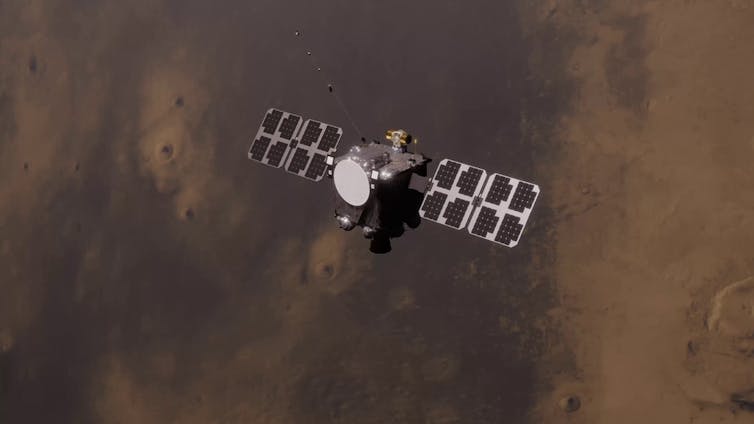
NASA’s ESCAPADE mission launched two small, affordable orbiters to Mars on Blue Origin’s New Glenn rocket. Discover how these twin spacecraft will study Mars’ atmosphere, test new trajectories, and usher in a new era of rapid, low-cost space exploration.
NASA goes on an ESCAPADE – twin small, low-cost orbiters will examine Mars’ atmosphere
Christopher Carr, Georgia Institute of Technology and Glenn Lightsey, Georgia Institute of Technology Envision a time when hundreds of spacecraft are exploring the solar system and beyond. That’s the future that NASA’s ESCAPADE, or Escape and Plasma Acceleration and Dynamics Explorers, mission will help unleash: one where small, low-cost spacecraft enable researchers to learn rapidly, iterate, and advance technology and science. The ESCAPADE mission launched on Nov. 13, 2025 on a Blue Origin New Glenn rocket, sending two small orbiters to Mars to study its atmosphere. As aerospace engineers, we’re excited about this mission because not only will it do great science while advancing the deep space capabilities of small spacecraft, but it also will travel to the red planet on an innovative new trajectory. The ESCAPADE mission is actually two spacecraft instead of one. Two identical spacecraft will take simultaneous measurements, resulting in better science. These spacecraft are smaller than those used in the past, each about the size of a copy machine, partly enabled by an ongoing miniaturization trend in the space industry. Doing more with less is very important for space exploration, because it typically takes most of the mass of a spacecraft simply to transport it where you want it to go.The ESCAPADE mission logo shows the twin orbiters.TRAX International/Kristen Perrin Having two spacecraft also acts as an insurance policy in case one of them doesn’t work as planned. Even if one completely fails, researchers can still do science with a single working spacecraft. This redundancy enables each spacecraft to be built more affordably than in the past, because the copies allow for more acceptance of risk.
Space is not a friendly place. Most of it is a vacuum – that is, mostly empty, without the gas molecules that create pressure and allow you to breathe or transfer heat. These molecules keep things from getting too hot or too cold. In space, with no pressure, a spacecraft can easily get too hot or too cold, depending on whether it is in sunlight or in shadow. In addition, the Sun and other, farther astronomical objects emit radiation that living things do not experience on Earth. Earth’s magnetic field protects you from the worst of this radiation. So when humans or our robotic representatives leave the Earth, our spacecraft must survive in this extreme environment not present on Earth. ESCAPADE will overcome these challenges with a shoestring budget totaling US$80 million. That is a lot of money, but for a mission to another planet it is inexpensive. It has kept costs low by leveraging commercial technologies for deep space exploration, which is now possible because of prior investments in fundamental research. For example, the GRAIL mission, launched in 2011, previously used two spacecraft, Ebb and Flow, to map the Moon’s gravity fields. ESCAPADE takes this concept to another world, Mars, and costs a fraction as much as GRAIL. Led by Rob Lillis of UC Berkeley’s Space Sciences Laboratory, this collaboration between spacecraft builders Rocket Lab, trajectory specialists Advanced Space LLC and launch provider Blue Origin – all commercial partners funded by NASA – aims to show that deep space exploration is now faster, more agile and more affordable than ever before.NASA’s ESCAPADE represents a partnership between a university, commercial companies and the government.
How will ESCAPADE get to Mars?
ESCAPADE will also use a new trajectory to get to Mars. Imagine being an archer in the Olympics. To hit a bull’s-eye, you have to shoot an arrow through a 15-inch – 40-centimeter – circle from a distance of 300 feet, or 90 meters. Now imagine the bull’s-eye represents Mars. To hit it from Earth, you would have to shoot an arrow through the same 15-inch bull’s-eye at a distance of over 13 miles, or 22 kilometers. You would also have to shoot the arrow in a curved path so that it goes around the Sun. Not only that, but Mars won’t be at the bull’s-eye at the time you shoot the arrow. You must shoot for the spot that Mars will be in 10 months from now. This is the problem that the ESCAPADE mission designers faced. What is amazing is that the physical laws and forces of nature are so predictable that this was not even the hardest problem to solve for the ESCAPADE mission. It takes energy to get from one place to another. To go from Earth to Mars, a spacecraft has to carry the energy it needs, in the form of rocket fuel, much like gasoline in a car. As a result, a high percentage of the total launch mass has to be fuel for the trip. When going to Mars orbit from Earth orbit, as much as 80% to 85% of the spacecraft mass has to be propellant, which means not much mass is dedicated to the part of the spacecraft that does all the experiments. This issue makes it important to pack as much capability into the rest of the spacecraft as possible. For ESCAPADE, the propellant is only about 65% of the spacecraft’s mass. ESCAPADE’s route is particularly fuel-efficient. First, Blue and Gold will go to the L2 Lagrange point, one of five places where gravitational forces of the Sun and Earth cancel out. Then, after about a year, during which they will collect data monitoring the Sun, they will fly by the Earth, using its gravitational field to get a boost. This way, they will arrive at Mars in about 10 more months. This new approach has another advantage beyond needing to carry less fuel: Trips from Earth to Mars are typically favorable to save fuel about every 26 months due to the two planets’ relative positions. However, this new trajectory makes the departure time more flexible. Future cargo and human missions could use a similar trajectory to have more frequent and less time-constrained trips to Mars. ESCAPADE is a testament to a new era in spaceflight. For a new generation of scientists and engineers, ESCAPADE is not just a mission – it is a blueprint for a new collaborative era of exploration and discovery. This article was updated on Nov. 13, 2025 to reflect the ESCAPADE launch’s date and success.Christopher Carr, Assistant Professor of Aerospace Engineering, Georgia Institute of Technology and Glenn Lightsey, Professor of Space Systems Technology, Georgia Institute of Technology This article is republished from The Conversation under a Creative Commons license. Read the original article.
NASA Astronaut Jonny Kim to Share Insights from Eight-Month Space Station Mission
NASA astronaut Jonny Kim will discuss his eight-month International Space Station mission during a live news conference on Dec. 19. Discover the science, technology, and teamwork behind his groundbreaking journey, streaming live via NASA and covered by STM Daily News.
NASA astronaut Jonny Kim poses inside the International Space Station’s cupola as it orbits 265 miles above the Indian Ocean near Madagascar. Credit: NASA
NASA Astronaut Jonny Kim Recaps Eight-Month International Space Station Mission in Live News Conference
Space exploration continues to push the boundaries of science and human achievement. This month, NASA astronaut Jonny Kim returns from an extraordinary eight-month mission aboard the International Space Station (ISS)—and he’s ready to share his story.
Event Details:
What: Jonny Kim’s ISS Mission Recap News Conference
Returning to Earth on Dec. 9 with Roscosmos cosmonauts Sergey Ryzhikov and Alexey Zubritsky, Kim logged an impressive 245 days in space as a flight engineer for Expeditions 72/73. The crew completed a staggering 3,920 orbits—covering nearly 104 million miles—and managed the arrival and departure of multiple spacecraft.
But it’s the science behind the mission that stands out:
Advancing Medicine and Technology
Bioprinted Tissues in Microgravity: Kim helped study the behavior of bioprinted tissues containing blood vessels, a step forward in space-based tissue production that could one day revolutionize patient care on Earth.
Remote Robotics Operations: Through the Surface Avatar study, Kim tested the remote command of multiple robots in space—work that could lead to more advanced robotic assistants for future missions to the Moon, Mars, and beyond.
Nanomaterials for Medicine: Kim contributed to the development of DNA-mimicking nanomaterials, opening doors for improved drug delivery and regenerative medicine both in space and at home.
How to Watch and Participate
NASA invites the public and media to join the news conference. For those interested in direct participation, media accreditation is required (details available via NASA’s newsroom). For everyone else, the event will be streamed live—no registration needed.
Learn more about International Space Station research and ongoing missions:NASA’s ISS Page
Why This Matters
Jonny Kim’s journey is a testament to the power of international collaboration and the relentless pursuit of knowledge. His work aboard the ISS is already shaping the future of medicine, robotics, and exploration—impacting lives both in space and right here on Earth.
Stay tuned to STM Daily News for more updates on science, innovation, and the stories that connect our community to the world beyond.
Want more space and science coverage? Visit STM Daily News for the latest updates, features, and community stories.
Blue Origin’s New Glenn rocket landed its booster on a barge at sea – an achievement that will broaden the commercial spaceflight market
Blue Origin’s New Glenn rocket successfully landed its booster at sea on only its second launch, marking a major milestone for commercial spaceflight. Learn how this achievement reduces launch costs and creates real competition for SpaceX.
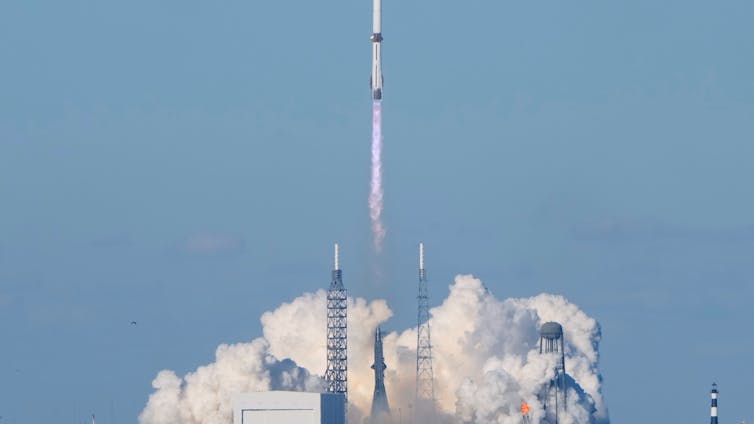
Blue Origin’s New Glenn rocket lifted off for its second orbital flight on Nov. 13, 2025. AP Photo/John Raoux
Blue Origin’s New Glenn rocket landed its booster on a barge at sea – an achievement that will broaden the commercial spaceflight market
Wendy Whitman Cobb, Air University Blue Origin’s New Glenn rocket successfully made its way to orbit for the second time on Nov. 13, 2025. Although the second launch is never as flashy as the first, this mission is still significant in several ways. For one, it launched a pair of NASA spacecraft named ESCAPADE, which are headed to Mars orbit to study that planet’s magnetic environment and atmosphere. The twin spacecraft will first travel to a Lagrange point, a place where the gravity between Earth, the Moon and the Sun balances. The ESCAPADE spacecraft will remain there until Mars is in better alignment to travel to. And two, importantly for Blue Origin, New Glenn’s first stage booster successfully returned to Earth and landed on a barge at sea. This landing allows the booster to be reused, substantially reducing the cost to get to space.Blue Origin launched its New Glenn rocket and landed the booster on a barge at sea on Nov. 13, 2025. As a space policy expert, I see this launch as a positive development for the commercial space industry. Even though SpaceX has pioneered this form of launch and reuse, New Glenn’s capabilities are just as important.
New Glenn in context
Although Blue Origin would seem to be following in SpaceX’s footsteps with New Glenn, there are significant differences between the two companies and their rockets. For most launches today, the rocket consists of several parts. The first stage helps propel the rocket and its spacecraft toward space and then drops away when its fuel is used up. A second stage then takes over, propelling the payload all the way to orbit. While both New Glenn and Falcon Heavy, SpaceX’s most powerful rocket currently available, are partially reusable, New Glenn is taller, more powerful and can carry a greater amount of payload to orbit. Blue Origin plans to use New Glenn for a variety of missions for customers such as NASA, Amazon and others. These will include missions to Earth’s orbit and eventually to the Moon to support Blue Origin’s own lunar and space exploration goals, as well as NASA’s. NASA’s Artemis program, which endeavors to return humans to the Moon, is where New Glenn may become important. In the past several months, several space policy leaders, as well as NASA officials, have expressed concern that Artemis is progressing too slowly. If Artemis stagnates, China may have the opportunity to leap ahead and beat NASA and its partners to the lunar south pole. These concerns stem from problems with two rockets that could potentially bring Americans back to the Moon: the space launch system and SpaceX’s Starship. NASA’s space launch system, which will launch astronauts on its Orion crew vehicle, has been criticized as too complex and costly. SpaceX’s Starship is important because NASA plans to use it to land humans on the Moon during the Artemis III mission. But its development has been much slower than anticipated. In response, Blue Origin has detailed some of its lunar exploration plans. They will begin with the launch of its uncrewed lunar lander, Blue Moon, early next year. The company is also developing a crewed version of Blue Moon that it will use on the Artemis V mission, the planned third lunar landing of humans. Blue Origin officials have said they are in discussions with NASA over how they might help accelerate the Artemis program.
New Glenn’s significance
New Glenn’s booster landing makes this most recent launch quite significant for the company. While it took SpaceX several tries to land its first booster, Blue Origin has achieved this feat on only the second try. Landing the boosters – and, more importantly, reusing them – has been key to reducing the cost to get to space for SpaceX, as well as others such as Rocket Lab. That two commercial space companies now have orbital rockets that can be partially reused shows that SpaceX’s success was no fluke. With this accomplishment, Blue Origin has been able to build on its previous experience and success with its suborbital rocket, New Shepard. Launching from Blue Origin facilities in Texas since 2015, New Shepard has taken people and cargo to the edge of space, before returning to its launch site under its own power.Blue Origin’s suborbital rocket, New Shepard.Joe Raedle/Getty Images New Glenn is also significant for the larger commercial space industry and U.S. space capabilities. It represents real competition for SpaceX, especially its Starship rocket. It also provides more launch options for NASA, the U.S. government and other commercial customers, reducing reliance on SpaceX or any other launch company. In the meantime, Blue Origin is looking to build on the success of New Glenn’s launch and its booster landing. New Glenn will next launch Blue Origin’s Blue Moon uncrewed lander in early 2026. This second successful New Glenn launch will also contribute to the rocket’s certification for national security space launches. This accomplishment will allow the company to compete for contracts to launch sensitive reconnaissance and defense satellites for the U.S. government. Blue Origin will also need to increase its number of launches and reduce the time between them to compete with SpaceX. SpaceX is on pace for between 165 and 170 launches in 2025 alone. While Blue Origin may not be able to achieve that remarkable cadence, to truly build on New Glenn’s success it will need to show it can scale up its launch operations. Wendy Whitman Cobb, Professor of Strategy and Security Studies, Air University This article is republished from The Conversation under a Creative Commons license. Read the original article.