

aerospace
NASA Launches Aeronautics Spanish-Language Webpages

Last Updated on January 27, 2023 by Daily News Staff
Lee esta nota de prensa en español aquí.
As part of its effort to provide more resources and information to new audiences, NASA has launched new webpages featuring aeronautics information in Spanish. The webpages aim to make aeronautics content more accessible to the Spanish-language community.
“This is a significant step forward in our efforts to make the knowledge we’ve accumulated at NASA available to people all over the country, and the world. We’re making sure that as we explore and tackle the biggest challenges facing aviation, we’re providing benefits for all,” said Bob Pearce, associate administrator for NASA’s Aeronautics Research Mission Directorate. “By presenting aeronautics information and educational materials in Spanish, we’re working to foster a diverse, bold and effective next generation of explorers. We’re counting on this generation to help NASA carry its vision into the future.”
According to data provided by the U.S. Census Bureau, Spanish is the second most widely spoken language in the United States, after English. The translation of NASA’s aeronautics content will help inspire the next generation of NASA explorers.
The webpages provide educational material on the work being done by NASA’s Aeronautics Research Mission Directorate. They contain information on top agency priorities, including sustainable aviation. NASA is committed to achieving net-zero greenhouse gas emissions from the aviation sector by 2050 and works to achieve that goal by leading in fields ranging from green technologies and aircraft design to composite manufacturing and sustainable fuel testing. The new pages will help the agency introduce new members of the public to this work.
In addition, the webpages will cover technological advances developed by NASA such as the Quesst mission, which will demonstrate quiet supersonic technology, possibly opening the door to commercial supersonic flight over land. Readers will be able to learn about NASA’s Advanced Air Mobility mission, which works to assist with the development of air transportation systems across the country, aeronautics tests at NASA’s wind tunnels and other facilities, and more.
The webpages also contain content designed for young learners focused on science, technology, engineering, and math (STEM), intended to help parents and teachers introduce children to these fields of study.
To view the Aeronautics webpages in Spanish, visit:
Source: NASA
Author





aerospace
NASA’s “Flying Swordfish” Takes Flight: The X-59 QueSST Begins Its Quiet Supersonic Journey
NASA’s X-59 QueSST “flying swordfish” made its first test flight from Palmdale, California, marking a breakthrough in quiet supersonic technology designed to reduce the sonic boom and reshape the future of air travel.

NASA’s experimental X-59 QueSST, also known as the “flying swordfish,” has officially made its first test flight, marking a major milestone in the future of quiet supersonic travel. Developed in partnership with Lockheed Martin, the sleek, needle-nosed aircraft lifted off from Air Force Plant 42 in Palmdale, California, on October 28, 2025, and safely landed at NASA’s Armstrong Flight Research Center.
While the maiden flight was subsonic, reaching speeds of around 230 miles per hour at 12,000 feet, it successfully demonstrated the aircraft’s fundamental systems and stability. Future test flights will push the X-59 to supersonic speeds, where NASA will evaluate its ability to drastically reduce the loud “sonic boom” to a soft “sonic thump.” The ultimate goal of the Quesst program is to pave the way for regulations that could one day allow commercial supersonic flights over land, revolutionizing air travel as we know it.
(Sources: Live Science, NASA, Lockheed Martin)
The science section of our news blog STM Daily News provides readers with captivating and up-to-date information on the latest scientific discoveries, breakthroughs, and innovations across various fields. We offer engaging and accessible content, ensuring that readers with different levels of scientific knowledge can stay informed. Whether it’s exploring advancements in medicine, astronomy, technology, or environmental sciences, our science section strives to shed light on the intriguing world of scientific exploration and its profound impact on our daily lives. From thought-provoking articles to informative interviews with experts in the field, STM Daily News Science offers a harmonious blend of factual reporting, analysis, and exploration, making it a go-to source for science enthusiasts and curious minds alike. https://stmdailynews.com/category/science/
Author
News
Taking Off: Archer Aviation’s Bold Move Brings Flying Taxis Closer to LA28
Archer Aviation’s LA airport acquisition could make flying taxis a reality just in time for the 2028 Olympics.

Last Updated on November 9, 2025 by Daily News Staff

Image Credit: Archer Aviation
From Olympic Dreams to Take-Off Plans
Back in our feature “Flying Taxis and Olympic Dreams: Will LA28 Be the Jetsons Era in Real Life?” we explored whether Los Angeles could become the first city to showcase flying taxis on the global stage during the 2028 Summer Olympics.
Now, that futuristic vision has gained some serious thrust. Archer Aviation — one of the leading players in electric vertical take-off and landing (eVTOL) aircraft — has announced a major move that could change how the city thinks about air mobility.
Archer Takes Control of Hawthorne Airport
In a landmark deal, Archer announced plans to acquire control of Hawthorne Airport — just three miles from LAX — for approximately $126 million in cash.
The 80-acre site, home to 190,000 square feet of hangars and terminal facilities, will become the company’s operational hub for its Los Angeles air-taxi network and a testbed for AI-driven aviation technology.
Alongside the purchase, Archer raised an additional $650 million in new equity funding, bringing its liquidity to more than $2 billion — a strong signal that the company is serious about turning concept into concrete.
What This Means for LA’s Mobility Future
This isn’t just a real estate move. It’s a strategic infrastructure play.
If Los Angeles is to handle Olympic crowds and long-term congestion, new vertical mobility hubs are essential. Hawthorne could serve as the first of several vertiports forming a network across the metro area.
It also puts Archer in a prime position to work alongside city planners and mobility partners preparing for the LA28 Games — potentially transforming how visitors move between venues, airports, and downtown.
Caution: Not Quite “Jetsons” Yet
While this progress looks promising, it’s not smooth skies ahead just yet.
FAA certification remains the biggest hurdle; only about 15% of compliance documentation has been approved. Production and scaling still pose risks — building and maintaining a fleet of electric aircraft at commercial levels isn’t cheap. Public acceptance will matter too. Even the quietest aircraft need to earn the city’s trust for noise, cost, and safety.
Still, compared to even a year ago, the vision of air taxis over Los Angeles feels far less like science fiction.
A Step Toward the Olympic Future
Archer’s move aligns perfectly with the question we raised earlier:
Can Los Angeles turn the 2028 Olympics into a showcase for sustainable, futuristic transportation?
By securing its own hub near LAX and backing it with fresh capital, Archer seems determined to make that answer a yes. Whether passengers will be hailing flying taxis in time for LA28 remains uncertain, but the groundwork — both financial and physical — is clearly being laid.
The skies over LA might just get busier — and cleaner — in the years to come.
Related Reading
- Flying Taxis and Olympic Dreams: Will LA28 Be the Jetsons Era in Real Life?
- Archer To Acquire Los Angeles Airport As Strategic Air Taxi Network
- HubTokyo Selects Archer’s Midnight Aircraft for First eVTOL Implementation Program
Dive into “The Knowledge,” where curiosity meets clarity. This playlist, in collaboration with STMDailyNews.com, is designed for viewers who value historical accuracy and insightful learning. Our short videos, ranging from 30 seconds to a minute and a half, make complex subjects easy to grasp in no time. Covering everything from historical events to contemporary processes and entertainment, “The Knowledge” bridges the past with the present. In a world where information is abundant yet often misused, our series aims to guide you through the noise, preserving vital knowledge and truths that shape our lives today. Perfect for curious minds eager to discover the ‘why’ and ‘how’ of everything around us. Subscribe and join in as we explore the facts that matter. https://stmdailynews.com/the-knowledge/
Author

aerospace
Boom Supersonic’s Overture: Supersonic Travel in the Making (2025 Update)
Boom Supersonic’s Overture jet is bringing back supersonic travel, with major airlines onboard and commercial flights targeted by 2029.
Last Updated on October 18, 2025 by Daily News Staff

The dream of passenger supersonic flight is getting closer to reality. Boom Supersonic has scored several key technical, regulatory, and business milestones in 2025. But as with any ambitious aerospace project, challenges loom. Here’s where things stand now—and what to watch going forward.
📰 Headlines You Should Know
In January 2025, Boom’s demonstrator aircraft XB-1 successfully broke the sound barrier (Mach ~1.1) during a test flight over the Mojave Desert.
In February, Boom officially announced “Boomless Cruise”, meaning that Overture is being designed to fly up to Mach 1.3 over land without producing an audible sonic boom at ground level.
On June 6, 2025, a presidential executive order effectively repealed the long-standing U.S. ban on supersonic flight over land, instructing the FAA to adopt updated noise limits rather than blanket prohibitions.
Boom has selected the Colorado Air & Space Port (near Aurora, CO) for its Symphony engine test facility.
In July 2025, Boom awarded a patent to its Aircraft Systems Director (Jim Senerth) for a “parallel power source system” to support large electrical power needs on future aircraft.
Boom remains active in recruiting: it made a visible push at the 2025 AIAA Aviation Forum, highlighting engineering roles in its supersonic program.
🛠 Technical & Program Status
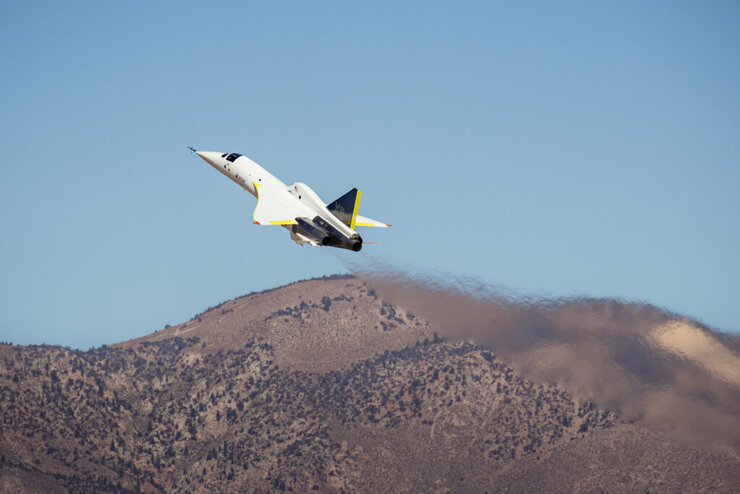
XB-1 Goes Mach 1
XB-1 Demonstrator: Mission Accomplished
The XB-1 test program is effectively complete. It proved that Boom’s design and sonic-boom models (especially for boomless cruise) are viable in real flight conditions.
The fact that XB-1’s supersonic runs did not generate audible sonic booms that reached the ground is a key enabler for overland routes.
Overture: Design & Business Assumptions
Overture is planned to cruise at Mach 1.7, carrying 60–80 passengers over a range of ~4,250 nautical miles.
Boom claims compatibility with 100% sustainable aviation fuel (SAF), aiming to pair speed with lower lifecycle emissions (relative to legacy approaches).
The order book (including firm orders and pre-orders) sits around 130 aircraft among United, American, Japan Airlines (and possibly others).
The Overture Superfactory in Greensboro, NC, is built and intended to scale up to producing 66 Overture jets per year.
Symphony Engine Development
The Symphony turbofan is central to Boom’s claims: it must enable sustained supersonic cruise and boomless operation.
The engine is in development, with additive manufacturing (3D printing) being used to produce critical core parts (compressor, combustor, turbine).
Boom expects to begin producing “thrusting cores” in full-scale testing by the end of 2025.
🏛 Regulation & Market Landscape
The June 2025 executive order removing the overland supersonic ban is a potential game-changer. It opens up many more route possibilities within the U.S. and globally, assuming stringent noise limits can be met.
Regulatory and certification risk remains significant. Even with favorable policy, Overture must satisfy FAA, EASA, and other jurisdictions’ airworthiness and noise standards. (Forecasts of program outlook caution that these remain major hurdles.)
Competitors are emerging internationally—China’s Comac C949 is being developed as a supersonic airliner (though it is in early stages).
✔ What’s Next: Key Milestones to Watch
Symphony engine thrust core tests (late 2025) — critical engineering moment
Final design freeze for Overture — when the aircraft’s shape, systems, and structure are locked
First Overture flight (planned ~2027)
Certification (FAA / EASA) and commercial launch (projected ~2029)
Route announcements and airline deployment plans
Market response and economics — will the speed premium be enough to support ticket pricing, fuel burn, maintenance, etc.
⚖️ Strengths & Risks
Strengths / Tailwinds
Real demonstration with XB-1 giving credibility to the concept
Favorable U.S. regulatory shift enabling overland supersonic
Strong airline interest (United, American, JAL)
Focus on sustainability via SAF and modern materials/engineering
Factory and supply chain investments already underway
Risks / Headwinds
Certification is notoriously difficult, especially for novel supersonic aircraft
Engine performance, thermal loads, and materials remain major engineering challenges
Noise limits and regulatory standards across multiple countries may differ
The business model must balance speed premium vs cost, fuel, maintenance
Timeline risk is high — delays, cost overruns, or technical setbacks are common in aerospace
As Boom finalizes its Superfactory in North Carolina and ramps up testing of its proprietary Symphony engines, the future of faster-than-sound flight is once again within reach.
Read more about this aviation breakthrough on STM Daily News.
Related Links:
Reuters – Boom Supersonic XB-1 Breaks Sound Barrier Over Mojave Desert
The Guardian – Supersonic Prototype Jet Breaks Sound Barrier on US Test Flight
AP News – First Independently Developed Jet Breaks the Sound Barrier
FlightGlobal – Supersonic Overture Beckons as Boom Concludes XB-1 Test Programme
WSJ – New York to Paris in Under Four Hours? Inside the Effort to Build the Next Concorde





