
Connect with us

Science

NASA, SpaceX Launch Solar Arrays, Cargo to Space Station

Published

on

Last Updated on June 5, 2023 by Daily News Staff

screenshot 2023 06 05 115927 1
The Falcon 9 rocket lifts off from NASA Kennedy Space Center in Florida on June 5, 2023, beginning the 28th resupply services mission to the International Space Station.
Credits: NASA

Following a successful launch of NASA’s SpaceX 28th commercial resupply services mission, two new solar arrays, science investigations, and supplies are on their way to the International Space Station.

Carrying more than 7,000 pounds of cargo to the orbiting laboratory, the uncrewed SpaceX Dragon spacecraft launched on the company’s Falcon 9 rocket at 11:47 a.m. EDT, Monday, June 5, from NASA’s Kennedy Space Center in Florida.

Live coverage of arrival will begin at 4:15 a.m., Tuesday, June 6, on NASA Television, the agency’s website, and the NASA app.

The cargo spacecraft is scheduled to autonomously dock with the space-facing port on the station’s Harmony module at approximately 5:50 a.m. and remain at the station for about 21 days.

The SpaceX Dragon will deliver a pair of IROSAs (International Space Station Roll Out Solar Arrays) that, once installed, will expand the energy-production capabilities of the microgravity complex.

The spacecraft will also deliver the following:

Thunderstorm Watch

What Happens Above Thunderstorms (Thor-Davis), an investigation from ESA (European Space Agency), will observe thunderstorms from the space station. This vantage point will allow researchers to see the electrical activity from above, particularly the inception, frequency, and altitude of recently discovered blue discharges. Scientists plan to estimate the energy of these phenomena to determine their effect on the atmosphere. A better understanding of lightning and electrical activity in Earth’s atmosphere could improve atmospheric models and provide a better understanding of Earth’s climate and weather.

Helping Plants Chill in Space

Plants exposed to environmental stress, including spaceflight, undergo changes to adapt, but those changes may not be passed on to the next generation. Plant Habitat-03 (PH-03) will assess whether plants grown in space can transfer such adaptations to the next generation and, if so, whether a change continues through subsequent generations or stabilizes.

Advertisement
Get More From A Face Cleanser And Spa-like Massage

The investigation will create a second generation of plants using seeds previously produced in space and returned to Earth. Results could provide insight into how to grow multiple generations of plants to provide food and other services on future space missions. This investigation also could support development of strategies for adapting crops and other economically important plants to marginal and reclaimed habitats on Earth.

Testing a Telomere Technique

Telomeres, genetic structures that protect our chromosomes, shorten with age and wear. But research has shown that telomeres lengthen in space. Genes in Spac e-10 will test a technique for measuring telomere length in microgravity, where methods typically employed on Earth are difficult to use due to gravity. The experiment will explore whether telomere lengthening in space is caused by proliferation of stem cells –undifferentiated cells that give rise to specific body components and that typically have long telomeres.

Understanding the mechanism behind telomere lengthening could reveal possible effects on astronaut health during long-duration missions. Results also could lay the groundwork for a variety of related research to benefit future space travel and people on the ground.

Genes in Space is a national contest for students in grades seven through 12 to design biotechnology experiments for space. The program is sponsored by miniPCR, Math for America, Boeing, New England Biolabs Ltd., and the International Space Station National Laboratory.

Thawing Ice, Solar Storms, and Attitude Recovery

Mission 26 for the station’s Nanoracks CubeSat Deployer (NRCSD) includes Educational Space Science and Engineering CubeSat Experiment Mission (ESSENCE), sponsored by the International Space Station National Laboratory and developed by universities in Canada and Australia. It carries a wide-angle camera to monitor thawing of ice and permafrost in the Canadian Arctic, which could provide a better understanding of the effects on Earth’s climate and support better local infrastructure planning.

The satellite also carries a solar energetic proton detector to collect data on periods of solar activity that emit highly energized radioactive protons that can damage the structure and electronic components of spacecraft. Understanding these effects could help make future CubeSats more resistant to radiation. In addition, the investigation demonstrates a novel method to recover control of a satellite’s attitude, or orientation, if a control mechanism fails. ESSENCE is part of the Canadian CubeSat Project, led by CSA (Canadian Space Agency).

Watching Cosmic Weathering

Iris, sponsored by the International Space Station National Laboratory, observes weathering of geological samples exposed to direct solar and background cosmic radiation and determines whether changes are visually detectable. The investigation also demonstrates experimental sun sensors, torque rods (which provide attitude control and detumbling for satellites), and a battery heater. A collaboration between graduate, undergraduate, and middle school students in Canada, the project provides hands-on experience that promotes interest in science, technology, engineering, and mathematics studies and careers.

Advertisement
Get More From A Face Cleanser And Spa-like Massage

Results also could provide insight into weathering processes on planetary bodies and, when combined with data from asteroid sampling missions, improve understanding of the origins of asteroids. Iris is part of the Canadian CubeSat Project, led by CSA.

Get breaking news, images, and features from the space station blog or on InstagramFacebook, and Twitter.

https://q5i.09c.myftpupload.com/category/science/

Author


Discover more from Daily News

Subscribe to get the latest posts sent to your email.

Science

Why can’t I wiggle my toes one at a time, like my fingers?

why can’t I wiggle my toes? Ever wondered why you can’t wiggle your toes one at a time like your fingers? Learn how evolution, muscles, and your brain all play a part in making fingers more independent than toes—and why that’s key for walking and balance.

Published

on

Why can’t I wiggle my toes one at a time, like my fingers?
A baby chimp can grab a stick equally well with its fingers and its toes. Anup Shah/Stone via Getty Images

Why Can’t You Wiggle Your Toes Like Your Fingers? The Science Behind Toe and Finger Movement

Steven Lautzenheiser, University of Tennessee Curious Kids is a series for children of all ages. If you have a question you’d like an expert to answer, send it to curiouskidsus@theconversation.com.
Why can’t I wiggle my toes individually, like I can with my fingers? – Vincent, age 15, Arlington, Virginia

One of my favorite activities is going to the zoo where I live in Knoxville when it first opens and the animals are most active. On one recent weekend, I headed to the chimpanzees first. Their breakfast was still scattered around their enclosure for them to find. Ripley, one of the male chimpanzees, quickly gathered up some fruits and vegetables, sometimes using his feet almost like hands. After he ate, he used his feet to grab the fire hoses hanging around the enclosure and even held pieces of straw and other toys in his toes. I found myself feeling a bit envious. Why can’t people use our feet like this, quickly and easily grasping things with our toes just as easily as we do with our fingers? I’m a biological anthropologist who studies the biomechanics of the modern human foot and ankle, using mechanical principles of movement to understand how forces affect the shape of our bodies and how humans have changed over time. Your muscles, brain and how human feet evolved all play a part in why you can’t wiggle individual toes one by one.
young chimp running on all fours
Chimpanzee hands and feet do similar jobs. Manoj Shah/Stone via Getty Images

Comparing humans to a close relative

Humans are primates, which means we belong to the same group of animals that includes apes like Riley the chimp. In fact, chimpanzees are our closest genetic relatives, sharing almost 98.8% of our DNA. Evolution is part of the answer to why chimpanzees have such dexterous toes while ours seem much more clumsy. Our very ancient ancestors probably moved around the way chimpanzees do, using both their arms and legs. But over time our lineage started walking on two legs. Human feet needed to change to help us stay balanced and to support our bodies as we walk upright. It became less important for our toes to move individually than to keep us from toppling over as we moved through the world in this new way.
bare feet walking across sandy surface toward camera
Feet adapted so we could walk and balance on just two legs. Karina Mansfield/Moment via Getty Images
Human hands became more important for things such as using tools, one of the hallmark skills of human beings. Over time, our fingers became better at moving on their own. People use their hands to do lots of things, such as drawing, texting or playing a musical instrument. Even typing this article is possible only because my fingers can make small, careful and controlled movements. People’s feet and hands evolved for different purposes.

Muscles that move your fingers or toes

Evolution brought these differences about by physically adapting our muscles, bones and tendons to better support walking and balance. Hands and feet have similar anatomy; both have five fingers or toes that are moved by muscles and tendons. The human foot contains 29 muscles that all work to help you walk and stay balanced when you stand. In comparison, a hand has 34 muscles. Most of the muscles of your foot let you point your toes down, like when you stand on tiptoes, or lift them up, like when you walk on your heels. These muscles also help feet roll slightly inward or outward, which lets you keep your balance on uneven ground. All these movements work together to help you walk and run safely. The big toe on each foot is special because it helps push your body forward when you walk and has extra muscles just for its movement. The other four toes don’t have their own separate muscles. A few main muscles in the bottom of your foot and in your calf move all four toes at once. Because they share muscles, those toes can wiggle, but not very independently like your fingers can. The calf muscles also have long tendons that reach into the foot; they’re better at keeping you steady and helping you walk than at making tiny, precise movements.
a pen and ink drawing of the interior anatomy of a human hand
Your hand is capable of delicate movements thanks to the muscles and ligaments that control its bones. Henry Gray, ‘Anatomy of the Human Body’/Wikimedia Commons, CC BY
In contrast, six main muscle groups help move each finger. The fingers share these muscles, which sit mostly in the forearm and connect to the fingers by tendons. The thumb and pinky have extra muscles that let you grip and hold objects more easily. All of these muscles are specialized to allow careful, controlled movements, such as writing. So, yes, I have more muscles dedicated to moving my fingers, but that is not the only reason I can’t wiggle my toes one by one.

Divvying up brain power

You also need to look inside your brain to understand why toes and fingers work differently. Part of your brain called the motor cortex tells your body how to move. It’s made of cells called neurons that act like tiny messengers, sending signals to the rest of your body. Your motor cortex devotes many more neurons to controlling your fingers than your toes, so it can send much more detailed instructions to your fingers. Because of the way your motor cortex is organized, it takes more “brain power,” meaning more signals and more activity, to move your fingers than your toes.
illustration of a brain looking down at the top of the head with one section highlighted orange
The motor cortex of your brain sends orders to move parts of your body. Kateryna Kon/Science Photo Library via Getty Images
Even though you can’t grab things with your feet like Ripley the chimp can, you can understand why.
Hello, curious kids! Do you have a question you’d like an expert to answer? Ask an adult to send your question to CuriousKidsUS@theconversation.com. Please tell us your name, age and the city where you live. And since curiosity has no age limit – adults, let us know what you’re wondering, too. We won’t be able to answer every question, but we will do our best. Steven Lautzenheiser, Assistant Professor of Biological Anthropology, University of Tennessee This article is republished from The Conversation under a Creative Commons license. Read the original article.
❄️ The Man Who Made Air Conditioning Cool
Link: https://stmdailynews.com/%e2%9d%84%ef%b8%8f-the-man-who-made-air-conditioning-cool/
View recent photos

Unlock fun facts & lost history—get The Knowledge in your inbox!

We don’t spam! Read our privacy policy for more info.


Discover more from Daily News

Subscribe to get the latest posts sent to your email.

Continue Reading

Artificial Intelligence

More than half of new articles on the internet are being written by AI – is human writing headed for extinction?

A new study finds over 50% of online articles are now AI-generated, raising questions about the future of human writing. Discover why formulaic content is most at risk, and why authentic, creative voices may become more valuable than ever.

Published

on

Is AI Replacing Human Writers? Why Over Half of Online Articles Are Now AI-Generated
Preserving the value of real human voices will likely depend on how people adapt to artificial intelligence and collaborate with it. BlackJack3D/E+ via Getty Images

More than half of new articles on the internet are being written by AI – is human writing headed for extinction?

Francesco Agnellini, Binghamton University, State University of New York The line between human and machine authorship is blurring, particularly as it’s become increasingly difficult to tell whether something was written by a person or AI. Now, in what may seem like a tipping point, the digital marketing firm Graphite recently published a study showing that more than 50% of articles on the web are being generated by artificial intelligence. As a scholar who explores how AI is built, how people are using it in their everyday lives, and how it’s affecting culture, I’ve thought a lot about what this technology can do and where it falls short. If you’re more likely to read something written by AI than by a human on the internet, is it only a matter of time before human writing becomes obsolete? Or is this simply another technological development that humans will adapt to?

It isn’t all or nothing

Thinking about these questions reminded me of Umberto Eco’s essay “Apocalyptic and Integrated,” which was originally written in the early 1960s. Parts of it were later included in an anthology titled “Apocalypse Postponed,” which I first read as a college student in Italy. In it, Eco draws a contrast between two attitudes toward mass media. There are the “apocalyptics” who fear cultural degradation and moral collapse. Then there are the “integrated” who champion new media technologies as a democratizing force for culture.
An older man with a beard, glasses and a suit poses while holding a cigarette.
Italian philosopher, cultural critic and novelist Umberto Eco cautioned against overreacting to the impact of new technologies. Leonardo Cendamo/Getty Images
Back then, Eco was writing about the proliferation of TV and radio. Today, you’ll often see similar reactions to AI. Yet Eco argued that both positions were too extreme. It isn’t helpful, he wrote, to see new media as either a dire threat or a miracle. Instead, he urged readers to look at how people and communities use these new tools, what risks and opportunities they create, and how they shape – and sometimes reinforce – power structures. While I was teaching a course on deepfakes during the 2024 election, Eco’s lesson also came back to me. Those were days when some scholars and media outlets were regularly warning of an imminent “deepfake apocalypse.” Would deepfakes be used to mimic major political figures and push targeted disinformation? What if, on the eve of an election, generative AI was used to mimic the voice of a candidate on a robocall telling voters to stay home? Those fears weren’t groundless: Research shows that people aren’t especially good at identifying deepfakes. At the same time, they consistently overestimate their ability to do so. In the end, though, the apocalypse was postponed. Post-election analyses found that deepfakes did seem to intensify some ongoing political trends, such as the erosion of trust and polarization, but there’s no evidence that they affected the final outcome of the election.

Listicles, news updates and how-to guides

Of course, the fears that AI raises for supporters of democracy are not the same as those it creates for writers and artists. For them, the core concerns are about authorship: How can one person compete with a system trained on millions of voices that can produce text at hyper-speed? And if this becomes the norm, what will it do to creative work, both as an occupation and as a source of meaning? It’s important to clarify what’s meant by “online content,” the phrase used in the Graphite study, which analyzed over 65,000 randomly selected articles of at least 100 words on the web. These can include anything from peer-reviewed research to promotional copy for miracle supplements. A closer reading of the Graphite study shows that the AI-generated articles consist largely of general-interest writing: news updates, how-to guides, lifestyle posts, reviews and product explainers. https://stmdailynews.com/wp-admin/post-new.php#visibility The primary economic purpose of this content is to persuade or inform, not to express originality or creativity. Put differently, AI appears to be most useful when the writing in question is low-stakes and formulaic: the weekend-in-Rome listicle, the standard cover letter, the text produced to market a business. A whole industry of writers – mostly freelance, including many translators – has relied on precisely this kind of work, producing blog posts, how-to material, search engine optimization text and social media copy. The rapid adoption of large language models has already displaced many of the gigs that once sustained them.

Collaborating with AI

The dramatic loss of this work points toward another issue raised by the Graphite study: the question of authenticity, not only in identifying who or what produced a text, but also in understanding the value that humans attach to creative activity. How can you distinguish a human-written article from a machine-generated one? And does that ability even matter? Over time, that distinction is likely to grow less significant, particularly as more writing emerges from interactions between humans and AI. A writer might draft a few lines, let an AI expand them and then reshape that output into the final text. This article is no exception. As a non-native English speaker, I often rely on AI to refine my language before sending drafts to an editor. At times the system attempts to reshape what I mean. But once its stylistic tendencies become familiar, it becomes possible to avoid them and maintain a personal tone. Also, artificial intelligence is not entirely artificial, since it is trained on human-made material. It’s worth noting that even before AI, human writing has never been entirely human, either. Every technology, from parchment and stylus paper to the typewriter and now AI, has shaped how people write and how readers make sense of it. Another important point: AI models are increasingly trained on datasets that include not only human writing but also AI-generated and human–AI co-produced text. This has raised concerns about their ability to continue improving over time. Some commentators have already described a sense of disillusionment following the release of newer large models, with companies struggling to deliver on their promises.

Human voices may matter even more

But what happens when people become overly reliant on AI in their writing? Some studies show that writers may feel more creative when they use artificial intelligence for brainstorming, yet the range of ideas often becomes narrower. This uniformity affects style as well: These systems tend to pull users toward similar patterns of wording, which reduces the differences that usually mark an individual voice. Researchers also note a shift toward Western – and especially English-speaking – norms in the writing of people from other cultures, raising concerns about a new form of AI colonialism. In this context, texts that display originality, voice and stylistic intention are likely to become even more meaningful within the media landscape, and they may play a crucial role in training the next generations of models. If you set aside the more apocalyptic scenarios and assume that AI will continue to advance – perhaps at a slower pace than in the recent past – it’s quite possible that thoughtful, original, human-generated writing will become even more valuable. Put another way: The work of writers, journalists and intellectuals will not become superfluous simply because much of the web is no longer written by humans. Francesco Agnellini, Lecturer in Digital and Data Studies, Binghamton University, State University of New York This article is republished from The Conversation under a Creative Commons license. Read the original article.

 

Dive into “The Knowledge,” where curiosity meets clarity. This playlist, in collaboration with STMDailyNews.com, is designed for viewers who value historical accuracy and insightful learning. Our short videos, ranging from 30 seconds to a minute and a half, make complex subjects easy to grasp in no time. Covering everything from historical events to contemporary processes and entertainment, “The Knowledge” bridges the past with the present. In a world where information is abundant yet often misused, our series aims to guide you through the noise, preserving vital knowledge and truths that shape our lives today. Perfect for curious minds eager to discover the ‘why’ and ‘how’ of everything around us. Subscribe and join in as we explore the facts that matter.  https://stmdailynews.com/the-knowledge/


Discover more from Daily News

Subscribe to get the latest posts sent to your email.

Continue Reading

astronomy

NASA goes on an ESCAPADE – twin small, low-cost orbiters will examine Mars’ atmosphere

NASA’s ESCAPADE mission launched two small, affordable orbiters to Mars on Blue Origin’s New Glenn rocket. Discover how these twin spacecraft will study Mars’ atmosphere, test new trajectories, and usher in a new era of rapid, low-cost space exploration.

Published

on

NASA’s ESCAPADE mission launched two small, affordable orbiters to Mars on Blue Origin’s New Glenn rocket. Discover how these twin spacecraft will study Mars’ atmosphere, test new trajectories, and usher in a new era of rapid, low-cost space exploration.
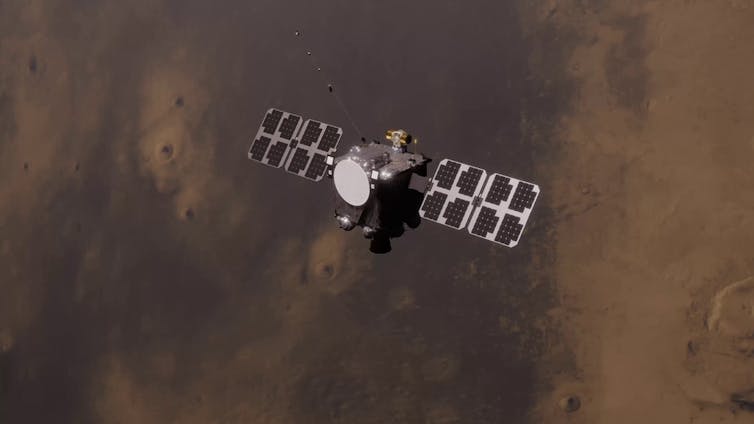
This close-up illustration shows what one of the twin ESCAPADE spacecraft will look like conducting its science operations. James Rattray/Rocket Lab USA/Goddard Space Flight Center

NASA goes on an ESCAPADE – twin small, low-cost orbiters will examine Mars’ atmosphere

Christopher Carr, Georgia Institute of Technology and Glenn Lightsey, Georgia Institute of Technology Envision a time when hundreds of spacecraft are exploring the solar system and beyond. That’s the future that NASA’s ESCAPADE, or Escape and Plasma Acceleration and Dynamics Explorers, mission will help unleash: one where small, low-cost spacecraft enable researchers to learn rapidly, iterate, and advance technology and science. The ESCAPADE mission launched on Nov. 13, 2025 on a Blue Origin New Glenn rocket, sending two small orbiters to Mars to study its atmosphere. As aerospace engineers, we’re excited about this mission because not only will it do great science while advancing the deep space capabilities of small spacecraft, but it also will travel to the red planet on an innovative new trajectory. The ESCAPADE mission is actually two spacecraft instead of one. Two identical spacecraft will take simultaneous measurements, resulting in better science. These spacecraft are smaller than those used in the past, each about the size of a copy machine, partly enabled by an ongoing miniaturization trend in the space industry. Doing more with less is very important for space exploration, because it typically takes most of the mass of a spacecraft simply to transport it where you want it to go.
A patch with a drawing of two spacecraft, one behind the other, on a red background and the ESCAPADE mission title.
The ESCAPADE mission logo shows the twin orbiters. TRAX International/Kristen Perrin
Having two spacecraft also acts as an insurance policy in case one of them doesn’t work as planned. Even if one completely fails, researchers can still do science with a single working spacecraft. This redundancy enables each spacecraft to be built more affordably than in the past, because the copies allow for more acceptance of risk.

Studying Mars’ history

Long before the ESCAPADE twin spacecraft Blue and Gold were ready to go to space – billions of years ago, to be more precise – Mars had a much thicker atmosphere than it does now. This atmosphere would have enabled liquids to flow on its surface, creating the channels and gullies that scientists can still observe today. But where did the bulk of this atmosphere go? Its loss turned Mars into the cold and dry world it is today, with a surface air pressure less than 1% of Earth’s. Mars also once had a magnetic field, like Earth’s, that helped to shield its atmosphere. That atmosphere and magnetic field would have been critical to any life that might have existed on early Mars.
A view of Mars' crater-flecked surface from above.
Today, Mars’ atmosphere is very thin. Billions of years ago, it was much thicker. ©UAESA/MBRSC/HopeMarsMission/EXI/AndreaLuck, CC BY-ND
ESCAPADE will measure remnants of this magnetic field that have been preserved by ancient rock and study the flow and energy of Mars’ atmosphere and how it interacts with the solar wind, the stream of particles that the sun emits along with light. These measurements will help to reveal where the atmosphere went and how quickly Mars is still losing it today.

Weathering space on a budget

Space is not a friendly place. Most of it is a vacuum – that is, mostly empty, without the gas molecules that create pressure and allow you to breathe or transfer heat. These molecules keep things from getting too hot or too cold. In space, with no pressure, a spacecraft can easily get too hot or too cold, depending on whether it is in sunlight or in shadow. In addition, the Sun and other, farther astronomical objects emit radiation that living things do not experience on Earth. Earth’s magnetic field protects you from the worst of this radiation. So when humans or our robotic representatives leave the Earth, our spacecraft must survive in this extreme environment not present on Earth. ESCAPADE will overcome these challenges with a shoestring budget totaling US$80 million. That is a lot of money, but for a mission to another planet it is inexpensive. It has kept costs low by leveraging commercial technologies for deep space exploration, which is now possible because of prior investments in fundamental research. For example, the GRAIL mission, launched in 2011, previously used two spacecraft, Ebb and Flow, to map the Moon’s gravity fields. ESCAPADE takes this concept to another world, Mars, and costs a fraction as much as GRAIL. Led by Rob Lillis of UC Berkeley’s Space Sciences Laboratory, this collaboration between spacecraft builders Rocket Lab, trajectory specialists Advanced Space LLC and launch provider Blue Origin – all commercial partners funded by NASA – aims to show that deep space exploration is now faster, more agile and more affordable than ever before.
NASA’s ESCAPADE represents a partnership between a university, commercial companies and the government.

How will ESCAPADE get to Mars?

ESCAPADE will also use a new trajectory to get to Mars. Imagine being an archer in the Olympics. To hit a bull’s-eye, you have to shoot an arrow through a 15-inch – 40-centimeter – circle from a distance of 300 feet, or 90 meters. Now imagine the bull’s-eye represents Mars. To hit it from Earth, you would have to shoot an arrow through the same 15-inch bull’s-eye at a distance of over 13 miles, or 22 kilometers. You would also have to shoot the arrow in a curved path so that it goes around the Sun. Not only that, but Mars won’t be at the bull’s-eye at the time you shoot the arrow. You must shoot for the spot that Mars will be in 10 months from now. This is the problem that the ESCAPADE mission designers faced. What is amazing is that the physical laws and forces of nature are so predictable that this was not even the hardest problem to solve for the ESCAPADE mission. It takes energy to get from one place to another. To go from Earth to Mars, a spacecraft has to carry the energy it needs, in the form of rocket fuel, much like gasoline in a car. As a result, a high percentage of the total launch mass has to be fuel for the trip. When going to Mars orbit from Earth orbit, as much as 80% to 85% of the spacecraft mass has to be propellant, which means not much mass is dedicated to the part of the spacecraft that does all the experiments. This issue makes it important to pack as much capability into the rest of the spacecraft as possible. For ESCAPADE, the propellant is only about 65% of the spacecraft’s mass. ESCAPADE’s route is particularly fuel-efficient. First, Blue and Gold will go to the L2 Lagrange point, one of five places where gravitational forces of the Sun and Earth cancel out. Then, after about a year, during which they will collect data monitoring the Sun, they will fly by the Earth, using its gravitational field to get a boost. This way, they will arrive at Mars in about 10 more months. This new approach has another advantage beyond needing to carry less fuel: Trips from Earth to Mars are typically favorable to save fuel about every 26 months due to the two planets’ relative positions. However, this new trajectory makes the departure time more flexible. Future cargo and human missions could use a similar trajectory to have more frequent and less time-constrained trips to Mars. ESCAPADE is a testament to a new era in spaceflight. For a new generation of scientists and engineers, ESCAPADE is not just a mission – it is a blueprint for a new collaborative era of exploration and discovery. This article was updated on Nov. 13, 2025 to reflect the ESCAPADE launch’s date and success. Christopher Carr, Assistant Professor of Aerospace Engineering, Georgia Institute of Technology and Glenn Lightsey, Professor of Space Systems Technology, Georgia Institute of Technology This article is republished from The Conversation under a Creative Commons license. Read the original article.
Space Force Faces New Challenge: Tracking Debris from Intelsat 33e Breakdown
Link: https://stmdailynews.com/space-force-faces-new-challenge-tracking-debris-from-intelsat-33e-breakdown/

Discover more from Daily News

Subscribe to get the latest posts sent to your email.

Continue Reading

Trending


