

Space and Tech
NASA’s Psyche Mission Achieves Milestone with Laser Communication from Space
NASA’s Psyche mission achieves milestone with deep space laser communication, paving the way for faster and more efficient exploration.

Last Updated on October 12, 2025 by Daily News Staff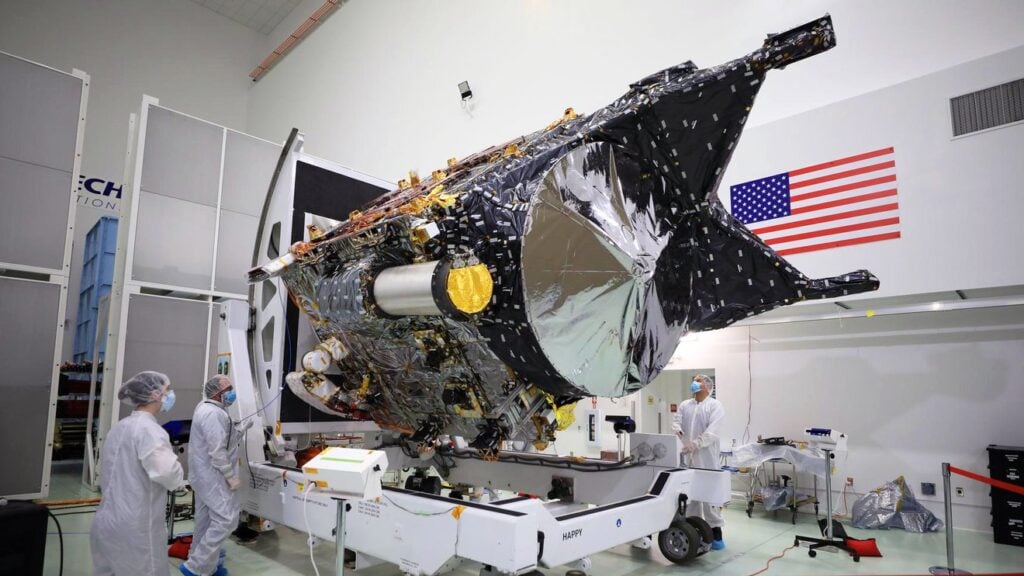
Credit: NASA/Ben Smegelsky
NASA’s Psyche Mission Achieves Milestone with Laser Communication from Space
NASA’s Psyche mission has reached a significant milestone by successfully demonstrating the most distant laser communications in space. This groundbreaking technology experiment, conducted aboard the Psyche spacecraft, holds the potential to revolutionize NASA’s missions and deepen our understanding of the universe’s origins. In this blog post, we will explore the recent achievements of the Deep Space Optical Communications technology demonstration (DSOC) and its implications for future space exploration.
The DSOC Experiment:
Launched in October, the Psyche mission aims to explore a metal asteroid located in the outer region of the main asteroid belt, between the orbits of Mars and Jupiter. Accompanying the spacecraft is the DSOC, designed to test high-bandwidth laser communications. Unlike traditional radio wave systems, the invisible near-infrared laser used in DSOC has the potential to transmit data at speeds 10 to 100 times faster.
First Light Achievement:
The DSOC recently achieved a significant milestone called “first light.” Engineers successfully sent and received data encoded in a laser beam from a distance of nearly 10 million miles (16 million kilometers) away. The laser signal traveled to the Hale Telescope at the California Institute of Technology’s Palomar Observatory, surpassing the distance of the moon from Earth by a factor of 40. This achievement marks a critical step towards advancing communication technology for future human missions to Mars.
Implications for Deep Space Communication:
The successful demonstration of laser communications across deep space opens new possibilities for the transmission of scientific information, high-definition imagery, and even streaming video. With the potential to transmit data at unprecedented speeds, laser communications could significantly enhance scientific research and exploration efforts. These advancements would enable scientists and researchers to gather more data and make groundbreaking discoveries about our universe.
The Future of Laser Communications:
While laser communications have been tested in space before, DSOC’s achievement marks the first successful attempt at sending laser signals across deep space. This feat demonstrates the precision required to aim and point laser beams over millions of miles. Moving forward, the DSOC team will focus on refining the laser’s pointing accuracy and further optimizing the system.
Challenges and Future Prospects:
As the Psyche spacecraft continues its journey, the DSOC team will face challenges such as the time it takes for laser messages to travel across vast distances. Despite these obstacles, the potential benefits of optical communication in deep space are immense. By utilizing laser technology, NASA can transmit larger amounts of data, leading to more significant discoveries and advancements in space exploration.
NASA’s Psyche mission and the DSOC experiment have achieved a remarkable milestone with the successful demonstration of laser communications from deep space. This breakthrough paves the way for faster, more efficient data transmission in future space missions, potentially revolutionizing our understanding of the universe and aiding in the exploration of Mars and beyond. As the mission progresses, scientists and engineers will continue to refine this technology, unlocking new frontiers in space exploration and research.
NASA’s Deep Space Optical Comm Demo Sends, Receives First Data https://www.jpl.nasa.gov/news/nasas-deep-space-optical-comm-demo-sends-receives-first-data




Last Updated on April 2, 2026 by Daily News Staff
🕒 [UPDATE] Orion Performs Translunar Injection Burn
The spacecraft has completed its critical engine burn, sending Artemis II on a trajectory toward the Moon. This marks the official start of its deep space journey.

Artemis II Successfully Launches
CAPE CANAVERAL, Fla. — NASA has successfully launched its Artemis II mission, marking the first crewed journey toward the Moon in more than 50 years.
The powerful Space Launch System (SLS) rocket lifted off from Kennedy Space Center on April 1, carrying four astronauts on a 10-day mission around the Moon and back.
On board are Commander Reid Wiseman, Pilot Victor Glover, Mission Specialist Christina Koch, and Canadian astronaut Jeremy Hansen. The mission is already being hailed as a major milestone in NASA’s effort to return humans to deep space.
Shortly after liftoff, the Orion spacecraft successfully reached orbit and deployed its solar arrays, beginning its journey that will eventually send the crew on a translunar trajectory toward the Moon. 
Artemis II is a lunar flyby mission, meaning astronauts will not land but will travel farther from Earth than any human mission in decades while testing critical systems needed for future landings.
The mission also marks several historic firsts, including the first woman and the first person of color—Victor Glover—to travel into lunar space.
NASA says the mission is a key step toward future lunar landings and long-term plans to establish a human presence on the Moon later this decade.
🛰️ Artemis II Mission Timeline
The 10-day Artemis II mission follows a carefully planned trajectory from Earth to the Moon and back:
- Day 1: Launch and Earth orbit
- Day 1–2: Translunar injection burn
- Days 2–4: Deep space travel
- Days 4–5: Lunar flyby
- Days 5–8: Return to Earth
- Days 9–10: Reentry and splashdown
For official updates and in-depth mission details, visit the following trusted sources:
- NASA: Artemis II Mission Overview
- NASA Artemis Program (Return to the Moon)
- Orion Spacecraft – Mission Details
- Space Launch System (SLS) Rocket Overview
- Kennedy Space Center – Launch Operations
- Watch NASA Live Coverage and Replays
🧾 Sources
- NASA official launch coverage and mission updates
- NASA Artemis II press materials and briefings
- NASA Kennedy Space Center launch operations updates
Stay with STM Daily News for live updates on Artemis II.
Last Updated on February 10, 2026 by Daily News Staff
Valerie Thomas is a true pioneer in the world of science and technology. A NASA engineer and physicist, she is best known for inventing the illusion transmitter, a groundbreaking device that creates 3D images using concave mirrors. This invention laid the foundation for modern 3D imaging and virtual reality technologies.
Beyond her inventions, Thomas broke barriers as an African American woman in STEM, mentoring countless young scientists and advocating for diversity in science and engineering. Her work at NASA’s Goddard Space Flight Center helped advance satellite technology and data visualization, making her contributions both innovative and enduring.
In our latest short video, we highlight Valerie Thomas’ remarkable journey—from her early passion for science to her groundbreaking work at NASA. Watch and be inspired by a true STEM pioneer whose legacy continues to shape the future of space and technology.
🎥 Watch the video here: https://youtu.be/P5XTgpcAoHw
Dive into “The Knowledge,” where curiosity meets clarity. This playlist, in collaboration with STMDailyNews.com, is designed for viewers who value historical accuracy and insightful learning. Our short videos, ranging from 30 seconds to a minute and a half, make complex subjects easy to grasp in no time. Covering everything from historical events to contemporary processes and entertainment, “The Knowledge” bridges the past with the present. In a world where information is abundant yet often misused, our series aims to guide you through the noise, preserving vital knowledge and truths that shape our lives today. Perfect for curious minds eager to discover the ‘why’ and ‘how’ of everything around us. Subscribe and join in as we explore the facts that matter. https://stmdailynews.com/the-knowledge/
Forgotten Genius Fridays
https://stmdailynews.com/the-knowledge-2/forgotten-genius-fridays/
🧠 Forgotten Genius Fridays
A Short-Form Series from The Knowledge by STM Daily News
Every Friday, STM Daily News shines a light on brilliant minds history overlooked.
Forgotten Genius Fridays is a weekly collection of short videos and articles dedicated to inventors, innovators, scientists, and creators whose impact changed the world—but whose names were often left out of the textbooks.
From life-saving inventions and cultural breakthroughs to game-changing ideas buried by bias, our series digs up the truth behind the minds that mattered.
Each episode of The Knowledge runs 30–90 seconds, designed for curious minds on the go—perfect for YouTube Shorts, TikTok, Reels, and quick reads.
Because remembering these stories isn’t just about the past—it’s about restoring credit where it’s long overdue.
🔔 New episodes every Friday
📺 Watch now at: stmdailynews.com/the-knowledge
🧠 Now you know.
Author

The Knowledge
Beneath the Waves: The Global Push to Build Undersea Railways
Undersea railways are transforming transportation, turning oceans from barriers into gateways. Proven by tunnels like the Channel and Seikan, these innovations offer cleaner, reliable connections for passengers and freight. Ongoing projects in China and Europe, alongside future proposals, signal a new era of global mobility beneath the waves.

For most of modern history, oceans have acted as natural barriers—dividing nations, slowing trade, and shaping how cities grow. But beneath the waves, a quiet transportation revolution is underway. Infrastructure once limited by geography is now being reimagined through undersea railways.
Undersea rail tunnels—like the Channel Tunnel and Japan’s Seikan Tunnel—proved decades ago that trains could reliably travel beneath the ocean floor. Today, new projects are expanding that vision even further.
Around the world, engineers and governments are investing in undersea railways—tunnels that allow high-speed trains to travel beneath oceans and seas. Once considered science fiction, these projects are now operational, under construction, or actively being planned.

Undersea Rail Is Already a Reality
Japan’s Seikan Tunnel and the Channel Tunnel between the United Kingdom and France proved decades ago that undersea railways are not only possible, but reliable. These tunnels carry passengers and freight beneath the sea every day, reshaping regional connectivity.
Undersea railways are cleaner than short-haul flights, more resilient than bridges, and capable of lasting more than a century. As climate pressures and congestion increase, rail beneath the sea is emerging as a practical solution for future mobility.
What’s Being Built Right Now
China is currently constructing the Jintang Undersea Railway Tunnel as part of the Ningbo–Zhoushan high-speed rail line, while Europe’s Fehmarnbelt Fixed Link will soon connect Denmark and Germany beneath the Baltic Sea. These projects highlight how transportation and technology are converging to solve modern mobility challenges.
The Mega-Projects Still on the Drawing Board
Looking ahead, proposals such as the Helsinki–Tallinn Tunnel and the long-studied Strait of Gibraltar rail tunnel could reshape global affairs by linking regions—and even continents—once separated by water.
Why Undersea Rail Matters
The future of transportation may not rise above the ocean—but run quietly beneath it.





