Connect with us

Entertainment

Netflix-Warner deal would drive streaming market further down the road of ‘Big 3’ domination

Netflix’s planned acquisition of Warner Bros. marks a new era of “Big Three” domination in the streaming industry, joining Amazon and Disney at the top. Discover what this means for viewers and the future of digital entertainment.

Published

on

Netflix and Warner Bros. logos side by side, symbolizing the major streaming industry merger and the emergence of a dominant “Big Three” in digital entertainment.
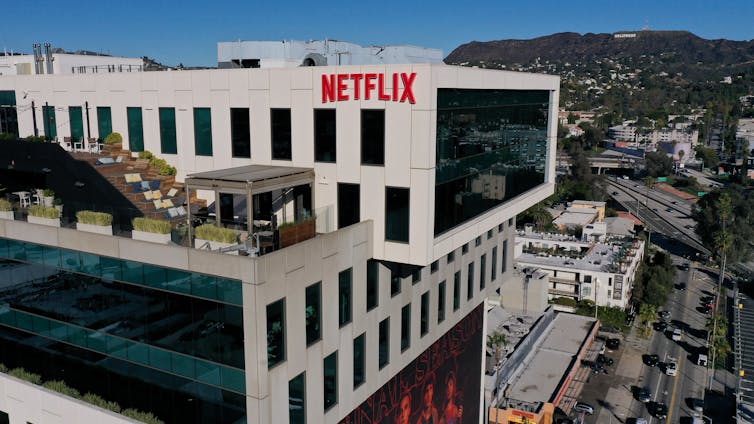
Netflix’s Hollywood studio offices at Sunset Bronson Studios in Los Angeles.
Patrick T. Fallon / AFP via Getty Images

Netflix-Warner deal would drive streaming market further down the road of ‘Big 3’ domination

David R. King, Florida State University

When it comes to major U.S. industries, three tends to be the magic number.

Historically, auto manufacturing was long dominated by Chrysler, Ford and General Motors – the so-called “Big Three,” which at one point controlled over 60% of the U.S. auto market. A dominant trio shows up elsewhere, too, in everything from the U.S. defense market – think Lockheed Martin, Boeing and Northrup Grumman – to cellphone service providers (AT&T, T-Mobile and Verizon). The same goes for the U.S. airline industry in which American, Delta and United fly higher than the rest.

The rule of three also applies to what Americans watch; the glory days of television was dominated by three giants: ABC, CBS and NBC.

Now, in the digital age, we are rapidly moving to a “Big Three” dominating streaming services: Netflix, Amazon and Disney.

The latest step in that process is Netflix’s plan to acquire Warner Bros. for US$72 billion. If approved, the move would solidify Netflix as the dominant streaming platform.

When streams converge

Starting life as a mail DVD subscription service, Netflix moved into streaming movies and TV shows in 2007, becoming a first-mover into the sphere.

Being an early adopter as viewing went from cable and legacy to online and streaming gave Netflix an advantages in also developing support technology and using subscriber data to create new content.

The subsequent impact was Netflix became a market leader, with quarterly profits now far exceeding its competitors, which often report losses.

Today, even without the Warner Bros. acquisition, Netflix has a dominant global base of over 300 million subscribers. Amazon Prime comes second with roughly 220 million subscribers, and Disney – which includes both Disney+ and Hulu – is third, with roughly 196 million subscribers. This means that between them, these three companies already control over 60% of the streaming market.

Netflix’s lead would only be reinforced by the proposed deal with Warner Bros., as it would add ownership of Warner subsidiary HBO Max, which is currently the fourth-biggest streamer in the U.S. with a combined 128 million subscribers. While some of them will overlap, Netflix is likely to still gain subscribers and better retain them with a broader selection of content.

Advertisement
Get More From A Face Cleanser And Spa-like Massage

Netflix’s move to acquire Warner Bros. also follows prior entertainment industry consolidation, driven by a desire to control content to retain streaming service subscribers.

In 2019, Disney acquired 21st Century Fox for $71.3 billion. Three years later, Amazon acquired Metro-Goldwyn-Mayer for $8.5 billion.

Should the Netflix deal go through, it would continue this trend of streaming consolidation. It would also leave a clear gap at the top between the emerging Big Three and other services, such as Paramount+ with 79 million subscribers and Apple TV+, which has around 45 million. Paramount on Dec. 8, 2025, announced a hostile takeover bid for Warner Bros. in a proposed $108.4 billion deal that would, unlike the Netflix plan, include Warner Bros. subsidiary Discovery+.

Why industries come in threes

But why do industries converge to a handful of companies?

As an expert on mergers, I know the answer comes down to market forces relating to competition, which tends to drive consolidation of an industry into three to five firms.

From a customer perspective, there is a need for multiple options. Having more than one option avoids monopolistic practices that can see prices fixed at a higher rate. Competition between more than one big player is also a strong incentive for additional innovation to improve a product or service.

For these reasons, governments – in the U.S. and over 100 other countries – have antitrust laws and practices to avoid any industry displaying limited competition.

However, as industries become more stable, growth tends to slow and remaining businesses are forced to compete over a largely fixed market. This can separate companies into industry leaders and laggards. While leaders enjoy greater stability and predictable profits, laggards struggle to remain profitable.

Lagging companies often combine to increase their market share and reduce costs.

Advertisement
Get More From A Face Cleanser And Spa-like Massage

The result is that consolidating industries quite often land on three main players as a source of stability – one or two risks falling into the pitfalls of monopolies and duopolies, while many more than three to five can struggle to be profitable in mature industries.

What’s ahead for the laggards

The long-term viability of companies outside the “Big Three” streamers is in doubt, as the main players get bigger and smaller companies are unable to offer as much content.

A temporary solution for smaller streamers to gain subscribers is to offer teaser rates that later increase for people that forget to cancel until companies take more permanent steps. But lagging services will also face increased pressure to exit streaming by licensing content to the leading streaming services, cease operations or sell their services and content.

Additionally, companies outside the Big Three could be tempted to acquire smaller services in an attempt to maintain market share.

There are already rumors that Paramount, which is a competing bidder for Warner Bros., may seek to acquire Starz or create a joint venture with Universal, which owns Peacock.

Apple shows no immediate plan of discontinuing Apple TV+, but that may be due to the company’s high profitability and an overall cash flow that limits pressures to end its streaming service.

Still, if the Netflix-Warner Bros. deal completes, it will likely increase the valuation of other lagging streaming services due to increased scarcity of valuable content and subscribers. This is due to competitive limits that restrict the Big Three from getting bigger, making the combination of smaller streaming services more valuable.

This is reinforced by shareholders expecting similar or greater premiums from prior deals, driving the need to pay higher prices for the fewer remaining available assets.

The cost to consumers

So what does this all mean for consumers?

I believe that in general, consumers will largely not be impacted when it comes to the overall cost of entertainment, as inflationary pressures for food and housing limit available income for streaming services.

Advertisement
Get More From A Face Cleanser And Spa-like Massage

But where they access content will continue to shift away from cable television and movie theaters.

Greater stability in the streaming industry through consolidation into a Big Three model only confirms the decline in traditional cable.

Netflix’s rationale in acquiring Warner Bros. is likely to enable it to offer streaming at a lower price than the combined price of separate subscriptions, but more than Netflix alone.

This could be achieved through additional subscription tiers for Netflix subscribers wanting to add HBO Max content. Beyond competition with other members of the “Big Three,” another reason why Netflix is unlikely to raise prices significantly is that it will likely commit to not doing so in order to get the merger approved.

Netflix’s goal is to ensure it remains consumer’s first choice for streaming TV and films. So while streaming is fast becoming a Big Three industry, Netflix’s plan is to remain at the top of the triangle.

This article was updated on Dec. 8, 2025, with news of Paramount’s hostile bid.

David R. King, Higdon Professor of Management, Florida State University

This article is republished from The Conversation under a Creative Commons license. Read the original article.

Want more stories 👋
“Your morning jolt of Inspiring & Interesting Stories!”

Sign up to receive awesome articles directly to your inbox.

STM Coffee Newsletter 1

We don’t spam! Read our privacy policy for more info.

Advertisement
Get More From A Face Cleanser And Spa-like Massage

Discover more from Daily News

Subscribe to get the latest posts sent to your email.

Continue Reading
Advertisement Sports Research
Click to comment

Leave a Reply

Your email address will not be published. Required fields are marked *

Entertainment

The dystopian Pottersville in ‘It’s a Wonderful Life’ is starting to feel less like fiction

A fresh look at It’s a Wonderful Life through the film’s darkest detour—Pottersville—and why its greed, corruption, and desensitization to cruelty feels uncomfortably familiar in America today.

Published

on

file 20251209 56 ruqe19.png?ixlib=rb 4.1
To many Americans, George Bailey’s dystopian nightmare is disquietingly familiar. Paramount

The dystopian Pottersville in ‘It’s a Wonderful Life’ is starting to feel less like fiction

Nora Gilbert, University of North Texas Along with millions of others, I’ll soon be taking 2 hours and 10 minutes out of my busy holiday schedule to sit down and watch a movie I’ve seen countless times before: Frank Capra’sIt’s a Wonderful Life,” which tells the story of a man’s existential crisis one Christmas Eve in the fictional town of Bedford Falls. There are lots of reasons why this eight-decade-old film still resonates, from its nostalgic pleasures to its cultural critiques. But when I watch it this year, the sequence where Bedford Falls transforms into the dark and dystopian “Pottersville” will resonate the most. In the film, protagonist George Bailey, who’s played by Jimmy Stewart, is on the brink of suicide. He seems to have achieved the hallmarks of the American dream: He’s taken over his father’s loan business, married the love of his life and fathered four excessively adorable children. But George feels stifled and beaten down. His Uncle Billy has misplaced US$8,000 of the company’s money, and the town’s resident tyrant, Mr. Potter, is using the mishap to try to ruin George, who’s his last remaining business competitor. An angel named Clarence is tasked with pulling George back from the brink. To stop him from attempting suicide, Clarence decides to show George what life would have been like if he’d never been born. In this alternate reality, Bedford Falls is called Pottersville, a place Mr. Potter runs as a ruthless banker and slumlord.
Movie still of young man walking through a dark, snowy town and passing by a bright sign reading 'Pottersville.'
Pottersville, the dark, dystopian version of Bedford Falls, is a place characterized by vice and moral decay. Paramount
Having previously written about “It’s a Wonderful Life” in my book on literary and film censorship, I can’t help but see parallels between Pottersville and the U.S. today. Think about it: In Pottersville, one man hoards all the financial profits and political power. In Pottersville, greed, corruption and cynicism reign supreme. In Pottersville, hard-working immigrants like Giuseppe Martini who were able to build a life and run a business in Bedford Falls have vanished. In Pottersville, homeless addicts like Mr. Gower and nonconformist “pixies” like Clarence are scorned and ostracized, then booted out of the local watering hole. In Pottersville, cops arrest people like Violet Bick while they’re at work and haul them away, kicking and screaming.
Black-and-white movie still of a young women being dragged away by the police as a worried young man looks on.
Violet Bick gets dragged away by the Pottersville police as George looks on. Paramount
But what horrifies George the most about Pottersville is how desensitized the people living in it seem to be to its harshness and cruelty – how they treat him like he’s the crazy, deranged one for wanting and expecting things to be different and better. This is what the current political moment feels like to me. There are days when the latest headlines feel so jarringly unprecedented that I find myself thinking, “Can this be happening? Can this be real?” If you think these comparisons are a bit of a stretch, consider when “It’s a Wonderful Life” was made, and the frame of mind Capra was in when he made it.

Frank Capra, anti-fascist

In 1946, Capra was just returning to Hollywood filmmaking after serving for four years in the U.S. Army, where the Office of War Information had tasked him with producing a series of documentary films about World War II and the lead-up to it. Even though Capra hadn’t been on the front lines, he’d been immersed in the sounds and images of war for years on end, and he had become acutely familiar with Germany, Italy and Japan’s respective rises to fascism.
Young man posing and smiling while wearing a military uniform.
Frank Capra served in the U.S. Army during World War II. Keystone/Hulton Archive via Getty Images
When deciding on his first postwar film, Capra recalled in his autobiography that he specifically “knew one thing – it would not be about war.” Instead, he chose to adapt a short story by Philip Van Doren Stern, “The Greatest Gift,” that Stern had originally sent to friends and family as a Christmas card in 1943. Stern’s story is certainly not about war. But it’s not exactly about Christmas, either. As Stern writes in his opening lines:
“The little town straggling up the hill was bright with colored Christmas lights. But George Pratt did not see them. He was leaning over the railing of the iron bridge, staring down moodily at the black water.”
The protagonist contemplates suicide because he’s “sick of everything” in the small-town “mudhole” he’s stuck in – until, that is, a “strange little man” gives him the chance to see what life would be like if he’d never been born. It was Capra and his team of screenwriters who added the sinister Henry F. Potter to Stern’s short, simple tale. The Potter subplot encapsulates the film’s most trenchant, still-resonant themes: the unfairness of socioeconomic injustices; the pervasiveness of corporate and political corruption; the threat of monopolized power; the need for affordable housing. These themes had, of course, run through many of Capra’s prewar films as well: “Mr. Deeds Goes to Town,” “You Can’t Take It with You,” “Meet John Doe” and “Mr. Smith Goes to Washington,” the last of which also starred Jimmy Stewart. But they take on a different kind of weight in “It’s a Wonderful Life” – a weight that’s especially visible on the weathered face of Stewart, who himself had just returned from a harrowing four-year tour of duty as a bomber pilot in Europe. The idealistic vigor with which Stewart had fought crooked politicians and oligarchs as Mr. Smith is replaced by the bitterness, exhaustion, frustration and desperation with which he battles against Mr. Potter as George Bailey.
Black-and-white movie still of a distraught man with snow on his jacket.
George Bailey feels helpless in the face of corruption and cruelty. Paramount

Life after Pottersville

By the time George has begged and pleaded his way out of Pottersville, the lost $8,000 is no longer top of mind. He’s mainly just relieved to find Bedford Falls as he had left it, warts and all. And yet, the Bedford Falls that George returns to isn’t quite the same as the one he left behind. In this Bedford Falls, the community rallies together to figure out a way to recoup George’s missing money. Their pre-digital version of a GoFundMe page saves George from what he’d feared most: bankruptcy, scandal and prison. And even though his wife, Mary, tries to attribute this sudden wave of collectivist, activist energy to some sort of divine intervention – “George, it’s a miracle; it’s a miracle!” – Uncle Billy points out that it really came about through more earthly organizing means: “Mary did it, George; Mary did it! She told some people you were in trouble, and they scattered all over town collecting money!”
A group of smiling people dump a large basket of cash on a desk.
The residents of Bedford Falls come together to save George from financial ruin. Paramount
But the question of whether George actually wins his battle against Potter is a murky one. While the typical Capra protagonist triumphs by defeating vice and exposing subterfuge, George never even realizes that Potter is the one who got hold of his money and tried to ruin his life. Potter is never held accountable for his crimes. On the other hand, George is able to learn, from his time in Pottersville, what a crucial role he plays in his community. George’s victory over Potter, then, lies not in some grand final act of retribution, but in the incremental ways he has stood up to Potter throughout his life: not capitulating to Potter’s bullying or intimidation tactics; speaking truth to power; and running a community-centered business rather than one guided by greed and exploitation. In recent months, there have been similar acts of protest, large and small, in the form of rallies, boycotts, immigrant aid efforts, subscription cancellations, food bank donations and more. That doesn’t mean the U.S. has made it out of Pottersville, however. Each day, more head-spinning headlines appear, whether they’re about masked agents terrorizing immigrant communities, the dismantling of anti-corruption oversights, the consolidation of executive power or the naked display of political grift. Zuzu’s petals are still missing. Clarence still hasn’t gotten his wings. But this holiday season, I’m hoping it will feel helpfully cathartic to go with George Bailey, for the umpteenth time, through the dark abyss of his dystopian nightmare – and come out with him, stronger and wiser, on the other side. Nora Gilbert, Professor of Literary and Film Studies, University of North Texas This article is republished from The Conversation under a Creative Commons license. Read the original article.
Dreambreaker: A Pickleball Story — A Closer Look at the Documentary and Its Uncredited Voice
Link: https://stmdailynews.com/dreambreaker-a-pickleball-story-a-closer-look-at-the-documentary-and-its-uncredited-voice/

Discover more from Daily News

Subscribe to get the latest posts sent to your email.

Continue Reading

Entertainment

Bad Bunny Set to Make History at Apple Music Super Bowl LX Halftime Show

Bad Bunny will headline the Apple Music Super Bowl LX Halftime Show on February 8, 2026, at Levi’s Stadium, marking a historic moment for Latin music. Industry leaders praise his cultural impact and global influence. The event promises to deliver an unforgettable performance, celebrating Bad Bunny’s significance in today’s music scene.

Published

on

Last Updated on January 2, 2026 by Daily News Staff

Global superstar will take center stage at Levi’s Stadium in February 2026

Bad Bunny
Global Sensation Bad Bunny to Perform at Apple Music Super Bowl LX Halftime Show

The NFL, Apple Music, and Roc Nation dropped major news this week that’s sending shockwaves through the music and sports worlds: three-time GRAMMY® Award-winning artist Bad Bunny will headline the Apple Music Super Bowl LX Halftime Show on February 8, 2026, at Levi’s Stadium in Santa Clara, California.

A Historic Moment for Latin Music

For Bad Bunny, this isn’t just another performance—it’s a cultural milestone. The Puerto Rican sensation expressed the profound significance of this opportunity in his own words:

“What I’m feeling goes beyond myself. It’s for those who came before me and ran countless yards so I could come in and score a touchdown… this is for my people, my culture, and our history. Ve y dile a tu abuela, que seremos el HALFTIME SHOW DEL SUPER BOWL.”

The announcement represents a watershed moment for Latin music on the world’s biggest stage, with Bad Bunny becoming one of the first Latin artists to solo headline the Super Bowl Halftime Show.

Industry Leaders Weigh In

Shawn “JAY-Z” Carter, whose Roc Nation serves as strategic entertainment advisor for the performance, praised Bad Bunny’s impact: “What Benito has done and continues to do for Puerto Rico is truly inspiring. We are honored to have him on the world’s biggest stage.”

Jon Barker, the NFL’s SVP of Global Event Production, highlighted why Bad Bunny is the perfect fit for this moment: “Bad Bunny represents the global energy and cultural vibrancy that define today’s music scene. As one of the most influential and streamed artists in the world, his unique ability to bridge genres, languages, and audiences makes him an exciting and natural choice.”

Oliver Schusser, Apple’s Vice President of Music, Sports and Beats, emphasized the artist’s cultural impact: “Few artists embody that intersection [of music and culture] more perfectly and authentically than Bad Bunny. His music has not only broken records but has elevated Latin music to the center of pop-culture.”

Tune In to the Special Announcement

Apple Music Radio is celebrating the news with a special Halftime Headliner broadcast featuring Zane Lowe, Ebro Darden, and surprise guests. The show aired Monday, September 29th at 9:30am ET across Apple Music Radio platforms.

What to Expect

The Apple Music Super Bowl LX Halftime Show will be produced by DPS, with Roc Nation and Jesse Collins serving as executive producers and Hamish Hamilton directing. The performance will air on NBC during Super Bowl LX, bringing Bad Bunny’s explosive stage presence and genre-defying music to an audience of millions.

Advertisement
Get More From A Face Cleanser And Spa-like Massage

A Winning Tradition

The Apple Music Super Bowl Halftime Show has become synonymous with excellence, racking up multiple Emmy wins in recent years. The Apple Music Super Bowl LIX Halftime Show starring Kendrick Lamar became the most-watched Super Bowl Halftime Show ever, earning four Emmy nominations and winning Outstanding Music Direction. Previous shows featuring Usher, Rihanna, and the legendary lineup of Dr. Dre, Snoop Dogg, Eminem, Mary J. Blige, and Kendrick Lamar have collectively earned dozens of nominations and awards.

With Bad Bunny’s proven track record of delivering unforgettable performances and his massive global fanbase, the Apple Music Super Bowl LX Halftime Show is shaping up to be one of the most anticipated musical events of 2026.

Mark your calendars for February 8, 2026—this is one performance you won’t want to miss.


What are your thoughts on Bad Bunny headlining the Super Bowl? Will you be tuning in? Let us know in the comments below, and follow Apple Music on social media for more updates as we get closer to game day.

Related Links

Official Announcements & Streaming:

Follow the Conversation:

More Super Bowl Halftime Content:

Explore Bad Bunny:

Looking for an entertainment experience that transcends the ordinary? Look no further than STM Daily News Blog’s vibrant Entertainment section. Immerse yourself in the captivating world of indie films, streaming and podcasts, movie reviews, music, expos, venues, and theme and amusement parks. Discover hidden cinematic gems, binge-worthy series and addictive podcasts, gain insights into the latest releases with our movie reviews, explore the latest trends in music, dive into the vibrant atmosphere of expos, and embark on thrilling adventures in breathtaking venues and theme parks. Join us at STM Entertainment and let your entertainment journey begin! https://stmdailynews.com/category/entertainment/

and let your entertainment journey begin!


Discover more from Daily News

Subscribe to get the latest posts sent to your email.

Continue Reading

holidays

Festivus: A Hilariously Unconventional Holiday

Festivus: The hilariously unconventional holiday that originated in Seinfeld, gaining popularity for its quirky traditions and anti-Christmas spirit.

Published

on

Festivus

Welcome, my fellow merrymakers, to the wacky wonderland of Festivus! This offbeat holiday originated in the sitcom Seinfeld, and boy, did it strike a chord with the anti-Christmas crowd.

Picture this: it’s December 23rd, and instead of decking the halls with boughs of holly, you’re airing your grievances with Uncle Bob’s questionable fashion choices. Festivus encourages us to unleash our inner grumps, letting loose a torrent of complaints that would make even the Grinch proud.


The Story Of Festivus | Seinfeld


But wait, there’s more! Prepare for the “Feats of Strength,” where you can prove your dominance in a wrestling match against Aunt Mildred. Who knew family gatherings could double as a WWE smackdown?

Despite its fictional origins, Festivus has somehow clawed its way into reality, gaining a cult following of merry misfits. In a world of reindeer sweaters and fruitcake disasters, this holiday offers a refreshing alternative—no tree decorating, no excessive gift-giving, just pure, unadulterated weirdness.

So, this December 23rd, don your Festivus pole, gather your loved ones, and let the grievances flow like a broken faucet. Embrace the absurdity, revel in the laughter, and remember: Festivus isn’t just a holiday; it’s a state of mind. Happy Festivus, you magnificent oddballs!

Author


Discover more from Daily News

Subscribe to get the latest posts sent to your email.

Continue Reading

Trending


