Connect with us

Space and Tech

Office of Space Commerce faces an uncertain future amid budget cuts and new oversight

Published

on

Space
The OSC advocates for commercial activities in space, including commercial satellite launches. AP Photo/John Raoux

Michael Liemohn, University of Michigan

When I imagine the future of space commerce, the first image that comes to mind is a farmer’s market on the International Space Station. This doesn’t exist yet, but space commerce is a growing industry. The Space Foundation, a nonprofit organization for education and advocacy of space, estimates that the global space economy rose to US$613 billion in 2024, up nearly 8% from 2023, and 250 times larger than all business at farmer’s markets in the United States. This number includes launch vehicles, satellite hardware, and services provided by these space-based assets, such as satellite phone or internet connection.

Companies involved in spaceflight have been around since the start of the Space Age. By the 1980s, corporate space activity was gaining traction. President Ronald Reagan saw the need for a federal agency to oversee and guide this industry and created the Office of Space Commerce, or OSC.

The logo of the OSC, which is circular and has three stars and nine black and white stripes.
The Office of Space Commerce is under the National Oceanic and Atmospheric Administration. Office of Space Commerce − National Oceanic and Atmospheric Administration

So, what exactly does this office do and why is it important?

As a space scientist, I am interested in how the U.S. regulates commercial activities in space. In addition, I teach a course on space policy. In class, we talk about the OSC and its role in the wider regulatory landscape affecting commercial use of outer space.

The OSC’s focus areas

The Office of Space Commerce, an office of about 50 people, exists within the Department of Commerce’s National Oceanic and Atmospheric Administration. To paraphrase its mission statement, its chief purpose is to enable a robust U.S. commercial interest in outer space.

OSC has three main focus areas. First, it is the office responsible for licensing and monitoring how private U.S. companies collect and distribute orbit-based images of Earth. There are many companies launching satellites with special cameras to look back down at the Earth these days. Companies offer a variety of data products and services from such imagery – for instance, to improve agricultural land use.

A second primary job of OSC is space advocacy. OSC works with the other U.S. government agencies that also have jurisdiction over commercial use of outer space to make the regulatory environment easier. This includes working with the Federal Aviation Administration on launch licensing, the Federal Communications Commission on radio wavelength usage and the Environmental Protection Agency on rules about the hazardous chemicals in rocket fuel.

This job also includes coordinating with other countries that allow companies to launch satellites, collect data in orbit and offer space-based services.

In 2024, for example, the OSC helped revise the U.S. Export Administration Regulations, one of the main documents restricting the shipping of advanced technologies out of the country. This change removed some limitations, allowing American companies to export certain types of spacecraft to three countries: Australia, Canada and the United Kingdom.

The OSC also coordinates commercial satellites’ flight paths in near-Earth space, which is its third and largest function. The Department of Defense keeps track of thousands of objects in outer space and issues alerts when the probability of a collision gets high. In 2018, President Donald Trump issued Space Policy Directive-3, which included tasking OSC to take this role over for nongovernment satellites – that is, those owned by companies, not NASA or the military. The Department od Defense wants out of the job of traffic management involving privately owned satellites, and Trump’s directive in 2018 started the process of handing off this task to OSC.

A rocket launching from a structure, with a plume of smoke beneath it.
When companies launch satellites into orbit, as on this SpaceX Falcon 9 rocket, the OSC helps manage the satellites’ flight paths in orbit to avoid collisions. AP Photo/John Raoux

To prevent satellites from colliding, OSC has been developing the traffic coordination system for space, known as TraCSS. It went into beta testing in 2024 and has some of the companies with the largest commercial constellations – such as SpaceX’s Starlink – participating. Progress on this has been slower than anticipated, though, and an audit in 2024 revealed that the plan is way behind schedule and perhaps still years away.

Elevating OSC

Deep in the text of Trump’s Aug. 13, 2025, executive order called Enabling Competition in the Commercial Space Industry, there’s a directive to elevate OSC to report directly to the office of the secretary of commerce. This would make OSC equivalent to its current overseer, NOAA, with respect to importance and priority within the Department of Commerce. It would give OSC higher stature in setting more of the rules regarding commercial use of space, and it would make space commerce more visible across the broader economy.

Advertisement
Get More From A Face Cleanser And Spa-like Massage

So, why did Trump include this line about elevating OSC in his Aug. 13 executive order?

An astronaut pointing a camera out a circular window in the International Space Station at a
European Space Agency astronaut Alexander Gerst, Expedition 41 flight engineer, uses a still camera at a window in the cupola of the International Space Station as the SpaceX Dragon commercial cargo craft approaches the station on Sept. 23, 2014. Alex Gerst/Johnson Space Center

Back in 2018, Trump issued Space Policy Directive-2 during his first term, which included a task to create the Space Policy Advancing Commerce Enterprise Administration, or SPACE. SPACE would have been an entity reporting directly to the secretary of commerce. While it was proposed as a bill in the House of Representatives later that year, it never became law.

The Aug. 13 executive order essentially directs the Department of Commerce to make this move now. Should the secretary of commerce enact the order, it would bypass the role of Congress in promoting OSC. The 60-day window that Trump placed in the executive order for making this change has closed, but with the government shutdown it is unclear whether the elevation of OSC might still occur.

Troubles for OSC

While all of this sounds good for promoting space as a place for commercial activity, OSC has been under stress in 2025. In February, the Department of Government Efficiency targeted NOAA for cuts, including firing eight people from OSC. Because about half of the people working in OSC are contractors, this represented a 30% reduction of force.

The dome of the Congress building in the dark.
Many space industry professionals have urged Congress to restore funding to the OSC, but its future remains uncertain. AP Photo/J. Scott Applewhite

In March, Trump’s presidential budget request for the 2026 fiscal year proposed a cut of 85% of the $65 million annual budget of OSC. In July, space industry leaders urged Congress to restore funding to OSC.

The Aug. 13 executive order appeared to be good news for OSC. On Sept. 9, however, Bloomberg reported that the Department of Commerce requested a 40% rescission to OSC’s fiscal year 2025 budget.

Rescissions are “clawbacks” of funds already approved and appropriated by Congress. The promised funding is essentially put on hold. Once proposed by the president, rescissions have to be voted on by both chambers of Congress to be enacted. This must occur within 45 days, or before the end of the fiscal year, which was Sept. 30.

This rescission request came so close to that deadline that Congress did not act to stop it. As a result, OSC lost this funding. The loss could mean additional cutbacks to staff and perhaps even a shrinking of its focus areas.

Will OSC be elevated? Will OSC be restructured or even dismantled? The future is still uncertain for this office.

Michael Liemohn, Professor of Climate and Space Sciences and Engineering, University of Michigan

This article is republished from The Conversation under a Creative Commons license. Read the original article.

https://stmdailynews.com/sinking-cities-why-parts-of-phoenix-and-much-of-urban-america-are-slowly-dropping/

Advertisement
Get More From A Face Cleanser And Spa-like Massage

Discover more from Daily News

Subscribe to get the latest posts sent to your email.

Continue Reading
Advertisement SodaStream USA, inc
Click to comment
0 0 votes
Article Rating
Subscribe
Notify of
guest

0 Comments
Oldest
Newest Most Voted
Inline Feedbacks
View all comments

Space and Tech

Blue Origin’s New Glenn rocket landed its booster on a barge at sea – an achievement that will broaden the commercial spaceflight market

Blue Origin’s New Glenn rocket successfully landed its booster at sea on only its second launch, marking a major milestone for commercial spaceflight. Learn how this achievement reduces launch costs and creates real competition for SpaceX.

Published

on

file 20251114 56 9a7x2v.jpg?ixlib=rb 4.1
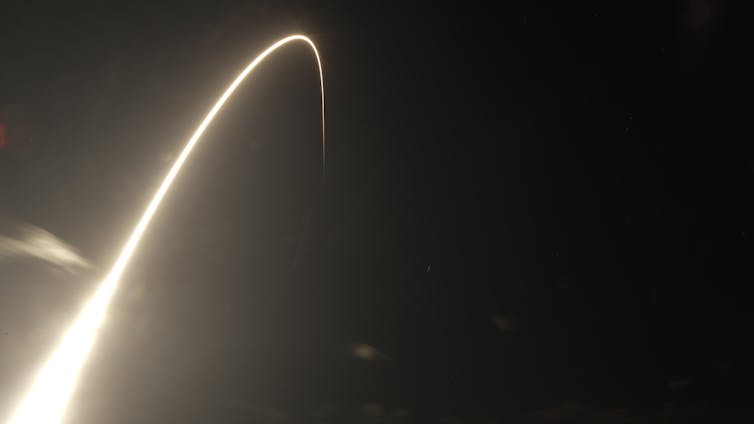
Blue Origin’s New Glenn rocket lifted off for its second orbital flight on Nov. 13, 2025. AP Photo/John Raoux

Blue Origin’s New Glenn rocket landed its booster on a barge at sea – an achievement that will broaden the commercial spaceflight market

Wendy Whitman Cobb, Air University Blue Origin’s New Glenn rocket successfully made its way to orbit for the second time on Nov. 13, 2025. Although the second launch is never as flashy as the first, this mission is still significant in several ways. For one, it launched a pair of NASA spacecraft named ESCAPADE, which are headed to Mars orbit to study that planet’s magnetic environment and atmosphere. The twin spacecraft will first travel to a Lagrange point, a place where the gravity between Earth, the Moon and the Sun balances. The ESCAPADE spacecraft will remain there until Mars is in better alignment to travel to. And two, importantly for Blue Origin, New Glenn’s first stage booster successfully returned to Earth and landed on a barge at sea. This landing allows the booster to be reused, substantially reducing the cost to get to space.
Blue Origin launched its New Glenn rocket and landed the booster on a barge at sea on Nov. 13, 2025.
As a space policy expert, I see this launch as a positive development for the commercial space industry. Even though SpaceX has pioneered this form of launch and reuse, New Glenn’s capabilities are just as important.

New Glenn in context

Although Blue Origin would seem to be following in SpaceX’s footsteps with New Glenn, there are significant differences between the two companies and their rockets. For most launches today, the rocket consists of several parts. The first stage helps propel the rocket and its spacecraft toward space and then drops away when its fuel is used up. A second stage then takes over, propelling the payload all the way to orbit. While both New Glenn and Falcon Heavy, SpaceX’s most powerful rocket currently available, are partially reusable, New Glenn is taller, more powerful and can carry a greater amount of payload to orbit. Blue Origin plans to use New Glenn for a variety of missions for customers such as NASA, Amazon and others. These will include missions to Earth’s orbit and eventually to the Moon to support Blue Origin’s own lunar and space exploration goals, as well as NASA’s. NASA’s Artemis program, which endeavors to return humans to the Moon, is where New Glenn may become important. In the past several months, several space policy leaders, as well as NASA officials, have expressed concern that Artemis is progressing too slowly. If Artemis stagnates, China may have the opportunity to leap ahead and beat NASA and its partners to the lunar south pole. These concerns stem from problems with two rockets that could potentially bring Americans back to the Moon: the space launch system and SpaceX’s Starship. NASA’s space launch system, which will launch astronauts on its Orion crew vehicle, has been criticized as too complex and costly. SpaceX’s Starship is important because NASA plans to use it to land humans on the Moon during the Artemis III mission. But its development has been much slower than anticipated. In response, Blue Origin has detailed some of its lunar exploration plans. They will begin with the launch of its uncrewed lunar lander, Blue Moon, early next year. The company is also developing a crewed version of Blue Moon that it will use on the Artemis V mission, the planned third lunar landing of humans. Blue Origin officials have said they are in discussions with NASA over how they might help accelerate the Artemis program.

New Glenn’s significance

New Glenn’s booster landing makes this most recent launch quite significant for the company. While it took SpaceX several tries to land its first booster, Blue Origin has achieved this feat on only the second try. Landing the boosters – and, more importantly, reusing them – has been key to reducing the cost to get to space for SpaceX, as well as others such as Rocket Lab. That two commercial space companies now have orbital rockets that can be partially reused shows that SpaceX’s success was no fluke. With this accomplishment, Blue Origin has been able to build on its previous experience and success with its suborbital rocket, New Shepard. Launching from Blue Origin facilities in Texas since 2015, New Shepard has taken people and cargo to the edge of space, before returning to its launch site under its own power.
A short, wide rocket lifts off from a launchpad.
Blue Origin’s suborbital rocket, New Shepard. Joe Raedle/Getty Images
New Glenn is also significant for the larger commercial space industry and U.S. space capabilities. It represents real competition for SpaceX, especially its Starship rocket. It also provides more launch options for NASA, the U.S. government and other commercial customers, reducing reliance on SpaceX or any other launch company. In the meantime, Blue Origin is looking to build on the success of New Glenn’s launch and its booster landing. New Glenn will next launch Blue Origin’s Blue Moon uncrewed lander in early 2026. This second successful New Glenn launch will also contribute to the rocket’s certification for national security space launches. This accomplishment will allow the company to compete for contracts to launch sensitive reconnaissance and defense satellites for the U.S. government. Blue Origin will also need to increase its number of launches and reduce the time between them to compete with SpaceX. SpaceX is on pace for between 165 and 170 launches in 2025 alone. While Blue Origin may not be able to achieve that remarkable cadence, to truly build on New Glenn’s success it will need to show it can scale up its launch operations. Wendy Whitman Cobb, Professor of Strategy and Security Studies, Air University This article is republished from The Conversation under a Creative Commons license. Read the original article.

Author

View recent photos

Unlock fun facts & lost history—get The Knowledge in your inbox!

We don’t spam! Read our privacy policy for more info.


Discover more from Daily News

Subscribe to get the latest posts sent to your email.

Continue Reading

Space and Tech

AI Spacecraft Propulsion: Machine Learning’s Role in Space Travel

AI Spacecraft Propulsion: Discover how AI and machine learning are transforming spacecraft propulsion systems, from nuclear thermal engines to fusion technology, making interplanetary travel faster and more efficient.

Published

on

AI Spacecraft Propulsion: Machine Learning's Role in Space Travel
Propulsion technology helps rockets get off the ground. Joel Kowsky/NASA via AP

AI Spacecraft Propulsion: Machine Learning’s Role in Space Travel

Marcos Fernandez Tous, University of North Dakota; Preeti Nair, University of North Dakota; Sai Susmitha Guddanti, University of North Dakota, and Sreejith Vidhyadharan Nair, University of North Dakota Every year, companies and space agencies launch hundreds of rockets into space – and that number is set to grow dramatically with ambitious missions to the Moon, Mars and beyond. But these dreams hinge on one critical challenge: propulsion – the methods used to push rockets and spacecraft forward. To make interplanetary travel faster, safer and more efficient, scientists need breakthroughs in propulsion technology. Artificial intelligence is one type of technology that has begun to provide some of these necessary breakthroughs. We’re a team of engineers and graduate students who are studying how AI in general, and a subset of AI called machine learning in particular, can transform spacecraft propulsion. From optimizing nuclear thermal engines to managing complex plasma confinement in fusion systems, AI is reshaping propulsion design and operations. It is quickly becoming an indispensable partner in humankind’s journey to the stars.

Machine learning and reinforcement learning

Machine learning is a branch of AI that identifies patterns in data that it has not explicitly been trained on. It is a vast field with its own branches, with a lot of applications. Each branch emulates intelligence in different ways: by recognizing patterns, parsing and generating language, or learning from experience. This last subset in particular, commonly known as reinforcement learning, teaches machines to perform their tasks by rating their performance, enabling them to continuously improve through experience. As a simple example, imagine a chess player. The player does not calculate every move but rather recognizes patterns from playing a thousand matches. Reinforcement learning creates similar intuitive expertise in machines and systems, but at a computational speed and scale impossible for humans. It learns through experiences and iterations by observing its environment. These observations allows the machine to correctly interpret each outcome and deploy the best strategies for the system to reach its goal. Reinforcement learning can improve human understanding of deeply complex systems – those that challenge the limits of human intuition. It can help determine the most efficient trajectory for a spacecraft heading anywhere in space, and it does so by optimizing the propulsion necessary to send the craft there. It can also potentially design better propulsion systems, from selecting the best materials to coming up with configurations that transfer heat between parts in the engine more efficiently.
In reinforcement learning, you can train an AI model to complete tasks that are too complex for humans to complete themselves.

Reinforcement learning for propulsion systems

In regard to space propulsion, reinforcement learning generally falls into two categories: those that assist during the design phase – when engineers define mission needs and system capabilities – and those that support real-time operation once the spacecraft is in flight. Among the most exotic and promising propulsion concepts is nuclear propulsion, which harnesses the same forces that power atomic bombs and fuel the Sun: nuclear fission and nuclear fusion. Fission works by splitting heavy atoms such as uranium or plutonium to release energy – a principle used in most terrestrial nuclear reactors. Fusion, on the other hand, merges lighter atoms such as hydrogen to produce even more energy, though it requires far more extreme conditions to initiate.
An infographic showing 'fission' on the left, with an atom breaking into two smaller ones and releasing energy. The right shows 'fusion' with two atoms combining together and releasing energy.
Fission splits atoms, while fusion combines atoms. Sarah Harman/U.S. Department of Energy
Fission is a more mature technology that has been tested in some space propulsion prototypes. It has even been used in space in the form of radioisotope thermoelectric generators, like those that powered the Voyager probes. But fusion remains a tantalizing frontier. Nuclear thermal propulsion could one day take spacecraft to Mars and beyond at a lower cost than that of simply burning fuel. It would get a craft there faster than electric propulsion, which uses a heated gas made of charged particles called plasma. Unlike these systems, nuclear propulsion relies on heat generated from atomic reactions. That heat is transferred to a propellant, typically hydrogen, which expands and exits through a nozzle to produce thrust and shoot the craft forward. So how can reinforcement learning help engineers develop and operate these powerful technologies? Let’s begin with design.
A circular metal container with a glowing cylinder inside.
The nuclear heat source for the Mars Curiosity rover, part of a radioisotope thermoelectric generator, is encased in a graphite shell. The fuel glows red hot because of the radioactive decay of plutonium-238. Idaho National Laboratory, CC BY

Reinforcement learning’s role in design

Early nuclear thermal propulsion designs from the 1960s, such as those in NASA’s NERVA program, used solid uranium fuel molded into prism-shaped blocks. Since then, engineers have explored alternative configurations – from beds of ceramic pebbles to grooved rings with intricate channels.
A black and white photo of a large, empty cylindrical structure, with a rocket releasing light in the background.
The first nuclear thermal rocket was built in 1967 and is seen in the background. In the foreground is the protective casing that would hold the reactor. NASA/Wikipedia
Why has there been so much experimentation? Because the more efficiently a reactor can transfer heat from the fuel to the hydrogen, the more thrust it generates. This area is where reinforcement learning has proved to be essential. Optimizing the geometry and heat flow between fuel and propellant is a complex problem, involving countless variables – from the material properties to the amount of hydrogen that flows across the reactor at any given moment. Reinforcement learning can analyze these design variations and identify configurations that maximize heat transfer. Imagine it as a smart thermostat but for a rocket engine – one you definitely don’t want to stand too close to, given the extreme temperatures involved.

Reinforcement learning and fusion technology

Reinforcement learning also plays a key role in developing nuclear fusion technology. Large-scale experiments such as the JT-60SA tokamak in Japan are pushing the boundaries of fusion energy, but their massive size makes them impractical for spaceflight. That’s why researchers are exploring compact designs such as polywells. These exotic devices look like hollow cubes, about a few inches across, and they confine plasma in magnetic fields to create the conditions necessary for fusion. Controlling magnetic fields within a polywell is no small feat. The magnetic fields must be strong enough to keep hydrogen atoms bouncing around until they fuse – a process that demands immense energy to start but can become self-sustaining once underway. Overcoming this challenge is necessary for scaling this technology for nuclear thermal propulsion.

Reinforcement learning and energy generation

However, reinforcement learning’s role doesn’t end with design. It can help manage fuel consumption – a critical task for missions that must adapt on the fly. In today’s space industry, there’s growing interest in spacecraft that can serve different roles depending on the mission’s needs and how they adapt to priority changes through time. Military applications, for instance, must respond rapidly to shifting geopolitical scenarios. An example of a technology adapted to fast changes is Lockheed Martin’s LM400 satellite, which has varied capabilities such as missile warning or remote sensing. But this flexibility introduces uncertainty. How much fuel will a mission require? And when will it need it? Reinforcement learning can help with these calculations. From bicycles to rockets, learning through experience – whether human or machine – is shaping the future of space exploration. As scientists push the boundaries of propulsion and intelligence, AI is playing a growing role in space travel. It may help scientists explore within and beyond our solar system and open the gates for new discoveries. Marcos Fernandez Tous, Assistant Professor of Space Studies, University of North Dakota; Preeti Nair, Master’s Student in Aerospace Sciences, University of North Dakota; Sai Susmitha Guddanti, Ph.D. Student in Aerospace Sciences, University of North Dakota, and Sreejith Vidhyadharan Nair, Research Assistant Professor of Aviation, University of North Dakota This article is republished from The Conversation under a Creative Commons license. Read the original article.

Dive into “The Knowledge,” where curiosity meets clarity. This playlist, in collaboration with STMDailyNews.com, is designed for viewers who value historical accuracy and insightful learning. Our short videos, ranging from 30 seconds to a minute and a half, make complex subjects easy to grasp in no time. Covering everything from historical events to contemporary processes and entertainment, “The Knowledge” bridges the past with the present. In a world where information is abundant yet often misused, our series aims to guide you through the noise, preserving vital knowledge and truths that shape our lives today. Perfect for curious minds eager to discover the ‘why’ and ‘how’ of everything around us. Subscribe and join in as we explore the facts that matter.  https://stmdailynews.com/the-knowledge/


Discover more from Daily News

Subscribe to get the latest posts sent to your email.

Continue Reading

Space and Tech

New Glenn Launches NASA’s ESCAPADE Mission and Sticks Historic Reusable Booster Landing

Blue Origin’s New Glenn rocket successfully launched NASA’s ESCAPADE mission, deployed twin Mars-bound spacecraft, and achieved a historic reusable booster landing on its second attempt—marking major progress for future lunar, Martian, and national security missions.

Published

on

Last Updated on November 15, 2025 by Daily News Staff

ESCAPADE

Image Credit: Ble Origin

New Glenn Successfully Launches NASA’s ESCAPADE Mission — And Nails a Historic Reusable Booster Landing

In a milestone moment for commercial spaceflight and NASA’s next wave of planetary science missions, Blue Origin’s New Glenn rocket successfully launched the agency’s ESCAPADE mission on Thursday, November 13, 2025. The massive orbital-class booster—powered by seven BE-4 engines—lifted off at 3:55:01 PM EST from Launch Complex 36 at Cape Canaveral Space Force Station and completed every objective of its second mission.

Not only did New Glenn deploy NASA’s twin ESCAPADE spacecraft into their planned loiter orbit, but it also achieved a precision landing of its fully reusable first stage on Jacklyn in the Atlantic Ocean—an unprecedented feat for a booster of this size on its second attempt.

“We achieved full mission success today, and I am so proud of the team,” said Dave Limp, CEO of Blue Origin. “Never before in history has a booster this large nailed the landing on the second try. This is just the beginning as we rapidly scale our flight cadence and continue delivering for our customers.”

ESCAPADE: Preparing for Mars’ Next Close Approach

The ESCAPADE mission—short for Escape and Plasma Acceleration and Dynamics Explorers—consists of two nearly identical spacecraft that will begin their journey to Mars when the planets reach optimal alignment in fall 2026. Their science goal: to understand how the solar wind interacts with Mars’ patchy magnetic field and how this ongoing tug-of-war contributes to the loss of the Martian atmosphere.

By mapping these solar-atmospheric interactions in tandem, ESCAPADE will deepen scientists’ understanding of how Mars transitioned from a warm, water-rich world to the cold desert planet we know today.

The mission also supported another technology milestone: Viasat’s HaloNet demonstration aboard New Glenn’s second stage completed its first telemetry data relay test for NASA’s Communications Services Project—an important step toward next-generation space communications architectures.

NASA Praises the Mission’s Scientific and Operational Impact

NASA’s acting Administrator, Secretary Sean Duffy, highlighted both the scientific significance and the broader implications for future human exploration:

“Congratulations to Blue Origin, Rocket Lab, UC Berkeley, and all of our partners on the successful launch of ESCAPADE. This heliophysics mission will help reveal how Mars became a desert planet, and how solar eruptions affect the Martian surface.”

He also emphasized New Glenn’s growing importance as NASA prepares for its next major programs:

“Every launch of New Glenn provides data that will be essential when we launch MK-1 through Artemis. All of this information will be critical to protect future NASA explorers and invaluable as we evaluate how to deliver on President Trump’s vision of planting the Stars and Stripes on Mars.”

A Cornerstone Vehicle for NASA, Commercial Customers, and National Security

Advertisement
Get More From A Face Cleanser And Spa-like Massage

New Glenn is increasingly positioned as a foundational launch system for government, commercial, and defense customers. The rocket underpins Blue Origin’s long-term plans ranging from sustained human lunar operations to in-space resource utilization and multi-orbit logistics through its Blue Ring spacecraft platform.

The program currently has multiple vehicles in production and a growing multiyear manifest. In addition to NASA and Viasat, future New Glenn customers include:

Amazon’s Project Kuiper AST SpaceMobile Multiple international telecommunications providers

The flight also served as New Glenn’s second certification mission for the National Security Space Launch (NSSL) program, bringing Blue Origin closer to full qualification for U.S. Space Force missions.

Jordan Charles, Vice President of New Glenn, said the company’s focus now turns to rapid reusability and increasing launch tempo:

“Today was a tremendous achievement for the New Glenn team, opening a new era for Blue Origin and the industry as we look to launch, land, repeat, again and again. We’ve made significant progress on manufacturing at rate and building ahead of need.”

A New Era of Heavy-Lift Reusability Begins

Blue Origin’s flawless execution of the ESCAPADE mission—and the successful recovery of its giant reusable booster—signals a major shift in the competitive landscape of heavy-lift launch. As New Glenn scales up its flight cadence, the company is positioning itself as a central player in the future of lunar exploration, Mars science, commercial broadband networks, and national security space.

With New Glenn now demonstrating repeatable performance and reusability, the space industry has officially entered a new chapter—one defined by larger vehicles, more complex missions, and the accelerating normalization of landing, refurbishing, and re-flying orbital-class boosters.

The science section of our news blog STM Daily News provides readers with captivating and up-to-date information on the latest scientific discoveries, breakthroughs, and innovations across various fields. We offer engaging and accessible content, ensuring that readers with different levels of scientific knowledge can stay informed. Whether it’s exploring advancements in medicine, astronomy, technology, or environmental sciences, our science section strives to shed light on the intriguing world of scientific exploration and its profound impact on our daily lives. From thought-provoking articles to informative interviews with experts in the field, STM Daily News Science offers a harmonious blend of factual reporting, analysis, and exploration, making it a go-to source for science enthusiasts and curious minds alike. https://stmdailynews.com/category/science/

Authors

Advertisement
Get More From A Face Cleanser And Spa-like Massage

Discover more from Daily News

Subscribe to get the latest posts sent to your email.

Continue Reading

Trending

0
Would love your thoughts, please comment.x
()
x