Connect with us

STM Blog

Pacific voyagers’ remarkable environmental knowledge allowed for long-distance navigation without Western technology

Published

on

file 20250512 56 8d2602.jpg?ixlib=rb 4.1
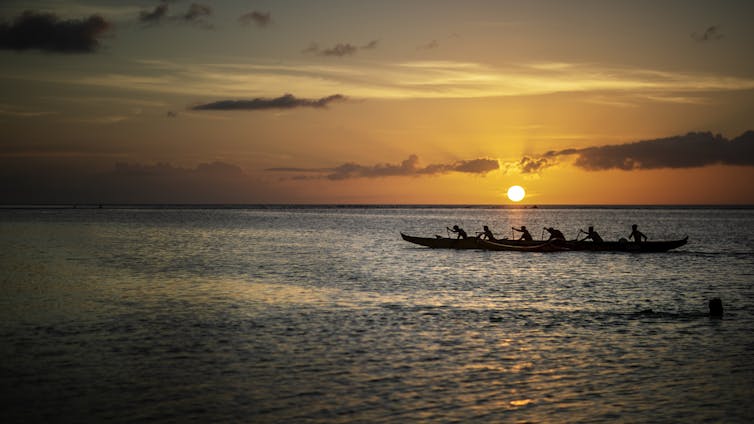
An outrigger canoe would typically have several paddlers and one navigator. AP Photo/David Goldman
Richard (Rick) Feinberg, Kent State University Wet and shivering, I rose from the outrigger of a Polynesian voyaging canoe. We’d been at sea all afternoon and most of the night. I’d hoped to get a little rest, but rain, wind and an absence of flat space made sleep impossible. My companions didn’t even try. It was May 1972, and I was three months into doctoral research on one of the world’s most remote islands. Anuta is the easternmost populated outpost in the Solomon Islands. It is a half-mile in diameter, 75 miles (120 kilometers) from its nearest inhabited neighbor, and remains one of the few communities where inter-island travel in outrigger canoes is regularly practiced.
A documentary team made a recent visit to Anuta.
My hosts organized a bird-hunting expedition to Patutaka, an uninhabited monolith 30 miles away, and invited me to join the team. We spent 20 hours en route to our destination, followed by two days there, and sailed back with a 20-knot tail wind. That adventure led to decades of anthropological research on how Pacific Islanders traverse the open sea aboard small craft, without “modern” instruments, and safely arrive at their intended destinations. Wayfinding techniques vary, depending upon geographic and environmental conditions. Many, however, are widespread. They include mental mapping of the islands in the sailors’ navigational universe and the location of potential destinations in relation to the movement of stars, ocean currents, winds and waves.

Western interest in Pacific voyaging

Disney’s two “Moana” movies have shined a recent spotlight on Polynesian voyaging. European admiration for Pacific mariners, however, dates back centuries. In 1768, the French explorer Louis Antoine de Bougainville named Sāmoa the “Navigators’ Islands.” The famed British sea captain James Cook reported that Indigenous canoes were as fast and agile as his ships. He welcomed Tupaia, a navigational expert from Ra‘iātea, onto his ship and documented Tupaia’s immense geographic knowledge.
Early 1800s lithograph of long canoe with about a dozen people on the ocean with island in background, along with a sailing ship in distance
European explorers were impressed by the navigational skills of the people they encountered in the Pacific islands. Science & Society Picture Library via Getty Images
In 1938, Māori scholar Te Rangi Hīroa (aka Sir Peter Buck) authored “Vikings of the Sunrise,” outlining Pacific exploration as portrayed in Polynesian legend. In 1947, Thor Heyerdahl, a Norwegian explorer and amateur archaeologist, crossed from Peru to the Tuamotu Islands aboard a balsa wood raft that he named Kon-Tiki, sparking further interest and inspiring a sequence of experimental voyages. Ten years later Andrew Sharp, a New Zealand-based historian and prominent naysayer, argued that accurate navigation over thousands of miles without instruments is impossible. Others responded with ethnographic studies showing that such voyages were both historic fact and current practice. In 1970, Thomas Gladwin published his findings on the Micronesian island of Polowat in “East Is a Big Bird.” Two years later, David Lewis’ “We, the Navigators” documented wayfinding techniques across much of Oceania. Many anthropologists, along with Indigenous mariners, have built on Gladwin’s and Lewis’ work. A final strand has been experimental voyaging. Most celebrated is the work of the Polynesian Voyaging Society. They constructed a double-hull voyaging canoe named Hōkūle‘a, built from modern materials but following a traditional design. In 1976, led by Micronesian navigator Mau Piailug, they sailed Hōkūle‘a over 2,500 miles, from Hawai‘i to Tahiti, without instruments. In 2017, Hōkūle‘a completed a circumnavigation of the planet. In traversing Earth’s largest ocean, one can travel thousands of miles and see nothing but sky and water in any direction. Absent a magnetic compass, much less GPS, how is it possible to navigate accurately to the intended destination?

Looking to the stars

Most Pacific voyagers rely on celestial navigation. Stars rise in the east, set in the west, and, near the equator, follow a set line of latitude. If a known star either rises or sets directly over the target island, the helmsman can align the vessel with that star. However, there are complications. Which stars are visible, as well as their rising and setting points, changes throughout the year. Therefore, navigation requires detailed astronomical understanding. Also, stars are constantly in motion. One that is positioned directly over the target island will soon either rise too high to be useful or sink below the horizon. Thus, a navigator must seek other stars that follow a similar trajectory and track them as long as they are visible and low on the horizon. Such a sequence of guide stars is often called a “star path.” Of course, stars may not align precisely with the desired target. In that case, instead of aiming directly toward the guide star, the navigator keeps it at an appropriate angle. A navigator must modify the vessel’s alignment with the stars to compensate for currents and wind that may push the canoe sideways. This movement is called leeway. Therefore, celestial navigation requires knowledge of the currents’ presence, speed, strength and direction, as well as being able to judge winds’ strength, direction and effect on the canoe. During daylight, when stars are invisible, the Sun may serve a similar purpose. In early morning and late afternoon, when the Sun is low in the sky, sailors use it to calculate their heading. Clouds, however, sometimes obscure both Sun and stars, in which case voyagers rely on other cues.
two canoes, each with several crew, out on the water
Navigating requires deep understanding of waves, in the form of both swells and seas. AP Photo/Esteban Felix

Waves, wind and other indicators

A critical indicator is swells. These are waves produced by winds that blow steadily across thousands of miles of open sea. They maintain their direction regardless of temporary or local winds, which produce differently shaped waves called “seas.” The helmsman, feeling swells beneath the vessel, gleans the proper heading, even in the dark. In some locations, as many as three or four distinct swell patterns may exist; voyagers distinguish them by size, shape, strength and direction in relation to prevailing winds. Once sailors near their target island, but before it is visible, they must determine its precise location. A common indicator is reflected waves: swells that hit the island and bounce back to sea. The navigator feels reflected waves and sails toward them. Pacific navigators who have spent their lives at sea appear quite confident in their reliance on reflected waves. I, by contrast, find them difficult to differentiate from waves produced directly by the wind.
pinkish blue sky with no sun over the ocean, with a formation of birds flying
Birds headed for home at the end of the day provide a clue about where land lies. Ecaterina Leonte/Photodisc via Getty Images
Certain birds that nest on land and fish at sea are also helpful. In early morning, one assumes they’re flying from the island; in late afternoon, they’re likely returning to their nesting spots. Navigators sometimes recognize a greenish tint to the sky above a not-yet-visible island. Clouds may gather over a volcanic peak. And sailors in the Solomon Islands’ Vaeakau-Taumako region report underwater streaks of light known as te lapa, which they say point toward distant islands. One well-known researcher has expressed confidence in te lapa’s existence and utility. Some scholars have suggested that it could be a bioluminescent or electromagnetic phenomenon. On the other hand, despite a year of concerted effort, I was unable to confirm its presence. Estimating one’s position at sea is another challenge. Stars move along a given parallel and indicate one’s latitude. To gauge longitude, by contrast, requires dead reckoning. Navigators calculate their position by keeping track of their starting point, direction, speed and time at sea. Some Micronesian navigators estimate their progress through a system known as etak. They visualize the angle between their canoe, pictured as stationary, and a reference island that is off to one side and represented as moving. Western researchers have speculated on how etak works, but there is no consensus yet. For millennia, Pacific voyagers have relied on techniques such as these to reach thousands of islands, strewn throughout our planet’s largest ocean. They did so without Western instruments. Instead, they held sophisticated knowledge and shared understandings, passed by word of mouth, through countless generations.The Conversation Richard (Rick) Feinberg, Professor Emeritus of Anthropology, Kent State University This article is republished from The Conversation under a Creative Commons license. Read the original article.

Discover more from Daily News

Subscribe to get the latest posts sent to your email.

Continue Reading
Advertisement SodaStream USA, inc

Blog

The 8,000-Year History of Pecans: How America’s Only Native Nut Became a Holiday Staple

Discover how pecans went from ignored trees to holiday staples over 8,000 years. Learn about Native American pecan use, the enslaved man who revolutionized pecan grafting, George Washington’s pecan obsession, and why the US produces 80% of the world’s pecans.

Published

on

file 20251113 56 e454f1.jpg?ixlib=rb 4.1
Pecan pie is a popular holiday treat in the United States. Julie Deshaies/iStock via Getty Images

How pecans went from ignored trees to a holiday staple – the 8,000-year history of America’s only native major nut crop

Shelley Mitchell, Oklahoma State University Pecans have a storied history in the United States. Today, American trees produce hundreds of million of pounds of pecans – 80% of the world’s pecan crop. Most of that crop stays here. Pecans are used to produce pecan milk, butter and oil, but many of the nuts end up in pecan pies. Throughout history, pecans have been overlooked, poached, cultivated and improved. As they have spread throughout the United States, they have been eaten raw and in recipes. Pecans have grown more popular over the decades, and you will probably encounter them in some form this holiday season. I’m an extension specialist in Oklahoma, a state consistently ranked fifth in pecan production, behind Georgia, New Mexico, Arizona and Texas. I’ll admit that I am not a fan of the taste of pecans, which leaves more for the squirrels, crows and enthusiastic pecan lovers.

The spread of pecans

The pecan is a nut related to the hickory. Actually, though we call them nuts, pecans are actually a type of fruit called a drupe. Drupes have pits, like the peach and cherry.
Three green, oval-shaped pods on the branch of a tree
Three pecan fruits, which ripen and split open to release pecan nuts, clustered on a pecan tree. IAISI/Moment via Getty Images
The pecan nuts that look like little brown footballs are actually the seed that starts inside the pecan fruit – until the fruit ripens and splits open to release the pecan. They are usually the size of your thumb, and you may need a nutcracker to open them. You can eat them raw or as part of a cooked dish. The pecan derives its name from the Algonquin “pakani,” which means “a nut too hard to crack by hand.” Rich in fat and easy to transport, pecans traveled with Native Americans throughout what is now the southern United States. They were used for food, medicine and trade as early as 8,000 years ago.
A map of the US with parts of Texas, Louisiana, Oklahoma, Arkansas and Missouri highlighted in green.
Pecans are native to the southern United States. Elbert L. Little Jr. of the U.S. Department of Agriculture, Forest Service
Pecans are native to the southern United States, and while they had previously spread along travel and trade routes, the first documented purposeful planting of a pecan tree was in New York in 1722. Three years later, George Washington’s estate, Mount Vernon, had some planted pecans. Washington loved pecans, and Revolutionary War soldiers said he was constantly eating them. Meanwhile, no one needed to plant pecans in the South, since they naturally grew along riverbanks and in groves. Pecan trees are alternate bearing: They will have a very large crop one year, followed by one or two very small crops. But because they naturally produced a harvest with no input from farmers, people did not need to actively cultivate them. Locals would harvest nuts for themselves but otherwise ignored the self-sufficient trees. It wasn’t until the late 1800s that people in the pecan’s native range realized the pecan’s potential worth for income and trade. Harvesting pecans became competitive, and young boys would climb onto precarious tree branches. One girl was lifted by a hot air balloon so she could beat on the upper branches of trees and let them fall to collectors below. Pecan poaching was a problem in natural groves on private property.

Pecan cultivation begins

Even with so obvious a demand, cultivated orchards in the South were still rare into the 1900s. Pecan trees don’t produce nuts for several years after planting, so their future quality is unknown.
Two lines of trees
An orchard of pecan trees. Jon Frederick/iStock via Getty Images
To guarantee quality nuts, farmers began using a technique called grafting; they’d join branches from quality trees to another pecan tree’s trunk. The first attempt at grafting pecans was in 1822, but the attempts weren’t very successful. Grafting pecans became popular after an enslaved man named Antoine who lived on a Louisiana plantation successfully produced large pecans with tender shells by grafting, around 1846. His pecans became the first widely available improved pecan variety.
A cut tree trunk with two smaller, thiner shoots (from a different type of tree) protruding from it.
Grafting is a technique that involves connecting the branch of one tree to the trunk of another. Orest Lyzhechka/iStock via Getty Images
The variety was named Centennial because it was introduced to the public 30 years later at the Philadelphia Centennial Expedition in 1876, alongside the telephone, Heinz ketchup and the right arm of the Statue of Liberty. This technique also sped up the production process. To keep pecan quality up and produce consistent annual harvests, today’s pecan growers shake the trees while the nuts are still growing, until about half of the pecans fall off. This reduces the number of nuts so that the tree can put more energy into fewer pecans, which leads to better quality. Shaking also evens out the yield, so that the alternate-bearing characteristic doesn’t create a boom-bust cycle.

US pecan consumption

The French brought praline dessert with them when they immigrated to Louisiana in the early 1700s. A praline is a flat, creamy candy made with nuts, sugar, butter and cream. Their original recipe used almonds, but at the time, the only nut available in America was the pecan, so pecan pralines were born.
Two clusters of nuts and creamy butter on a plate.
Pralines were originally a French dessert, but Americans began making them with pecans. Jupiterimages/The Image Bank via Getty Images
During the Civil War and world wars, Americans consumed pecans in large quantities because they were a protein-packed alternative when meat was expensive and scarce. One cup of pecan halves has about 9 grams of protein. After the wars, pecan demand declined, resulting in millions of excess pounds at harvest. One effort to increase demand was a national pecan recipe contest in 1924. Over 21,000 submissions came from over 5,000 cooks, with 800 of them published in a book. Pecan consumption went up with the inclusion of pecans in commercially prepared foods and the start of the mail-order industry in the 1870s, as pecans can be shipped and stored at room temperature. That characteristic also put them on some Apollo missions. Small amounts of pecans contain many vitamins and minerals. They became commonplace in cereals, which touted their health benefits. In 1938, the federal government published the pamphlet Nuts and How to Use Them, which touted pecans’ nutritional value and came with recipes. Food writers suggested using pecans as shortening because they are composed mostly of fat. The government even put a price ceiling on pecans to encourage consumption, but consumers weren’t buying them. The government ended up buying the surplus pecans and integrating them into the National School Lunch Program.
A machine with an arm attached to a tree, and a wheeled cab on the ground.
Today, pecan producers use machines called tree shakers to shake pecans out of the trees. Christine_Kohler/iStock via Getty Images
While you are sitting around the Thanksgiving table this year, you can discuss one of the biggest controversies in the pecan industry: Are they PEE-cans or puh-KAHNS? Editor’s note: This article was updated to include the amount of protein in a cup of pecans. Shelley Mitchell, Senior Extension Specialist in Horticulture and Landscape Architecture, Oklahoma State University This article is republished from The Conversation under a Creative Commons license. Read the original article.
High Demand Marks “Veggies for Veterans” Event Amid SNAP Delays
Link: https://stmdailynews.com/high-demand-marks-veggies-for-veterans-event-amid-snap-delays/
View recent photos

Unlock fun facts & lost history—get The Knowledge in your inbox!

We don’t spam! Read our privacy policy for more info.


Discover more from Daily News

Subscribe to get the latest posts sent to your email.

Continue Reading

Blog

Why the chemtrail conspiracy theory lingers and grows – and why Tucker Carlson is talking about it

The chemtrail conspiracy theory has surged despite being thoroughly debunked. Learn why people believe contrails are chemical weapons, how Tucker Carlson amplified the theory, and what psychology reveals about conspiracy thinking and our need for control.

Published

on

Why the chemtrail conspiracy theory lingers and grows – and why Tucker Carlson is talking about it
Contrails have a simple explanation, but not everyone wants to believe it. AP Photo/Carolyn Kaster

Why the chemtrail conspiracy theory lingers and grows – and why Tucker Carlson is talking about it

Calum Lister Matheson, University of Pittsburgh Everyone has looked up at the clouds and seen faces, animals, objects. Human brains are hardwired for this kind of whimsy. But some people – perhaps a surprising number – look to the sky and see government plots and wicked deeds written there. Conspiracy theorists say that contrails – long streaks of condensation left by aircraft – are actually chemtrails, clouds of chemical or biological agents dumped on the unsuspecting public for nefarious purposes. Different motives are ascribed, from weather control to mass poisoning. The chemtrails theory has circulated since 1996, when conspiracy theorists misinterpreted a U.S. Air Force research paper about weather modification, a valid topic of research. Social media and conservative news outlets have since magnified the conspiracy theory. One recent study notes that X, formerly Twitter, is a particularly active node of this “broad online community of conspiracy.” I’m a communications researcher who studies conspiracy theories. The thoroughly debunked chemtrails theory provides a textbook example of how conspiracy theories work.

Boosted into the stratosphere

Conservative pundit Tucker Carlson, whose podcast averages over a million viewers per episode, recently interviewed Dane Wigington, a longtime opponent of what he calls “geoengineering.” While the interview has been extensively discredited and mocked in other media coverage, it is only one example of the spike in chemtrail belief. Although chemtrail belief spans the political spectrum, it is particularly evident in Republican circles. U.S. Secretary of Health and Human Services Robert F. Kennedy Jr. has professed his support for the theory. U.S. Rep. Marjorie Taylor Greene of Georgia has written legislation to ban chemical weather control, and many state legislatures have done the same. Online influencers with millions of followers have promoted what was once a fringe theory to a large audience. It finds a ready audience among climate change deniers and anti-deep state agitators who fear government mind control.

Heads I win, tails you lose

Although research on weather modification is real, the overwhelming majority of qualified experts deny that the chemtrail theory has any solid basis in fact. For example, geoengineering researcher David Keith’s lab posted a blunt statement on its website. A wealth of other resources exist online, and many of their conclusions are posted at contrailscience.com. But even without a deep dive into the science, the chemtrail theory has glaring logical problems. Two of them are falsifiability and parsimony.
The philosopher Karl Popper explains that unless your conjecture can be proved false, it lies outside the realm of science.
According to psychologist Rob Brotherton, conspiracy theories have a classic “heads I win, tails you lose” structure. Conspiracy theorists say that chemtrails are part of a nefarious government plot, but its existence has been covered up by the same villains. If there was any evidence that weather modification was actually happening, that would support the theory, but any evidence denying chemtrails also supports the theory – specifically, the part that alleges a cover-up. People who subscribe to the conspiracy theory consider anyone who confirms it to be a brave whistleblower and anyone who denies it to be foolish, evil or paid off. Therefore, no amount of information could even hypothetically disprove it for true believers. This denial makes the theory nonfalsifiable, meaning it’s impossible to disprove. By contrast, good theories are not false, but they must also be constructed in such a way that if they were false, evidence could show that. Nonfalsifiable theories are inherently suspect because they exist in a closed loop of self-confirmation. In practice, theories are not usually declared “false” based on a single test but are taken more or less seriously based on the preponderance of good evidence and scientific consensus. This approach is important because conspiracy theories and disinformation often claim to falsify mainstream theories, or at least exploit a poor understanding of what certainty means in scientific methods. Like most conspiracy theories, the chemtrail story tends not to meet the criteria of parsimony, also known as Occam’s razor, which suggests that the more suppositions a theory requires to be true, the less likely it actually is. While not perfect, this concept can be an important way to think about probability when it comes to conspiracy theories. Is it more likely that the government is covering up a massive weather program, mind-control program or both that involve thousands or millions of silent, complicit agents, from the local weather reporter to the Joint Chiefs of Staff, or that we’re seeing ice crystals from plane engines? Of course, calling something a “conspiracy theory” does not automatically invalidate it. After all, real conspiracies do exist. But it’s important to remember scientist and science communicator Carl Sagan’s adage that “extraordinary claims require extraordinary evidence.” In the case of chemtrails, the evidence just isn’t there.
Scientists explain how humans are susceptible to believing conspiracy theories.

Psychology of conspiracy theory belief

If the evidence against it is so powerful and the logic is so weak, why do people believe the chemtrail conspiracy theory? As I have argued in my new book, “Post-Weird: Fragmentation, Community, and the Decline of the Mainstream,” conspiracy theorists create bonds with each other through shared practices of interpreting the world, seeing every detail and scrap of evidence as unshakable signs of a larger, hidden meaning. Uncertainty, ambiguity and chaos can be overwhelming. Conspiracy theories are symptoms, ad hoc attempts to deal with the anxiety caused by feelings of powerlessness in a chaotic and complicated world where awful things like tornadoes, hurricanes and wildfires can happen seemingly at random for reasons that even well-informed people struggle to understand. When people feel overwhelmed and helpless, they create fantasies that give an illusion of mastery and control. Although there are liberal chemtrail believers, aversion to uncertainty might explain why the theory has become so popular with Carlson’s audience: Researchers have long argued that authoritarian, right-wing beliefs have a similar underlying structure. On some level, chemtrail theorists would rather be targets of an evil conspiracy than face the limits of their knowledge and power, even though conspiracy beliefs are not completely satisfying. Sigmund Freud described a fort-da (“gone-here”) game played by his grandson where he threw away a toy and dragged it back on a string, something Freud interpreted as a simulation of control when the child had none. Conspiracy theories may serve a similar purpose, allowing their believers to feel that the world isn’t really random and that they, the ones who see through the charade, really have some control over it. The grander the conspiracy, the more brilliant and heroic the conspiracy theorists must be. Conspiracies are dramatic and exciting, with clear lines of good and evil, whereas real life is boring and sometimes scary. The chemtrail theory is ultimately prideful. It’s a way for theorists to feel powerful and smart when they face things beyond their comprehension and control. Conspiracy theories come and go, but responding to them in the long term means finding better ways to embrace uncertainty, ambiguity and our own limits alongside a new embrace of the tools we do have: logic, evidence and even humility. Calum Lister Matheson, Associate Professor of Communication, University of Pittsburgh This article is republished from The Conversation under a Creative Commons license. Read the original article.

Dive into “The Knowledge,” where curiosity meets clarity. This playlist, in collaboration with STMDailyNews.com, is designed for viewers who value historical accuracy and insightful learning. Our short videos, ranging from 30 seconds to a minute and a half, make complex subjects easy to grasp in no time. Covering everything from historical events to contemporary processes and entertainment, “The Knowledge” bridges the past with the present. In a world where information is abundant yet often misused, our series aims to guide you through the noise, preserving vital knowledge and truths that shape our lives today. Perfect for curious minds eager to discover the ‘why’ and ‘how’ of everything around us. Subscribe and join in as we explore the facts that matter.  https://stmdailynews.com/the-knowledge/


Discover more from Daily News

Subscribe to get the latest posts sent to your email.

Continue Reading

Blog

DoorDash Driver Arrested After Claiming Sexual Assault: What Really Happened?

A DoorDash driver who claimed she was sexually assaulted during a delivery is now facing felony charges after police say her viral video showed an unconscious, partially nude customer without consent. Here’s what investigators found and why the case is sparking national debate.

Published

on

Last Updated on December 3, 2025 by Daily News Staff

DoorDash driver controversy involving a viral video and police investigation after claims of sexual assault; Oswego authorities say no assault occurred.

DoorDash delivery driver involved in a viral video controversy after claiming sexual assault; police say no assault occurred, and the driver now faces felony charges.

DoorDash Driver Arrested After Claiming Sexual Assault: What Really Happened?

A Viral Accusation Turns Into a Criminal Case

A routine food drop-off turned into a national controversy this month after a DoorDash delivery driver claimed she was sexually assaulted during a delivery — only to later be arrested herself following a police investigation. The incident, which quickly spread across TikTok and other platforms, has generated fierce debate over privacy, personal safety, and the power of viral video culture.

The driver, identified as Livie Rose Henderson, posted a video on social media in mid-October claiming that when she arrived at a customer’s home in Oswego, New York, she found the front door open and discovered a man “half-naked and unconscious” on his couch. She publicly described the moment as a sexual assault, saying she felt endangered and traumatized.

Her posts went viral almost immediately, drawing attention from millions of viewers and sparking outrage over the safety risks faced by gig workers — particularly women — who make deliveries to unfamiliar homes.

But the narrative took a dramatic turn.


Police: No Sexual Assault Occurred

According to the Oswego Police Department, an investigation found no evidence that Henderson was sexually assaulted. Instead, authorities say that she:

  • Entered the home without consent

  • Recorded the unconscious customer, who was partially nude

  • Posted the footage online, identifying him

  • Made claims police say were “false and misleading”

Investigators concluded the man was intoxicated and unconscious, not acting with intent or awareness. As a result, Henderson was arrested and charged with:

  • Second-degree unlawful surveillance (felony)

  • First-degree dissemination of unlawful surveillance images (felony)

Police emphasized that recording a person who is nude or partially nude inside their home — regardless of context — constitutes a violation of New York’s surveillance and privacy laws if done without permission.


DoorDash Drops the Driver

Henderson also claimed that DoorDash deactivated her account, something she described as retaliation for “exposing her assaulter.” But following her arrest, DoorDash stated that recording customers inside their homes violates company policy and local laws.

DoorDash said it cooperated with investigators but declined to comment further on personnel matters.


A Complicated Public Reaction

Social media reaction has been sharply divided:

Advertisement
Get More From A Face Cleanser And Spa-like Massage

Sympathy for the driver

Many viewers initially supported Henderson, arguing that gig workers often deal with unsafe conditions and should not be forced to decide between finishing a delivery or backing away from a potentially threatening situation.

Backlash over privacy violations

Others argue that Henderson crossed legal and ethical boundaries by:

  • Entering a private residence

  • Recording a vulnerable, unconscious person

  • Posting it publicly

  • Accusing the individual of a crime without evidence

These actions, critics say, show the dangerous consequences of rushing to social media before police or professional investigators evaluate the facts.


The Larger Issue: Safety vs. Responsibility

This case highlights a broader tension in the era of app-based work and viral content:

  • Gig workers do indeed face unpredictable and sometimes unsafe situations.

  • Customers have a right to privacy in their homes.

  • Social media, meanwhile, rewards the fastest and most dramatic version of a story — even before the truth is known.

As the criminal process continues, Henderson’s case may set a new precedent for how privacy laws interact with the realities of delivery work and the instant visibility of online platforms.

Further Reading

STM Daily News is a vibrant news blog dedicated to sharing the brighter side of human experiences. Emphasizing positive, uplifting stories, the site focuses on delivering inspiring, informative, and well-researched content. With a commitment to accurate, fair, and responsible journalism, STM Daily News aims to foster a community of readers passionate about positive change and engaged in meaningful conversations. Join the movement and explore stories that celebrate the positive impacts shaping our world.

https://stmdailynews.com/


Discover more from Daily News

Subscribe to get the latest posts sent to your email.

Continue Reading

Trending


