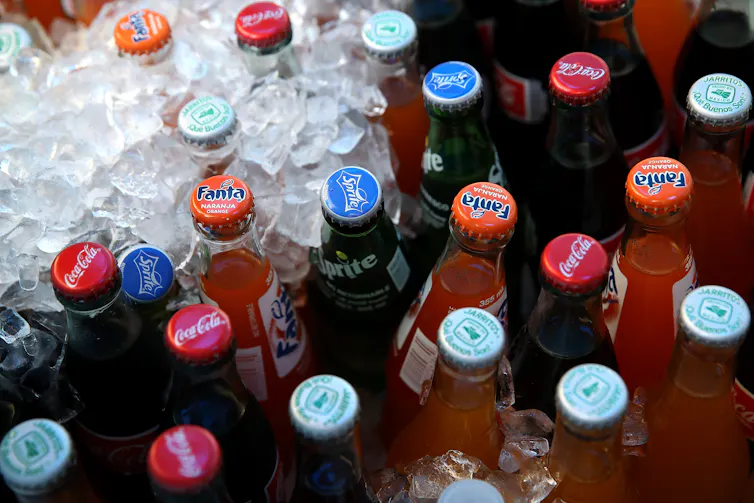
‘I’ll have a coke – no, not Coca-Cola, Sprite.’ Justin Sullivan/Getty ImagesValerie M. Fridland, University of Nevada, Reno With burgers sizzling and classic rock thumping, many Americans revel in summer cookouts – at least until that wayward cousin asks for a “pop” in soda country, or even worse, a “coke” when they actually want a Sprite. Few American linguistic debates have bubbled quite as long and effervescently as the one over whether a generic soft drink should be called a soda, pop or coke. The word you use generally boils down to where you’re from: Midwesterners enjoy a good pop, while soda is tops in the North and far West. Southerners, long the cultural mavericks, don’t bat an eyelash asking for coke – lowercase – before homing in on exactly the type they want: Perhaps a root beer or a Coke, uppercase. As a linguist who studies American dialects, I’m less interested in this regional divide and far more fascinated by the unexpected history behind how a fizzy “health” drink from the early 1800s spawned the modern soft drink’s many names and iterations.
Bubbles, anyone?
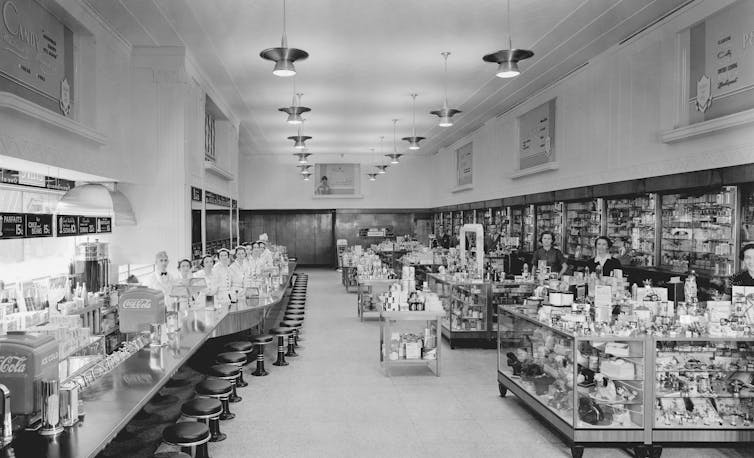
Foods and drinks with wellness benefits might seem like a modern phenomenon, but the urge to create drinks with medicinal properties inspired what might be called a soda revolution in the 1800s.An 1878 engraving of a soda fountain.Smith Collection/Gado via Getty Images The process of carbonating water was first discovered in the late 1700s. By the early 1800s, this carbonated water had become popular as a health drink and was often referred to as “soda water.” The word “soda” likely came from “sodium,” since these drinks often contained salts, which were then believed to have healing properties. Given its alleged curative effects for health issues such as indigestion, pharmacists sold soda water at soda fountains, innovative devices that created carbonated water to be sold by the glass. A chemistry professor, Benjamin Stillman, set up the first such device in a drugstore in New Haven, Connecticut, in 1806. Its eventual success inspired a boom of soda fountains in drugstores and health spas. By the mid-1800s, pharmacists were creating unique root-, fruit- and herb-infused concoctions, such as sassafras-based root beer, at their soda fountains, often marketing them as cures for everything from fatigue to foul moods. These flavored, sweetened versions gave rise to the linking of the word “soda” with a sweetened carbonated beverage, as opposed to simple, carbonated water. Seltzer – today’s popular term for such sparkling water – was around, too. But it was used only for the naturally carbonated mineral water from the German town Nieder-Selters. Unlike Perrier, sourced similarly from a specific spring in France, seltzer made the leap to becoming a generic term for fizzy water.Many late-19th-century and early 20th-century drugstores contained soda fountains – a nod to the original belief that the sugary, bubbly drink possessed medicinal qualities.Hall of Electrical History Foundation/Corbis via Getty Images
Regional naming patterns
So how did “soda” come to be called so many different things in different places? It all stems from a mix of economic enterprise and linguistic ingenuity. The popularity of “soda” in the Northeast likely reflects the soda fountain’s longer history in the region. Since a lot of Americans living in the Northeast migrated to California in the mid-to-late 1800s, the name likely traveled west with them. As for the Midwestern preference for “pop” – well, the earliest American use of the term to refer to a sparkling beverage appeared in the 1840s in the name of a flavored version called “ginger pop.” Such ginger-flavored pop, though, was around in Britain by 1816, since a Newcastle songbook is where you can first see it used in text. The “pop” seems to be onomatopoeic for the noise made when the cork was released from the bottle before drinking.A jingle for Faygo touts the company’s ‘red pop.’ Linguists don’t fully know why “pop” became so popular in the Midwest. But one theory links it to a Michigan bottling company, Feigenson Brothers Bottling Works – today known as Faygo Beverages – that used “pop” in the name of the sodas they marketed and sold. Another theory suggests that because bottles were more common in the region, soda drinkers were more likely to hear the “pop” sound than in the Northeast, where soda fountains reigned. As for using coke generically, the first Coca-Cola was served in 1886 by Dr. John Pemberton, a pharmacist at Jacobs’ Pharmacy in Atlanta and the founder of the company. In the 1900s, the Coca-Cola company tried to stamp out the use of “Coke” for “Coca-Cola.” But that ship had already sailed. Since Coca-Cola originated and was overwhelmingly popular in the South, its generic use grew out of the fact that people almost always asked for “Coke.”No alcohol means not ‘hard’ but ‘soft.’Nostalgic Collections/eBay As with Jell-O, Kleenex, Band-Aids and seltzer, it became a generic term.
What’s soft about it?
Speaking of soft drinks, what’s up with that term? It was originally used to distinguish all nonalcoholic drinks from “hard drinks,” or beverages containing spirits. Interestingly, the original Coca-Cola formula included wine – resembling a type of alcoholic “health” drink popular overseas, Vin Mariani. But Pemberton went on to develop a “soft” version a few years later to be sold as a medicinal drink. Due to the growing popularity of soda water concoctions, eventually “soft drink” came to mean only such sweetened carbonated beverages, a linguistic testament to America’s enduring love affair with sugar and bubbles. With the average American guzzling almost 40 gallons per year, you can call it whatever you what. Just don’t call it healthy.Valerie M. Fridland, Professor of Linguistics, University of Nevada, Reno This article is republished from The Conversation under a Creative Commons license. Read the original article.
Dive into “The Knowledge,” where curiosity meets clarity. This playlist, in collaboration with STMDailyNews.com, is designed for viewers who value historical accuracy and insightful learning. Our short videos, ranging from 30 seconds to a minute and a half, make complex subjects easy to grasp in no time. Covering everything from historical events to contemporary processes and entertainment, “The Knowledge” bridges the past with the present. In a world where information is abundant yet often misused, our series aims to guide you through the noise, preserving vital knowledge and truths that shape our lives today. Perfect for curious minds eager to discover the ‘why’ and ‘how’ of everything around us. Subscribe and join in as we explore the facts that matter. https://stmdailynews.com/the-knowledge/
I’ve been legally drinking beer long enough to remember when the default choice at most bars was something cold, fizzy, and forgettable. Like most people, when I turned 21, I drank what was available, what was cheap, and what everyone else was drinking.
Over time, my palate evolved—and my patience for bland, mass-produced beer disappeared.
These days, if I’m reaching for a beer, chances are it’s a wheat beer.
From “Anything Cold” to Actually Tasting Beer
Early on, I learned something important: not all beer is created equal. The big mainstream domestic brands—built for volume, shelf life, and advertising budgets—never really did it for me. They’re engineered to offend no one, which usually means they excite no one either.
Thin body. Muted flavor. A sameness that makes one brand blur into the next.
That doesn’t mean I dislike American beer. Quite the opposite.
Why Craft and Small Breweries Changed Everything
What I do appreciate are medium-sized breweries, small operations, and microbreweries that actually care about flavor, balance, and craftsmanship. Domestic brewers who treat beer like food—not just a commodity—have produced some outstanding work over the years.
The rise of craft beer proved that American brewers could compete with the best in the world when flavor came first.
Discovering Wheat Beers: Flavor Without Heaviness
My appreciation for wheat beers came naturally. Unlike many heavy ales or aggressively hopped styles, wheat beers offer complexity without exhaustion.
A great wheat beer delivers:
A soft, rounded mouthfeel
Notes of banana, clove, citrus, or spice
Natural carbonation that lifts the flavor
Balance that works whether you sip or socialize
German Hefeweizens, Weissbiers, and Weizenbocks set the standard. Breweries like Weihenstephaner, Paulaner, Franziskaner, and Schneider Weisse showed me just how expressive wheat beer can be without trying to overwhelm the drinker.
Tasting the World, Not Just the Shelf
Over the years, I’ve sampled beers from around the world—Germany, Belgium, the UK, Mexico, Japan, and beyond. Each region brings something different, but the best beers share a common thread: intention.
Advertisement
Once you’ve tasted beers refined over centuries, it’s hard to get excited about products designed mainly for shelf stability and mass appeal.
Yes, American Wheat Beers Can Be Great Too
To be fair, American craft brewers have done some excellent work with wheat beers. Some stay true to traditional styles, while others experiment carefully with citrus or spice.
The good ones respect the base beer instead of burying it under gimmicks.
Why Wheat Beers Still Top My List
After years of drinking, tasting, and learning, wheat beers remain my go-to for one simple reason: they deliver flavor without fatigue.
They don’t need extreme bitterness. They don’t rely on shock value. They don’t pretend to be something they’re not.
Wheat beers are confident, approachable, and honest—and that’s something I appreciate more with every passing year.
I’ll always respect a well-made beer, no matter where it’s brewed. But if you ask me what I actually enjoy drinking, what I come back to again and again, it’s wheat beers.
Not shouted through a commercial.
Further Reading & Reference
Weihenstephan Brewery – Official site of the world’s oldest continuously operating brewery and a benchmark for German wheat beer.
Schneider Weisse – Renowned Bavarian brewery specializing in traditional and strong wheat beer styles.
Paulaner Brewery – One of Munich’s historic breweries, best known in the U.S. for its Hefe-Weißbier.
Franziskaner Weissbier – Classic German wheat beer brand with a strong yeast-forward profile.
Erdinger Weissbräu – One of the world’s largest wheat beer breweries, known for consistency and global distribution.
Teremana® The People’s Margarita and Wingstop Original Hot Wings
Teremana® Tequila Partners With Wingstop to Celebrate Fans of Flavor This Postseason
Teremana® Tequila is bringing the good energy to game day. In a new “Fans of Flavor” partnership announced Jan. 9, 2026, the premium tequila brand founded by Dwayne Johnson is teaming up with Wingstop—the global wing brand known for fresh, made-to-order chicken wings, bold flavors, and its iconic housemade ranch—to help fans turn watch parties into full-on flavor celebrations. The idea is simple: rival teams may split the room, but wings and margaritas are universal.
Teremana Tequila and Wingstop
Wings + Margaritas: A Game Day Pairing Worth Building Around
From now through Feb. 8, fans can explore wing-and-cocktail combinations using the new Fans of Flavor pairing generator, built to match Wingstop’s signature flavors with Teremana margarita recipes. It’s a fun way to level up the table—where the food, drinks, and people become the main event. Here are a few standout pairings highlighted in the launch:
Wingstop Original Hot wings + Teremana® The People’s Margarita for a tropical twist on a classic heat-forward flavor
Wingstop Spicy Korean Q wings + Teremana® Spicy Margarita for heat that builds and keeps the party going
Wingstop Garlic Parmesan wings + Teremana® Strawberry Margarita for a fresh, fruity contrast against savory richness
Sweepstakes: Win the Ultimate Game Day Flavor Fest
The partnership also includes a nationwide sweepstakes offering fans a shot at a seriously upgraded watch party. One grand prize winner will receive the Ultimate Game Day Flavor Fest, featuring:
Wingstop gift cards
Game day drink funds
A 75″ TV
Support for a private bartender and party essentials
Plus, 60 additional winners will each receive Teremana drink cash prizes and a Wingstop gift card—an extra nod to the 60th anniversary of football’s biggest game. Official rules and prize values are available at TeremanaFansofFlavor.com.
“Mana” Meets Flavor: The Point of the Partnership
At its core, this collaboration is built around shared moments—bold taste, good company, and the kind of food-and-drink spread that makes people linger a little longer. Teremana’s brand philosophy centers on Mana—good energy that brings people together—and the pairing concept fits naturally into how fans already celebrate postseason football. “Wingstop has always delivered on bold flavor, and that spirit shows up naturally in how people enjoy Teremana on game day,” said Richard Black, CEO of Teremana® Tequila. “The best game day moments don’t happen by accident, they come from good energy, great flavor, and the people you share them with.”
Three Teremana Margarita Recipes to Try at Home
If you’re hosting—or just want to bring a little “Fans of Flavor” energy to your next game day meal—Teremana shared three margarita recipes designed to pair with Wingstop favorites.
Teremana® The People’s Margarita
Paired with Wingstop Original Hot WingsIngredients
2 oz Teremana Blanco
¾ oz lime juice
½ oz agave nectar
1 oz pineapple juice (to taste)
Preparation
Combine all ingredients and shake with ice in a cocktail shaker.
Strain into a chili-rimmed rocks glass over fresh ice.
Garnish with a lime wheel and pineapple leaves.
Teremana® Spicy Margarita
Paired with Wingstop Spicy Korean Q WingsIngredients
2 oz Teremana Blanco or Reposado
¾ oz lime juice
½ oz agave nectar
2 jalapeño slices (remove seeds)
Preparation
Muddle jalapeños in a shaker.
Add Teremana, lime juice, and agave.
Shake with ice.
Strain into a chili-rimmed rocks glass over fresh ice.
Garnish with jalapeño slices.
Teremana® Strawberry Margarita
Paired with Wingstop Garlic Parmesan wingsIngredients
2 oz Teremana Blanco
1 oz strawberry puree
¾ oz lime juice
½ oz agave nectar
Preparation
Combine all ingredients and shake with ice in a cocktail shaker.
At our core, we at STM Daily News, strive to keep you informed and inspired with the freshest content on all things food and beverage. From mouthwatering recipes to intriguing articles, we’re here to satisfy your appetite for culinary knowledge.
Visit our Food & Drink section to get the latest on Foodie News and recipes, offering a delightful blend of culinary inspiration and gastronomic trends to elevate your dining experience. https://stmdailynews.com/food-and-drink/
Ojos Locos Sports Cantina Launches Loyalty Program and Refreshed Menu Innovations
With Loco Rewards and a Refreshed Menu
Ojos Locos Sports Cantina is starting 2026 with a clear message for fans of big games and bold flavors: come hungry, come often, and get rewarded for it. The culturally-rooted sports cantina just announced a new loyalty program—Loco Rewards—plus a round of menu and beverage upgrades aimed at delivering more authentic Latin flavor, stronger value, and a better overall guest experience across its Southwest footprint.
Loco Rewards: A loyalty program built for regulars
At the center of the update is Loco Rewards, Ojos Locos’ new points-based program designed to recognize frequent guests. Here’s how it works:
250 bonus points when you join
5 points for every $1 spent
Rewards with no minimum purchase required
Ability to redeem multiple rewards at once
Access to members-only offers and early alerts on specials and menu updates
Destinee Rollins, CMO of Ojos Locos Sports Cantina, says the program is an extension of what the brand has always been about—community, food, and sports—while giving loyal guests “real value” and a deeper connection to the culture and hospitality behind the concept.
January perk: A shot at 2026 World Cup tickets
To celebrate the launch, Ojos Locos is tying its loyalty push directly to its sports DNA. Guests who sign up for Loco Rewards in January will be entered to win two free tickets to the 2026 World Cup—a timely hook as soccer fans begin looking ahead to the biggest tournament on the planet.
Menu upgrades: More Latin technique, more scratch-made detail
Alongside the loyalty rollout, Ojos Locos is refining core menu items with upgraded ingredients and preparation methods that lean further into classic Latin cooking techniques. A few highlights from the refreshed lineup include:
Elote Loco: roasted and charred, finished with crema, queso fresco, Valentina, and chile en polvo
Birria de Res: reimagined with slow-cooked brisket
Fresh churros: made daily by a Dallas-based Mexican bakery
Hand-pressed tortillas: now pressed daily in the cantinas
Alex Sadowsky, Director of Culinary and Beverage, says the updates focus on preparation, presentation, and ingredient pairings—keeping the menu approachable while letting the ingredients “stand on their own” in a lively game-day environment.
Built for groups: New platters and $10-and-under Especiales
With the 2026 World Cup on the horizon (and group dining likely to spike), Ojos Locos is also leaning into shareable options. Starting in January, the brand is introducing:
A larger taco platter designed for sharing
Expanded late-night food offerings
A broader rollout of daily Especiales, many priced at $10 or less
One standout value play: a Late-Night Taco Platter featuring 10 tacos for $10.
Behind the bar: Updated cocktails and an expanded tequila program
The refresh isn’t just happening in the kitchen. Ojos Locos is also rolling out a revamped 2026 beverage lineup featuring:
Reworked cocktail recipes
An expanded high-end tequila program
Trend-forward flavors built for game-day energy
New and featured drinks include:
Milagro Mexican Martini
Cadillac Margarita
Horchata Sin Dolor
Plus a mixed-shot lineup with returning favorites like Paleta and new options like Mexican Candy and Spicy Mango.
A growing brand across the Southwest
Ojos Locos currently operates 35 locations across Texas, California, Arizona, New Mexico, and Nevada, and says these January updates reflect continued investment in quality, hospitality, and the communities it serves. For guests ready to join, Loco Rewards is available through the Ojos Locos app on the App Store or Google Play.
At our core, we at STM Daily News, strive to keep you informed and inspired with the freshest content on all things food and beverage. From mouthwatering recipes to intriguing articles, we’re here to satisfy your appetite for culinary knowledge.
Visit our Food & Drink section to get the latest on Foodie News and recipes, offering a delightful blend of culinary inspiration and gastronomic trends to elevate your dining experience. https://stmdailynews.com/food-and-drink/