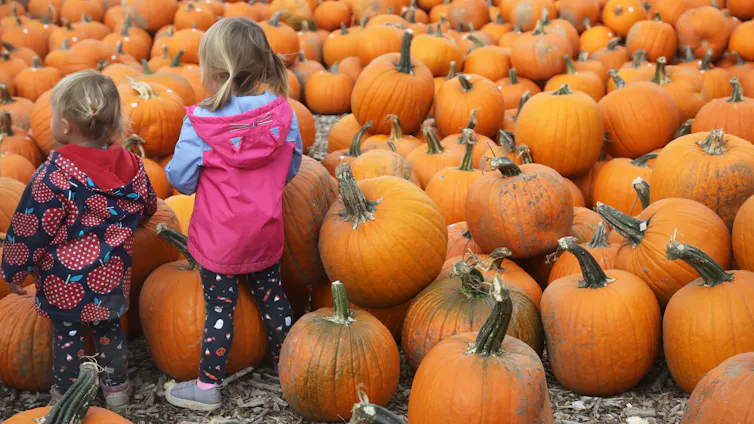
Pumpkins’ journey from ancient food staple to spicy fall obsession spans thousands of years
Shelley Mitchell, Oklahoma State University October in much of the U.S. brings cooler weather, vibrant fall colors and, of course, pumpkin-spiced everything. This is peak pumpkin season, with most of the American pumpkin crop harvested in October. With the pumpkin spice craze fully underway, I find myself thinking more about pumpkins. As an extension specialist working at Oklahoma State University’s botanic garden, I educate the people pouring in to buy pumpkins at our annual sale about the plant’s storied history and its prominence today. While people often picture pumpkins as bright orange, they actually come in a wide range of colors, including red, yellow, white, blue and even green. They vary in size and texture too: Some are smooth, others warty. They can even be miniature or giant. The word “pumpkin” comes from the Greek word “peopon,” meaning “large melon.” Botanically, pumpkins are fruits because they contain seeds, and they belong to the squash family, Cucurbitaceae. This family also includes cucumbers, zucchini and gourds. Pumpkins are grown for many purposes: food, seasonal decorating, carving for Halloween and even giant pumpkin contests.Some pumpkins can be over 1,000 pounds. Pumpkin-growing contests are common at county and state fairs.Joseph Prezioso/AFP via Getty Images All 50 states produce some pumpkins, with Illinois harvesting the most. In 2023, Illinois grew 15,400 acres of pumpkins. The next largest amount was grown in Indiana, with about 6,500 acres. Pumpkin yields vary each year, depending on the varieties grown and the growing conditions in each area. The top six pumpkin-producing states are California, Illinois, Indiana, Michigan, Pennsylvania and Washington.
Early pumpkin history
Pumpkins originated in Central and South America, ending up in North America as Native Americans migrated north and carried the seeds with them. The oldest pumpkin seeds discovered were found in Mexico and date back about 9,000 years. Pumpkins were grown as a crop even before corn or beans, the other two sisters in a traditional Native American “three sisters” garden. The three sister crops – corn, beans and squash – are planted together, and each has a role in helping the others grow. Native Americans planted corn in the spring, and once the plants were a few inches tall, they planted beans. The beans vine around the corn as it grows, giving them a natural trellis. Beans also have the ability to take nitrogen from the atmosphere, and with the help of bacteria they convert it into forms that plants can use, such as ammonia, for fertilizer. After the beans started growing, it was time to plant squash, such as pumpkin. Squash leaves covered the ground, shading the soil and helping keep it moist. The giant leaves also helped reduce the number of weeds that would compete with the corn, bean and squash growth. Every part of the pumpkin plant is edible, even the flowers. Some Native American groups would dry pumpkins’ tough outer shells, cut them into strips and weave them into mats. Pumpkins were introduced to Europe from North America through the Columbian Exchange. Europeans found that the pumpkins grown in the New World were easier to grow and sweeter than the ones in 1600s England or France, likely due to the weather and soil conditions in the Americas.People have been harvesting pumpkin for centuries. This historical illustration from around 1893 shows the pumpkin harvest in Hungary.bildagentur-online/uig via Getty Images
Baking American pumpkins
Native Americans introduced early settlers to pumpkins, and the colonists eagerly incorporated them into their diet, even making pies with them. Early settlers’ pumpkin pies were hollowed-out pumpkins filled with milk, honey and spices, cooked over an open fire or in hot ashes. Others followed English traditions, combining pumpkin and apple with sugar and spices between two crusts. The custard-style pumpkin pie we know today first appeared in 1796 as part of the first cookbook written and published in the United States, “American Cookery,” by Amelia Simmons. There were actually two pumpkin pie recipes: one used mace, nutmeg and ginger, the other just allspice and ginger.
The pumpkin spice craze
Pumpkin spice as one mixed ingredient was sold beginning in the early 1930s for convenience. The spice mix typically includes a blend of cinnamon, nutmeg, ginger, allspice and cloves. Pumpkins and pumpkin spice are now synonymous with fall in America. Pumpkin spice flavoring is used in candles, marshmallows, coffees, lotions, yogurts, pretzels, cookies, milk and many other products.Starbucks’ pumpkin spice latte kicked off the craze thath put this seasonal flavor in high demand.Beata Zawrzel/NurPhoto via Getty Images While pumpkin spice is available in one form or another all year long, sales of pumpkin-spiced products increase exponentially in the fall. The pumpkin spice craze is so popular that the start of the pumpkin spice season is a couple of months before the pumpkins themselves are even ready to harvest in October.
Pumpkin excursions
Americans continue to wholeheartedly embrace pumpkins today. Pumpkins in production are typically hand-harvested as soon as they mature, when the skins are hard enough to not be dented when you press it with your thumb. Children often take field trips to pumpkin patches to pick their own. With the growing popularity of agritourism, many farmers are letting the customers go into the field and pick their own, getting more dollars per pumpkin than farmers could get by selling through the markets. Customer harvesting also reduces labor costs, produces immediate profits and builds community relationships. In addition, farmers often combine the you-pick experience with other sources of income: corn mazes, hay rides, petting zoos and more. The customers get fresher fruit, enjoy a fun and educational activity and support the local economy. This year you could get pumpkin spice flavors across the United States by late August, and the industry started promoting pumpkin spice season in July. Because fall has the right conditions for pumpkin picking, the season will keep its hold on pumpkin spice flavor, and consumers will continue to eagerly await its return each year. Shelley Mitchell, Senior Extension Specialist, Horticulture and Landscape Architecture, Oklahoma State University This article is republished from The Conversation under a Creative Commons license. Read the original article.
Dive into “The Knowledge,” where curiosity meets clarity. This playlist, in collaboration with STMDailyNews.com, is designed for viewers who value historical accuracy and insightful learning. Our short videos, ranging from 30 seconds to a minute and a half, make complex subjects easy to grasp in no time. Covering everything from historical events to contemporary processes and entertainment, “The Knowledge” bridges the past with the present. In a world where information is abundant yet often misused, our series aims to guide you through the noise, preserving vital knowledge and truths that shape our lives today. Perfect for curious minds eager to discover the ‘why’ and ‘how’ of everything around us. Subscribe and join in as we explore the facts that matter. https://stmdailynews.com/the-knowledge/
The Unfavorable Semicircle Mystery: The YouTube Channel That Uploaded Tens of Thousands of Cryptic Videos
In 2015, the YouTube channel Unfavorable Semicircle gained attention for its enigmatic and abundant video uploads, totaling over 70,000 before its deletion in 2016. Theories about its purpose vary, from automated content generation to digital art experimentation, leaving its intent unresolved.
In the vast digital landscape of the internet, strange phenomena occasionally emerge that leave investigators, tech enthusiasts, and everyday viewers scratching their heads. One of the most puzzling cases appeared in 2015, when a mysterious YouTube channel called Unfavorable Semicircle began uploading an astonishing number of cryptic videos.
Within months, the channel had published tens of thousands of bizarre clips, many of which seemed random, incomprehensible, and visually chaotic. But as internet detectives began analyzing the content more closely, they discovered that these videos might not have been random at all.
The Sudden Appearance of an Internet Mystery
The Unfavorable Semicircle channel reportedly appeared in March 2015, with its first uploads arriving in early April.
Almost immediately, the channel began publishing videos at an incredible pace. Observers estimated that the account uploaded thousands of videos per week, sometimes multiple videos per minute. By the time the channel disappeared in early 2016, researchers believed it had uploaded well over 70,000 videos, possibly far more.
The scale alone made the project seem impossible for a human to manage manually.
Most of the videos shared similar characteristics:
Extremely short or very long runtime
Abstract visuals such as flashing colors, static, or distorted imagery
Little or no audio, or heavily distorted sounds
Titles made of random characters, symbols, or numbers
To casual viewers, the videos looked like pure digital noise. However, online investigators suspected something more deliberate was happening.
Hidden Images Discovered
The mystery deepened when researchers began extracting individual frames from some videos.
When thousands of frames from certain clips were stitched together, the results sometimes formed coherent images. One of the most famous examples involved a video titled “LOCK.” While the footage appeared chaotic at first, combining the frames revealed a recognizable composite image.
This discovery suggested the videos were carefully constructed rather than random uploads.
Theories About the Channel’s Purpose
Because the creator never explained the project, several theories emerged across Reddit, YouTube, and internet forums.
Automated Experiment Many believe the channel was created using automated software that generated and uploaded content at scale.
Alternate Reality Game (ARG) Some viewers suspected the channel might be part of a hidden puzzle or digital scavenger hunt.
Advertisement
Encrypted Communication Others compared the channel to Cold War “numbers stations,” suggesting the videos could contain coded messages.
Digital Art Project Another theory suggests the channel was an experimental art project exploring algorithms, data, and visual noise.
Despite years of investigation, no single explanation has been confirmed.
Why the Channel Disappeared
In February 2016, YouTube removed the channel, reportedly due to spam or automated activity violations.
By that time, the channel had already become a minor internet legend. Fortunately, some researchers managed to archive a large portion of the videos before they disappeared.
Even today, archived clips continue to circulate online as investigators attempt to decode them.
Unfavorable Semicircle: The Most Bizarre YouTube Mystery
Other Mysterious YouTube Channels
The Unfavorable Semicircle mystery is not the only strange case on YouTube.
One well-known example is Webdriver Torso, a channel that uploaded hundreds of thousands of videos showing red and blue rectangles with simple beeping sounds. Internet speculation ran wild before Google eventually confirmed it was an internal YouTube testing account.
Another example is AETBX, which posts distorted visuals and unusual audio that some viewers believe contain hidden patterns or encoded information.
These cases highlight how automation, experimentation, and creativity can sometimes blur the line between technology and mystery.
Advertisement
A Digital Mystery That Remains Unsolved
Nearly a decade later, the true purpose behind Unfavorable Semicircle remains unknown.
Was it a sophisticated experiment? A piece of algorithmic art? Or simply an automated test that accidentally captured the internet’s imagination?
Whatever the explanation, the channel stands as a reminder that even in a world filled with billions of videos and endless information, the internet can still produce mysteries that challenge our understanding of technology.
Why Internet Mysteries Still Fascinate Us
Stories like Unfavorable Semicircle capture attention because they combine technology, creativity, and the unknown. They invite people from around the world to collaborate, analyze patterns, and search for meaning hidden in the noise.
And sometimes, the most intriguing part of the mystery is that the answer may never fully be known.
Dive into “The Knowledge,” where curiosity meets clarity. This playlist, in collaboration with STMDailyNews.com, is designed for viewers who value historical accuracy and insightful learning. Our short videos, ranging from 30 seconds to a minute and a half, make complex subjects easy to grasp in no time. Covering everything from historical events to contemporary processes and entertainment, “The Knowledge” bridges the past with the present. In a world where information is abundant yet often misused, our series aims to guide you through the noise, preserving vital knowledge and truths that shape our lives today. Perfect for curious minds eager to discover the ‘why’ and ‘how’ of everything around us. Subscribe and join in as we explore the facts that matter. https://stmdailynews.com/the-knowledge/
Byron Allen’s Starz Stake Signals Bigger Moves in the Streaming Industry
Byron Allen’s Starz: Byron Allen has acquired a 10.7% stake in Starz Entertainment for approximately $25 million, signaling his long-term media strategy amidst industry consolidation. This investment positions him influentially in the evolving streaming market despite intense competition.
Byron Allen — Founder/Chairman/CEO of Allen Media Group
Byron Allen’s Starz investment
Media entrepreneur Byron Allen has taken another step toward expanding his growing media empire. Through his family office, Allen recently acquired a 10.7% stake in Starz Entertainment, purchasing the shares from a fund managed by former U.S. Treasury Secretary Steven Mnuchin.
The transaction, valued at approximately $25 million, gives Allen a significant minority position in the premium cable and streaming platform. While the investment itself may seem modest compared to the billion-dollar deals common in Hollywood, analysts say the move could signal a larger strategy unfolding in the rapidly evolving streaming industry.
Why the Starz Deal Matters
The shares were sold by Mnuchin’s Liberty 77 Capital fund, which previously invested in the company when Starz was still connected to its former parent, Lionsgate.
In 2025, Lionsgate completed a corporate restructuring that separated its operations into two distinct companies:
Lionsgate Studios – responsible for film and television production
Starz – focused on premium cable and streaming services
Following the spin-off, Starz became an independent publicly traded company. As a result, investors are still determining the platform’s long-term value in an increasingly crowded streaming marketplace.
Despite facing intense competition from larger platforms such as Netflix, Disney+, and Amazon Prime Video, Starz continues to maintain a strong subscriber base and recognizable content franchises.
Outlander – historical drama series
The Power franchise created by Courtney A. Kemp and executive produced by 50 Cent
Byron Allen’s Long-Term Media Strategy
Allen’s investment strategy has long focused on owning media distribution and infrastructure rather than simply producing content.
The Weather Channel
Dozens of local television stations across the United States
Multiple niche cable networks and digital platforms
Over the past several years, Allen has also pursued larger acquisitions, reportedly exploring deals involving companies such as Paramount Global and BET Media Group. While those deals did not materialize, they signaled his ambition to expand Allen Media Group into a major force in global media ownership.
The Bigger Picture: Industry Consolidation
Allen’s investment arrives during a time of significant disruption in the entertainment business. Traditional cable television continues to decline as audiences migrate toward streaming platforms. At the same time, major studios and media companies are struggling to make streaming services consistently profitable.
Industry observers believe these pressures could lead to a new wave of consolidation across Hollywood and the streaming sector. Smaller platforms like Starz could become attractive acquisition targets for larger companies seeking additional subscribers and content libraries.
A Potential Hidden Opportunity
For now, Allen’s 10.7% stake does not give him control of Starz. However, it does provide influence as one of the company’s larger shareholders and leaves open the possibility of increasing his ownership in the future.
If consolidation accelerates and streaming platforms begin merging or forming partnerships, assets like Starz could become significantly more valuable. For Byron Allen—whose career began as a stand-up comedian before evolving into one of the most prominent independent media owners in America—the investment may represent another calculated step in a decades-long strategy built around media ownership and long-term growth.
Dive into “The Knowledge,” where curiosity meets clarity. This playlist, in collaboration with STMDailyNews.com, is designed for viewers who value historical accuracy and insightful learning. Our short videos, ranging from 30 seconds to a minute and a half, make complex subjects easy to grasp in no time. Covering everything from historical events to contemporary processes and entertainment, “The Knowledge” bridges the past with the present. In a world where information is abundant yet often misused, our series aims to guide you through the noise, preserving vital knowledge and truths that shape our lives today. Perfect for curious minds eager to discover the ‘why’ and ‘how’ of everything around us. Subscribe and join in as we explore the facts that matter. https://stmdailynews.com/the-knowledge/
Valley Metro to Exit CAPEX Capitol Extension After Phoenix Council Shifts Focus to Indian School Road Corridor
Valley Metro is shifting its focus on high-capacity transit planning in west Phoenix following a City Council vote, prioritizing a new corridor along Indian School Road while exiting the Capitol Extension project, CAPEX, and seeking community engagement.
Valley Metro is officially shifting gears on high-capacity transit planning in west Phoenix following a Phoenix City Council vote earlier this year.
In a message to the public, Valley Metro said that after the Jan. 27, 2026 City Council decision to re-evaluate high-capacity transit options and prioritize a proposed West Phoenix corridor along Indian School Road, the agency will exit project development and the Federal Transit Administration Capital Investment Grant (CIG) process for the Capitol Extension (CAPEX) project.
What the City Council voted to do
According to Valley Metro, the Phoenix City Council voted to take another look at high-capacity transit options for west Phoenix and to prioritize studying a new corridor alignment along Indian School Road.
What Valley Metro is doing next
Valley Metro emphasized it still supports expanding high-capacity transit in west Phoenix, citing demand and mobility needs in the corridor. But the agency says it will now pivot away from CAPEX and toward the new study effort.
Key next steps Valley Metro outlined include:
Exiting the CAPEX project development process and the federal CIG pipeline
Advancing planning for the West Phoenix study along Indian School Road
Centering comprehensive community engagement, including outreach to residents, business owners, and stakeholders along the corridor
Working closely with the City of Phoenix on project development
Coordinating with the Federal Transit Administration to explore funding opportunities
How to stay engaged
Valley Metro is encouraging residents to sign up for updates as the next phase moves forward at valleymetro.org/notices.
Dive into “The Knowledge,” where curiosity meets clarity. This playlist, in collaboration with STMDailyNews.com, is designed for viewers who value historical accuracy and insightful learning. Our short videos, ranging from 30 seconds to a minute and a half, make complex subjects easy to grasp in no time. Covering everything from historical events to contemporary processes and entertainment, “The Knowledge” bridges the past with the present. In a world where information is abundant yet often misused, our series aims to guide you through the noise, preserving vital knowledge and truths that shape our lives today. Perfect for curious minds eager to discover the ‘why’ and ‘how’ of everything around us. Subscribe and join in as we explore the facts that matter. https://stmdailynews.com/the-knowledge/