Connect with us

Blog

The 8,000-Year History of Pecans: How America’s Only Native Nut Became a Holiday Staple

Discover how pecans went from ignored trees to holiday staples over 8,000 years. Learn about Native American pecan use, the enslaved man who revolutionized pecan grafting, George Washington’s pecan obsession, and why the US produces 80% of the world’s pecans.

Published

on

Last Updated on December 22, 2025 by Daily News Staff

file 20251113 56 e454f1.jpg?ixlib=rb 4.1
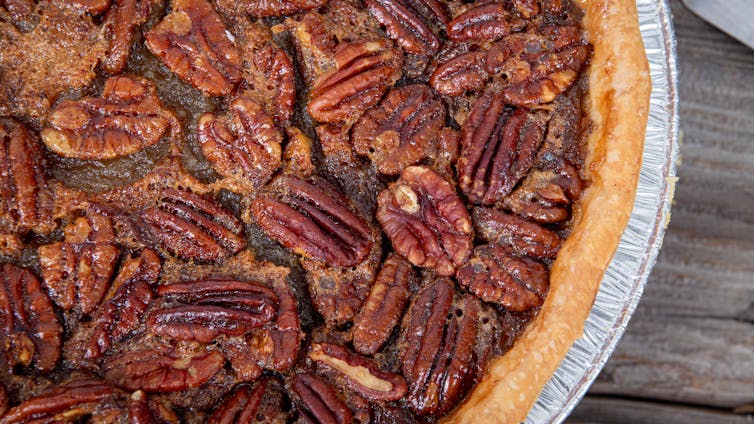
Pecan pie is a popular holiday treat in the United States.
Julie Deshaies/iStock via Getty Images

How pecans went from ignored trees to a holiday staple – the 8,000-year history of America’s only native major nut crop

Shelley Mitchell, Oklahoma State University

Pecans have a storied history in the United States. Today, American trees produce hundreds of million of pounds of pecans – 80% of the world’s pecan crop. Most of that crop stays here. Pecans are used to produce pecan milk, butter and oil, but many of the nuts end up in pecan pies.

Throughout history, pecans have been overlooked, poached, cultivated and improved. As they have spread throughout the United States, they have been eaten raw and in recipes. Pecans have grown more popular over the decades, and you will probably encounter them in some form this holiday season.

I’m an extension specialist in Oklahoma, a state consistently ranked fifth in pecan production, behind Georgia, New Mexico, Arizona and Texas. I’ll admit that I am not a fan of the taste of pecans, which leaves more for the squirrels, crows and enthusiastic pecan lovers.

The spread of pecans

The pecan is a nut related to the hickory. Actually, though we call them nuts, pecans are actually a type of fruit called a drupe. Drupes have pits, like the peach and cherry.

Three green, oval-shaped pods on the branch of a tree
Three pecan fruits, which ripen and split open to release pecan nuts, clustered on a pecan tree.
IAISI/Moment via Getty Images

The pecan nuts that look like little brown footballs are actually the seed that starts inside the pecan fruit – until the fruit ripens and splits open to release the pecan. They are usually the size of your thumb, and you may need a nutcracker to open them. You can eat them raw or as part of a cooked dish.

The pecan derives its name from the Algonquin “pakani,” which means “a nut too hard to crack by hand.” Rich in fat and easy to transport, pecans traveled with Native Americans throughout what is now the southern United States. They were used for food, medicine and trade as early as 8,000 years ago.

A map of the US with parts of Texas, Louisiana, Oklahoma, Arkansas and Missouri highlighted in green.
Pecans are native to the southern United States.
Elbert L. Little Jr. of the U.S. Department of Agriculture, Forest Service

Pecans are native to the southern United States, and while they had previously spread along travel and trade routes, the first documented purposeful planting of a pecan tree was in New York in 1722. Three years later, George Washington’s estate, Mount Vernon, had some planted pecans. Washington loved pecans, and Revolutionary War soldiers said he was constantly eating them.

Meanwhile, no one needed to plant pecans in the South, since they naturally grew along riverbanks and in groves. Pecan trees are alternate bearing: They will have a very large crop one year, followed by one or two very small crops. But because they naturally produced a harvest with no input from farmers, people did not need to actively cultivate them. Locals would harvest nuts for themselves but otherwise ignored the self-sufficient trees.

It wasn’t until the late 1800s that people in the pecan’s native range realized the pecan’s potential worth for income and trade. Harvesting pecans became competitive, and young boys would climb onto precarious tree branches. One girl was lifted by a hot air balloon so she could beat on the upper branches of trees and let them fall to collectors below. Pecan poaching was a problem in natural groves on private property.

Pecan cultivation begins

Even with so obvious a demand, cultivated orchards in the South were still rare into the 1900s. Pecan trees don’t produce nuts for several years after planting, so their future quality is unknown.

Two lines of trees
An orchard of pecan trees.
Jon Frederick/iStock via Getty Images

To guarantee quality nuts, farmers began using a technique called grafting; they’d join branches from quality trees to another pecan tree’s trunk. The first attempt at grafting pecans was in 1822, but the attempts weren’t very successful.

Grafting pecans became popular after an enslaved man named Antoine who lived on a Louisiana plantation successfully produced large pecans with tender shells by grafting, around 1846. His pecans became the first widely available improved pecan variety.

Advertisement
Get More From A Face Cleanser And Spa-like Massage
A cut tree trunk with two smaller, thiner shoots (from a different type of tree) protruding from it.
Grafting is a technique that involves connecting the branch of one tree to the trunk of another.
Orest Lyzhechka/iStock via Getty Images

The variety was named Centennial because it was introduced to the public 30 years later at the Philadelphia Centennial Expedition in 1876, alongside the telephone, Heinz ketchup and the right arm of the Statue of Liberty.

This technique also sped up the production process. To keep pecan quality up and produce consistent annual harvests, today’s pecan growers shake the trees while the nuts are still growing, until about half of the pecans fall off. This reduces the number of nuts so that the tree can put more energy into fewer pecans, which leads to better quality. Shaking also evens out the yield, so that the alternate-bearing characteristic doesn’t create a boom-bust cycle.

US pecan consumption

The French brought praline dessert with them when they immigrated to Louisiana in the early 1700s. A praline is a flat, creamy candy made with nuts, sugar, butter and cream. Their original recipe used almonds, but at the time, the only nut available in America was the pecan, so pecan pralines were born.

Two clusters of nuts and creamy butter on a plate.
Pralines were originally a French dessert, but Americans began making them with pecans.
Jupiterimages/The Image Bank via Getty Images

During the Civil War and world wars, Americans consumed pecans in large quantities because they were a protein-packed alternative when meat was expensive and scarce. One cup of pecan halves has about 9 grams of protein.

After the wars, pecan demand declined, resulting in millions of excess pounds at harvest. One effort to increase demand was a national pecan recipe contest in 1924. Over 21,000 submissions came from over 5,000 cooks, with 800 of them published in a book.

Pecan consumption went up with the inclusion of pecans in commercially prepared foods and the start of the mail-order industry in the 1870s, as pecans can be shipped and stored at room temperature. That characteristic also put them on some Apollo missions. Small amounts of pecans contain many vitamins and minerals. They became commonplace in cereals, which touted their health benefits.

In 1938, the federal government published the pamphlet Nuts and How to Use Them, which touted pecans’ nutritional value and came with recipes. Food writers suggested using pecans as shortening because they are composed mostly of fat.

The government even put a price ceiling on pecans to encourage consumption, but consumers weren’t buying them. The government ended up buying the surplus pecans and integrating them into the National School Lunch Program.

A machine with an arm attached to a tree, and a wheeled cab on the ground.
Today, pecan producers use machines called tree shakers to shake pecans out of the trees.
Christine_Kohler/iStock via Getty Images

While you are sitting around the Thanksgiving table this year, you can discuss one of the biggest controversies in the pecan industry: Are they PEE-cans or puh-KAHNS?

Editor’s note: This article was updated to include the amount of protein in a cup of pecans.

Shelley Mitchell, Senior Extension Specialist in Horticulture and Landscape Architecture, Oklahoma State University

This article is republished from The Conversation under a Creative Commons license. Read the original article.

High Demand Marks “Veggies for Veterans” Event Amid SNAP Delays

Advertisement
Get More From A Face Cleanser And Spa-like Massage

Link: https://stmdailynews.com/high-demand-marks-veggies-for-veterans-event-amid-snap-delays/

View recent photos

Unlock fun facts & lost history—get The Knowledge in your inbox!

We don’t spam! Read our privacy policy for more info.


Discover more from Daily News

Subscribe to get the latest posts sent to your email.

Continue Reading
Advertisement Tool Tickets
Click to comment

Leave a Reply

Your email address will not be published. Required fields are marked *

STM Blog

When Flick’s Tongue Froze: A Christmas Story That Hit Differently in Southern California

Why Flick’s tongue stuck to a frozen pole in A Christmas Story — and why that scene felt different growing up in Southern California. Nostalgia meets real-world science.

Published

on

Last Updated on December 25, 2025 by Daily News Staffenvato labs image edit 3

For many of us, A Christmas Story isn’t just a holiday movie — it’s an annual ritual. The leg lamp, the Red Ryder BB gun, the Old Man’s furnace… and of course, the moment Flick accepts the double dog dare and sticks his tongue to the frozen tetherball pole.

But growing up in Southern California, that scene always landed a little differently.

In places like Lynwood, winter rarely meant frozen playground equipment or snow-covered streets. It meant cool mornings, maybe a stiff breeze — and on rare occasions, a freeze warning that had families covering plants overnight. Those nights stood out precisely because they were unusual. Snow sticking to the ground? Almost unheard of.

So when Flick’s tongue froze solid to that pole, it felt less like a warning and more like Midwestern folklore — something that happened somewhere else.

The Science Behind the Scene

Despite how extreme it looks, the moment is scientifically accurate.

Your tongue sticks to metal because:

  • The tongue is wet

  • Metal rapidly conducts heat away

  • Moisture freezes almost instantly

  • A thin layer of ice bonds skin to metal

It doesn’t require snow — just cold enough metal and moisture. In colder climates, those conditions line up easily. In Southern California, they rarely do.

The Part the Movie Leaves Out

A Christmas Story cuts away before showing Flick’s rescue, and that’s intentional. But in the real world, firefighters wouldn’t pull or panic.

The solution is simple:

  • Warm water poured over the tongue and metal

  • The ice melts

  • The tongue releases safely

No heroics. No tearing skin. Just physics.

Advertisement
Get More From A Face Cleanser And Spa-like Massage

Why the Scene Endures

The power of the scene isn’t just the gag — it’s the shared childhood experience:

  • Bravado fueled by peer pressure

  • Instant regret

  • The quiet humiliation of adult intervention

For Southern California kids, it was less a cautionary tale and more a glimpse into another world — one where winter itself was a character. That contrast is part of why the scene still resonates decades later.

Some lessons are regional.

Some are universal.

And some — like the double dog dare — transcend weather entirely.

Author

  • Rod Washington

    Rod: A creative force, blending words, images, and flavors. Blogger, writer, filmmaker, and photographer. Cooking enthusiast with a sci-fi vision. Passionate about his upcoming series and dedicated to TNC Network. Partnered with Rebecca Washington for a shared journey of love and art. View all posts


Discover more from Daily News

Subscribe to get the latest posts sent to your email.

Continue Reading

News

Girls and boys solve math problems differently – with similar short-term results but different long-term outcomes

Girls and Boys: New research finds girls and women more often use step-by-step algorithms, while boys and men use shortcuts. Accuracy is similar short-term, but algorithm use links to weaker performance on complex problems and may help explain gaps on high-stakes tests and in math-intensive careers.

Published

on

file 20251104 56 f7pa3s.jpg?ixlib=rb 4.1
Math teachers have to accommodate high school students’ different approaches to problem-solving. RJ Sangosti/MediaNews Group/The Denver Post via Getty Images

Girls and boys solve math problems differently – with similar short-term results but different long-term outcomes

Sarah Lubienski, Indiana University; Colleen Ganley, Florida State University, and Martha Makowski, University of Alabama Among high school students and adults, girls and women are much more likely to use traditional, step-by-step algorithms to solve basic math problems – such as lining up numbers to add, starting with the ones place, and “carrying over” a number when needed. Boys and men are more likely to use alternative shortcuts, such as rounding both numbers, adding the rounded figures, and then adjusting to remove the rounding. But those who use traditional methods on basic problems are less likely to solve more complex math problems correctly. These are the main findings of two studies our research team published in November 2025. This new evidence may help explain an apparent contradiction in the existing research – girls do better at math in school, but boys do better on high-stakes math tests and are more likely to pursue math-intensive careers. Our research focuses not just on getting correct answers, but on the methods students use to arrive at them. We find that boys and girls approach math problems differently, in ways that persist into adulthood.

A possible paradox

In a 2016 study of U.S. elementary students, boys outnumbered girls 4 to 1 among the top 1% of scorers on a national math test. And over many decades, boys have been about twice as likely as girls to be among the top scorers on the SAT and AP math exams. However, girls tend to be more diligent in elementary school and get better grades in math class throughout their schooling. And girls and boys across the grades tend to score similarly on state math tests, which tend to be more aligned with the school curriculum and have more familiar problems than the SAT or other national tests. Beyond grades and test scores, the skills and confidence acquired in school carry far beyond, into the workforce. In lucrative STEM occupations, such as computer science and engineering, men outnumber women 3 to 1. Researchers have considered several explanations for this disparity, including differences in math confidence and occupational values, such as prioritizing helping others or making money. Our study suggests an additional factor to consider: gender differences in approaches to math problems. When older adults think of math, they may recall memorizing times tables or doing the tedious, long-division algorithm. Memorization and rule-following can pay off on math tests focused on procedures taught in school. But rule-following has its limits and seems to provide more payoff among low-achieving than high-achieving students in classrooms. More advanced math involves solving new, perplexing problems rather than following rules.
A teacher shows students a math lesson.
Math can be creative, not rote. AP Photo/Jacquelyn Martin

Differing strategies

In looking at earlier studies of young children, our research team was struck by findings that young boys use more inventive strategies on computation problems, whereas girls more often use standard algorithms or counting. We wondered whether these differences disappear after elementary school, or whether they persist and relate to gender disparities in more advanced math outcomes. In an earlier study, we surveyed students from two high schools with different demographic characteristics to see whether they were what we called bold problem-solvers. We asked them to rate how much they agreed or disagreed with specific statements, such as “I like to think outside the box when I solve math problems.” Boys reported bolder problem-solving tendencies than girls did. Importantly, students who reported bolder problem-solving tendencies scored higher on a math problem-solving test we administered. Our newer studies echo those earlier results but reveal more specifics about how boys and girls, and men and women, approach basic math problems.

Algorithms and teacher-pleasing

In the first study, we gave three questions to more than 200 high school students: “25 x 9 = ___,” “600 – 498 = ___,” and “19 + 47 + 31 = ___.” Each question could be solved with a traditional algorithm or with a mental shortcut, such as solving 25 x 9 by first multiplying 25 x 8 to get 200 and then adding the final 25 to get 225. Regardless of their gender, students were equally likely to solve these basic computation items correctly. But there was a striking gender difference in how they arrived at that answer. Girls were almost three times as likely as boys – 52% versus 18% – to use a standard algorithm on all three items. Boys were far more likely than girls – 51% versus 15% – to never use an algorithm on the questions. We suspected that girls’ tendency to use algorithms might stem from greater social pressure toward compliance, including complying with traditional teacher expectations. So, we also asked all the students eight questions to probe how much they try to please their teachers. We also wanted to see whether algorithm use might relate to gender differences in more advanced problem-solving, so we gave students several complex math problems from national tests, including the SAT. As we suspected, we found that girls were more likely to report a desire to please teachers, such as by completing work as directed. Those who said they did have that desire used the standard algorithm more often. Also, the boys in our sample scored higher than the girls on the complex math problems. Importantly, even though students who used algorithms on the basic computation items were just as likely to compute these items correctly, algorithm users did worse on the more complex math problems.

Continuing into adulthood

In our second study, we gave 810 adults just one problem: “125 + 238 = ___.” We asked them to add mentally, which we expected would discourage them from using an algorithm. Again, there was no gender difference in answering correctly. But 69% of women, compared to 46% of men, reported using the standard algorithm for their mental calculation, rather than using another strategy entirely. We also gave the adults a more advanced problem-solving test, this time focused on probability-related reasoning, such as the chances that rolling a seven-sided die would result in an even number. Similar to our first study, women and those who used the standard algorithm on the computation problem performed worse on the reasoning test.

The importance of inventiveness

We identified some factors that may play a role in these gender differences, including spatial-thinking skills, which may help people develop alternate calculation approaches. Anxiety about taking tests and perfectionism, both more prevalent among women, may also be a factor. We are also interested in the power of gender-specific social pressures on girls. National data has shown that young girls exhibit more studious behavior than do boys. And the high school girls we studied were more likely than boys to report they made a specific effort to meet teachers’ expectations. More research definitely is needed to better understand this dynamic, but we hypothesize that the expectation some girls feel to be compliant and please others may drive teacher-pleasing tendencies that result in girls using algorithms more frequently than boys, who are more socialized to be risk-takers. While compliant behavior and standard math methods often lead to correct answers and good grades in school, we believe schools should prepare all students – regardless of gender – for when they face unfamiliar problems that require inventive problem-solving skills, whether in daily life, on high-stakes tests or in math-intensive professions.The Conversation Sarah Lubienski, Professor of Mathematics Education, Indiana University; Colleen Ganley, Professor of Developmental Psychology, Florida State University, and Martha Makowski, Assistant Professor of Mathematics, University of Alabama This article is republished from The Conversation under a Creative Commons license. Read the original article.
Hollywood vs. Reality: How LA’s Wilshire Subway Was Really Built
Link: https://stmdailynews.com/wilshire-subway-tunneling-hollywood-vs-reality/

Author


Discover more from Daily News

Subscribe to get the latest posts sent to your email.

Continue Reading

Stories of Change

Delivering What Matters Most This Holiday Season

Delivering What Matters! This holiday season, give gifts that matter. Support UNICEF’s mission to deliver essentials like nutrition, education, and shelter to children worldwide through meaningful charitable giving.

Published

on

Last Updated on December 24, 2025 by Daily News Staff

Delivering What Matters Most This Holiday Season

Delivering What Matters Most This Holiday Season

(Family Features) As families prepare for the holidays, presents and packages fill doorsteps seemingly on demand. For millions of children around the world, however, each delivery carries more than convenience – it carries purpose. For example, UNICEF continues its lifesaving work, delivering essentials like nutrition, shelter and warm clothes to children who need it most. From Sudan to Ukraine, Gaza to Malawi and beyond, the organization delivers more than just supplies – it provides a hopeful future for children around the world. When conflict unfolds, when disaster strikes or when the winter cold hits, the organization’s critical aid is never out of reach, even for the world’s hardest-to-reach children. This holiday season, give a gift that matters. With UNICEF Market and Inspired Gifts, you can bring education and lifesaving tools to children around the world. An Art Therapy Kit can give children an outlet needed to heal while a Math Classroom Kit can open doors to brighter futures. Through The K.I.N.D. Fund – now celebrating its 15th anniversary – you can support education in Malawi by providing children with desks and scholarships to help kids go beyond elementary school learning levels. 17712 detail embed2You can send Essential Winter Kits – filled with clothing – to ensure children stay safe through the cold months. Every gift fuels the mission of pursuing a more equitable world for every child. These partner gift ideas also support the organization’s global work: Your Marriott Bonvoy points can protect and care for children worldwide. From Dec. 2-9, the travel company will match five points for every point members donate to philanthropic partners, up to 25 million total points. Furthermore, members who earn 50 or 75 qualifying nights in a calendar year are eligible to select UNICEF to benefit from their Annual Choice Benefit with a $100 USD donation. Learn more at giving.marriott.com. Give the gift of holiday radiance with The Serum by Clé de Peau Beauté. Whether you are treating yourself or a loved one, this gift is sure to spread some cheer. Since 2019, the brand has proudly donated $14.5 million total to UNICEF to support girls’ education and empowerment around the world. Find out how you can help unlock the power of girls at cledepeaubeaute.com. To help tackle the stigma around poor mental health and provide support for children, young people and caregivers globally, Jo Malone London will donate a minimum of 70% of the recommended retail price from each Charity Home Candle sold to the U.S. Fund for UNICEF with a commitment to raise at least $200,000 from July 1, 2025 by June 30, 2026. For more information, visit jomalone.com. Children of the world are too often at risk, exposed to conflicts, diseases and natural disasters that threaten their safety and well-being. Since 2016, Louis Vuitton has helped protect these children through its partnership with UNICEF. Each year, the brand creates a dedicated Silver Lockit collection in support of UNICEF’s work, and more than $24 million has been donated through this initiative. For 2025, a new design was created in collaboration with House Ambassador and UNICEF Korea Goodwill Ambassador Felix. Engraved with the word “DREAM,” representing every child’s right to grow, live and learn in a nurturing environment with access to education, health care and protection. For each piece purchased, $100-200 will be donated to help deliver life-saving assistance and education to children in urgent need around the world. Learn more at us.louisvuitton.com. Visit unicefusa.org/stories/delivering-vital-supplies-children-who-need-them-most to learn more and deliver what matters most to children this holiday season. collect?v=1&tid=UA 482330 7&cid=1955551e 1975 5e52 0cdb 8516071094cd&sc=start&t=pageview&dl=http%3A%2F%2Ftrack.familyfeatures SOURCE: UNICEF

Stories of Change: People Making a Difference

Discover inspiring stories of changemakers making a positive impact. Explore videos and articles of people tackling today’s biggest challenges with action and hope. Visit: https://stmdailynews.com/stories-of-change/


Discover more from Daily News

Subscribe to get the latest posts sent to your email.

Continue Reading

Trending