
Connect with us

infrastructure

Understanding the Cost of Replacing Diesel Buses

Published

on

Last Updated on September 8, 2025 by Daily News Staff

Replacing Diesel Buses

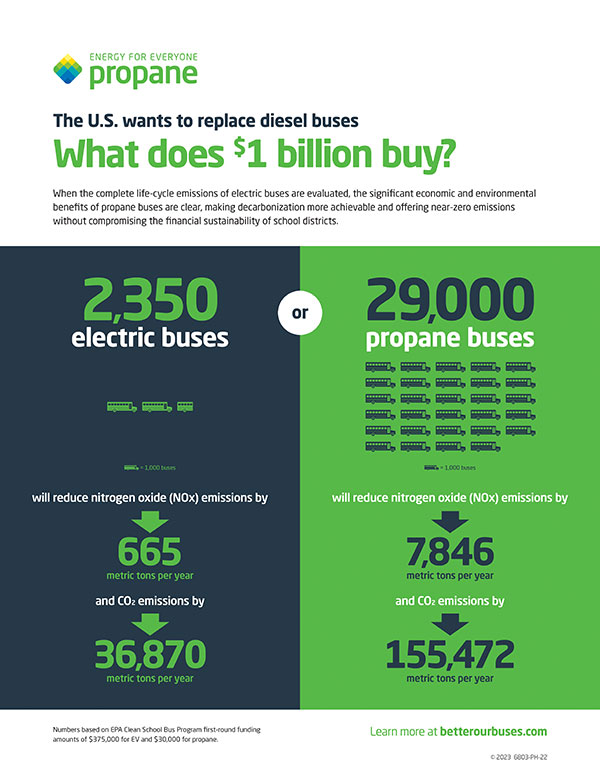
(Family Features) Diesel school buses are not only expensive to operate, they pose risks to children’s health and the environment. There are two practical energy choices for clean student transportation: propane and electric. However, when evaluating the complete life-cycle emissions and cost of electric buses, the economic and environmental benefits of propane buses are clear, according to the experts at the Propane Education & Research Council. With or without available funding, propane buses cost a fraction of electric buses, allowing school districts to replace their aging diesel fleets faster and further reduce harmful emissions. Learn more at BetterOurBuses.com.

16534 detail image embed

collect?v=1&tid=UA 482330 7&cid=1955551e 1975 5e52 0cdb 8516071094cd&sc=start&t=pageview&dl=http%3A%2F%2Ftrack.familyfeatures
SOURCE:
Propane Education & Research Council


Discover more from Daily News

Subscribe to get the latest posts sent to your email.

Blog

The Dodger Gondola Project: A High-Flying Transit Idea Facing Heavy Headwinds

The Dodger Gondola Project, a proposed aerial transit line between Union Station and Dodger Stadium, faces major political, legal, and community opposition in 2025. Here’s where the controversial project stands now.

Published

on

Dodger Gondola Project
Imagine credit: Aerial Rapid Transit Technologies/ LA Metro

Dodger Gondola Project Faces Major Setbacks as L.A. Leaders and Residents Push Back


For years, the Los Angeles Aerial Rapid Transit (LA ART) — better known as the Dodger Gondola Project — has been pitched as a bold, futuristic connection between Union Station and Dodger Stadium, whisking riders above traffic in a six-minute aerial trip. Supporters call it L.A.’s chance to build a cleaner, faster, iconic transit link. But as 2025 winds toward its close, the project faces more turbulence than ever.

A Quick Refresher: What the Gondola Would Be

The proposed gondola line would travel about 1.2 miles, with stations at Union Station, a stop near L.A. State Historic Park, and Dodger Stadium. Private backers connected to former Dodgers owner Frank McCourt have promoted it as a zero-emission way to move more than 5,000 passengers per hour on game days — and potentially daily for tourists, residents, and park visitors.

Why the Dream Is Stalling

In November 2025, the Los Angeles City Council voted 12–1 to formally oppose the project, urging Metro to abandon it. While the vote isn’t legally binding, it signaled a major political shift. Councilmember Eunisses Hernandez, who introduced the resolution, cited environmental and community concerns — especially the impact on Chinatown, Solano Canyon, and L.A. State Historic Park.

A California Court of Appeals ruling earlier in the year also struck down Metro’s original environmental review, forcing a supplemental EIR that reopened debates about tree removal, tower placement, noise, and neighborhood impacts. The city has additionally ordered a comprehensive traffic study, pausing key permits until it’s complete.

Communities Speak Out

Local opposition has been strong and well-organized. Residents warn the gondola would remove mature trees, alter the character of the State Historic Park, and intrude over communities that have already shouldered decades of infrastructure burdens. Advocacy groups say the project favors private interests over public need, pointing to the lack of a clear long-term funding or maintenance plan.

Not Dead — But Deeply Uncertain

Despite mounting challenges, the gondola isn’t entirely grounded. Metro is still reviewing public comments on the supplemental environmental report, and state lawmakers are debating legislation that could streamline some project requirements. Whether those efforts succeed — or whether political pressure ultimately stalls the gondola indefinitely — remains to be seen.

Advertisement
Get More From A Face Cleanser And Spa-like Massage

The Big Picture

The Dodger Gondola Project sits at the intersection of transit innovation, environmental justice, and the future of Los Angeles mobility. For supporters, it represents a chance to modernize travel to one of the nation’s most visited stadiums. For opponents, it’s an unnecessary experiment that risks community space and public resources.

Either way, the next year will be pivotal — and L.A.’s debate over the gondola is far from over.

Sources and links for further information

Attachment.pngAssociated Press: “Los Angeles officials seek to halt proposed Dodger Stadium gondola” — apnews.com 

Attachment.pngLos Angeles Times: “Los Angeles City Council votes 12-1 to urge Metro to halt Dodgers gondola project” — latimes.com 

Attachment.pngNBC Los Angeles: “Dodger Stadium gondola should be a no-go, LA City Council says” — nbclosangeles.com 

Attachment.pngPR Newswire (project press release): “LA ART Gondola Project Takes Next Step Forward … with Release of Draft Supplemental Environmental Report” — prnewswire.com 

Attachment.pngLAist: “Controversial Dodger Stadium gondola project gets new environmental report. Here’s how you can weigh in” — laist.com 

Attachment.pngOfficial Metro page: “Los Angeles Aerial Rapid Transit (LA ART)” — metro.net 

Attachment.pngSite for public comment: “Stop The Gondola – Public Comment” — stopthegondola.org 

Attachment.pngCEQA Notice of Availability: “Draft Supplemental Environmental Impact Report – LA ART Project” — ceqanet.lci.ca.gov 

https://stmdailynews.com/rediscovering-the-charm-of-mass-transit-a-personal-perspective/

Discover more from Daily News

Subscribe to get the latest posts sent to your email.

Continue Reading

Science

NASA wants to put a nuclear reactor on the Moon by 2030 – choosing where is tricky

Published

on

Last Updated on October 5, 2025 by Daily News Staff

nuclear reactor on the Moon
Several missions have already attempted to land on the lunar surface in 2025, with more to come. AP Photo

NASA wants to put a nuclear reactor on the Moon by 2030 – choosing where is tricky

Clive Neal, University of Notre Dame In a bold, strategic move for the U.S., acting NASA Administrator Sean Duffy announced plans on Aug. 5, 2025, to build a nuclear fission reactor for deployment on the lunar surface in 2030. Doing so would allow the United States to gain a foothold on the Moon by the time China plans to land the first taikonaut, what China calls its astronauts, there by 2030. Apart from the geopolitical importance, there are other reasons why this move is critically important. A source of nuclear energy will be necessary for visiting Mars, because solar energy is weaker there. It could also help establish a lunar base and potentially even a permanent human presence on the Moon, as it delivers consistent power through the cold lunar night. As humans travel out into the solar system, learning to use the local resources is critical for sustaining life off Earth, starting at the nearby Moon. NASA plans to prioritize the fission reactor as power necessary to extract and refine lunar resources. As a geologist who studies human space exploration, I’ve been mulling over two questions since Duffy’s announcement. First, where is the best place to put an initial nuclear reactor on the Moon, to set up for future lunar bases? Second, how will NASA protect the reactor from plumes of regolith – or loosely fragmented lunar rocks – kicked up by spacecraft landing near it? These are two key questions the agency will have to answer as it develops this technology.

Where do you put a nuclear reactor on the Moon?

The nuclear reactor will likely form the power supply for the initial U.S.-led Moon base that will support humans who’ll stay for ever-increasing lengths of time. To facilitate sustainable human exploration of the Moon, using local resources such as water and oxygen for life support and hydrogen and oxygen to refuel spacecraft can dramatically reduce the amount of material that needs to be brought from Earth, which also reduces cost. In the 1990s, spacecraft orbiting the Moon first observed dark craters called permanently shadowed regions on the lunar north and south poles. Scientists now suspect these craters hold water in the form of ice, a vital resource for countries looking to set up a long-term human presence on the surface. NASA’s Artemis campaign aims to return people to the Moon, targeting the lunar south pole to take advantage of the water ice that is present there.
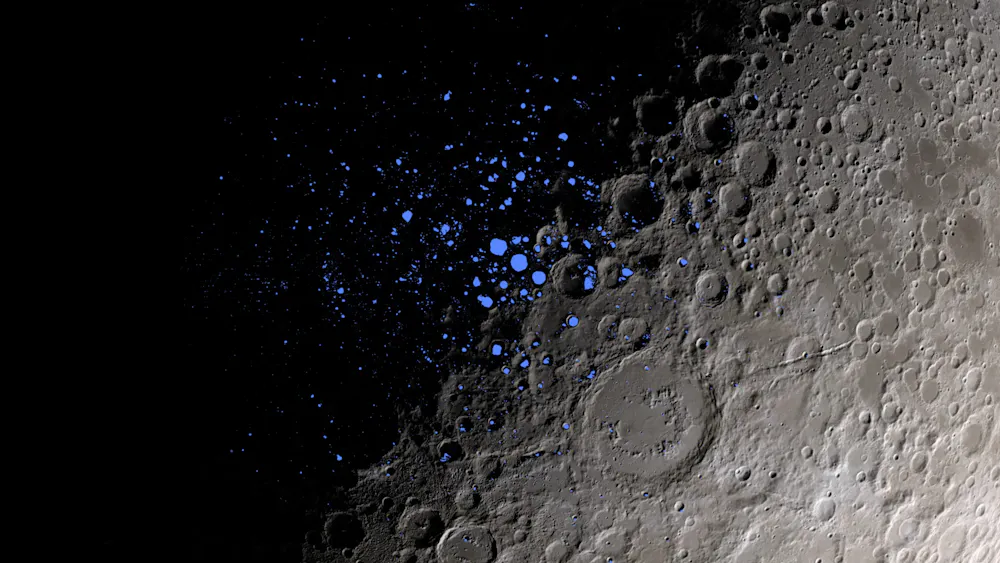
A close-up shot of the Moon's surface, with the left half covered in shadow, and the right half visible, with gray craters. Tiny blue dots in the center indicate PSRs.
Dark craters on the Moon, parts of which are indicated here in blue, never get sunlight. Scientists think some of these permanently shadowed regions could contain water ice. NASA’s Goddard Space Flight Center
In order to be useful, the reactor must be close to accessible, extractable and refinable water ice deposits. The issue is we currently do not have the detailed information needed to define such a location. The good news is the information can be obtained relatively quickly. Six lunar orbital missions have collected, and in some cases are still collecting, relevant data that can help scientists pinpoint which water ice deposits are worth pursuing. These datasets give indications of where either surface or buried water ice deposits are. It is looking at these datasets in tandem that can indicate water ice “hot prospects,” which rover missions can investigate and confirm or deny the orbital observations. But this step isn’t easy. Luckily, NASA already has its Volatiles Investigating Polar Exploration Rover mission built, and it has passed all environmental testing. It is currently in storage, awaiting a ride to the Moon. The VIPER mission can be used to investigate on the ground the hottest prospect for water ice identified from orbital data. With enough funding, NASA could probably have this data in a year or two at both the lunar north and south poles.
The VIPER rover would survey water at the south pole of the Moon.

How do you protect the reactor?

Once NASA knows the best spots to put a reactor, it will then have to figure out how to shield the reactor from spacecraft as they land. As spacecraft approach the Moon’s surface, they stir up loose dust and rocks, called regolith. It will sandblast anything close to the landing site, unless the items are placed behind large boulders or beyond the horizon, which is more than 1.5 miles (2.4 kilometers) away on the Moon. Scientists already know about the effects of landing next to a pre-positioned asset. In 1969, Apollo 12 landed 535 feet (163 meters) away from the robotic Surveyor 3 spacecraft, which showed corrosion on surfaces exposed to the landing plume. The Artemis campaign will have much bigger lunar landers, which will generate larger regolith plumes than Apollo did. So any prepositioned assets will need protection from anything landing close by, or the landing will need to occur beyond the horizon. Until NASA can develop a custom launch and landing pad, using the lunar surface’s natural topography or placing important assets behind large boulders could be a temporary solution. However, a pad built just for launching and landing spacecraft will eventually be necessary for any site chosen for this nuclear reactor, as it will take multiple visits to build a lunar base. While the nuclear reactor can supply the power needed to build a pad, this process will require planning and investment. Human space exploration is complicated. But carefully building up assets on the Moon means scientists will eventually be able to do the same thing a lot farther away on Mars. While the devil is in the details, the Moon will help NASA develop the abilities to use local resources and build infrastructure that could allow humans to survive and thrive off Earth in the long term. Clive Neal, Professor of Civil and Environmental Engineering and Earth Sciences, University of Notre Dame This article is republished from The Conversation under a Creative Commons license. Read the original article.

Want more stories 👋
"Your morning jolt of Inspiring & Interesting Stories!"

Sign up to receive awesome articles directly to your inbox.

STM Coffee Newsletter 1

We don’t spam! Read our privacy policy for more info.


Discover more from Daily News

Subscribe to get the latest posts sent to your email.

Continue Reading

Urbanism

New Construction Project at Phoenix Sky Harbor Airport

Published

on

Last Updated on April 18, 2025 by Rod Washington


Sky Harbor
Image Credit: Sky Harbor Airport

Phoenix Sky Harbor International Airport, a major transportation hub in Arizona, is set to undergo significant improvements with a new construction project at Terminal 3. According to AZ Family, the work is officially commencing this month on a project that will enhance the airport’s infrastructure, making it more accommodating for travelers.

Expansion at Sky Harbor

The upcoming expansion, which boasts a budget of $326 million, will introduce a new concourse on the north side of Terminal 3. This new addition is designed to increase the terminal’s capacity by adding six new passenger gates, bringing the total to 26 gates. The construction will encompass a vast 173,000 square feet, ultimately providing more flight options and enhanced facilities for travelers.

As reported by AZ Central, the expansion is much-needed, given that Terminal 3 is the oldest terminal at Sky Harbor. McCarthy Building Cos. Inc. has been entrusted with the construction, and they are committed to creating an exceptional experience for passengers. Thomas Assante, McCarthy’s senior project director, stated, “Every portion of the new Terminal 3 concourse will provide an exceptional experience for Sky Harbor passengers.” Notably, McCarthy has experience with airport projects, having recently completed a five-gate concourse at Mesa Gateway Airport, which opened in February 2024.

In addition to expanding gate capacity, the new Terminal 3 concourse plans to feature improvements beyond functionality. Travelers can look forward to new dining options, including three food and beverage spaces, as well as two retail spaces, alongside a passenger lounge. Greg Roybal, an airport spokesman, has confirmed these plans, emphasizing the project’s focus on improving the overall passenger experience.

The anticipated completion date for the new concourse is set for 2027. Once finished, this expansion will not only bolster the terminal’s capabilities but also enhance the amenities available to travelers. The airlines currently operating out of Terminal 3 include Delta, United, Frontier, and Alaska Airlines, among others.

As this construction project unfolds, we will keep readers updated with the latest developments and milestones. With these enhancements on the horizon, Sky Harbor Airport is poised to deliver an even better travel experience for passengers in the coming years. Stay tuned!

Related links:

https://www.azfamily.com/video/2025/04/07/terminal-expansion-project-underway-phoenix-sky-harbor-airport

https://www.skyharbor.com/about-phx/news-media/press-releases/new-terminal-coming-to-americas-friendliest-airport

Advertisement
Get More From A Face Cleanser And Spa-like Massage

STM Daily News is a vibrant news blog dedicated to sharing the brighter side of human experiences. Emphasizing positive, uplifting stories, the site focuses on delivering inspiring, informative, and well-researched content. With a commitment to accurate, fair, and responsible journalism, STM Daily News aims to foster a community of readers passionate about positive change and engaged in meaningful conversations. Join the movement and explore stories that celebrate the positive impacts shaping our world.

https://stmdailynews.com/


Discover more from Daily News

Subscribe to get the latest posts sent to your email.

Continue Reading

Trending

