

Science
Webb’s Discovery: Colors of Earendel, Distant Star
James Webb Telescope discovers Earendel, the most distant star ever detected, revealing fascinating colors and potential companion.

Last Updated on July 5, 2024 by Daily News Staff
The star, nicknamed Earendel, was first discovered by the Hubble Space Telescope. Follow-up observations using Webb’s NIRCam (Near-Infrared Camera) reveals the star to be a massive B-type star more than twice as hot as our Sun, and about a million times more luminous.
Earendel is positioned along a wrinkle in spacetime that gives it extreme magnification, allowing it to emerge into view from its host galaxy, which appears as a red smear across the sky. The star is detectable only due to the combined power of human technology and nature via an effect called gravitational lensing.
In this image, the Sunrise Arc appears just below the diffraction spike at the 5 o’clock position. The fuzzier, white galaxies at the center of the image are part of the galaxy cluster bound together by gravity. The various redder, curved galaxies are background galaxies picked up by Webb’s sensitive mirror.
Image Credits: NASA, ESA, CSA
In an unprecedented astronomical breakthrough, NASA’s James Webb Space Telescope has surpassed the Hubble Space Telescope by detecting the farthest star ever observed in the universe. Named Earendel, this massive B-type star resides in the Sunrise Arc galaxy, existing during the first billion years after the big bang. The combined power of human technology and gravitational lensing made this groundbreaking discovery possible. Webb’s NIRCam instrument has unveiled remarkable details about Earendel, shedding light on its characteristics and potential companion star.
Unveiling Earendel:
Earendel, more than twice as hot as the Sun and a million times more luminous, was detected through the elusive phenomenon of gravitational lensing. Positioned behind the colossal galaxy cluster WHL0137-08, Earendel’s light was magnified by a factor of at least 4,000, enabling its detection. Despite the magnification, Earendel only appears as a single point of light even in Webb’s high-resolution imaging. This observation confirms it as the most distant star ever detected, existing a mere 1 billion years after the big bang.
Hints of a Companion:
The study of Earendel’s colors has led astronomers to speculate the presence of a cooler companion star. Webb’s NIRCam detected light wavelengths stretched by the expansion of the universe, providing evidence that Hubble’s instruments couldn’t capture. While the proximity of the potential companion star makes it indistinguishable in the sky, its influence on Earendel’s colors hints at its existence.
The Sunrise Arc:
Webb’s observations of the Sunrise Arc, the most highly magnified galaxy discovered in the universe’s early stages, have unveiled fascinating details. The region exhibits both young star-forming areas and older established star clusters. The gravitational lensing effect distorts these features, mirroring them on either side of the magnification wrinkle. Astronomers estimate the star-forming region to be at least 10 million years old, while the older star cluster predates it, potentially offering insights into the formation of globular clusters in our Milky Way.
Future Prospects:
Webb’s NIRSpec instrument is currently analyzing data from the Sunrise Arc galaxy and Earendel, aiming to provide precise measurements of the galaxy’s composition and distance. The discoveries made by Webb, including Earendel and other distant stars, have revolutionized stellar physics and expanded the realm of early universe exploration. Astronomers hope that these findings will eventually lead to the detection of the first-generation stars, composed solely of hydrogen and helium.
Webb’s NIRCam (Near-Infrared Camera) instrument reveals the star, nicknamed Earendel, to be a massive B-type star more than twice as hot as our Sun, and about a million times more luminous. Stars of this mass often have companions. Astronomers did not expect Webb to reveal any companions of Earendel since they would be so close together and indistinguishable on the sky. However, based solely on the colors of Earendel detected by Webb, astronomers think they see hints of a cooler companion star.
Image Credits: NASA, ESA, CSA
The detection of Earendel, the most distant star ever observed, has demonstrated the remarkable capabilities of the James Webb Space Telescope. By leveraging gravitational lensing, Webb has provided valuable insights into the early universe and opened new avenues for scientific exploration. Webb’s collaboration with NASA, ESA, and the Canadian Space Agency continues to unravel the mysteries of our universe, providing a deeper understanding of our place within it.
Visit:
https://webbtelescope.org/home
The science section of our news blog STM Daily News provides readers with captivating and up-to-date information on the latest scientific discoveries, breakthroughs, and innovations across various fields. We offer engaging and accessible content, ensuring that readers with different levels of scientific knowledge can stay informed. Whether it’s exploring advancements in medicine, astronomy, technology, or environmental sciences, our science section strives to shed light on the intriguing world of scientific exploration and its profound impact on our daily lives. From thought-provoking articles to informative interviews with experts in the field, STM Daily News Science offers a harmonious blend of factual reporting, analysis, and exploration, making it a go-to source for science enthusiasts and curious minds alike. https://stmdailynews.com/category/science/
Author




Last Updated on April 1, 2026 by Daily News Staff
🕒 [UPDATE] Solar Arrays Successfully Deployed
NASA confirms Orion’s solar arrays have deployed, providing power for the spacecraft as it prepares for its journey beyond Earth orbit.

Artemis II Successfully Launches
CAPE CANAVERAL, Fla. — NASA has successfully launched its Artemis II mission, marking the first crewed journey toward the Moon in more than 50 years.
The powerful Space Launch System (SLS) rocket lifted off from Kennedy Space Center on April 1, carrying four astronauts on a 10-day mission around the Moon and back.
On board are Commander Reid Wiseman, Pilot Victor Glover, Mission Specialist Christina Koch, and Canadian astronaut Jeremy Hansen. The mission is already being hailed as a major milestone in NASA’s effort to return humans to deep space.
Shortly after liftoff, the Orion spacecraft successfully reached orbit and deployed its solar arrays, beginning its journey that will eventually send the crew on a translunar trajectory toward the Moon. 
Artemis II is a lunar flyby mission, meaning astronauts will not land but will travel farther from Earth than any human mission in decades while testing critical systems needed for future landings.
The mission also marks several historic firsts, including the first woman and the first person of color—Victor Glover—to travel into lunar space.
NASA says the mission is a key step toward future lunar landings and long-term plans to establish a human presence on the Moon later this decade.
🚀 What’s Next:
A critical engine burn in the coming days will send Orion out of Earth orbit and toward the Moon, continuing humanity’s return to deep space exploration.
🔗 Related External Links & Sources
For official updates and in-depth mission details, visit the following trusted sources:
- NASA: Artemis II Mission Overview
- NASA Artemis Program (Return to the Moon)
- Orion Spacecraft – Mission Details
- Space Launch System (SLS) Rocket Overview
- Kennedy Space Center – Launch Operations
- Watch NASA Live Coverage and Replays
🧾 Sources
- NASA official launch coverage and mission updates
- NASA Artemis II press materials and briefings
- NASA Kennedy Space Center launch operations updates
Stay with STM Daily News for live updates on Artemis II.
Last Updated on April 1, 2026 by Daily News Staff
Published: April 1, 2026 | By: STM Daily News
Source: NASA/John Kraus
Artemis II countdown is underway
CAPE CANAVERAL, Fla. — The countdown has officially begun for Artemis II, NASA’s highly anticipated return to crewed lunar missions, marking a historic step toward sending humans back to the Moon for the first time in more than 50 years.
At precisely 4:44 p.m. EDT, the countdown clock started ticking at Kennedy Space Center, targeting a 6:24 p.m. launch on Wednesday, April 1. The mission will be the first crewed flight of NASA’s powerful Space Launch System (SLS) rocket and Orion spacecraft. The Artemis II mission marks NASA’s first crewed journey toward the Moon since the Apollo era, using the powerful Space Launch System (SLS) rocket and Orion spacecraft.
The mission is part of NASA’s broader Artemis program, which aims to return humans to the Moon and establish a sustainable presence for future Mars exploration.
Launch operations are being conducted at Kennedy Space Center in Florida, the historic site of previous Apollo and Space Shuttle missions.
🚀 Final Preparations Underway
Inside the Rocco Petrone Launch Control Center, engineers and launch teams are actively powering up flight systems, verifying communications, and preparing for one of the most complex fueling operations ever attempted.
The rocket will be loaded with hundreds of thousands of gallons of super-cooled liquid hydrogen and liquid oxygen, a delicate process requiring precise timing and coordination.
Meanwhile, at Launch Complex 39B, crews are filling the sound suppression system—a massive water tank designed to release a high-volume deluge at liftoff, protecting the rocket from extreme acoustic energy generated during launch.
Source: NASA / Bill Ingalls
👨🚀 Crew in Quarantine Ahead of Launch
The four-person crew remains in quarantine at the Neil A. Armstrong Operations and Checkout Building, undergoing final medical checks and mission briefings.
- Reid Wiseman – Commander
- Victor Glover – Pilot
- Christina Koch – Mission Specialist
- Jeremy Hansen – Mission Specialist (Canadian Space Agency)
Glover, a Southern California native and Ontario High School graduate, is set to make history as the first Black astronaut to travel to lunar space—bringing a powerful local connection to this global mission.
The crew is following a controlled sleep and nutrition schedule while receiving continuous updates on launch conditions and spacecraft readiness.
🌤️ Weather Conditions 80% Favorable
NASA and U.S. Space Force weather teams are closely monitoring conditions ahead of fueling operations. Current forecasts show an 80% chance of favorable weather, with concerns focused on potential cloud cover and high winds.
Weather will continue to be evaluated as the countdown progresses.
📺 How to Watch the Launch Live
NASA will provide live coverage throughout launch day:
- 7:45 a.m. EDT – Tanking operations coverage begins (NASA YouTube)
- 12:50 p.m. EDT – Full launch coverage begins on NASA+
Viewers can also follow along via NASA’s official social media platforms for real-time updates.
🚀 Artemis II Mission Snapshot
- Mission: Artemis II
- Agency: NASA
- Launch Vehicle: Space Launch System (SLS)
- Spacecraft: Orion
- Launch Site: Kennedy Space Center (LC-39B)
- Mission Duration: ~10 days
- Objective: Crewed lunar flyby (no landing)
- Commander: Reid Wiseman
- Pilot: Victor Glover
- Mission Specialists: Christina Koch, Jeremy Hansen
🌕 A Mission Decades in the Making
Artemis II will send astronauts on a 10-day journey around the Moon and back, serving as a critical test flight for future lunar landings under NASA’s Artemis program.
The mission is designed to validate deep space navigation, life support systems, and spacecraft performance—laying the groundwork for Artemis III, which aims to return humans to the lunar surface.
As the countdown continues, all eyes are now on Florida’s Space Coast for what could become one of the most significant spaceflight milestones of the 21st century.
🧾 Sources & References
- NASA – Artemis II Mission Updates and Press Materials
- NASA Kennedy Space Center Launch Operations Briefings
- NASA Artemis Program Overview
- Official NASA Broadcast and Launch Coverage
For more details on NASA’s Artemis II mission and live launch coverage, explore the official resources below:
🔗 Related External Links & Sources
- NASA: Artemis II Mission Overview
- NASA Artemis Program Explained
- Kennedy Space Center Official Site
- Orion Spacecraft Details
- Space Launch System (SLS) Rocket Overview
- Watch Artemis II Live on NASA YouTube
❓ Frequently Asked Questions
What is Artemis II?
Artemis II is NASA’s first crewed mission in its Artemis program, sending astronauts on a flight around the Moon to test systems for future lunar landings.
When is the Artemis II launch?
The mission is targeting a launch on April 1, 2026, from Kennedy Space Center in Florida.
Will Artemis II land on the Moon?
No, Artemis II is a lunar flyby mission designed to test spacecraft systems before a future landing mission.
Who is Victor Glover?
Victor Glover is a NASA astronaut and Artemis II pilot who will become the first Black astronaut to travel to lunar space.
Stay with STM Daily News for continuing coverage of Artemis II and NASA’s return to the Moon.
Stay ahead of the curve with STM Daily News’ Tech section, featuring the latest on innovation, consumer technology, digital trends, startups, AI, and the stories shaping how we live and work.
Artificial Intelligence
As OpenAI attracts billions in new investment, its goal of balancing profit with purpose is getting more challenging to pull off

Last Updated on March 23, 2026 by Daily News Staff
Alnoor Ebrahim, Tufts University
OpenAI, the artificial intelligence company that developed the popular ChatGPT chatbot and the text-to-art program Dall-E, is at a crossroads. On Oct. 2, 2024, it announced that it had obtained US$6.6 billion in new funding from investors and that the business was worth an estimated $157 billion – making it only the second startup ever to be valued at over $100 billion.
Unlike other big tech companies, OpenAI is a nonprofit with a for-profit subsidiary that is overseen by a nonprofit board of directors. Since its founding in 2015, OpenAI’s official mission has been “to build artificial general intelligence (AGI) that is safe and benefits all of humanity.”
By late September 2024, The Associated Press, Reuters, The Wall Street Journal and many other media outlets were reporting that OpenAI plans to discard its nonprofit status and become a for-profit tech company managed by investors. These stories have all cited anonymous sources. The New York Times, referencing documents from the recent funding round, reported that unless this change happens within two years, the $6.6 billion in equity would become debt owed to the investors who provided that funding.
The Conversation U.S. asked Alnoor Ebrahim, a Tufts University management scholar, to explain why OpenAI’s leaders’ reported plans to change its structure would be significant and potentially problematic.
How have its top executives and board members responded?
There has been a lot of leadership turmoil at OpenAI. The disagreements boiled over in November 2023, when its board briefly ousted Sam Altman, its CEO. He got his job back in less than a week, and then three board members resigned. The departing directors were advocates for building stronger guardrails and encouraging regulation to protect humanity from potential harms posed by AI.
Over a dozen senior staff members have quit since then, including several other co-founders and executives responsible for overseeing OpenAI’s safety policies and practices. At least two of them have joined Anthropic, a rival founded by a former OpenAI executive responsible for AI safety. Some of the departing executives say that Altman has pushed the company to launch products prematurely.
Safety “has taken a backseat to shiny products,” said OpenAI’s former safety team leader Jan Leike, who quit in May 2024.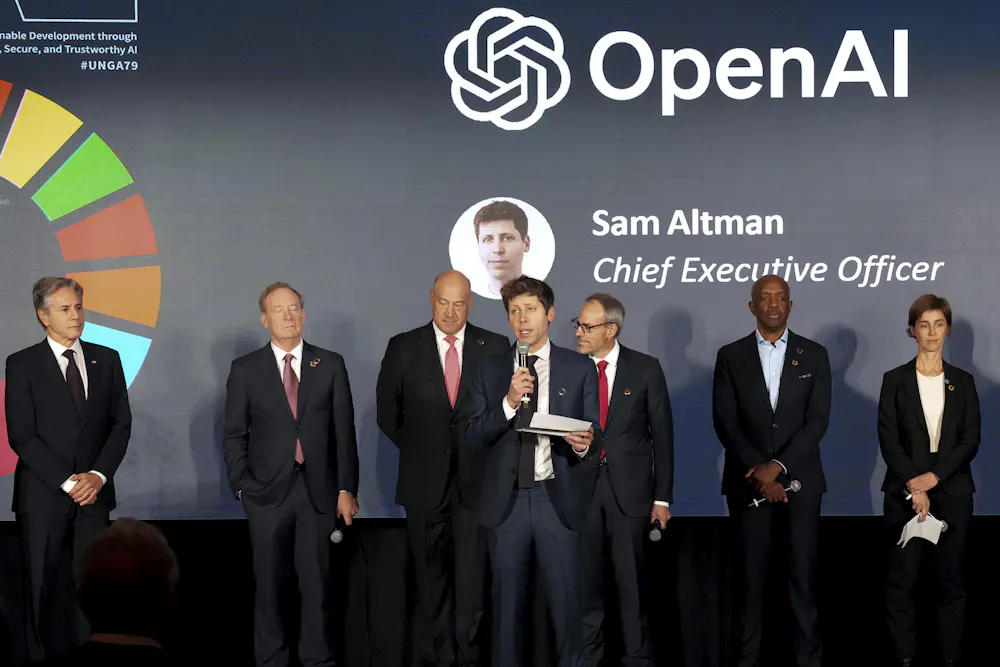
Why would OpenAI’s structure change?
OpenAI’s deep-pocketed investors cannot own shares in the organization under its existing nonprofit governance structure, nor can they get a seat on its board of directors. That’s because OpenAI is incorporated as a nonprofit whose purpose is to benefit society rather than private interests. Until now, all rounds of investments, including a reported total of $13 billion from Microsoft, have been channeled through a for-profit subsidiary that belongs to the nonprofit.
The current structure allows OpenAI to accept money from private investors in exchange for a future portion of its profits. But those investors do not get a voting seat on the board, and their profits are “capped.” According to information previously made public, OpenAI’s original investors can’t earn more than 100 times the money they provided. The goal of this hybrid governance model is to balance profits with OpenAI’s safety-focused mission.
Becoming a for-profit enterprise would make it possible for its investors to acquire ownership stakes in OpenAI and no longer have to face a cap on their potential profits. Down the road, OpenAI could also go public and raise capital on the stock market.
Altman reportedly seeks to personally acquire a 7% equity stake in OpenAI, according to a Bloomberg article that cited unnamed sources.
That arrangement is not allowed for nonprofit executives, according to BoardSource, an association of nonprofit board members and executives. Instead, the association explains, nonprofits “must reinvest surpluses back into the organization and its tax-exempt purpose.”
What kind of company might OpenAI become?
The Washington Post and other media outlets have reported, also citing unnamed sources, that OpenAI might become a “public benefit corporation” – a business that aims to benefit society and earn profits.
Examples of businesses with this status, known as B Corps., include outdoor clothing and gear company Patagonia and eyewear maker Warby Parker.
It’s more typical that a for-profit business – not a nonprofit – becomes a benefit corporation, according to the B Lab, a network that sets standards and offers certification for B Corps. It is unusual for a nonprofit to do this because nonprofit governance already requires those groups to benefit society.
Boards of companies with this legal status are free to consider the interests of society, the environment and people who aren’t its shareholders, but that is not required. The board may still choose to make profits a top priority and can drop its benefit status to satisfy its investors. That is what online craft marketplace Etsy did in 2017, two years after becoming a publicly traded company.
In my view, any attempt to convert a nonprofit into a public benefit corporation is a clear move away from focusing on the nonprofit’s mission. And there will be a risk that becoming a benefit corporation would just be a ploy to mask a shift toward focusing on revenue growth and investors’ profits.
Many legal scholars and other experts are predicting that OpenAI will not do away with its hybrid ownership model entirely because of legal restrictions on the placement of nonprofit assets in private hands.
But I think OpenAI has a possible workaround: It could try to dilute the nonprofit’s control by making it a minority shareholder in a new for-profit structure. This would effectively eliminate the nonprofit board’s power to hold the company accountable. Such a move could lead to an investigation by the office of the relevant state attorney general and potentially by the Internal Revenue Service.
What could happen if OpenAI turns into a for-profit company?
The stakes for society are high.
AI’s potential harms are wide-ranging, and some are already apparent, such as deceptive political campaigns and bias in health care.
If OpenAI, an industry leader, begins to focus more on earning profits than ensuring AI’s safety, I believe that these dangers could get worse. Geoffrey Hinton, who won the 2024 Nobel Prize in physics for his artificial intelligence research, has cautioned that AI may exacerbate inequality by replacing “lots of mundane jobs.” He believes that there’s a 50% probability “that we’ll have to confront the problem of AI trying to take over” from humanity.
And even if OpenAI did retain board members for whom safety is a top concern, the only common denominator for the members of its new corporate board would be their obligation to protect the interests of the company’s shareholders, who would expect to earn a profit. While such expectations are common on a for-profit board, they constitute a conflict of interest on a nonprofit board where mission must come first and board members cannot benefit financially from the organization’s work.
The arrangement would, no doubt, please OpenAI’s investors. But would it be good for society? The purpose of nonprofit control over a for-profit subsidiary is to ensure that profit does not interfere with the nonprofit’s mission. Without guardrails to ensure that the board seeks to limit harm to humanity from AI, there would be little reason for it to prevent the company from maximizing profit, even if its chatbots and other AI products endanger society.
Regardless of what OpenAI does, most artificial intelligence companies are already for-profit businesses. So, in my view, the only way to manage the potential harms is through better industry standards and regulations that are starting to take shape.
California’s governor vetoed such a bill in September 2024 on the grounds it would slow innovation – but I believe slowing it down is exactly what is needed, given the dangers AI already poses to society.
Alnoor Ebrahim, Thomas Schmidheiny Professor of International Business, The Fletcher School & Tisch College of Civic Life, Tufts University
This article is republished from The Conversation under a Creative Commons license. Read the original article.
The science section of our news blog STM Daily News provides readers with captivating and up-to-date information on the latest scientific discoveries, breakthroughs, and innovations across various fields. We offer engaging and accessible content, ensuring that readers with different levels of scientific knowledge can stay informed. Whether it’s exploring advancements in medicine, astronomy, technology, or environmental sciences, our science section strives to shed light on the intriguing world of scientific exploration and its profound impact on our daily lives. From thought-provoking articles to informative interviews with experts in the field, STM Daily News Science offers a harmonious blend of factual reporting, analysis, and exploration, making it a go-to source for science enthusiasts and curious minds alike. https://stmdailynews.com/category/science/





