Connect with us

The Knowledge

Why two tiny mountain peaks became one of the internet’s most famous images

Two tiny mountain peaks: Ever wonder why a mountain icon appears when images won’t load? Discover the fascinating history behind the internet’s most ubiquitous placeholder symbol, from Japanese camera dials to Windows XP’s “Bliss” wallpaper, and why mountains represent mystery in digital life.

Published

on

Why two tiny mountain peaks became one of the internet’s most famous images
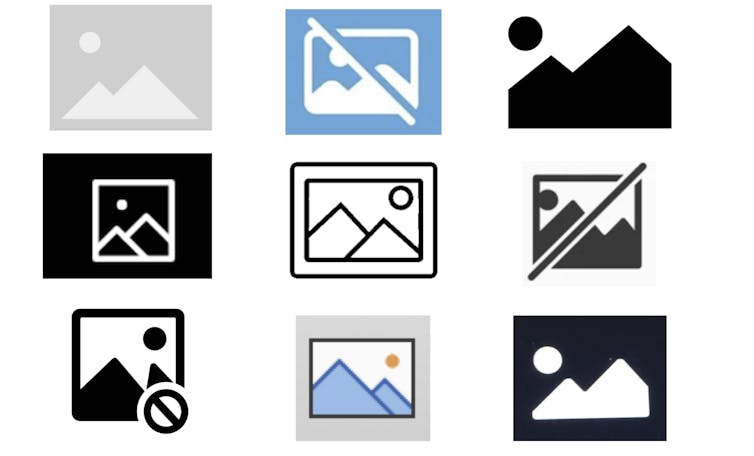
The icon has various iterations, but all convey the same meaning: an image should be here.
Christopher Schaberg, CC BY-SA

Why two tiny mountain peaks became one of the internet’s most famous images

Christopher Schaberg, Washington University in St. Louis

It’s happened to you countless times: You’re waiting for a website to load, only to see a box with a little mountain range where an image should be. It’s the placeholder icon for a “missing image.”

But have you ever wondered why this scene came to be universally adopted?

As a scholar of environmental humanities, I pay attention to how symbols of wilderness appear in everyday life.

The little mountain icon – sometimes with a sun or cloud in the background, other times crossed out or broken – has become the standard symbol, across digital platforms, to signal something missing or something to come. It appears in all sorts of contexts, and the more you look for this icon, the more you’ll see it.

You click on it in Microsoft Word or PowerPoint when you want to add a picture. You can purchase an ironic poster of the icon to put on your wall. The other morning, I even noticed a version of it in my Subaru’s infotainment display as a stand-in for a radio station logo.

So why this particular image of the mountain peaks? And where did it come from?

Arriving at the same solution

The placeholder icon can be thought of as a form of semiotic convergence, or when a symbol ends up meaning the same thing in a variety of contexts. For example, the magnifying glass is widely understood as “search,” while the image of a leaf means “eco-friendly.”

It’s also related to something called “convergent design evolution,” or when organisms or cultures – even if they have little or no contact – settle on a similar shape or solution for something.

In evolutionary biology, you can see convergent design evolution in bats, birds and insects, who all utilize wings but developed them in their own ways. Stilt houses emerged in various cultures across the globe as a way to build durable homes along shorelines and riverbanks. More recently, engineers in different parts of the world designed similar airplane fuselages independent of one another.

For whatever reason, the little mountain just worked across platforms to evoke open-ended meanings: Early web developers needed a simple shorthand way to present that something else should or could be there.

Advertisement
Get More From A Face Cleanser And Spa-like Massage

Depending on context, a little mountain might invite a user to insert a picture in a document; it might mean that an image is trying to load, or is being uploaded; or it could mean an image is missing or broken.

Down the rabbit hole on a mountain

But of the millions of possibilities, why a mountain?

In 1994, visual designer Marsh Chamberlain created a graphic featuring three colorful shapes as a stand-in for a missing image or broken link for the web browser Netscape Navigator. The shapes appeared on a piece of paper with a ripped corner. Though the paper with the rip will sometimes now appear with the mountain, it isn’t clear when the square, circle and triangle became a mountain.

A generic camera dial featuring various modes, with the 'landscape mode' – represented by two little mountain peaks – highlighted.
Two little mountain peaks are used to signal ‘landscape mode’ on many SLR cameras.
Althepal/Wikimedia Commons, CC BY

Users on Stack Exchange, a forum for developers, suggest that the mountain peak icon may trace back to the “landscape mode” icon on the dials of Japanese SLR cameras. It’s the feature that sets the aperture to maximize the depth of field so that both the foreground and background are in focus.

The landscape scene mode – visible on many digital cameras in the 1990s – was generically represented by two mountain peaks, with the idea that the camera user would intuitively know to use this setting outdoors.

Another insight emerged from the Stack Exchange discussion: The icon bears a resemblance to the Microsoft XP wallpaper called “Bliss.” If you had a PC in the years after 2001, you probably recall the rolling green hills with blue sky and wispy clouds.

The stock photo was taken by National Geographic photographer Charles O’Rear. It was then purchased by Bill Gates’ digital licensing company Corbis in 1998. The empty hillside in this picture became iconic through its adoption by Windows XP as its default desktop wallpaper image.
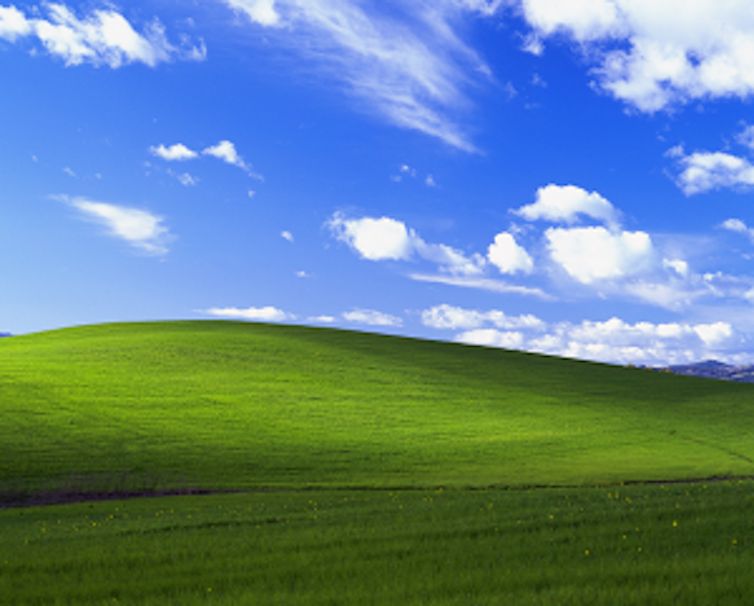
A colorful stock photo of green rolling hills, a blue sky and clouds.
If you used a PC at the turn of the 21st century, you probably encountered ‘Bliss.’
Wikimedia Commons

Mountain riddles

“Bliss” became widely understood as the most generic of generic stock photos, in the same way the placeholder icon became universally understood to mean “missing image.” And I don’t think it’s a coincidence that they both feature mountains or hills and a sky.

Mountains and skies are mysterious and full of possibilities, even if they remain beyond grasp.

Consider Japanese artist Hokusai’s “36 Views of Mount Fuji,” which were his series of paintings from the 1830s – the most famous of which is probably “The Great Wave off Kanagawa,” where a tiny Mount Fuji can be seen in the background. Each painting features the iconic mountain from different perspectives and is full of little details; all possess an ambiance of mystery.

A painting of a large rowboat manned by people on rolling waves with a large mountain in the background.
‘Tago Bay near Ejiri on the Tokaido,’ from Hokusai’s series ‘36 Views of Mount Fuji.’
Heritage Art/Heritage Images via Getty Images

I wouldn’t be surprised if the landscape icon on those Japanese camera dials emerged as a minimalist reference to Mount Fuji, Japan’s highest mountain. From some perspectives, Mount Fuji rises behind a smaller incline. And the Japanese photography company Fujifilm even borrowed the namesake of that mountain for their brand.

The enticing aesthetics of mountains also reminded me of the environmental writer Gary Snyder’s 1965 translation of Han Shan’s “Cold Mountain Poems.” Han Shan – his name literally means “Cold Mountain” – was a Chinese Buddhist poet who lived in the late eighth century. “Shan” translates as “mountain” and is represented by the Chinese character 山, which also resembles a mountain.

Han Shan’s poems, which are little riddles themselves, revel in the bewildering aspects of mountains:

Advertisement
Get More From A Face Cleanser And Spa-like Massage

Cold Mountain is a house
Without beams or walls.
The six doors left and right are open
The hall is a blue sky.
The rooms are all vacant and vague.
The east wall beats on the west wall
At the center nothing.

The mystery is the point

I think mountains serve as a universal representation of something unseen and longed for – whether it’s in a poem or on a sluggish internet browser – because people can see a mountain and wonder what might be there.

The placeholder icon does what mountains have done for millennia, serving as what the environmental philosopher Margret Grebowicz describes as an object of desire. To Grebowicz, mountains exist as places to behold, explore and sometimes conquer.

The placeholder icon’s inherent ambiguity is baked into its form: Mountains are often regarded as distant, foreboding places. At the same time, the little peaks appear in all sorts of mundane computing circumstances. The icon could even be a curious sign of how humans can’t help but be “nature-positive,” even when on computers or phones.

This small icon holds so much, and yet it can also paradoxically mean that there is nothing to see at all.

Viewing it this way, an example of semiotic convergence becomes a tiny allegory for digital life writ large: a wilderness of possibilities, with so much just out of reach.

Christopher Schaberg, Director of Public Scholarship, Washington University in St. Louis

This article is republished from The Conversation under a Creative Commons license. Read the original article.

Dive into “The Knowledge,” where curiosity meets clarity. This playlist, in collaboration with STMDailyNews.com, is designed for viewers who value historical accuracy and insightful learning. Our short videos, ranging from 30 seconds to a minute and a half, make complex subjects easy to grasp in no time. Covering everything from historical events to contemporary processes and entertainment, “The Knowledge” bridges the past with the present. In a world where information is abundant yet often misused, our series aims to guide you through the noise, preserving vital knowledge and truths that shape our lives today. Perfect for curious minds eager to discover the ‘why’ and ‘how’ of everything around us. Subscribe and join in as we explore the facts that matter.  https://stmdailynews.com/the-knowledge/

View recent photos

Unlock fun facts & lost history—get The Knowledge in your inbox!

We don’t spam! Read our privacy policy for more info.

Advertisement
Get More From A Face Cleanser And Spa-like Massage

Discover more from Daily News

Subscribe to get the latest posts sent to your email.

Continue Reading
Advertisement Tool Tickets
Click to comment
0 0 votes
Article Rating
Subscribe
Notify of
guest

0 Comments
Oldest
Newest Most Voted
Inline Feedbacks
View all comments

STM Blog

Why people trust influencers more than brands – and what that means for the future of marketing

Why people trust influencers? Discover why people trust influencers over traditional brands and what it means for marketing’s future. Learn about parasocial relationships, the 5 types of value influencers provide, and why microinfluencers often outperform mega-creators.

Published

on

Last Updated on December 16, 2025 by Daily News Staff

Why people trust influencers more than brands – and what that means for the future of marketing

Why people trust influencers more than brands – and what that means for the future of marketing

Kelley Cours Anderson, College of Charleston Not long ago, the idea of getting paid to share your morning routine online would have sounded absurd. Yet today, influencers are big business: The global market is expected to surpass US$32 billion by the end of 2025. Rooted in celebrity culture but driven by digital platforms, the influencer economy represents a powerful force in both commerce and culture. I’m an expert on digital consumer research, and I see the rise of influencers as an important evolution in the relationship between companies, consumers and creators. Historically, brands leaned on traditional celebrities like musicians, athletes and actors to endorse their products. However, by the late 2000s, social media platforms opened the door for everyday people to build audiences. Initially, influencers were viewed as a low-cost marketing tactic. Soon, however, they became a central part of marketing strategies. In the 2010s, influencer marketing matured into a global industry. Agencies and digital marketplaces emerged to professionalize influencer-brand matchmaking, and regulators like the Federal Trade Commission started paying more attention to sponsored content. The rise of video and short-form content like TikTok and Reels in the mid-2010s and 2020s added authenticity and emotional immediacy. These dynamics deepened influencer-follower relations in ways that brands couldn’t easily replicate. Influencers are now recognized as not only content creators, but also as entrepreneurs and cultural producers.

Why people trust influencers

Social media influencers often foster what researchers call “parasocial relationships” – one-sided bonds where followers feel as if they personally know the influencer. While the concept has roots in traditional celebrity culture, influencers amplify it through consistent, seemingly authentic content. This perceived intimacy helps explain why consumers often trust influencers more than brands. Though the parasocial relationship isn’t mutual, it feels real. That emotional closeness cultivates trust, a scarce but powerful currency in today’s economy. The goal for many influencers may be financial independence, but the path begins with social and cultural capital, acquired through community connection, relatability and niche expertise. As an influencer’s following grows, so does their perceived legitimacy. Brands, in turn, recognize and tap into that legitimacy. Although risks exist, like algorithmic incentives and commercial partnerships that undercut authenticity, many influencers successfully navigate this tension to preserve their community’s trust.

The many ways creators add value

Like any economy, the influencer economy revolves around value exchange. Followers spend their valuable resources – time and attention – in return for something meaningful. Researchers have identified several forms of value that influencers’ content can take:
  • Connection, or what researchers call “social value”: Influencers often build tight-knit communities around shared interests. Through live chats, comments and relatable storytelling, they offer a sense of belonging.
  • Fun, or “hedonic value”: Many influencers provide enjoyment using entertainment, humor and a touch of allure in their content. Think cat videos, TikTok dances and random acts of kindness that deliver joy and distraction from the day-to-day.
  • Knowledge, or “epistemic value”: Creators offer informational or educational content to feed consumer curiosity. This can be through tutorials, product reviews or deep dives into niche topics.
  • Usefulness, or “utilitarian value”: From life hacks to product roundups, like “Amazon must-haves,” influencers provide utilitarian or practical value to help simplify consumer decisions and solve everyday problems.
  • Money, or “financial value”: People love finding a bargain. Discounts, affiliate links and deal alerts offer direct economic benefit to followers. Some influencers even launch their own products or digital courses, delivering long-term value through entrepreneurial spinoffs.
These forms of value often overlap, reinforcing trust, and can pay off financially for influencers. In fact, consumers are significantly more likely to trust user-generated content like influencer posts over brand-generated advertising.

Lessons for brands

First, there’s evidence that smaller is often stronger. Marketing researchers categorize influencers based on how many followers they have, and nano- and microinfluencers – defined as those with fewer than 10,000 and 100,000 followers, respectively – often generate stronger engagement than mega-influencers with more than 1 million. Influencers with smaller followings can interact with their communities more closely, making their endorsements feel more credible. This has driven brands to focus on mid-tier and microinfluencers, where return on investment is often stronger. As a result, influencer agencies, brokers, platforms and trade associations have sprung up to facilitate these partnerships. Second, brands should remember that influencers’ role in the market comes with new challenges. As the field continues to become more professionalized, it’s also become more complex. Like other entrepreneurs, influencers must keep up with shifting regulations – namely, FTC sponsorship guidelines – which can lead to hefty fines if violated. Many struggle to identify how to best file their taxes when they receive freebies they are expected to build content around. It can also be a challenge for influencers to keep up with continued algorithm tweaks from the multiple social media platforms where they publish. Influencers manage more than content creation. Their role includes quickly responding to followers’ comments and managing communities, as well as handling trolls, all of which is stressful. Personal brand management adds another layer of pressure. As influencers gain more brand partnerships, they run the risk of being seen as “selling out.” Because parasocial trust depends on being viewed as authentic, aligning with the wrong brand or being too promotional can damage the very connection that built an influencer’s following. A single misstep can trigger public backlash. While growing a following can bring brand recognition and financial independence, some influencers even fear that they will lose their own identity. Influencers can struggle with work-life balance, as this is not a nine-to-five job. It requires being “always on” and the constant blurred lines. Their lives become their livelihoods, with little separation between personal and professional identity. In short, when engaging with influencers, strategic brands will recognize that they operate within an intense, high-pressure environment. Organizations such as the American Influencer Council offer support and advocacy, but industry-wide protections are lacking. Influencers have earned a central place in consumer culture not just by selling products, but by offering emotional proximity, cultural relevance and value. They’re not just marketers – they’re creators, community leaders and entrepreneurs. As the creator economy continues to grow, trust will remain its cornerstone. However, the next chapter will require thoughtful navigation of issues like regulation, platform ethics and creator well-being. Understanding influencers means recognizing both their creative work and the evolving market that now depends on them. Kelley Cours Anderson, Assistant Professor of Marketing, College of Charleston This article is republished from The Conversation under a Creative Commons license. Read the original article.

Dive into “The Knowledge,” where curiosity meets clarity. This playlist, in collaboration with STMDailyNews.com, is designed for viewers who value historical accuracy and insightful learning. Our short videos, ranging from 30 seconds to a minute and a half, make complex subjects easy to grasp in no time. Covering everything from historical events to contemporary processes and entertainment, “The Knowledge” bridges the past with the present. In a world where information is abundant yet often misused, our series aims to guide you through the noise, preserving vital knowledge and truths that shape our lives today. Perfect for curious minds eager to discover the ‘why’ and ‘how’ of everything around us. Subscribe and join in as we explore the facts that matter.  https://stmdailynews.com/the-knowledge/


Discover more from Daily News

Subscribe to get the latest posts sent to your email.

Continue Reading

Science

Why can’t I wiggle my toes one at a time, like my fingers?

why can’t I wiggle my toes? Ever wondered why you can’t wiggle your toes one at a time like your fingers? Learn how evolution, muscles, and your brain all play a part in making fingers more independent than toes—and why that’s key for walking and balance.

Published

on

Why can’t I wiggle my toes one at a time, like my fingers?
A baby chimp can grab a stick equally well with its fingers and its toes. Anup Shah/Stone via Getty Images

Why Can’t You Wiggle Your Toes Like Your Fingers? The Science Behind Toe and Finger Movement

Steven Lautzenheiser, University of Tennessee Curious Kids is a series for children of all ages. If you have a question you’d like an expert to answer, send it to curiouskidsus@theconversation.com.
Why can’t I wiggle my toes individually, like I can with my fingers? – Vincent, age 15, Arlington, Virginia

One of my favorite activities is going to the zoo where I live in Knoxville when it first opens and the animals are most active. On one recent weekend, I headed to the chimpanzees first. Their breakfast was still scattered around their enclosure for them to find. Ripley, one of the male chimpanzees, quickly gathered up some fruits and vegetables, sometimes using his feet almost like hands. After he ate, he used his feet to grab the fire hoses hanging around the enclosure and even held pieces of straw and other toys in his toes. I found myself feeling a bit envious. Why can’t people use our feet like this, quickly and easily grasping things with our toes just as easily as we do with our fingers? I’m a biological anthropologist who studies the biomechanics of the modern human foot and ankle, using mechanical principles of movement to understand how forces affect the shape of our bodies and how humans have changed over time. Your muscles, brain and how human feet evolved all play a part in why you can’t wiggle individual toes one by one.
young chimp running on all fours
Chimpanzee hands and feet do similar jobs. Manoj Shah/Stone via Getty Images

Comparing humans to a close relative

Humans are primates, which means we belong to the same group of animals that includes apes like Riley the chimp. In fact, chimpanzees are our closest genetic relatives, sharing almost 98.8% of our DNA. Evolution is part of the answer to why chimpanzees have such dexterous toes while ours seem much more clumsy. Our very ancient ancestors probably moved around the way chimpanzees do, using both their arms and legs. But over time our lineage started walking on two legs. Human feet needed to change to help us stay balanced and to support our bodies as we walk upright. It became less important for our toes to move individually than to keep us from toppling over as we moved through the world in this new way.
bare feet walking across sandy surface toward camera
Feet adapted so we could walk and balance on just two legs. Karina Mansfield/Moment via Getty Images
Human hands became more important for things such as using tools, one of the hallmark skills of human beings. Over time, our fingers became better at moving on their own. People use their hands to do lots of things, such as drawing, texting or playing a musical instrument. Even typing this article is possible only because my fingers can make small, careful and controlled movements. People’s feet and hands evolved for different purposes.

Muscles that move your fingers or toes

Evolution brought these differences about by physically adapting our muscles, bones and tendons to better support walking and balance. Hands and feet have similar anatomy; both have five fingers or toes that are moved by muscles and tendons. The human foot contains 29 muscles that all work to help you walk and stay balanced when you stand. In comparison, a hand has 34 muscles. Most of the muscles of your foot let you point your toes down, like when you stand on tiptoes, or lift them up, like when you walk on your heels. These muscles also help feet roll slightly inward or outward, which lets you keep your balance on uneven ground. All these movements work together to help you walk and run safely. The big toe on each foot is special because it helps push your body forward when you walk and has extra muscles just for its movement. The other four toes don’t have their own separate muscles. A few main muscles in the bottom of your foot and in your calf move all four toes at once. Because they share muscles, those toes can wiggle, but not very independently like your fingers can. The calf muscles also have long tendons that reach into the foot; they’re better at keeping you steady and helping you walk than at making tiny, precise movements.
a pen and ink drawing of the interior anatomy of a human hand
Your hand is capable of delicate movements thanks to the muscles and ligaments that control its bones. Henry Gray, ‘Anatomy of the Human Body’/Wikimedia Commons, CC BY
In contrast, six main muscle groups help move each finger. The fingers share these muscles, which sit mostly in the forearm and connect to the fingers by tendons. The thumb and pinky have extra muscles that let you grip and hold objects more easily. All of these muscles are specialized to allow careful, controlled movements, such as writing. So, yes, I have more muscles dedicated to moving my fingers, but that is not the only reason I can’t wiggle my toes one by one.

Divvying up brain power

You also need to look inside your brain to understand why toes and fingers work differently. Part of your brain called the motor cortex tells your body how to move. It’s made of cells called neurons that act like tiny messengers, sending signals to the rest of your body. Your motor cortex devotes many more neurons to controlling your fingers than your toes, so it can send much more detailed instructions to your fingers. Because of the way your motor cortex is organized, it takes more “brain power,” meaning more signals and more activity, to move your fingers than your toes.
illustration of a brain looking down at the top of the head with one section highlighted orange
The motor cortex of your brain sends orders to move parts of your body. Kateryna Kon/Science Photo Library via Getty Images
Even though you can’t grab things with your feet like Ripley the chimp can, you can understand why.
Hello, curious kids! Do you have a question you’d like an expert to answer? Ask an adult to send your question to CuriousKidsUS@theconversation.com. Please tell us your name, age and the city where you live. And since curiosity has no age limit – adults, let us know what you’re wondering, too. We won’t be able to answer every question, but we will do our best. Steven Lautzenheiser, Assistant Professor of Biological Anthropology, University of Tennessee This article is republished from The Conversation under a Creative Commons license. Read the original article.
❄️ The Man Who Made Air Conditioning Cool
Link: https://stmdailynews.com/%e2%9d%84%ef%b8%8f-the-man-who-made-air-conditioning-cool/

Discover more from Daily News

Subscribe to get the latest posts sent to your email.

Continue Reading

Entertainment

Hollywood vs. Reality: How LA’s Wilshire Subway Was Really Built

Wilshire Subway: Did LA blast subway tunnels under Wilshire Boulevard? Hollywood says yes — engineers say no. Here’s how Metro safely tunneled beneath Miracle Mile.

Published

on

envato labs image edit

When the 1997 disaster film Volcano depicted lava erupting along Wilshire Boulevard and referenced blasting during Red Line subway construction, it delivered gripping cinema — but not accurate engineering.

In reality, Los Angeles Metro did not rely on large-scale blasting to construct subway tunnels beneath Wilshire Boulevard and the Miracle Mile. Instead, engineers used tunnel boring machines (TBMs) specifically to avoid the very risks Hollywood dramatized.

Why Blasting Was Avoided

The Wilshire Corridor sits atop historic oil fields, making methane gas pockets a known and serious concern. A deadly methane explosion near Fairfax Avenue in 1985 led to heightened scrutiny of underground construction in the area. Blasting in such conditions could have caused unpredictable gas releases, ground instability, or damage to surface structures.

As a result, Metro engineers chose pressurized, closed-face tunnel boring machines, which allow for:

  • Controlled excavation in dense urban environments

  • Continuous ground support to prevent settlement

  • Integrated gas detection and ventilation systems

These machines grind slowly through soil and rock while installing precast concrete tunnel linings, creating a sealed, gas-resistant structure as they advance. envato labs image edit

The Real Engineering Feat

Although Volcano took creative liberties for dramatic effect, the true story of tunneling under Wilshire is no less impressive. Advances in TBM technology and methane mitigation ultimately allowed the Metro D Line (formerly the Red Line/Purple Line) to safely pass through one of Los Angeles’ most geologically complex corridors — without explosions, collapsing streets, or cinematic chaos.

Bottom Line

Volcano remains a memorable piece of 1990s disaster cinema, but its portrayal of subway construction is fiction. The real achievement lies in decades of careful planning, modern tunneling technology, and engineering solutions that quietly reshaped Los Angeles beneath its busiest boulevard.

Related Links:

Dreambreaker: A Pickleball Story — A Closer Look at the Documentary and Its Uncredited Voice
Link: https://stmdailynews.com/dreambreaker-a-pickleball-story-a-closer-look-at-the-documentary-and-its-uncredited-voice/

Discover more from Daily News

Subscribe to get the latest posts sent to your email.

Continue Reading

Trending

0
Would love your thoughts, please comment.x
()
x