Connect with us

Blog

The 8,000-Year History of Pecans: How America’s Only Native Nut Became a Holiday Staple

Discover how pecans went from ignored trees to holiday staples over 8,000 years. Learn about Native American pecan use, the enslaved man who revolutionized pecan grafting, George Washington’s pecan obsession, and why the US produces 80% of the world’s pecans.

Published

on

Last Updated on December 22, 2025 by Daily News Staff

file 20251113 56 e454f1.jpg?ixlib=rb 4.1
Pecan pie is a popular holiday treat in the United States.
Julie Deshaies/iStock via Getty Images

How pecans went from ignored trees to a holiday staple – the 8,000-year history of America’s only native major nut crop

Shelley Mitchell, Oklahoma State University

Pecans have a storied history in the United States. Today, American trees produce hundreds of million of pounds of pecans – 80% of the world’s pecan crop. Most of that crop stays here. Pecans are used to produce pecan milk, butter and oil, but many of the nuts end up in pecan pies.

Throughout history, pecans have been overlooked, poached, cultivated and improved. As they have spread throughout the United States, they have been eaten raw and in recipes. Pecans have grown more popular over the decades, and you will probably encounter them in some form this holiday season.

I’m an extension specialist in Oklahoma, a state consistently ranked fifth in pecan production, behind Georgia, New Mexico, Arizona and Texas. I’ll admit that I am not a fan of the taste of pecans, which leaves more for the squirrels, crows and enthusiastic pecan lovers.

The spread of pecans

The pecan is a nut related to the hickory. Actually, though we call them nuts, pecans are actually a type of fruit called a drupe. Drupes have pits, like the peach and cherry.

Three green, oval-shaped pods on the branch of a tree
Three pecan fruits, which ripen and split open to release pecan nuts, clustered on a pecan tree.
IAISI/Moment via Getty Images

The pecan nuts that look like little brown footballs are actually the seed that starts inside the pecan fruit – until the fruit ripens and splits open to release the pecan. They are usually the size of your thumb, and you may need a nutcracker to open them. You can eat them raw or as part of a cooked dish.

The pecan derives its name from the Algonquin “pakani,” which means “a nut too hard to crack by hand.” Rich in fat and easy to transport, pecans traveled with Native Americans throughout what is now the southern United States. They were used for food, medicine and trade as early as 8,000 years ago.

A map of the US with parts of Texas, Louisiana, Oklahoma, Arkansas and Missouri highlighted in green.
Pecans are native to the southern United States.
Elbert L. Little Jr. of the U.S. Department of Agriculture, Forest Service

Pecans are native to the southern United States, and while they had previously spread along travel and trade routes, the first documented purposeful planting of a pecan tree was in New York in 1722. Three years later, George Washington’s estate, Mount Vernon, had some planted pecans. Washington loved pecans, and Revolutionary War soldiers said he was constantly eating them.

Meanwhile, no one needed to plant pecans in the South, since they naturally grew along riverbanks and in groves. Pecan trees are alternate bearing: They will have a very large crop one year, followed by one or two very small crops. But because they naturally produced a harvest with no input from farmers, people did not need to actively cultivate them. Locals would harvest nuts for themselves but otherwise ignored the self-sufficient trees.

It wasn’t until the late 1800s that people in the pecan’s native range realized the pecan’s potential worth for income and trade. Harvesting pecans became competitive, and young boys would climb onto precarious tree branches. One girl was lifted by a hot air balloon so she could beat on the upper branches of trees and let them fall to collectors below. Pecan poaching was a problem in natural groves on private property.

Pecan cultivation begins

Even with so obvious a demand, cultivated orchards in the South were still rare into the 1900s. Pecan trees don’t produce nuts for several years after planting, so their future quality is unknown.

Two lines of trees
An orchard of pecan trees.
Jon Frederick/iStock via Getty Images

To guarantee quality nuts, farmers began using a technique called grafting; they’d join branches from quality trees to another pecan tree’s trunk. The first attempt at grafting pecans was in 1822, but the attempts weren’t very successful.

Grafting pecans became popular after an enslaved man named Antoine who lived on a Louisiana plantation successfully produced large pecans with tender shells by grafting, around 1846. His pecans became the first widely available improved pecan variety.

Advertisement
Get More From A Face Cleanser And Spa-like Massage
A cut tree trunk with two smaller, thiner shoots (from a different type of tree) protruding from it.
Grafting is a technique that involves connecting the branch of one tree to the trunk of another.
Orest Lyzhechka/iStock via Getty Images

The variety was named Centennial because it was introduced to the public 30 years later at the Philadelphia Centennial Expedition in 1876, alongside the telephone, Heinz ketchup and the right arm of the Statue of Liberty.

This technique also sped up the production process. To keep pecan quality up and produce consistent annual harvests, today’s pecan growers shake the trees while the nuts are still growing, until about half of the pecans fall off. This reduces the number of nuts so that the tree can put more energy into fewer pecans, which leads to better quality. Shaking also evens out the yield, so that the alternate-bearing characteristic doesn’t create a boom-bust cycle.

US pecan consumption

The French brought praline dessert with them when they immigrated to Louisiana in the early 1700s. A praline is a flat, creamy candy made with nuts, sugar, butter and cream. Their original recipe used almonds, but at the time, the only nut available in America was the pecan, so pecan pralines were born.

Two clusters of nuts and creamy butter on a plate.
Pralines were originally a French dessert, but Americans began making them with pecans.
Jupiterimages/The Image Bank via Getty Images

During the Civil War and world wars, Americans consumed pecans in large quantities because they were a protein-packed alternative when meat was expensive and scarce. One cup of pecan halves has about 9 grams of protein.

After the wars, pecan demand declined, resulting in millions of excess pounds at harvest. One effort to increase demand was a national pecan recipe contest in 1924. Over 21,000 submissions came from over 5,000 cooks, with 800 of them published in a book.

Pecan consumption went up with the inclusion of pecans in commercially prepared foods and the start of the mail-order industry in the 1870s, as pecans can be shipped and stored at room temperature. That characteristic also put them on some Apollo missions. Small amounts of pecans contain many vitamins and minerals. They became commonplace in cereals, which touted their health benefits.

In 1938, the federal government published the pamphlet Nuts and How to Use Them, which touted pecans’ nutritional value and came with recipes. Food writers suggested using pecans as shortening because they are composed mostly of fat.

The government even put a price ceiling on pecans to encourage consumption, but consumers weren’t buying them. The government ended up buying the surplus pecans and integrating them into the National School Lunch Program.

A machine with an arm attached to a tree, and a wheeled cab on the ground.
Today, pecan producers use machines called tree shakers to shake pecans out of the trees.
Christine_Kohler/iStock via Getty Images

While you are sitting around the Thanksgiving table this year, you can discuss one of the biggest controversies in the pecan industry: Are they PEE-cans or puh-KAHNS?

Editor’s note: This article was updated to include the amount of protein in a cup of pecans.

Shelley Mitchell, Senior Extension Specialist in Horticulture and Landscape Architecture, Oklahoma State University

This article is republished from The Conversation under a Creative Commons license. Read the original article.

High Demand Marks “Veggies for Veterans” Event Amid SNAP Delays

Advertisement
Get More From A Face Cleanser And Spa-like Massage

Link: https://stmdailynews.com/high-demand-marks-veggies-for-veterans-event-amid-snap-delays/

View recent photos

Unlock fun facts & lost history—get The Knowledge in your inbox!

We don’t spam! Read our privacy policy for more info.


Discover more from Daily News

Subscribe to get the latest posts sent to your email.

amusement and theme parks

Inside the Wait for Mattel Adventure Park & VAI Resort in Glendale, Arizona

Published

on

Last Updated on March 4, 2026 by Daily News Staff

What was once pitched as one of the most exciting new additions to Arizona’s entertainment landscape — a world-class resort and theme park featuring some of Mattel’s most beloved brands — has become a long-anticipated project marked by persistent delays, evolving plans, and growing expectations.

Mattel Adventure Park
Rendering of Mattel Adventure Park, Image courtesy of Mattel

A Vision Bigger Than a Theme Park

The centerpiece of the massive development near State Farm Stadium in Glendale, Arizona is VAI Resort, a 60-acre luxury entertainment destination designed to combine upscale hospitality with dynamic entertainment. Plans include:

  • Over 1,100 luxury hotel rooms spread across multiple towers, catering to visitors of all types.  
  • A beach-style water oasis with white sand and temperature-controlled pools — a first for Arizona.  
  • A state-of-the-art concert amphitheater for national performers and DJ-driven nightlife.  
  • Dozens of restaurants, lounges, shopping experiences, and convention spaces.  And anchored within this resort footprint is the long-awaited Mattel Adventure Park — a theme park bringing Hot Wheels™, Barbie™, Thomas & Friends™, and other iconic Mattel brands to life.  

Construction Progress — Visible and Ongoing

The resort and park construction continue visibly along Cardinals Way and West Cardinals Way just south of the State Farm Stadium area. Over the past several years, crews have been steadily working on building structures for the resort’s hotels, water features, and entertainment venues.  

For Mattel Adventure Park specifically:

  • Core infrastructure and coaster track supports have been erected, including sections of the distinctive Hot Wheels-themed attractions, though construction has been slower than initially anticipated.  
  • The project’s official construction live-camera feed continues to stream real-time activity, underscoring that work is not abandoned even if progress isn’t tracking toward imminent completion.  

In support of the wider development, the City of Glendale approved construction of a large parking garage designed to handle tens of thousands of visitors tied to future resort events and park operations.  

Most recently, the resort’s developer expanded its footprint by acquiring an additional 33 acres of land to support future hospitality, residential, and commercial uses — a sign of long-term confidence in the destination despite timeline shifts.  


Opening Date Ambiguity and Shifting Targets

From the outset, Mattel Adventure Park was slated to open in coordination with major regional events — originally pegged for 2022 and the Super Bowl LVII timeframe — then revised for 2023, 2024, and late 2025.  

Similarly, VAI Resort itself has repeatedly shifted its projected debut:

  • In April 2025, resort officials were targeting late 2025 for phased openings.  
  • By late 2025, that target had quietly dropped from public materials, and the official website no longer listed a specific opening date.  
  • As of early 2026, VAI Resort officials have refused to commit to any set opening date, saying they intend to announce a timeline only 9–12 months prior to launch — a stance that has left Arizona residents and visitors without concrete expectations.  

There’s no public evidence yet that Mattel Adventure Park will open in early 2026, and some observers speculate the project may slide further into the future before doors open to the public.  


What Guests Can Expect (When It Opens)

When ultimately completed, Mattel Adventure Park promises a unique experience distinct from traditional amusement parks:

  • Hot Wheels™ Bone Shaker™ and Twin Mill™ Racer coasters
  • Barbie™ Beach House with themed experiences
  • Interactive zones featuring Thomas & Friends™ and other Mattel franchisesAll designed to appeal to families, children, and thrill seekers alike.  

Beyond the park itself, the resort’s expansive amenities — including beaches, concert venues, fine dining, luxury spas, and convention space — intend to make Glendale a year-round entertainment hub for visitors from across the Southwest and beyond.  


Looking Ahead

With additional land purchased and visible work continuing on multiple fronts, the broader VAI Resort and Mattel Adventure Park project is far from stalled, even if its opening dates have become increasingly uncertain.  

Industry watchers and local residents alike will likely continue to track construction progress closely, waiting for the first official announcement of firm opening dates — a milestone the resort has said it’s now hesitant to set prematurely.

Track updates on the VAI Resort official website and the project’s construction live camera feed.

Advertisement
Get More From A Face Cleanser And Spa-like Massage

For more information about Mattel Adventure Park and VAI Resort, visit the Official website

Authors

  • Rod Washington

    Rod: A creative force, blending words, images, and flavors. Blogger, writer, filmmaker, and photographer. Cooking enthusiast with a sci-fi vision. Passionate about his upcoming series and dedicated to TNC Network. Partnered with Rebecca Washington for a shared journey of love and art. View all posts

  • IMG 2910 square e1726830094359

    Rebecca Jo is a mother of four and is a creative soul from Phoenix, Arizona, who also enjoys new adventures. Rebecca Jo has a passion for the outdoors and indulges in activities like camping, fishing, hunting and riding roller coasters. She is married to Rod Washington View all posts


Discover more from Daily News

Subscribe to get the latest posts sent to your email.

Continue Reading

Urbanism

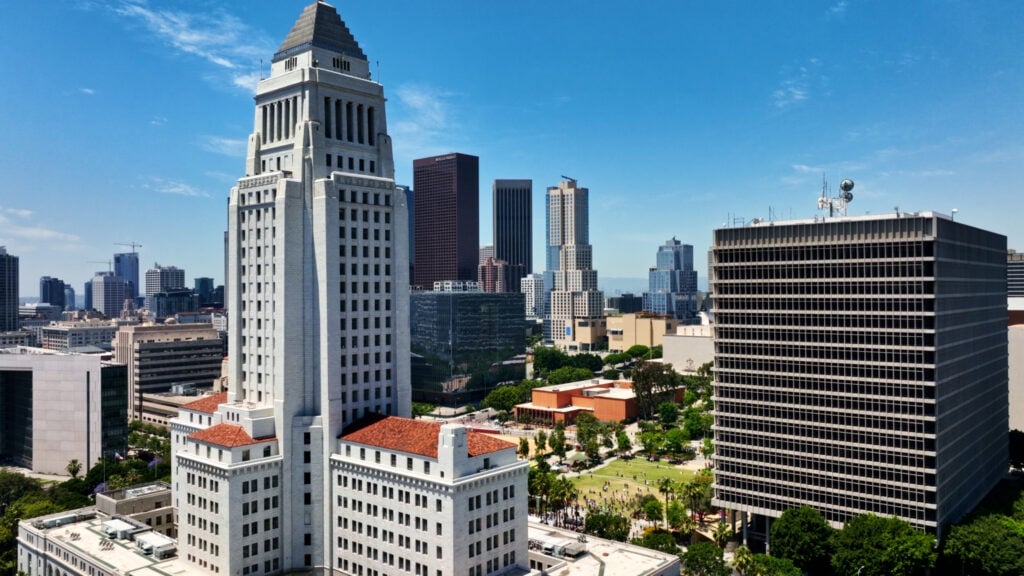
The Building That Proved Los Angeles Could Go Vertical

Los Angeles once banned skyscrapers, yet City Hall broke the height limit and proved high-rise buildings could be engineered safely in an earthquake zone.

Published

on

Last Updated on February 19, 2026 by Daily News Staff

Los Angeles once banned skyscrapers, yet City Hall broke the height limit and proved high-rise buildings could be engineered safely in an earthquake zone.
LA City Hall. Image Credit: TNC Network & Envato

How City Hall Quietly Undermined LA’s Own Height Limits

The Knowledge Series | STM Daily News

For more than half a century, Los Angeles enforced one of the strictest building height limits in the United States. Beginning in 1905, most buildings were capped at 150 feet, shaping a city that grew outward rather than upward.

The goal was clear: avoid the congestion, shadows, and fire dangers associated with dense Eastern cities. Los Angeles sold itself as open, sunlit, and horizontal — a place where growth spread across land, not into the sky.

And yet, in 1928, Los Angeles City Hall rose to 454 feet, towering over the city like a contradiction in concrete.

It wasn’t built to spark a commercial skyscraper boom.
But it ended up proving that Los Angeles could safely build one.


A Rule Designed to Prevent a Manhattan-Style City

The original height restriction was rooted in early 20th-century fears:

  • Limited firefighting capabilities
  • Concerns over blocked sunlight and airflow
  • Anxiety about congestion and overcrowding
  • A strong desire not to resemble New York or Chicago

Los Angeles wanted prosperity — just not vertical density.

The height cap reinforced a development model where:

  • Office districts stayed low-rise
  • Growth moved outward
  • Automobiles became essential
  • Downtown never consolidated into a dense core

This philosophy held firm even as other American cities raced upward.


@stmblog

Los Angeles banned skyscrapers for decades — except one. 🏛️ While most buildings were capped at 150 feet, LA City Hall rose three times higher. This wasn’t a loophole — it was power, symbolism, and city planning shaping the skyline we know today. Why was City Hall the exception? And how did this one decision change Los Angeles forever? 📍 Forgotten LA 🧠 The Knowledge Series 📰 STM Daily News LosAngelesHistory LACityHall ForgottenLA UrbanPlanning CityPlanning LASkyline DidYouKnow HistoryTok TheKnowledge STMDailyNews ♬ original sound – STMDailyNews – STMDailyNews


Why City Hall Was Never Meant to Change the Rules

City Hall was intentionally exempt from the height limit because the law applied primarily to private commercial buildings, not civic monuments.

But city leaders were explicit about one thing:
City Hall was not a precedent.

It was designed to:

Advertisement
Get More From A Face Cleanser And Spa-like Massage
  • Serve as a symbolic seat of government
  • Stand alone as a civic landmark
  • Represent stability, authority, and modern governance
  • Avoid competing with private office buildings

In effect, Los Angeles wanted a skyline icon — without a skyline.


Innovation Hidden in Plain Sight

What made City Hall truly significant wasn’t just its height — it was how it was built.

At a time when seismic science was still developing, City Hall incorporated advanced structural ideas for its era:

  • A steel-frame skeleton designed for flexibility
  • Reinforced concrete shear walls for lateral strength
  • A tapered tower to reduce wind and seismic stress
  • Thick structural cores that distributed force instead of resisting it rigidly

These choices weren’t about aesthetics — they were about survival.


The Earthquake That Changed the Conversation

In 1933, the Long Beach earthquake struck Southern California, causing widespread damage and reshaping building codes statewide.

Los Angeles City Hall survived with minimal structural damage.

This moment quietly reshaped the debate:

  • A tall building had endured a major earthquake
  • Structural engineering had proven effective
  • Height alone was no longer the enemy — poor design was

City Hall didn’t just survive — it validated a new approach to vertical construction in seismic regions.


Proof Without Permission

Despite this success, Los Angeles did not rush to repeal its height limits.

Cultural resistance to density remained strong, and developers continued to build outward rather than upward. But the technical argument had already been settled.

City Hall stood as living proof that:

  • High-rise buildings could be engineered safely in Los Angeles
  • Earthquakes were a challenge, not a barrier
  • Fire, structural, and seismic risks could be managed

The height restriction was no longer about safety — it was about philosophy.


The Ironic Legacy

When Los Angeles finally lifted its height limit in 1957, the city did not suddenly erupt into skyscrapers. The habit of building outward was already deeply entrenched.

The result:

Advertisement
Get More From A Face Cleanser And Spa-like Massage
  • A skyline that arrived decades late
  • Uneven density across the region
  • Multiple business centers instead of one core
  • Housing and transit challenges baked into the city’s growth pattern

City Hall never triggered a skyscraper boom — but it quietly made one possible.


Why This Still Matters

Today, Los Angeles continues to wrestle with:

  • Housing shortages
  • Transit-oriented development debates
  • Height and zoning battles near rail corridors
  • Resistance to density in a growing city

These debates didn’t begin recently.

They trace back to a single contradiction: a city that banned tall buildings — while proving they could be built safely all along.

Los Angeles City Hall wasn’t just a monument.
It was a test case — and it passed.

Further Reading & Sources


More from The Knowledge Series on STM Daily News


Discover more from Daily News

Subscribe to get the latest posts sent to your email.

Continue Reading

The Long Track Back

Why Downtown Los Angeles Feels Small Compared to Other Cities

Downtown Los Angeles often feels “small” compared to other U.S. cities, but that’s only part of the story. With some of the tallest buildings west of the Mississippi and skyline clusters spread across the region, LA’s downtown reflects the city’s unique polycentric identity—one that, if combined, could form a true mega downtown.

Published

on

Last Updated on February 18, 2026 by Daily News Staff

Downtown Los Angeles

Panorama of Los Angeles from Mount Hollywood – California, United States

When people think of major American cities, they often imagine a bustling, concentrated downtown core filled with skyscrapers. New York has Manhattan, Chicago has the Loop, San Francisco has its Financial District. Los Angeles, by contrast, often leaves visitors surprised: “Is this really downtown?”

The answer is yes—and no.

Downtown LA in Context

Compared to other major cities, Downtown Los Angeles (DTLA) is relatively small as a central business district. For much of the 20th century, strict height restrictions capped most buildings under 150 feet, while cities like Chicago and New York were erecting early skyscrapers. LA’s skyline didn’t really begin to climb until the late 1960s.

But history alone doesn’t explain why DTLA feels different. The real story lies in how Los Angeles grew: not as one unified city center, but as a collection of many hubs.

Downtown Los Angeles

Downtown Los Angeles

A Polycentric City

Los Angeles is famously decentralized. Hollywood developed around the film industry. Century City rose on former studio land as a business hub. Burbank became a studio and aerospace center. Long Beach grew around the port. The Wilshire Corridor filled with office towers and condos.

Unlike other cities where downtown is the place for work, culture, and finance, Los Angeles spread its energy outward. Freeways and car culture made it easy for businesses and residents to operate outside of downtown. The result is a polycentric metropolis, with multiple “downtowns” rather than one dominant core.

A Resident’s Perspective

As someone who lived in Los Angeles for 28 years, I see DTLA differently. While some outsiders describe it as “small,” the reality is that Downtown Los Angeles is still significant. It has some of the tallest buildings west of the Mississippi River, including the Wilshire Grand Center and the U.S. Bank Tower. Over the last two decades, adaptive reuse projects have transformed old office buildings into lofts, while developments like LA Live, Crypto.com Arena, and the Broad Museum have revitalized the area.

In other words, DTLA is large enough—it just plays a different role than downtowns in other American cities.

Downtown Los Angeles

View of Westwood, Century City, Beverly Hills, and the Wilshire Corridor.

The “Mega Downtown” That Isn’t

A friend once put it to me with a bit of imagination: “If you could magically pick up all of LA’s skyline clusters—Downtown, Century City, Hollywood, the Wilshire Corridor—and drop them together in one spot, you’d have a mega downtown.”

He’s right. Los Angeles doesn’t lack tall buildings or urban energy—it just spreads them out over a vast area, reflecting the city’s unique history, geography, and culture.

Advertisement
Get More From A Face Cleanser And Spa-like Massage

A Downtown That Fits Its City

So, is Downtown LA “small”? Compared to Manhattan or Chicago’s Loop, yes. But judged on its own terms, DTLA is a vibrant hub within a much larger, decentralized metropolis. It’s a downtown that reflects Los Angeles itself: sprawling, diverse, and impossible to fit neatly into the mold of other American cities.

🔗 Related Links

Dive into “The Knowledge,” where curiosity meets clarity. This playlist, in collaboration with STMDailyNews.com, is designed for viewers who value historical accuracy and insightful learning. Our short videos, ranging from 30 seconds to a minute and a half, make complex subjects easy to grasp in no time. Covering everything from historical events to contemporary processes and entertainment, “The Knowledge” bridges the past with the present. In a world where information is abundant yet often misused, our series aims to guide you through the noise, preserving vital knowledge and truths that shape our lives today. Perfect for curious minds eager to discover the ‘why’ and ‘how’ of everything around us. Subscribe and join in as we explore the facts that matter.  https://stmdailynews.com/the-knowledge/


Author


Discover more from Daily News

Subscribe to get the latest posts sent to your email.

Continue Reading

Trending