(Family Features) Las reuniones navideñas son esa época especial del año en que los ingredientes se transforman en mucho más gracias a su habilidad. El secreto de los bocadillos deliciosos, las comidas memorables y las celebraciones fantásticas puede ser simple: siga algunos principios básicos clave. Safeway facilita encontrar el valor y los productos esenciales que necesita en las festividades para que cree su propia magia navideña.
“Las seis semanas festivas están basadas en productos esenciales”, afirmó Jeff Anderson, chef ejecutivo de Safeway Culinary Kitchens. “Les aconsejo llenar su alacena con productos básicos como harina, azúcar y mantequilla, tanto regular como sin sal. Si cuenta con estos productos y algunas recetas simples, estará preparado para cualquier comida y para cocinar un lote extra de galletas”.
Desde pastelillos picantes hasta una versión sabrosa de su guarnición festiva preferida, el Chef Anderson recomienda recetas fáciles y deliciosas con ingredientes simples y económicos.
En esta temporada festiva, cree reuniones mágicas: visite el Safeway de su zona para aprovechar los precios bajos de todos los productos básicos. Para obtener más ideas de recetas festivas, visite safeway.com.
Platillos básicos festivos del Chef Jeff
Los platillos básicos son mucho más de lo que cree. Tenga a mano estos artículos durante esta época del año para agasajar a los invitados con deliciosas comidas.
Panecillos Compre de más y guárdelos en el freezer. Caliéntelos unos minutos en el horno a la hora de la comida, o prepare emparedados, pan rallado y trocitos de pan casero.
Queso Tenga a mano queso blando y duro para deleitar a los invitados de último momento. Se conserva bien en el refrigerador, y puede utilizarse en cualquier comida, incluso en los postres.
Galletas A todo el mundo le gustan las galletas, pero no son solo aperitivos. Son un ingrediente versátil para decorar cazuelas de último momento, para un rebozado crocante o para preparar albóndigas.
Mantequilla Es el producto básico esencial en esta época festiva. Desde galletas hasta puré, la mantequilla es un ingrediente clave para obtener un sabor delicioso en casi todo. La mantequilla sin sal permite controlar la cantidad de sal de sus platillos.
Harina Además de la harina multipropósito, considere alternativas: obtendrá exquisitos resultados. Pruebe la harina de trigo integral para el pan, la harina para repostería para los postres y la fécula de maíz para espesar salsas y aderezos.
Cremas heladas En la época festiva, son el platillo preferido por todos, tanto niños como adultos: deliciosas como cobertura de tartas recién horneadas, en el café después de una espectacular comida festiva, en pasteles o galletas como postre helado o solas.
Advertisement
Tartas Siempre tenga una tarta en el freezer para los invitados de último momento. Tenga a mano masa para tarta congelada. Es ideal para preparar tartas rápidas con las sobras de las reunions.
Cazuela con puré de papa
Ingredients
4 papas russet grandes (o 2 de 2 1/2 libras), peladas y en cubos
2 dientes de ajo grandes, pelados (ver a continuación)
1 taza (8 onzas) de crema agria Lucerne Sour Cream
1/4 taza de cebollinos frescos picados (o 1 1/2 cucharada de cebollino deshidratado)
2 cucharadas de perejil picado (o 2 cucharaditas de perejil deshidratado)
sal al gusto
Preparation
En una olla grande, cocine las papas y el ajo con agua hirviendo y sal hasta que las papas estén suaves; escurra. Precaliente el horno a 350 °F. (No lo precaliente si dejará la cazuela en el refrigerador toda la noche).
Con el pasapurés o la batidora de mano, prepare el puré con el ajo hasta obtener una preparación suave.
Incorpore la crema agria, la mantequilla, 1 taza de queso rallado, los cebollinos, el perejil y la sal al gusto.
Pase las papas a una cazuela de 2 cuartos de galón. Rocíe el queso restante. Lleve al horno de inmediato, o cubra y refrigere durante toda la noche.
Lleve al horno precalentado a 350 °F durante 15 minutos (30 minutos si estaba refrigerado) hasta calentar completamente y hasta que se derrita el queso.
Serves
6-8
Notes, Tips & Suggestions
Puede reemplazar el ajo por 1/2 cucharadita de ajo en polvo. Incorpore el polvo en la crema agria y los ingredientes restantes.
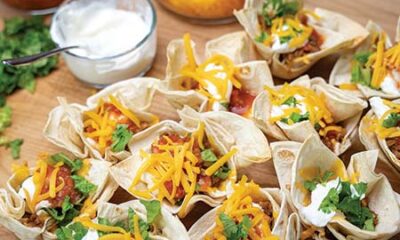
Pastelillos picantes
Ingredients
1 taza de harina multipropósito
1 1/2 taza (6 onzas) de queso Lucerne Pepper Jack Cheese, rallado
1/2 cucharadita de sal
una pizca de pimienta de cayena
1 taza de leche
2 huevos Lucerne
3 cucharadas de mantequilla Lucerne, derretida
Preparation
Precaliente el horno a 375 °F.
En un tazón mediano, mezcle la harina, 1 taza de queso, la sal y la pimienta de cayena.
Incorpore la leche y los huevos hasta integrar.
Con un pincel para postres o una toalla de papel, cubra de manera uniforme el molde para 12 pastelillos con la mantequilla derretida.
Vierta 1/4 taza de la preparación en cada molde mientras el molde aún está caliente. Rocíe el queso restante de manera uniforme sobre los moldes con la preparación.
Lleve al horno hasta que los pastelillos estén inflados y dorados: unos 25 minutos en una placa metálica oscura o unos 30 minutos en una placa de metal brilloso. Retire la placa del horno, y déjela reposar 1 minuto. Pase un cuchillo por los bordes para retirar los pastelillos de la placa. Sirva caliente.
Chef Swap at the Beach Christmas Special Hits Cooking Channel Dec. 20 — and You Can Taste It in Myrtle Beach
Chef Swap at the Beach returns with a Christmas Special on Dec. 20 on Cooking Channel. Plus, Myrtle Beach’s new Chef Swap Chef’s Table Pass lets visitors dine at featured restaurants across the Grand Strand.
A “Chef Swap at The Beach” Christmas Special will air December 20 on the Cooking Channel. The cast includes L-R: Jamie Daskalis, Jason Trinh, Johanna Wilson Jones, Mason Zeglen, Dylan Foster, Jess Sagun, Gabriel Hernandez. The holiday-themed episode was filmed at the International Culinary Institute of Myrtle Beach. In addition, the new Chef Swap Chef’s Table Pass dining trail allows fans to engage with the featured restaurants and chefs when in Myrtle Beach. Credit: Visit Myrtle Beach
Chef Swap at the Beach Christmas Special Hits Cooking Channel Dec. 20 — and You Can Taste It in Myrtle Beach
If you’ve ever watched a cooking competition and thought, I need to eat that, Myrtle Beach is making it easy to turn screen-time cravings into real-life reservations. On Dec. 20, the Cooking Channel will air a festive new episode of “Chef Swap at The Beach” — a Christmas Special that brings back familiar chefs from past seasons for a holiday-themed cooking competition. And for anyone planning a trip (or looking for a reason to), the show’s newest extension makes the experience even more tangible: the Chef Swap Chef’s Table Pass, a free digital dining trail that connects fans directly to the restaurants featured across the series.
A holiday episode built on community (and a little friendly pressure)
The Christmas Special follows the established “Chef Swap” format: chefs step outside their own kitchens and comfort zones, then race to create themed dishes under tight time constraints. The twist is the season. Filmed at the International Culinary Institute of Myrtle Beach, the special leans into holiday energy with seasonal elements and a charitable component — while still spotlighting what the series does best: collaboration, creativity, and the relationships that make the Myrtle Beach food scene feel like a community. As Stuart Butler, President of Visit Myrtle Beach, put it, the series has become “a meaningful way to showcase the talent of the Myrtle Beach area’s culinary community to a national audience,” reflecting “the relationships and sense of community that exist across the Grand Strand.”
Why the International Culinary Institute matters
The setting isn’t just a backdrop. The International Culinary Institute of Myrtle Beach plays a real role in the region’s dining identity — serving as a training ground for aspiring chefs and hospitality pros, and helping feed the local restaurant ecosystem with new talent. In other words: Myrtle Beach’s culinary growth isn’t accidental. It’s being built, taught, and refined — and this special gives viewers a look at that foundation.
The Chef Swap Chef’s Table Pass: from TV episode to dining itinerary
Here’s the part that makes this more than a one-night watch. Restaurants featured throughout multiple seasons of “Chef Swap at The Beach” are now included in the Chef Swap Chef’s Table Pass, a self-guided dining trail that visitors can use while exploring the Grand Strand. When you sign up for the free digital pass, you unlock a mobile “passport” to participating restaurants, including:
Special offers
Insights into the show’s signature dishes
A curated way to experience restaurants from every season, year-round
It’s a smart move for food lovers who want structure without feeling boxed in — and a fun way to build a Myrtle Beach trip around meals you’ll actually remember. For details on the pass and participating restaurants, visit ChefSwap.com.
Myrtle Beach: more than 60 miles of oceanfront
Yes, Myrtle Beach has 60 miles of beautiful oceanfront — but the story Visit Myrtle Beach is telling here is bigger than sand and surf. Known as the Grand Strand, Myrtle Beach is made up of 14 unique communities along South Carolina’s northeast coast. Visitors come for the classic vacation staples — entertainment, family attractions, shopping, and world-class golf — but increasingly, they’re also coming hungry. Fresh coastal Carolina cuisine isn’t a side note anymore. It’s part of the main event.
Mark your calendar (and maybe your restaurant list)
If you’re looking for a holiday watch that’s equal parts competition and community, set a reminder for Dec. 20 on the Cooking Channel. And if you want to take it one step further, the Chef Swap Chef’s Table Pass gives you a ready-made reason to plan a winter escape — one plate at a time. Learn more about Myrtle Beach tourism:visitmyrtlebeach.comExplore the Chef’s Table Pass:ChefSwap.com
How Pecans Became a Holiday Staple: 8,000 Years of American Pecan History
Pecan History? Discover the 8,000-year history of pecans—America’s only native major nut crop. Learn how pecans evolved from wild, overlooked trees to a beloved holiday staple found in pies, pralines, and more.
How Pecans Became a Holiday Staple: 8,000 Years of American Pecan History
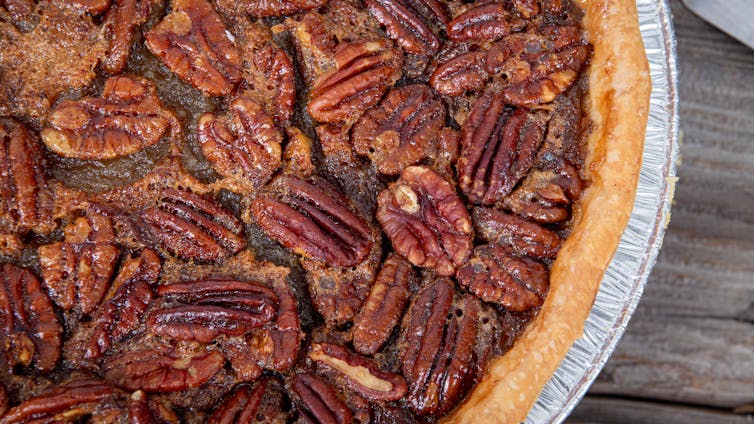
Shelley Mitchell, Oklahoma State University Pecans have a storied history in the United States. Today, American trees produce hundreds of million of pounds of pecans – 80% of the world’s pecan crop. Most of that crop stays here. Pecans are used to produce pecan milk, butter and oil, but many of the nuts end up in pecan pies. Throughout history, pecans have been overlooked, poached, cultivated and improved. As they have spread throughout the United States, they have been eaten raw and in recipes. Pecans have grown more popular over the decades, and you will probably encounter them in some form this holiday season. I’m an extension specialist in Oklahoma, a state consistently ranked fifth in pecan production, behind Georgia, New Mexico, Arizona and Texas. I’ll admit that I am not a fan of the taste of pecans, which leaves more for the squirrels, crows and enthusiastic pecan lovers.
The spread of pecans
The pecan is a nut related to the hickory. Actually, though we call them nuts, pecans are actually a type of fruit called a drupe. Drupes have pits, like the peach and cherry.Three pecan fruits, which ripen and split open to release pecan nuts, clustered on a pecan tree.IAISI/Moment via Getty Images The pecan nuts that look like little brown footballs are actually the seed that starts inside the pecan fruit – until the fruit ripens and splits open to release the pecan. They are usually the size of your thumb, and you may need a nutcracker to open them. You can eat them raw or as part of a cooked dish. The pecan derives its name from the Algonquin “pakani,” which means “a nut too hard to crack by hand.” Rich in fat and easy to transport, pecans traveled with Native Americans throughout what is now the southern United States. They were used for food, medicine and trade as early as 8,000 years ago.Pecans are native to the southern United States.Elbert L. Little Jr. of the U.S. Department of Agriculture, Forest Service Pecans are native to the southern United States, and while they had previously spread along travel and trade routes, the first documented purposeful planting of a pecan tree was in New York in 1722. Three years later, George Washington’s estate, Mount Vernon, had some planted pecans. Washington loved pecans, and Revolutionary War soldiers said he was constantly eating them. Meanwhile, no one needed to plant pecans in the South, since they naturally grew along riverbanks and in groves. Pecan trees are alternate bearing: They will have a very large crop one year, followed by one or two very small crops. But because they naturally produced a harvest with no input from farmers, people did not need to actively cultivate them. Locals would harvest nuts for themselves but otherwise ignored the self-sufficient trees. It wasn’t until the late 1800s that people in the pecan’s native range realized the pecan’s potential worth for income and trade. Harvesting pecans became competitive, and young boys would climb onto precarious tree branches. One girl was lifted by a hot air balloon so she could beat on the upper branches of trees and let them fall to collectors below. Pecan poaching was a problem in natural groves on private property.
Pecan cultivation begins
Even with so obvious a demand, cultivated orchards in the South were still rare into the 1900s. Pecan trees don’t produce nuts for several years after planting, so their future quality is unknown.An orchard of pecan trees.Jon Frederick/iStock via Getty Images To guarantee quality nuts, farmers began using a technique called grafting; they’d join branches from quality trees to another pecan tree’s trunk. The first attempt at grafting pecans was in 1822, but the attempts weren’t very successful. Grafting pecans became popular after an enslaved man named Antoine who lived on a Louisiana plantation successfully produced large pecans with tender shells by grafting, around 1846. His pecans became the first widely available improved pecan variety.Grafting is a technique that involves connecting the branch of one tree to the trunk of another.Orest Lyzhechka/iStock via Getty Images The variety was named Centennial because it was introduced to the public 30 years later at the Philadelphia Centennial Expedition in 1876, alongside the telephone, Heinz ketchup and the right arm of the Statue of Liberty. This technique also sped up the production process. To keep pecan quality up and produce consistent annual harvests, today’s pecan growers shake the trees while the nuts are still growing, until about half of the pecans fall off. This reduces the number of nuts so that the tree can put more energy into fewer pecans, which leads to better quality. Shaking also evens out the yield, so that the alternate-bearing characteristic doesn’t create a boom-bust cycle.
US pecan consumption
The French brought praline dessert with them when they immigrated to Louisiana in the early 1700s. A praline is a flat, creamy candy made with nuts, sugar, butter and cream. Their original recipe used almonds, but at the time, the only nut available in America was the pecan, so pecan pralines were born.Pralines were originally a French dessert, but Americans began making them with pecans.Jupiterimages/The Image Bank via Getty Images During the Civil War and world wars, Americans consumed pecans in large quantities because they were a protein-packed alternative when meat was expensive and scarce. One cup of pecan halves has about 9 grams of protein. After the wars, pecan demand declined, resulting in millions of excess pounds at harvest. One effort to increase demand was a national pecan recipe contest in 1924. Over 21,000 submissions came from over 5,000 cooks, with 800 of them published in a book. Pecan consumption went up with the inclusion of pecans in commercially prepared foods and the start of the mail-order industry in the 1870s, as pecans can be shipped and stored at room temperature. That characteristic also put them on some Apollo missions. Small amounts of pecans contain many vitamins and minerals. They became commonplace in cereals, which touted their health benefits. In 1938, the federal government published the pamphlet Nuts and How to Use Them, which touted pecans’ nutritional value and came with recipes. Food writers suggested using pecans as shortening because they are composed mostly of fat. The government even put a price ceiling on pecans to encourage consumption, but consumers weren’t buying them. The government ended up buying the surplus pecans and integrating them into the National School Lunch Program.Today, pecan producers use machines called tree shakers to shake pecans out of the trees.Christine_Kohler/iStock via Getty Images While you are sitting around the Thanksgiving table this year, you can discuss one of the biggest controversies in the pecan industry: Are they PEE-cans or puh-KAHNS? Editor’s note: This article was updated to include the amount of protein in a cup of pecans.Shelley Mitchell, Senior Extension Specialist in Horticulture and Landscape Architecture, Oklahoma State University This article is republished from The Conversation under a Creative Commons license. Read the original article.
Unwrap the Holidays: Whataburger Launches 12 Days of Whatacheer With Daily App Deals
Celebrate the holidays with Whataburger’s 12 Days of Whatacheer! Discover daily in-app deals, exclusive to Rewards members, from December 12–23. Unwrap new menu favorites, BOGO offers, and festive savings—only on the Whataburger App.
As the holiday lights go up and the year winds down, Whataburger is serving up more than just its signature burgers—it’s delivering a sleigh-full of savings and cheer to its loyal fans. For Rewards members, the season just got a whole lot tastier.
12 Days of Whatacheer: Festive Deals for Rewards Members
From December 12 through December 23, Whataburger is rolling out a new holiday tradition: the 12 Days of Whatacheer. Each day, Rewards members can unlock a fresh, exclusive deal in the Whataburger App—think crave-worthy classics, “buy one, get one” surprises, and complimentary add-ons that make every meal feel like a celebration.
Whether you’re craving a hot Honey Butter Chicken Biscuit to start your morning, a classic Whataburger for lunch, or a sweet Strawberry Shake to cap off your evening, there’s a daily treat waiting to be unwrapped. Just sign in to your Rewards account, check the app, and claim your deal to add a little extra joy to your holiday routine.
How It Works
Who: Whataburger Rewards members (sign up in the app if you’re not already!)
When: December 12–23, with a new offer every day
How: Open the Whataburger App, claim the day’s deal, and enjoy with your next order
A new reward pops up each morning—so there’s always a reason to check in, tap, and treat yourself. According to Scott Hudler, Whataburger’s Chief Marketing Officer, “12 Days of Whatacheer is Whataburger’s way of celebrating the season with a bit of holiday magic and special savings just for our Rewards members.”
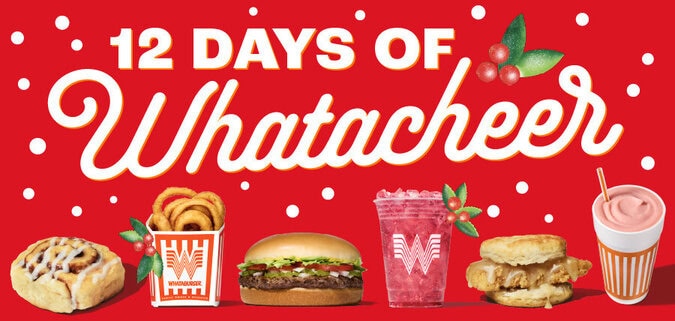
Holiday-themed graphic reading ‘12 Days of WhataCheer’ on a red background with white dots. Below the text are images of Whataburger menu items: a Cinnamon Roll, Onion Rings, a Whataburger, a Whatafresher, a Honey Butter Chicken Biscuit, and a Strawberry Shake.
Why Join the Whataburger Rewards Fun?
It’s not just about the deals (though those are pretty great). It’s about celebrating the season with a brand that’s been a community favorite for 76 years. With over 1,100 locations across 17 states, Whataburger’s family members serve up more than just food—they deliver hospitality and hometown spirit.
Plus, the Whataburger App makes it easy to order, customize, and save—right from your phone. If you haven’t joined the Rewards program yet, now’s the perfect time to start.
Get Started
Ready to add some Whatacheer to your holiday countdown? Download the Whataburger App on iOS or Android, create your Rewards account, and get set to unwrap a new deal every day. For more details, visit Whataburger.com.
Wishing you a season of flavor, fun, and festive deals—see you in the drive-thru!