

STM Daily News
HGTV Unveils the HGTV Dream Home 2026: A $2.4M+ Lake Wylie Retreat Near Charlotte
HGTV unveils the Dream Home 2026 on Lake Wylie near Charlotte, NC—a 3,000+ sq.-ft. waterfront retreat. Enter daily through Feb. 13, 2026.


HGTV just pulled back the curtain on its HGTV® Dream Home 2026—a newly built, fully furnished waterfront escape set on a secluded peninsula along Lake Wylie near Charlotte, North Carolina. And yes, the stakes are big: the sweepstakes winner takes home a grand prize package valued at more than $2.4 million, including the home plus $100,000 cash.
Designed to feel equal parts “weekend getaway” and “forever home,” the property leans hard into lake life—panoramic water views, warm natural finishes, and outdoor spaces built for slow mornings and long sunsets.
A lakeside home built for views (and actual living)
Spanning more than 3,000 square feet, HGTV Dream Home 2026 includes three bedrooms and three-and-a-half bathrooms, with a layout intentionally oriented to capture Lake Wylie views from nearly every angle.
HGTV describes the home as a calm, curated retreat—where indoor comfort and outdoor beauty are basically in constant conversation. The design palette is rooted in the landscape: earth tones, organic materials, hand-laid stone, custom millwork, classic furnishings, and vintage collectibles that keep the vibe warm and timeless rather than overly trendy.



Some of the standout interior features include:
- A central great room anchored by a reclaimed-wood mantle
- A welcoming dining space with a café-style door
- A chef-style kitchen featuring an over-grouted stone backsplash
- A morning room for casual coffee-and-light moments
- A garage with pantry access plus a dedicated pet wash
- A main bedroom suite with sweeping lake views and a spa-like bath, plus a closet that includes an all-in-one washer/dryer
Outdoor living takes center stage—hello, two-story dock
If the inside is designed for comfort, the outside is designed for the lifestyle. HGTV’s Dream Home 2026 leans into relaxed waterfront living with natural landscaping, laid-back outdoor furnishings, and a pebbled pathway leading to what might be the showstopper: a spectacular two-story dock.
It’s the kind of feature HGTV fans will immediately picture in use—sunrise coffee, sunset watching, and full-on lake days without leaving your property line.
Why Lake Wylie? Location meets laid-back Southern charm
Lake Wylie sits across the North Carolina–South Carolina border and is known for calm waters and an outdoors-first pace. HGTV highlights the lake’s 300+ miles of shoreline and its reputation as a haven for water activities—boating, paddling, and everything in between.
The location also hits that sweet spot of “peaceful but not remote”: it’s about 20 minutes from downtown Charlotte, and within easy reach of nearby towns like Belmont and Fort Mill.
The team behind the build and design
The home was built by Knotts Builders, with interior design led by Brian Patrick Flynn, who said he aimed to reflect Lake Wylie’s natural beauty while keeping the home “warm, inviting, and effortlessly livable.”
HGTV’s Howard Lee, Chief Creative Officer & President, US Networks, added that the home showcases the lifestyle of the Lake Wylie destination—and invited viewers to explore and enter for a chance to make it their own.
Sponsors featured throughout the home
HGTV Dream Home projects are also a showcase for sponsor products integrated into the build and lifestyle experience. This year’s lineup includes:
- Spectrum (connectivity)
- HGTV Home® by Sherwin-Williams (paint palette)
- Husqvarna (lawn tools)
- SimpliSafe (home security)
- Snuggle (laundry products)
- Stanley Steemer (cleaning)
- Trex (decking/outdoor materials)
- VELUX (skylights and sun tunnels)
- Wayfair (furniture, décor, appliances)
How to enter the HGTV Dream Home 2026 giveaway
The official entry window runs from 9 a.m. ET Tuesday, Dec. 16, 2025 through 5 p.m. ET Friday, Feb. 13, 2026. Eligible fans can enter daily at:
- HGTV.com
- FoodNetwork.com
HGTV notes that both sites will include full details, official rules, and additional home features.
When to watch the HGTV Dream Home 2026 special
Viewers can tune into the one-hour special HGTV Dream Home 2026 on Tuesday, Jan. 1, 2026 at 8 p.m. ET on HGTV, with streaming availability on Max and discovery+ the same day.
For fans who want a closer look right now, HGTV also has a dedicated Dream Home hub and photo tours online.
Sources:
- https://www.multivu.com/warner_bros_discovery/9364151-en-hgtv-dream-home-2026-sweepstakes
- https://www.hgtv.com/sweepstakes/hgtv-dream-home
- https://www.hgtv.com/sweepstakes/hgtv-dream-home/2026/tour-hgtv-dream-home-2026-pictures
If you tell me which outlet this is for (STM Daily News vs. another publication), I can tighten the lede and SEO it to match that site’s voice (headline options + meta description + suggested tags).
Authors


Discover more from Daily News
Subscribe to get the latest posts sent to your email.


Artificial Intelligence
As OpenAI attracts billions in new investment, its goal of balancing profit with purpose is getting more challenging to pull off

Last Updated on March 23, 2026 by Daily News Staff
Alnoor Ebrahim, Tufts University
OpenAI, the artificial intelligence company that developed the popular ChatGPT chatbot and the text-to-art program Dall-E, is at a crossroads. On Oct. 2, 2024, it announced that it had obtained US$6.6 billion in new funding from investors and that the business was worth an estimated $157 billion – making it only the second startup ever to be valued at over $100 billion.
Unlike other big tech companies, OpenAI is a nonprofit with a for-profit subsidiary that is overseen by a nonprofit board of directors. Since its founding in 2015, OpenAI’s official mission has been “to build artificial general intelligence (AGI) that is safe and benefits all of humanity.”
By late September 2024, The Associated Press, Reuters, The Wall Street Journal and many other media outlets were reporting that OpenAI plans to discard its nonprofit status and become a for-profit tech company managed by investors. These stories have all cited anonymous sources. The New York Times, referencing documents from the recent funding round, reported that unless this change happens within two years, the $6.6 billion in equity would become debt owed to the investors who provided that funding.
The Conversation U.S. asked Alnoor Ebrahim, a Tufts University management scholar, to explain why OpenAI’s leaders’ reported plans to change its structure would be significant and potentially problematic.
How have its top executives and board members responded?
There has been a lot of leadership turmoil at OpenAI. The disagreements boiled over in November 2023, when its board briefly ousted Sam Altman, its CEO. He got his job back in less than a week, and then three board members resigned. The departing directors were advocates for building stronger guardrails and encouraging regulation to protect humanity from potential harms posed by AI.
Over a dozen senior staff members have quit since then, including several other co-founders and executives responsible for overseeing OpenAI’s safety policies and practices. At least two of them have joined Anthropic, a rival founded by a former OpenAI executive responsible for AI safety. Some of the departing executives say that Altman has pushed the company to launch products prematurely.
Safety “has taken a backseat to shiny products,” said OpenAI’s former safety team leader Jan Leike, who quit in May 2024.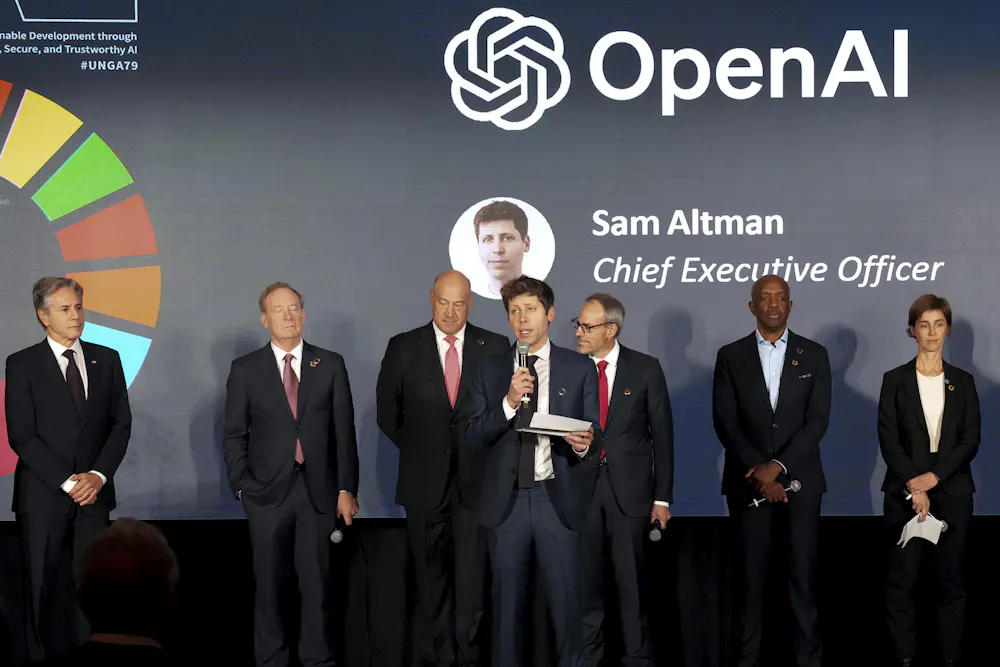
Why would OpenAI’s structure change?
OpenAI’s deep-pocketed investors cannot own shares in the organization under its existing nonprofit governance structure, nor can they get a seat on its board of directors. That’s because OpenAI is incorporated as a nonprofit whose purpose is to benefit society rather than private interests. Until now, all rounds of investments, including a reported total of $13 billion from Microsoft, have been channeled through a for-profit subsidiary that belongs to the nonprofit.
The current structure allows OpenAI to accept money from private investors in exchange for a future portion of its profits. But those investors do not get a voting seat on the board, and their profits are “capped.” According to information previously made public, OpenAI’s original investors can’t earn more than 100 times the money they provided. The goal of this hybrid governance model is to balance profits with OpenAI’s safety-focused mission.
Becoming a for-profit enterprise would make it possible for its investors to acquire ownership stakes in OpenAI and no longer have to face a cap on their potential profits. Down the road, OpenAI could also go public and raise capital on the stock market.
Altman reportedly seeks to personally acquire a 7% equity stake in OpenAI, according to a Bloomberg article that cited unnamed sources.
That arrangement is not allowed for nonprofit executives, according to BoardSource, an association of nonprofit board members and executives. Instead, the association explains, nonprofits “must reinvest surpluses back into the organization and its tax-exempt purpose.”
What kind of company might OpenAI become?
The Washington Post and other media outlets have reported, also citing unnamed sources, that OpenAI might become a “public benefit corporation” – a business that aims to benefit society and earn profits.
Examples of businesses with this status, known as B Corps., include outdoor clothing and gear company Patagonia and eyewear maker Warby Parker.
It’s more typical that a for-profit business – not a nonprofit – becomes a benefit corporation, according to the B Lab, a network that sets standards and offers certification for B Corps. It is unusual for a nonprofit to do this because nonprofit governance already requires those groups to benefit society.
Boards of companies with this legal status are free to consider the interests of society, the environment and people who aren’t its shareholders, but that is not required. The board may still choose to make profits a top priority and can drop its benefit status to satisfy its investors. That is what online craft marketplace Etsy did in 2017, two years after becoming a publicly traded company.
In my view, any attempt to convert a nonprofit into a public benefit corporation is a clear move away from focusing on the nonprofit’s mission. And there will be a risk that becoming a benefit corporation would just be a ploy to mask a shift toward focusing on revenue growth and investors’ profits.
Many legal scholars and other experts are predicting that OpenAI will not do away with its hybrid ownership model entirely because of legal restrictions on the placement of nonprofit assets in private hands.
But I think OpenAI has a possible workaround: It could try to dilute the nonprofit’s control by making it a minority shareholder in a new for-profit structure. This would effectively eliminate the nonprofit board’s power to hold the company accountable. Such a move could lead to an investigation by the office of the relevant state attorney general and potentially by the Internal Revenue Service.
What could happen if OpenAI turns into a for-profit company?
The stakes for society are high.
AI’s potential harms are wide-ranging, and some are already apparent, such as deceptive political campaigns and bias in health care.
If OpenAI, an industry leader, begins to focus more on earning profits than ensuring AI’s safety, I believe that these dangers could get worse. Geoffrey Hinton, who won the 2024 Nobel Prize in physics for his artificial intelligence research, has cautioned that AI may exacerbate inequality by replacing “lots of mundane jobs.” He believes that there’s a 50% probability “that we’ll have to confront the problem of AI trying to take over” from humanity.
And even if OpenAI did retain board members for whom safety is a top concern, the only common denominator for the members of its new corporate board would be their obligation to protect the interests of the company’s shareholders, who would expect to earn a profit. While such expectations are common on a for-profit board, they constitute a conflict of interest on a nonprofit board where mission must come first and board members cannot benefit financially from the organization’s work.
The arrangement would, no doubt, please OpenAI’s investors. But would it be good for society? The purpose of nonprofit control over a for-profit subsidiary is to ensure that profit does not interfere with the nonprofit’s mission. Without guardrails to ensure that the board seeks to limit harm to humanity from AI, there would be little reason for it to prevent the company from maximizing profit, even if its chatbots and other AI products endanger society.
Regardless of what OpenAI does, most artificial intelligence companies are already for-profit businesses. So, in my view, the only way to manage the potential harms is through better industry standards and regulations that are starting to take shape.
California’s governor vetoed such a bill in September 2024 on the grounds it would slow innovation – but I believe slowing it down is exactly what is needed, given the dangers AI already poses to society.
Alnoor Ebrahim, Thomas Schmidheiny Professor of International Business, The Fletcher School & Tisch College of Civic Life, Tufts University
This article is republished from The Conversation under a Creative Commons license. Read the original article.
The science section of our news blog STM Daily News provides readers with captivating and up-to-date information on the latest scientific discoveries, breakthroughs, and innovations across various fields. We offer engaging and accessible content, ensuring that readers with different levels of scientific knowledge can stay informed. Whether it’s exploring advancements in medicine, astronomy, technology, or environmental sciences, our science section strives to shed light on the intriguing world of scientific exploration and its profound impact on our daily lives. From thought-provoking articles to informative interviews with experts in the field, STM Daily News Science offers a harmonious blend of factual reporting, analysis, and exploration, making it a go-to source for science enthusiasts and curious minds alike. https://stmdailynews.com/category/science/
Discover more from Daily News
Subscribe to get the latest posts sent to your email.
unknown
How extraterrestrial tales of aliens gain traction
The narrative explores humanity’s intrigue with extraterrestrial entities, juxtaposing evolutionary processes with claims of alien interventions, ultimately emphasizing the need for scientific evidence over fantastical stories. Aliens!
Last Updated on March 18, 2026 by Daily News Staff
Ester Lázaro Lázaro, Centro de Astrobiología (INTA-CSIC)
One night, upon returning to the cave that his tribe calls home, the monkey-humanoid Moon-Watcher finds a strange crystal object, a kind of monolith that fascinates him at first, but then quickly loses his interest when he discovers that it is not edible. Soon after, the true purpose of the monolith is revealed to be none other than penetrating the minds of our ancestors to induce new abilities that, over time, will cause the development of an intelligence capable of creating new technology.
Many readers will recognise this scene from the novel 2001, A Space Odyssey, by Arthur C. Clarke, and the film of the same name, directed by Stanley Kubrick. It almost goes without saying that the crystal monolith in question is the work of an extraterrestrial civilisation that observes life on other planets and “experiments” on them to encourage the development of intelligence in as many parts of the cosmos as possible.
Seeking simple answers to complex questions
Understanding how we, as a species, came to be intelligent is one of the great enigmas of evolutionary study. Small mutations, followed by a process of natural selection to choose the most advantageous, seems too slow a process for structures as complex as the human nervous system or brain to emerge. It is this very complexity that allows millions of neurons to communicate with each other, resulting in the emergence of qualities such as the ability to respond voluntarily to environmental stimuli, or to ask questions about the very nature of humankind and the universe.
Nowadays, we know that there are evolutionary mechanisms that have lead to great leaps in terms of complexity, but that does not stop people from turning to non-human forces – Gods, extraterrestrials, spiritual energies – to explain things that are difficult to comprehend.
This has always been the case, in all human cultures. A classic example would be attributing atmospheric events – thunder, lightning, floods – to the wrath of God. These ideas came about before humans had ever left the ground, so it is no surprise that we turned our eyes even higher – to extraterrestrials – to explain other phenomena that we could only observe once travelling at high altitudes became part of our daily lives.
The allure of the unknown
The possibility that we might have been visited by beings from other worlds has always fascinated us. The element of mystery, of the unknown, only makes it more interesting.
Any phenomenon is made all the more enticing when it seems it is being covered up or hidden for secretive reasons. The attractiveness of conspiracies often leads people towards ideas which have no scientific basis, such as the belief that the Earth is flat, that humans never set foot on the Moon, or that vaccines can control our behaviour.
Even though these ideas have repeatedly been shown to be untrue, their rapid dissemination through social media, using simple, blunt language that appeals to emotion over logic, makes them very powerful weapons.
The supposed “proof” of alien visits to our planet ranges from specific Bible passages to ancient stone carvings portraying creatures or objects that may appear to be aliens or spacecraft. The latter often take the form of flying saucers.
However, we cannot forget that humans have always created imaginary creatures that resemble them and attributed them with magical powers. When imagining Gods, humans have given them a human appearance, and almost always imagined them as living in the sky.
When we look at these representations through modern eyes, we associate them with extraterrestrial beings or structures, when in fact they could be referring to a range of different things.
When unproven stories become larger than life
Recently, in the United States Congress, UFOs (currently known as UAPs: “Unidentified Anomalous Phenomena”) are back in the limelight. This is because a former air force intelligence official has made claims that the Pentagon is in possession of remains of extraterrestrial craft and “non-human biological matter”. The claims have been backed up by the testimony of a retired navy commander and a former navy pilot.
What we can be certain of is that the more we explore our skies, the more likely it is that we will encounter phenomena that we cannot explain. However, this does not mean that they are extraterrestrial. Past experience has shown us that most of these events can be attributed to optical illusions, spy or weather balloons, space junk, or even satellites that we ourselves have made.
In Spain, UFOs were a hot topic between the 1960s and the 1980s. In this era, everyone knew someone who was convinced that they had seen a UFO. This even reached the point where an exoplanet, called Ummo, was made up. It was populated by a more advanced civilisation than ours who made contact with people on Earth. In the letters these aliens supposedly sent, the ‘Ummites’ explained concepts such as genetics and cell structure.
The truth is that nowadays, reading some of these letters can be quite amusing. The story of the planet of Ummo was ultimately proved to be a monumental hoax, a fact later admitted by its own creator.
The Ummo hoax was even linked to the creation of a paedophile ring, which should make us reflect on the harmful consequences that the spread of fabricated news stories can have.
Can we deny the possibility that intelligent alien civilisations exist?
The answer, of course, is no. The universe is immense, and it is more than likely that circumstances similar to those which led to the appearance of life on Earth have been repeated on other planets. But there is a huge distance (literally and figuratively) between acknowledging the existence of these creatures and considering the possibility that they might have visited us.
Exoplanets, also known as extrasolar planets, are extremely far away, and we are limited by the speed of light which, as proven by Einstein, is the maximum possible speed at which anything can travel. Therefore, the journey to even a “nearby” exoplanet would take thousands of years. Maybe a civilisation more advanced than ours could find a way to do it faster, but not to the point of it being something easy or commonplace.
In any case, if the remains of alien life or spacecraft are stored away somewhere, why are they not being shown to us? Scientists would jump at the chance to analyse this organic matter to find out how it is structured, how it metabolises energy, or what molecules it uses to store genetic information.
Until there is proof, this is not a question of science, but rather, of stories. Stories can be very entertaining, but these kinds of stories do not help us to build a more accurate or helpful view of the world.
Ester Lázaro Lázaro, Investigadora Científica de los Organismos Públicos de Investigación. Especializada en evolución de virus, Centro de Astrobiología (INTA-CSIC)
This article is republished from The Conversation under a Creative Commons license. Read the original article.
The science section of our news blog STM Daily News provides readers with captivating and up-to-date information on the latest scientific discoveries, breakthroughs, and innovations across various fields. We offer engaging and accessible content, ensuring that readers with different levels of scientific knowledge can stay informed. Whether it’s exploring advancements in medicine, astronomy, technology, or environmental sciences, our science section strives to shed light on the intriguing world of scientific exploration and its profound impact on our daily lives. From thought-provoking articles to informative interviews with experts in the field, STM Daily News Science offers a harmonious blend of factual reporting, analysis, and exploration, making it a go-to source for science enthusiasts and curious minds alike. https://stmdailynews.com/category/science/
Discover more from Daily News
Subscribe to get the latest posts sent to your email.
News
Jay Leno Test Drives the Slate Truck as Startup Pushes Toward 2026 Launch
The affordable electric pickup from Slate Auto is gaining attention after Jay Leno test drove the prototype on Jay Leno’s Garage. Here’s the latest update on pricing, features, reservations, and the planned 2026 production launch.


Testing the Slate Truck
The affordable electric pickup from Slate Auto is continuing to gain attention as the startup moves closer to production. One of the most visible recent developments came when legendary car collector and TV host Jay Leno featured the truck on his popular YouTube series Jay Leno’s Garage.
The episode offered one of the most detailed looks yet at the upcoming Slate Truck, including a real-world test drive, design insights, and a closer look at the company’s philosophy behind building what could become one of America’s most affordable electric vehicles.
Watch the Jay Leno Test Drive
What Jay Leno Revealed About the Slate Truck
During the episode, Leno drove a pre-production prototype of the truck while engineers from Slate Auto explained the design approach.
Unlike many modern EVs packed with luxury features, the Slate Truck is intentionally simple.
Key highlights from the test drive include:
A Focus on Simplicity and Repairability
One of the most notable ideas behind the truck is that it is designed to be easy to repair and modify. Instead of relying on proprietary parts or complex electronics, the vehicle uses a more straightforward architecture that could allow owners or independent mechanics to work on it.
This approach contrasts with many EVs that require dealership service or specialized tools.
Modular Body Panels and Customization
The Slate Truck is built around a modular platform with removable exterior panels and optional accessory kits.
According to the company, owners will be able to customize the vehicle with:
Different body panel styles Accessory racks and cargo options A potential conversion kit that can transform the pickup into a small SUV
The idea is to allow the vehicle to evolve with the owner’s needs over time.
Minimalist Interior
Inside the prototype shown to Leno, the truck features a very basic interior layout.
Instead of a large infotainment system, the vehicle relies heavily on smartphone integration and simpler controls to keep costs down. This minimalist philosophy is part of the company’s effort to build a lower-cost EV.
Pricing and the “Affordable EV” Promise
When the truck was first revealed in 2025, Slate Auto suggested the vehicle could cost under $20,000 after incentives.
However, with changes to federal EV incentives and updated pricing expectations, analysts now estimate the truck will likely start around the mid-$20,000 range.
Even at that price, the vehicle could still become one of the most affordable electric trucks available in the United States.
Production Plans in Indiana
The company plans to manufacture the truck in Warsaw, Indiana, where a large former industrial facility is being converted into an EV factory.
Production targets include:
Production start: Late 2026 Early deliveries: Possibly 2027 Potential capacity: Up to about 150,000 vehicles per year once fully ramped
Strong early interest has also been reported, with more than 100,000 reservations placed for the truck shortly after its reveal.
A Different Kind of Electric Truck
The Slate Truck is entering a market where most electric pickups—such as the Ford F-150 Lightning and Rivian R1T—sit at much higher price points.
Rather than competing on luxury or performance, the Slate Truck is aiming to fill a different niche: a practical, customizable, and relatively affordable electric work vehicle.
If the company can deliver on its promises, it could open the door to a new category of budget-friendly EVs.
For now, the test drive on Jay Leno’s Garage provides one of the clearest glimpses yet at how the truck might perform in the real world.
Related Coverage on STM Daily News
- Automotive News and Innovation – STM Daily News
- Boom Supersonic and the Overture: The Return of Commercial Supersonic Travel
- The Evolution of Public Transportation in Los Angeles
- Technology News and Emerging Innovations
Further Reading and Information
- Slate Auto Official Website
- Watch the Slate Truck Test Drive on Jay Leno’s Garage
- Car and Driver: First Look at the Slate Truck
- TechCrunch: Slate Auto Leadership Changes Ahead of Launch
- InsideEVs: Latest Electric Vehicle News
Welcome to the Consumer Corner section of STM Daily News, your ultimate destination for savvy shopping and informed decision-making! Dive into a treasure trove of insights and reviews covering everything from the hottest toys that spark joy in your little ones to the latest electronic gadgets that simplify your life. Explore our comprehensive guides on stylish home furnishings, discover smart tips for buying a home or enhancing your living space with creative improvement ideas, and get the lowdown on the best cars through our detailed auto reviews. Whether you’re making a major purchase or simply seeking inspiration, the Consumer Corner is here to empower you every step of the way—unlock the keys to becoming a smarter consumer today!
https://stmdailynews.com/category/consumer-corner
Author

Discover more from Daily News
Subscribe to get the latest posts sent to your email.





