How bigotry crushed the dreams of an all-Black Little League team
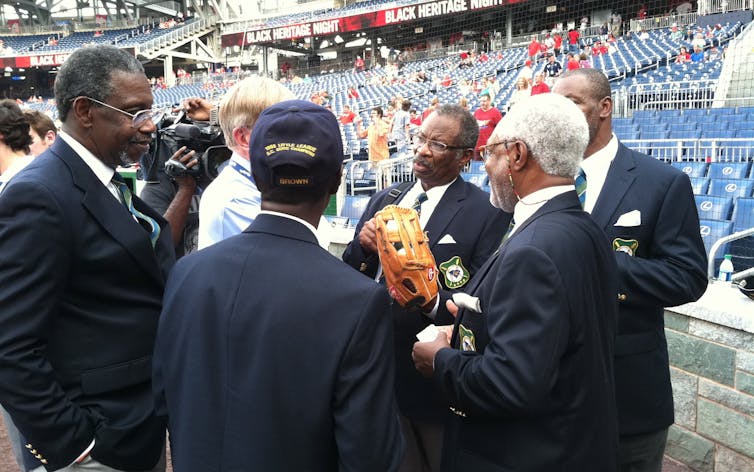
Chris Lamb, Indiana University John Rivers, John Bailey, David Middleton, Leroy Major and Buck Godfrey – all teammates from the 1955 Cannon Street YMCA Little League All-Star team – left Charleston, South Carolina, on a bus on Aug. 18, 2025. After a stop at the Baseball Hall of Fame in Cooperstown, New York, for a couple days – where their story is included in an exhibit on Black baseball that opened in 2024 – they’ll head to Williamsport, Pennsylvania. There, they’ll be recognized before the Little League World Series championship game on August 24, 2025 – 70 years after the players, then 11 and 12 years old, watched the championship game from the bleachers, wondering why they weren’t on the field living out their own dreams instead of watching other boys live out theirs. When the Cannon Street team registered for a baseball tournament in Charleston in July 1955, it put the team and the forces of integration on a collision course with segregation, bigotry and the Southern way of life. White teams refused to take the field with the Cannon Street team, who represented the first Black Little League in South Carolina. The team won two tournaments by forfeit. They were supposed to then go to a regional tournament in Rome, Georgia, where, if they won, they’d advance to the Little League World Series. But Little League officials ruled the team ineligible for the regional tournament because it had advanced by winning on forfeit and not on the field, as the rules stipulated.
A 4-team Black league is born
The Civil Rights Movement is often told in terms of court decisions, bus boycotts and racist demagogues. It’s rarely told from the point of view of children, who suffered in ways that left physical and emotional scars. When I was a journalism professor at the College of Charleston, I learned how the presence of a single Black all-star team was enough to cause one of the biggest crises in Little League history. In 2022, I wrote the book “Stolen Dreams: The 1955 Cannon Street All-Stars and Little League Baseball’s Civil War.” The team’s story begins in 1953. Robert Morrison, president of the Cannon Street YMCA, petitioned Little League Baseball to create a league for Black teams, and Little League Baseball granted the charter. Dozens of Black 11- and 12-year-old boys were selected for the four-team league before the 1954 season. They played on a diamond of grass and gravel at Harmon Field in Charleston, a city with a long history of racial strife. In 1861, the Civil War began in Charleston harbor, where hundreds of thousands of slaves had been brought to the U.S. from the 1600s to the 1800s. The field also wasn’t far from Emanuel AME church, where nine Black parishioners were murdered during a prayer meeting in 2015. Little League Baseball barred first-year leagues from the postseason tournaments. At some point during the 1955 season, the best players were selected for the league’s All-Star team. Cannon Street YMCA officials then registered the team for the Charleston city tournament, which included all-star teams from the city’s all-white leagues. Little League Baseball officially prohibited racial discrimination. But in South Carolina, racial discrimination was still legal.
Dixie fights back
The U.S. Supreme Court had ruled a year earlier that segregation in schools was unconstitutional in the landmark Brown v. Board of Education decision, paving the way for racial integration. Few states resisted integration as fiercely as South Carolina, and no politician fought harder against racial equality than the state’s junior U.S. senator, Strom Thurmond. So when the Cannon Street YMCA All-Stars registered for Charleston’s citywide tournament in July 1955, all the white teams withdrew. The Cannon Street team won by forfeit and advanced to the state tournament. Danny Jones, the state’s director of Little League Baseball, petitioned the organization to create a segregated state tournament. Little League Baseball’s president, Peter McGovern, denied Jones’ request. He said that any team that refused to play the Cannon Street team would be banned from the organization. Thurmond let it be known to Jones that an integrated tournament could not be permitted. In the end, Jones urged all the white teams to withdraw from the state tournament. He then resigned from Little League Baseball, created the Little Boys League and wrote the league’s charter, which prohibited Black players.The official logo for Dixie Youth Baseball, which was originally established as an all-white league.Dixie Youth Baseball The Little Boys League – which was rebranded as Dixie Youth Baseball – soon replaced Little League in other Southern states; within six years, there were 390 such leagues spanning most of the former Confederacy. It would be decades before Little League Baseball returned to South Carolina. Having won the South Carolina tournament by forfeit, the Cannon Street YMCA All-Stars prepared for the regional tournament in Rome, Georgia, where the state’s governor, Marvin Griffin, objected to integration. If youth baseball could be integrated, so, too, could schools, swimming pools and municipal parks, he said.
Let them play!
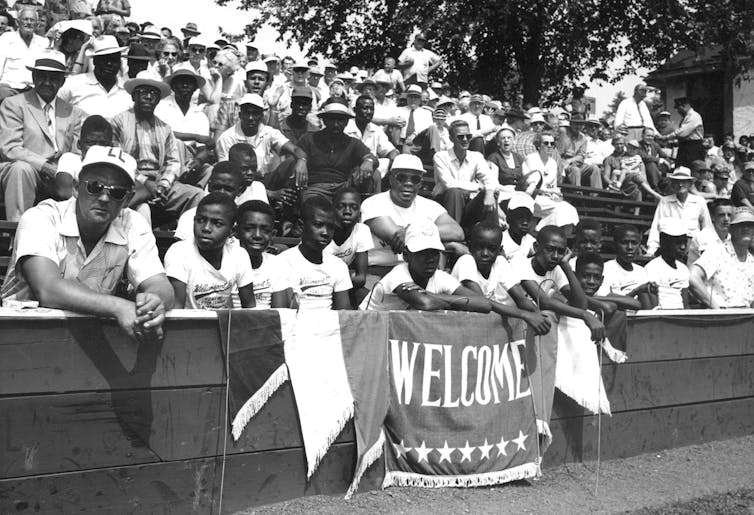
Little League rules said that teams could advance only by playing and winning, so the Cannon Street’s state championship was ruled invalid because it had come by forfeit. McGovern decided against making an exception for the Cannon Street YMCA All-Stars. Most white-owned newspapers, whether in the South or North, had long stayed silent on the topic of racial discrimination. But the story of the Cannon Street All-Stars broke through. Editors and reporters may have wanted to avoid the topic of racism, but boys being denied the opportunity to play in a baseball tournament was too objectionable to ignore. On July 31, 1955, New York Daily News columnist Dick Young asked Brooklyn Dodgers star Jackie Robinson, who had broken Major League Baseball’s color barrier eight years earlier, about the white teams that had quit the tournament rather than play against a Black team. “How stupid can they be?” Robinson said. “I had to laugh when I read the story.” Perhaps pressured by criticism, McGovern, Little League’s president, invited the team to be Little League’s guests for the championship game. So the team boarded a bus for Williamsport. They arrived the night before the championship game, which pitted Morrisville, Pennsylvania, against Delaware Township, New Jersey, an integrated team. The Cannon Street YMCA All-Stars and their coaches were introduced before the game, and the players recall hearing a loud voice from the bleachers. “Let them play!” it boomed. Others in the crowd joined in, the players said. “Let them play! Let them play!” John Rivers, who played second base for the team, told me he can still “hear it now.” After their brief moment on the field, the Cannon Street All-Stars returned to their seats and watched other boys live out their dreams. A photograph of the team in the stands reveals the disappointment on their faces.The Cannon Street All-Stars watch from the stands at the 1955 Little League World Series in Williamsport, Pa.1955 Cannon Street All-Stars/Facebook On the following day – Aug. 28, 1955 – the team boarded its bus to return to Charleston. It was the same date that Emmett Till, not much older than the players on the team, was brutally murdered in Money, Mississippi, for reportedly whistling at a white woman. The boys and girls who play in the 2025 tournament will forever remember the experience. The surviving members of the Cannon Street All-Stars, who are all in their early 80s, never forgot what they were denied. Rivers, who went on to become a successful architect, says this is the moral of their story. “It’s a tragedy to take dreams away from a youngster,” Rivers told The Washington Post in 2022. “I knew it then. I know it now, and I’ve seen to it that no one takes dreams away from me again.” Now there are some on the political right who want to bury America’s ugly racial history. America has never fully reckoned with slavery or the decades of segregation, Rivers recently told me. “It just decided to move on from that ugly period in its history without any kind of therapy,” he said. “And now they are trying to sweep it all under the rug again.” Portions of this article first appeared in an article published on Aug. 19, 2016.Chris Lamb, Professor of Journalism, Indiana University This article is republished from The Conversation under a Creative Commons license. Read the original article.
This question fascinates me because I am a business professor who studies why society abandons and then sometimes returns to certain technologies, such as vinyl records, landline phones and metal coins. The demise of electric streetcars in Los Angeles and attempts to bring them back today vividly demonstrate the costs and challenges of such revivals. https://www.youtube.com/embed/9X78ZqGyc5o?wmode=transparent&start=0 The 2028 Olympic Games will be held in existing sports venues around Los Angeles and are expected to host 15,000 athletes and over 1 million spectators.
Riding the Red and Yellow Cars
Transportation is a critical priority in any city, but especially so in Los Angeles, which has been a sprawling metropolis from the start.
In the early 1900s, railroad magnate Henry Huntington, who owned vast tracts of land around LA, started subdividing his holdings into small plots and building homes. In order to attract buyers, he also built a trolley system that whisked residents from outlying areas to jobs and shopping downtown.
By the 1930s, Los Angeles had a vibrant public transportation network, with over 1,000 miles of electric streetcar routes, operated by two companies: Pacific Electric Railway, with its “Red Cars,” and Los Angeles Railway, with its “Yellow Cars.”
The system wasn’t perfect by any means. Many people felt that streetcars were inconvenient and also unhealthy when they were jammed with riders. Moreover, streetcars were slow because they had to share the road with automobiles. As auto usage climbed and roads became congested, travel times increased.
Advertisement
Nonetheless, many Angelenos rode the streetcars – especially during World War II, when gasoline was rationed and automobile plants shifted to producing military vehicles. https://www.youtube.com/embed/AwKv3_WwD4o?wmode=transparent&start=0 In 1910, Los Angeles had a widely used local rail network, with over 1,200 miles (1,930 kilometers) of track. What happened?
Demise of public transit
The end of the war marked the end of the line for streetcars. The war effort had transformed oil, tire and car companies into behemoths, and these industries needed new buyers for goods from the massive factories they had built for military production. Civilians and returning soldiers were tired of rationing and war privations, and they wanted to spend money on goods such as cars.
After years of heavy usage during the war, Los Angeles’ streetcar system needed an expensive capital upgrade. But in the mid-1940s, most of the system was sold to a company called National City Lines, which was partly owned by the carmaker General Motors, the oil companies Standard Oil of California and Phillips Petroleum, and the Firestone tire company.
These powerful forces had no incentive to maintain or improve the old electric streetcar system. National City ripped up tracks and replaced the streetcars with buses that were built by General Motors, used Firestone tires and ran on gasoline.
What’s undisputed is that, starting in the mid-1940s, powerful social forces transformed Los Angeles so that commuters had only two choices: drive or take a public bus. As a result, LA became so choked with traffic that it often took hours to cross the city.
Three key improvements are planned for the Olympics. First, LA’s airport terminals will be connected to the rail system. Second, the Los Angeles organizing committee is planning heavily on using buses to move people. It will do this by reassigning some lanes away from cars and making them available for 3,000 more buses, which will be borrowed from other locales.
Finally, there are plans to permanently increase bicycle lanes around the city. However, one major initiative, a bike path along the Los Angeles River, is still under an environmental review that may not be completed by 2028.
Car-free for 17 days
I expect that organizers will pull off a car-free Olympics, simply by making driving and parking conditions so awful during the Games that people are forced to take public transportation to sports venues around the city. After the Games end, however, most of LA is likely to quickly revert to its car-centric ways.
As Casey Wasserman, chair of the LA 2028 organizing committee, recently put it: “The unique thing about Olympic Games is for 17 days you can fix a lot of problems when you can set the rules – for traffic, for fans, for commerce – than you do on a normal day in Los Angeles.”
This article has been updated to indicate that Los Angeles has four light-rail lines.
Dive into “The Knowledge,” where curiosity meets clarity. This playlist, in collaboration with STMDailyNews.com, is designed for viewers who value historical accuracy and insightful learning. Our short videos, ranging from 30 seconds to a minute and a half, make complex subjects easy to grasp in no time. Covering everything from historical events to contemporary processes and entertainment, “The Knowledge” bridges the past with the present. In a world where information is abundant yet often misused, our series aims to guide you through the noise, preserving vital knowledge and truths that shape our lives today. Perfect for curious minds eager to discover the ‘why’ and ‘how’ of everything around us. Subscribe and join in as we explore the facts that matter. https://stmdailynews.com/the-knowledge/
International Women’s Day is celebrated globally on March 8th to honor women’s achievements and promote gender equality, originating from a 1908 march in New York for better rights.
International Women’s Day is a global celebration that honors the achievements of women and highlights the progress still to be made in the fight for gender equality. On this day, people around the world come together to recognize the amazing contributions of women everywhere and to rally for greater gender equity in all areas of life.
The origins of International Women’s Day can be traced back to 1908, when 15,000 women marched through the streets of New York City to demand better working conditions and the right to vote. Since then, the celebration has grown to be an international event, with more than 100 countries recognizing the day. The United Nations even declared March 8th as International Women’s Day in 1975, to honor the struggles of women around the world.
This year’s International Women’s Day theme is #ChooseToChallenge, meaning that everyone is encouraged to call out gender bias and inequality when they see it. We’re also encouraged to celebrate women’s achievements, support each other, and take action for equality.
It’s important to recognize the progress we’ve made in terms of gender equality, but we still have a long way to go. International Women’s Day serves as a reminder that we must continue to fight for gender equality in all areas of life. Let’s use this day to honor the contributions of women around the world, and to continue the fight for a more equitable world.
Rebecca Jo is a mother of four and is a creative soul from Phoenix, Arizona, who also enjoys new adventures. Rebecca Jo has a passion for the outdoors and indulges in activities like camping, fishing, hunting and riding roller coasters. She is married to Rod Washington
Arizona scholarships 2026: Arizona scholarships are open through ACF: one application for 160+ awards, plus ARAC’s $1,500 Ashby-Herring scholarships due April 6, 2026.
Scholarship season moves fast, and for a lot of Arizona families, the hardest part isn’t writing the essay or gathering transcripts—it’s simply finding the right opportunities in time.
The Archer Ragsdale Arizona Chapter (ARAC), Tuskegee Airmen, Inc. is encouraging students and the community to take advantage of scholarship resources through the Arizona Community Foundation (ACF), including an easy online application that can match applicants with 160+ scholarships—plus virtual workshops where students can get help directly from ACF’s scholarship team.
Whether you’re a high school senior, a current college student, or an adult re-entry student, ACF’s scholarship portal is designed to meet people where they are.
The Big Picture: One Application, 160+ Scholarships
According to the flyer, ACF awarded $6.3 million in scholarships last year, with over 160 scholarships available through a single, easy application.
What to watch for: Even if a student is only targeting one scholarship, completing the ACF application can surface additional matches they didn’t know existed.
ARAC (Tuskegee Airmen, Inc.) awards two or more scholarships to deserving Arizona students who are college-bound. The flyer highlights the Ashby-Herring scholarships, named in honor of late founding ARAC members who were original Tuskegee Airmen.
Free Virtual Workshops (Zoom): Get Help With Your Application
If you’ve ever watched a student stall out halfway through an application, these workshops are a smart fix: they’re designed so applicants can work on their scholarship application with support from ACF’s scholarship team.
Workshop dates (Zoom):
February 12, 2026 — 4:00 to 5:00 p.m.
March 5, 2026 — 4:00 to 5:00 p.m.
March 26 — 4:00 to 5:00 p.m. (date listed on flyer; confirm year when registering)
What to watch for: Register for the dates you can attend and come prepared with what you already have (basic info, activities list, questions). One hour of guided progress can save days of procrastination.
Why This Matters (and Why Sharing Helps)
The Tuskegee Airmen legacy is rooted in excellence, discipline, and breaking barriers—and scholarships tied to that legacy are meant to elevate futures for the next generation.
If you’re a parent, teacher, coach, mentor, or neighbor, consider this your nudge: forward the link, post it in a group chat, or share it with a student who might qualify. Deadlines hit quickly, and the easiest scholarship to win is often the one you actually apply for.
College isn’t just classes and credits — it’s learning how to manage your time, money, health, and relationships while you build a future that actually fits. In our College Life coverage, STM Daily News shares practical, real-world guides for students and families: campus living tips, study and productivity habits, career prep, budgeting basics, mental wellness check-ins, and smart ways to make the most of college in Arizona and beyond.
Expect quick reads, useful takeaways, and “what to do next” advice — whether you’re a first-year student, a transfer, or heading back to school.

