

Black History
NASA Experts Go on Tour with The Color of Space Documentary

Credits: NASA/Bill Ingalls
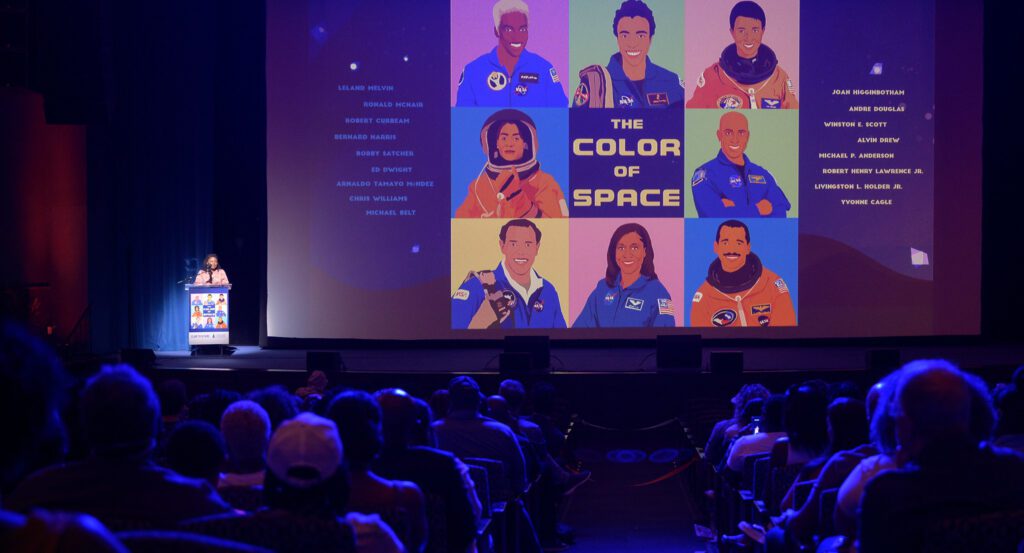
NASA and Blue Origin’s nonprofit Club for the Future will co-host multiple free in-person viewing events of the agency’s documentary, The Color of Space, at historically Black colleges and universities, conferences, festivals, and more nationwide. The documentary is a conversation between seven current and former Black astronauts, each of whom were selected to become part of NASA’s astronaut corps.
The viewing tour kicks-off at 5 p.m. EST Wednesday, at Morgan State University in Baltimore, followed by an event at Texas Southern University in Houston at 5 p.m. CST on Thursday, Feb. 23, which will include remarks from NASA’s Johnson Space Center Director Vanessa Wyche. More viewing events are planned through fall 2023.
In the documentary, current NASA astronauts Stephanie Wilson, Victor Glover, Jeanette Epps, as well as retired astronauts Leland Melvin, Bernard Harris, Robert Curbeam, and Bobby Satcher, spoke about their journeys and their motivations in a panel hosted by Wyche, the first Black woman to lead a NASA center.
In addition to the viewing of the 50-minute documentary, events may include selfie opportunities, appearances from current and former NASA astronauts, greetings by NASA leadership, and other activities led by Blue Origin.
To attend an upcoming viewing event, register on NASA’s Eventbrite page. Registration is required to attend the screenings.
NASA works to explore the secrets of the universe and solve the world’s most complex problems, which requires creating space for all people to participate in and learn from its work in space. Providing access to opportunities where individuals can be curious, creative, and innovative is how the agency will continue to inspire the next generation of scientists, engineers, astronauts, and more.
To learn more about NASA and its missions visit:
Source: NASA


Food Truths
Soul Food Has African Roots—and a Distinct Black American History
Soul food connects African heritage with generations of Black American creativity and community. Here’s why shared roots and a distinct cultural identity both deserve recognition.

Last Updated on October 15, 2026 by Rod Washington
Shared ancestry connects the African diaspora. It also makes understanding each community’s food traditions worth the effort.
A debate over who can claim soul food raises a question larger than any social media argument: When does a shared cultural inheritance become a distinct tradition?
People across Africa and the African diaspora have foods that evoke home, family, comfort, and belonging. Recognizing that connection is valuable. But using “soul food” as a general description of comforting food is different from identifying the cuisine historically known by that name.
Soul food is a distinctly African American culinary tradition with African roots, shaped by generations of Black life in the United States. Recognizing its American development does not erase Africa. Recognizing Africa should not erase what Black Americans created.
African Roots, American Development
Enslaved Africans arrived with agricultural knowledge, cooking skills, and food traditions. They adapted those traditions to unfamiliar surroundings and unequal access to food, drawing on available ingredients and encounters with Indigenous and European foodways.
Okra, black-eyed peas, and vegetable-centered cooking offer important connections to African traditions. Corn and cornmeal reflect Indigenous American agriculture. These ingredients and influences became part of an evolving food culture rather than remaining unchanged copies of dishes from another continent. [1]
The distinction is between ancestry and development. A cuisine can descend from older traditions and acquire its own identity through the experiences of the people who preserve and transform it.
More Than a Story About Scraps
Slavery and deprivation belong in this history. Enslaved people supplemented restricted food supplies through gardening and other means, and used small amounts of meat to season vegetables. But telling the entire story as “making something out of scraps” understates their knowledge and creativity.
Black food history also includes seafood work, farming, skilled cooking, and enterprise. The Smithsonian’s account of Black foodways, for example, documents African Americans’ extensive involvement in harvesting, processing, and selling oysters. [2]
These were people with expertise. Their contributions deserve recognition as culinary work and cultural creation.
Why the Name Matters
The food traditions are older than the widespread use of the name “soul food.” The term became prominent during the 1960s, amid movements asserting Black identity and cultural pride. Smithsonian histories describe the soul food movement as celebrating foods that mainstream America had often disparaged. [3]
That context gives the name meaning beyond a meal that tastes good or brings comfort.
For some families, a pot of greens or a pan of cornbread carries memories of relatives, church dinners, holidays, and recipes learned by watching someone cook. Calling those foods “soul food” places them within a particular cultural story.
Southern Roots Traveled
Soul food also developed beyond the South. During the Great Migration, Black Americans carried Southern food traditions into new cities and neighborhoods, preserving familiar dishes while adapting their cooking. Smithsonian programming connects that movement directly to soul food’s development. [4]
That helps explain how a cuisine rooted in the South became part of Black community life across the country.
It also makes geography an imperfect test of authenticity. Soul food cooked in London can still be African American soul food. A cuisine’s cultural origins do not change simply because someone prepares it elsewhere.
Shared Heritage Does Not Mean Identical Cultures
Africa is a continent of many food traditions. The diaspora is similarly diverse. African American, Afro-Caribbean, Afro-Latin American, and Black British identities encompass different histories and relationships to food.
Someone may use “soul food” figuratively to describe a cherished family dish. That emotional use is understandable. The difficulty arises when it becomes a historical claim that all Black cuisines are versions of the same named tradition.
Shared ingredients and ancestry establish connections; they do not make distinct cuisines interchangeable.
A useful conversation would ask which dishes are related, what techniques survived, and how different communities adapted them. That approach gives people more history to appreciate.
Respect Through Recognition
Defending soul food’s African American identity need not become an attack on Africans, Caribbean people, or Black Britons. Equally, celebrating connections across the diaspora should include respect for Black Americans’ particular contributions.
Anyone can cook, enjoy, study, and share soul food. Cultural recognition does not require closing the kitchen door. It requires crediting the people and history behind the cuisine.
Soul food’s African roots and African American identity belong in the same sentence. Both deserve to be remembered.
What dish connects you most strongly to your family’s history—and who taught you to make it? Share your story in the comments.
Explore more food stories and culinary traditions in STM Daily News’ Food & Drink section.
Sources and Further Reading
- African and Native American Foodways and Resilience: From 1619 to COVID-19 — Research on food traditions, adaptation, and cultural resilience.
- Black Foodways and Cuisine — National Museum of African American History and Culture.
- African American History Highlights — National Museum of American History, including the soul food movement.
- Cooking Up History — National Museum of American History programming on migration and soul food.

Forgotten Genius Fridays
Alexander Miles: The Black Inventor Who Helped Make Elevators Safer
In 1887, Black inventor Alexander Miles patented an improved mechanism for operating elevator car and shaft doors, helping make elevator travel safer and more convenient.

Elevators transformed American cities, allowing buildings to rise higher and making upper floors more accessible. But early elevator travel carried a serious danger: doors had to be opened and closed manually, and an elevator shaft could remain exposed if someone failed to secure it properly.
Alexander Miles, a Black inventor, barber and businessman, developed an innovative solution. His patented mechanism helped elevators operate their car and shaft doors automatically, making elevator travel safer and more convenient.
The danger of early elevators
By the late 19th century, elevators were appearing in hotels, offices and other multistory buildings. Although they made vertical travel easier, many depended on operators or passengers to close the doors manually.
A carelessly opened shaft door could expose an empty elevator shaft. Miles recognized that elevator safety could not always depend on someone remembering to close every door.
He designed a system that connected the movement of the elevator car with the operation of its doors.
Alexander Miles’ elevator innovation
On October 11, 1887, Miles received U.S. Patent No. 371,207 for what he described as “new and useful improvements in elevators.”
His design addressed two related problems. It provided a way to close shaft openings above and below the elevator car, and it allowed the movement of the car to help open and close the elevator doors at the appropriate floor.
Miles’s mechanism used a flexible belt attached to the elevator car, along with drums positioned at the top and bottom of the shaft. A system of levers, rollers and specially designed grooves helped control the car and shaft doors as the elevator moved.
The goal was straightforward but potentially lifesaving: prevent elevator-shaft openings from being left unprotected because of human negligence.
Did Alexander Miles invent the elevator door?
Alexander Miles is sometimes described as the inventor of the automatic elevator door. The complete history is more complicated.
John W. Meaker received a patent for an earlier automatic elevator-door mechanism in 1874, approximately 13 years before Miles received his patent. Therefore, Miles should not be credited with inventing the first automatic elevator door.
What Miles did was develop and patent his own important improvement to the way elevator car and shaft doors operated. His design advanced the effort to make elevators safer, more reliable and easier to use.
Recognizing that distinction does not diminish his accomplishment. Invention is often a continuing process in which engineers and innovators improve existing technology. Miles contributed a valuable new solution to a dangerous problem.
More than an inventor
Born in 1838, Alexander Miles built a successful life during an era when Black Americans faced severe restrictions on economic opportunity.
Miles worked as a barber before establishing himself in Duluth, Minnesota. He operated a barbershop in the city’s St. Louis Hotel and invested in real estate. He also became the first Black member of the Duluth Chamber of Commerce.
His achievements extended beyond mechanical invention. In Chicago, Miles later established the United Brotherhood, an organization intended to provide life insurance to Black Americans who were frequently denied coverage by established insurance companies.
That part of his story demonstrates the larger scope of his work. Miles was not only interested in solving mechanical problems. He also attempted to create economic security and opportunity for members of his community.
A lasting contribution to elevator safety
Modern elevators use far more sophisticated electrical controls, sensors and computerized safety systems than those available during Miles’s lifetime. His exact mechanism is not the system operating inside every elevator today.
However, the safety principle behind his work remains essential: an elevator should coordinate the movement of the car with the opening and closing of its doors, while preventing passengers from entering an unprotected shaft.
In recognition of his contribution, Alexander Miles was inducted into the National Inventors Hall of Fame in 2007.
Remembering Alexander Miles accurately
Alexander Miles did not invent the elevator, and he was not the first person to patent an automatic elevator-door system. He was a creative Black inventor who recognized a serious safety hazard and developed a patented method for addressing it.
Everyday technologies are rarely the work of only one person. They develop through generations of experimentation, refinement and improvement. Miles deserves recognition as one of the innovators who helped move elevator technology toward the safer automatic operation passengers now expect.
His work is another reminder that Black inventors helped build and improve many of the technologies that shaped modern American life.
Forgotten Genius Friday celebrates the Black inventors, scientists and innovators whose ideas helped shape the world—even when their names were left out of the history books.
Sources
- Alexander Miles — U.S. Patent No. 371,207
- Alexander Miles — National Inventors Hall of Fame
- Alexander Miles Patent — IEEE REACH
- Alexander Miles — Lemelson-MIT Program
- Alexander Miles — Duluth Public Library’s Vintage Duluth
Historical context
Health
Black Girl Sunscreen Founder Shontay Lundy Inducted into Sigma Gamma Rho’s 2026 TrailblazerΣ Honorary Membership Class

Shontay Lundy, Founder and CEO of Black Girl Sunscreen, has been inducted into Sigma Gamma Rho Sorority’s 2026 TrailblazerΣ Honorary Membership Class—an honor recognizing women whose leadership and accomplishments create measurable impact across culture and community.
Announced July 29, 2026, the recognition places Lundy among 21 accomplished women celebrated for reshaping their industries through service, sisterhood, and scholarship. For Lundy, it’s a milestone that reflects not only entrepreneurial success, but also the broader advocacy work that has helped expand how the beauty and skincare world talks about inclusive sun care and representation.

What the TrailblazerΣ Honorary Membership Recognizes
Sigma Gamma Rho Sorority, founded in 1922, is a national collegiate sorority with more than 100,000 members across 500 chapters worldwide. Built on principles of leadership and service, the organization is known for its long-standing commitment to community outreach—captured in its slogan, “Greater Service, Greater Progress.”
Honorary membership is among Sigma Gamma Rho’s most prestigious distinctions. It is awarded to women whose work excels in their field while also positively influencing society at large. The TrailblazerΣ class, in particular, highlights leaders who redefine what’s possible and open doors for others.
A Recognition Linked to a Larger Mission
Lundy founded Black Girl Sunscreen in 2016 to address a persistent gap in the market: sun protection products that work well for people of color, without leaving an unwanted white cast. Since then, the brand has become a recognizable name in inclusive skincare—helping educate consumers on sun safety and shifting public perception around who sunscreen is “for.”
Her induction into Sigma Gamma Rho’s 2026 class connects that work to a larger legacy of women breaking barriers across industries. It also underscores the brand’s impact beyond product innovation—positioning Black Girl Sunscreen as part of a wider movement toward representation, health education, and community-driven leadership.
In a statement, Lundy emphasized that the honor reflects shared values and a commitment to creating opportunities for others:
“To be welcomed into Sigma Gamma Rho is incredibly meaningful because it represents more than recognition—it reflects a shared commitment to service, leadership, and creating opportunities for others. Throughout my journey, I’ve always believed success should open doors, not just for yourself, but for the women coming behind you. I’m honored to join a sisterhood whose legacy is rooted in that same purpose, and I look forward to continuing that work together.”

A Class of Leaders Across Industries
Lundy joins a group of honorees spanning business, sports, media, and public service—reflecting Sigma Gamma Rho’s tradition of recognizing women whose achievements extend beyond personal success to broader community impact.
As the beauty industry continues to evolve toward more inclusive products and messaging, Lundy’s recognition signals how far the conversation has come—and how much it still depends on leaders willing to challenge assumptions, educate consumers, and build brands with purpose.
About Black Girl Sunscreen
Black Girl Sunscreen is a beauty and skincare company founded by Shontay Lundy in 2016 to address the lack of sun protection products formulated for people of color. The brand’s mission centers on educating consumers about safe skin practices and sun protection, while providing premium sun care products formulated for melanated skin and designed to be exceptional for everyone.
For more information, visit blackgirlsunscreen.com.
💪 Your health journey starts here! Explore the latest health news, fitness tips, wellness trends, and healthy living advice. Share your thoughts in the comments and subscribe to the STM Daily News newsletter to stay informed and inspired every day.




