
Connect with us

Blog

Prime numbers, the building blocks of mathematics, have fascinated for centuries − now technology is revolutionizing the search for them

Prime numbers, essential in mathematics and history, have been studied since ancient times. They are defined as whole numbers greater than one with only two divisors: one and themselves.

Published

on

Last Updated on August 31, 2025 by Daily News Staff

file 20250520 56 lrfedu.png?ixlib=rb 4.1

Prime numbers are numbers that are not products of smaller whole numbers.
Jeremiah Bartz

Jeremiah Bartz, University of North Dakota

A shard of smooth bone etched with irregular marks dating back 20,000 years puzzled archaeologists until they noticed something unique – the etchings, lines like tally marks, may have represented prime numbers. Similarly, a clay tablet from 1800 B.C.E. inscribed with Babylonian numbers describes a number system built on prime numbers.

As the Ishango bone, the Plimpton 322 tablet and other artifacts throughout history display, prime numbers have fascinated and captivated people throughout history. Today, prime numbers and their properties are studied in number theory, a branch of mathematics and active area of research today.

A history of prime numbers

A long, thin shard of bone with small lines scratched into it.
Some scientists guess that the markings on the Ishango bone represent prime numbers.
Joeykentin/Wikimedia Commons, CC BY-SA

Informally, a positive counting number larger than one is prime if that number of dots can be arranged only into a rectangular array with one column or one row. For example, 11 is a prime number since 11 dots form only rectangular arrays of sizes 1 by 11 and 11 by 1. Conversely, 12 is not prime since you can use 12 dots to make an array of 3 by 4 dots, with multiple rows and multiple columns. Math textbooks define a prime number as a whole number greater than one whose only positive divisors are only 1 and itself.

Math historian Peter S. Rudman suggests that Greek mathematicians were likely the first to understand the concept of prime numbers, around 500 B.C.E.

Around 300 B.C.E., the Greek mathematician and logician Euclid proved that there are infinitely many prime numbers. Euclid began by assuming that there is a finite number of primes. Then he came up with a prime that was not on the original list to create a contradiction. Since a fundamental principle of mathematics is being logically consistent with no contradictions, Euclid then concluded that his original assumption must be false. So, there are infinitely many primes.

The argument established the existence of infinitely many primes, however it was not particularly constructive. Euclid had no efficient method to list all the primes in an ascending list.
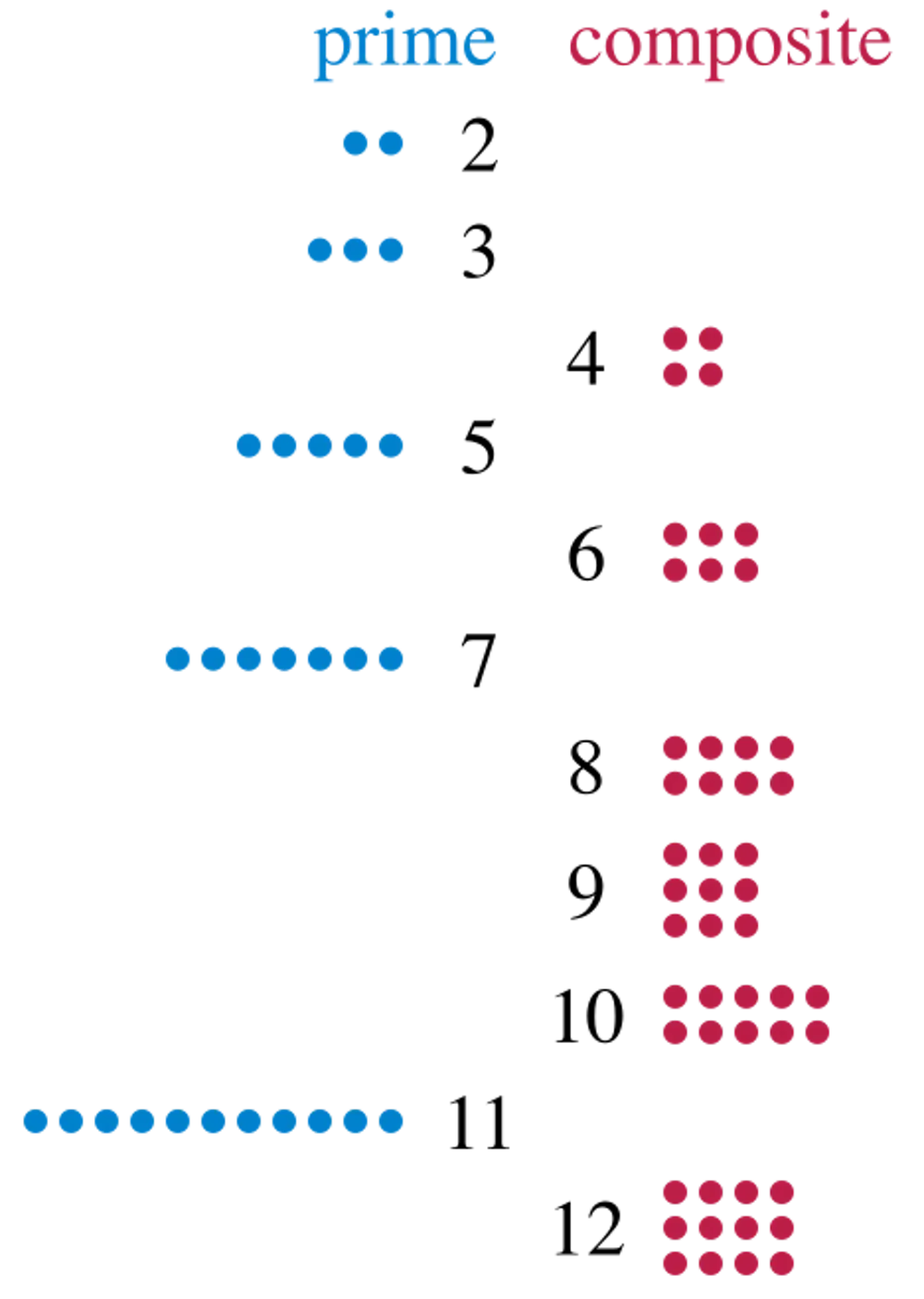
a diagram showing prime numbers as dots in rows, with composite numbers as dots arranged in rectangles of at least two rows of dots, with the same number of dots in each row.
Prime numbers, when expressed as that number of dots, can be arranged only in a single row or column, rather than a square or rectangle.
David Eppstein/Wikimedia Commons

In the middle ages, Arab mathematicians advanced the Greeks’ theory of prime numbers, referred to as hasam numbers during this time. The Persian mathematician Kamal al-Din al-Farisi formulated the fundamental theorem of arithmetic, which states that any positive integer larger than one can be expressed uniquely as a product of primes.

From this view, prime numbers are the basic building blocks for constructing any positive whole number using multiplication – akin to atoms combining to make molecules in chemistry.

Prime numbers can be sorted into different types. In 1202, Leonardo Fibonacci introduced in his book “Liber Abaci: Book of Calculation” prime numbers of the form (2p – 1) where p is also prime.

Today, primes in this form are called Mersenne primes after the French monk Marin Mersenne. Many of the largest known primes follow this format.

Several early mathematicians believed that a number of the form (2p – 1) is prime whenever p is prime. But in 1536, mathematician Hudalricus Regius noticed that 11 is prime but not (211 – 1), which equals 2047. The number 2047 can be expressed as 23 times 89, disproving the conjecture.

Advertisement
Get More From A Face Cleanser And Spa-like Massage

While not always true, number theorists realized that the (2p – 1) shortcut often produces primes and gives a systematic way to search for large primes.

The search for large primes

The number (2p – 1) is much larger relative to the value of p and provides opportunities to identify large primes.

When the number (2p – 1) becomes sufficiently large, it is much harder to check whether (2p – 1) is prime – that is, if (2p – 1) dots can be arranged only into a rectangular array with one column or one row.

Fortunately, Édouard Lucas developed a prime number test in 1878, later proved by Derrick Henry Lehmer in 1930. Their work resulted in an efficient algorithm for evaluating potential Mersenne primes. Using this algorithm with hand computations on paper, Lucas showed in 1876 that the 39-digit number (2127 – 1) equals 170,141,183,460,469,231,731,687,303,715,884,105,727, and that value is prime.

Also known as M127, this number remains the largest prime verified by hand computations. It held the record for largest known prime for 75 years.

Researchers began using computers in the 1950s, and the pace of discovering new large primes increased. In 1952, Raphael M. Robinson identified five new Mersenne primes using a Standard Western Automatic Computer to carry out the Lucas-Lehmer prime number tests.

As computers improved, the list of Mersenne primes grew, especially with the Cray supercomputer’s arrival in 1964. Although there are infinitely many primes, researchers are unsure how many fit the type (2p – 1) and are Mersenne primes.

By the early 1980s, researchers had accumulated enough data to confidently believe that infinitely many Mersenne primes exist. They could even guess how often these prime numbers appear, on average. Mathematicians have not found proof so far, but new data continues to support these guesses.

George Woltman, a computer scientist, founded the Great Internet Mersenne Prime Search, or GIMPS, in 1996. Through this collaborative program, anyone can download freely available software from the GIMPS website to search for Mersenne prime numbers on their personal computers. The website contains specific instructions on how to participate.

GIMPS has now identified 18 Mersenne primes, primarily on personal computers using Intel chips. The program averages a new discovery about every one to two years.

Advertisement
Get More From A Face Cleanser And Spa-like Massage

The largest known prime

Luke Durant, a retired programmer, discovered the current record for the largest known prime, (2136,279,841 – 1), in October 2024.

Referred to as M136279841, this 41,024,320-digit number was the 52nd Mersenne prime identified and was found by running GIMPS on a publicly available cloud-based computing network.

This network used Nvidia chips and ran across 17 countries and 24 data centers. These advanced chips provide faster computing by handling thousands of calculations simultaneously. The result is shorter run times for algorithms such as prime number testing.

A small rectangle metal chip reading 'nVIDIA'
New and increasingly powerful computer chips have allowed prime-number hunters to find increasingly larger primes.
Fritzchens Fritz/Flickr

The Electronic Frontier Foundation is a civil liberty group that offers cash prizes for identifying large primes. It awarded prizes in 2000 and 2009 for the first verified 1 million-digit and 10 million-digit prime numbers.

Large prime number enthusiasts’ next two challenges are to identify the first 100 million-digit and 1 billion-digit primes. EFF prizes of US$150,000 and $250,000, respectively, await the first successful individual or group.

Eight of the 10 largest known prime numbers are Mersenne primes, so GIMPS and cloud computing are poised to play a prominent role in the search for record-breaking large prime numbers.

Large prime numbers have a vital role in many encryption methods in cybersecurity, so every internet user stands to benefit from the search for large prime numbers. These searches help keep digital communications and sensitive information safe.

This story was updated on May 30, 2025 to correct the name of the Greek mathematician Euclid and to correct the factors of 2047.The Conversation

Jeremiah Bartz, Associate Professor of Mathematics, University of North Dakota

This article is republished from The Conversation under a Creative Commons license. Read the original article.

https://stmdailynews.com/groundbreaking-for-a-sustainable-future-la-metros-southeast-gateway-line-light-rail-project/

https://stmdailynews.com/groundbreaking-for-a-sustainable-future-la-metros-southeast-gateway-line-light-rail-project/

Advertisement
Get More From A Face Cleanser And Spa-like Massage

Discover more from Daily News

Subscribe to get the latest posts sent to your email.

Continue Reading
Advertisement Sports Research

Urbanism

The Building That Proved Los Angeles Could Go Vertical

Los Angeles once banned skyscrapers, yet City Hall broke the height limit and proved high-rise buildings could be engineered safely in an earthquake zone.

Published

on

Los Angeles once banned skyscrapers, yet City Hall broke the height limit and proved high-rise buildings could be engineered safely in an earthquake zone.
LA City Hall. Image Credit: TNC Network & Envato

How City Hall Quietly Undermined LA’s Own Height Limits

The Knowledge Series | STM Daily News

For more than half a century, Los Angeles enforced one of the strictest building height limits in the United States. Beginning in 1905, most buildings were capped at 150 feet, shaping a city that grew outward rather than upward.

The goal was clear: avoid the congestion, shadows, and fire dangers associated with dense Eastern cities. Los Angeles sold itself as open, sunlit, and horizontal — a place where growth spread across land, not into the sky.

And yet, in 1928, Los Angeles City Hall rose to 454 feet, towering over the city like a contradiction in concrete.

It wasn’t built to spark a commercial skyscraper boom.
But it ended up proving that Los Angeles could safely build one.


A Rule Designed to Prevent a Manhattan-Style City

The original height restriction was rooted in early 20th-century fears:

  • Limited firefighting capabilities
  • Concerns over blocked sunlight and airflow
  • Anxiety about congestion and overcrowding
  • A strong desire not to resemble New York or Chicago

Los Angeles wanted prosperity — just not vertical density.

The height cap reinforced a development model where:

  • Office districts stayed low-rise
  • Growth moved outward
  • Automobiles became essential
  • Downtown never consolidated into a dense core

This philosophy held firm even as other American cities raced upward.


How Los Angeles City Hall Proved Skyscrapers Could Be Built Safely

Why City Hall Was Never Meant to Change the Rules

City Hall was intentionally exempt from the height limit because the law applied primarily to private commercial buildings, not civic monuments.

But city leaders were explicit about one thing:
City Hall was not a precedent.

It was designed to:

  • Serve as a symbolic seat of government
  • Stand alone as a civic landmark
  • Represent stability, authority, and modern governance
  • Avoid competing with private office buildings

In effect, Los Angeles wanted a skyline icon — without a skyline.


Innovation Hidden in Plain Sight

What made City Hall truly significant wasn’t just its height — it was how it was built.

Advertisement
Get More From A Face Cleanser And Spa-like Massage

At a time when seismic science was still developing, City Hall incorporated advanced structural ideas for its era:

  • A steel-frame skeleton designed for flexibility
  • Reinforced concrete shear walls for lateral strength
  • A tapered tower to reduce wind and seismic stress
  • Thick structural cores that distributed force instead of resisting it rigidly

These choices weren’t about aesthetics — they were about survival.


The Earthquake That Changed the Conversation

In 1933, the Long Beach earthquake struck Southern California, causing widespread damage and reshaping building codes statewide.

Los Angeles City Hall survived with minimal structural damage.

This moment quietly reshaped the debate:

  • A tall building had endured a major earthquake
  • Structural engineering had proven effective
  • Height alone was no longer the enemy — poor design was

City Hall didn’t just survive — it validated a new approach to vertical construction in seismic regions.


Proof Without Permission

Despite this success, Los Angeles did not rush to repeal its height limits.

Cultural resistance to density remained strong, and developers continued to build outward rather than upward. But the technical argument had already been settled.

City Hall stood as living proof that:

  • High-rise buildings could be engineered safely in Los Angeles
  • Earthquakes were a challenge, not a barrier
  • Fire, structural, and seismic risks could be managed

The height restriction was no longer about safety — it was about philosophy.


The Ironic Legacy

When Los Angeles finally lifted its height limit in 1957, the city did not suddenly erupt into skyscrapers. The habit of building outward was already deeply entrenched.

The result:

  • A skyline that arrived decades late
  • Uneven density across the region
  • Multiple business centers instead of one core
  • Housing and transit challenges baked into the city’s growth pattern

City Hall never triggered a skyscraper boom — but it quietly made one possible.


Why This Still Matters

Today, Los Angeles continues to wrestle with:

Advertisement
Get More From A Face Cleanser And Spa-like Massage
  • Housing shortages
  • Transit-oriented development debates
  • Height and zoning battles near rail corridors
  • Resistance to density in a growing city

These debates didn’t begin recently.

They trace back to a single contradiction: a city that banned tall buildings — while proving they could be built safely all along.

Los Angeles City Hall wasn’t just a monument.
It was a test case — and it passed.

Further Reading & Sources


More from The Knowledge Series on STM Daily News

View recent photos

Unlock fun facts & lost history—get The Knowledge in your inbox!

We don’t spam! Read our privacy policy for more info.


Discover more from Daily News

Subscribe to get the latest posts sent to your email.

Continue Reading

small business

When TV Talks About Gentrification and Shopping Local — and Where It Gets It Right (and Wrong)

A closer look at how the TV show The Neighborhood tackles gentrification and shopping local—and where the reality of online sales and small business survival is more complex.

Published

on

a buy local signage. A closer look at how the TV show The Neighborhood tackles gentrification and shopping local—and where the reality of online sales and small business survival is more complex.
Photo by RDNE Stock project on Pexels.com

In our continuing look at how entertainment—television, movies, and streaming shows—grapples with real-world issues, this time we turn our attention to gentrification and the often-repeated call to “shop local.” Once again, we examine how popular culture frames these conversations, this time through the CBS sitcom The Neighborhood and the episode “Welcome Back to What Used to Be the Neighborhood.”

A Familiar Story: When the Neighborhood Changes

In the episode, Calvin’s favorite longtime restaurant closes its doors and is replaced by a flashy new pet spa. To Calvin, the change symbolizes something much bigger than a single business closing—it represents the slow erosion of the neighborhood he knows and loves. In response, he launches a campaign urging friends and neighbors to buy local in order to protect small businesses from disappearing.

Emotionally, the episode hits home. Many communities across the country have watched beloved neighborhood institutions vanish, replaced by businesses that feel disconnected from the area’s history and culture. In that sense, The Neighborhood gets something very right: gentrification often shows up one storefront at a time.

Where Television Simplifies a Complicated Reality

But, as is often the case with television, the episode also simplifies a much more complex economic reality.

The show frames “shopping local” as a direct alternative to shopping online, subtly suggesting that online platforms are inherently harmful to small businesses. In real life, however, the line between “local” and “online” is no longer so clear.

Many local and small businesses now survive precisely because they sell online—through their own websites, through Amazon, or through other platforms that support independent sellers. For some, online sales are not a threat to local commerce; they are a lifeline.

Why Brick-and-Mortar Isn’t Always Sustainable

Rising costs are a major factor driving these changes. Commercial leases, insurance premiums, utilities, staffing costs, and local fees have all increased dramatically in many cities. For small business owners, keeping a physical storefront open can become financially impossible—even when customer support remains strong.

As a result, some businesses choose to close their brick-and-mortar locations while continuing to operate online. Others scale back to pop-ups, shared spaces, or hybrid models. These businesses may no longer have a traditional storefront, but they are still local—employing local workers, paying local taxes, and serving their communities in new ways.

The Real Issue Behind “Shop Local”

Where The Neighborhood succeeds is in capturing the emotional truth of gentrification: the sense of loss, displacement, and cultural change that comes with rising rents and shifting demographics.

Where it misses the mark is in suggesting that consumer choices alone—simply avoiding online shopping—can solve the problem.

The real challenges facing local and small businesses go far beyond individual buying habits. They include zoning policies, commercial rent practices, corporate consolidation, and economic systems that increasingly favor scale over community presence.

Advertisement
Get More From A Face Cleanser And Spa-like Massage
Visit: https://stmdailynews.com/stm-daily-news-pop-culture-fact-check-do-electric-cars-have-fuses/

A Conversation Worth Having—Even If TV Can’t Finish It

The Neighborhood deserves credit for bringing these issues into mainstream conversation. It sparks discussion, even if it wraps a complicated topic in a sitcom-friendly moral lesson.

The reality is messier. Supporting local businesses today often means rethinking what “local” looks like in a digital economy—and recognizing that survival sometimes requires adaptation, not nostalgia.

Further Reading & External Resources

At STM Daily News, our Local and Small Business coverage continues to explore these real-world dynamics beyond the TV screen, highlighting the challenges, innovations, and resilience of the businesses that keep communities alive—whether their doors are on Main Street or their storefronts live online.

📍 Read more Local and Small Business coverage at: STM Daily News

Author

  • Rod Washington

    Rod: A creative force, blending words, images, and flavors. Blogger, writer, filmmaker, and photographer. Cooking enthusiast with a sci-fi vision. Passionate about his upcoming series and dedicated to TNC Network. Partnered with Rebecca Washington for a shared journey of love and art. View all posts


Discover more from Daily News

Subscribe to get the latest posts sent to your email.

Continue Reading

The Knowledge

Metro Board Advances Sepulveda Transit Corridor as C Line South Bay Extension Remains Under Review

The Los Angeles Metro Board meeting addressed progress on two key rail projects: the approved underground Sepulveda Transit Corridor, enhancing regional connectivity, and the debated extension of the Metro C Line into the South Bay, which remains undecided.

Published

on

The LA Metro Board approved the Sepulveda Transit Corridor’s underground rail plan while continuing debate over the C Line extension into the South Bay. Here’s what it means for LA transit’s future.
Image Credit: LA Metro

The future of Los Angeles transit was the focus of a recent Los Angeles County Metropolitan Transportation Authority (Metro) Board meeting, where directors considered progress on two major rail projects: the Sepulveda Transit Corridor and the long-planned extension of the Metro C Line into the South Bay.

STC LPA scaled 1
Image Credit: LA Metro

While the meeting resulted in a decisive vote on one project, the other continues to generate debate among Metro officials, local cities, and residents.

Sepulveda Transit Corridor: Underground Heavy Rail Moves Forward

The Metro Board unanimously approved the Locally Preferred Alternative (LPA) for the Sepulveda Transit Corridor, marking a major milestone for a project that has been discussed for decades.

The approved alternative calls for a fully underground heavy rail subway connecting the San Fernando Valley to the Westside, running from the Van Nuys Metrolink Station to the Metro E Line’s Expo/Sepulveda Station. The line would pass beneath the Sepulveda Pass, UCLA, and other high-demand travel areas.

Metro officials emphasized that the underground alignment offers the fastest travel times, highest passenger capacity, and the fewest surface-level impacts when compared with earlier aerial or monorail alternatives. The project is expected to significantly reduce congestion along the 405 Freeway corridor and improve regional connectivity.

With the LPA now selected, the Sepulveda Transit Corridor advances toward final environmental clearance, engineering, and eventual construction — a process that will continue over the coming years.

Metro C Line Extension: South Bay Alignment Debate Continues

The Board also discussed the Metro C Line extension into the South Bay, a project intended to extend light rail service approximately 4.5 miles from the current Redondo Beach station to the Torrance Transit Center.

Metro has released the project’s Final Environmental Impact Report (FEIR), which incorporates years of technical analysis and public input. However, unlike the Sepulveda project, the Board did not take final action to certify the FEIR or formally adopt a locally preferred alignment at this meeting.

Hawthorne Boulevard vs. Metro Right-of-Way

At the center of the C Line discussion is the question of alignment.

Metro staff has identified a “hybrid” alignment using an existing Metro-owned rail right-of-way as the preferred option. This route would largely follow the historic Harbor Subdivision corridor, minimizing new street disruptions while blending at-grade, elevated, and below-grade segments.

Some South Bay cities, however, continue to advocate for a Hawthorne Boulevard alignment, which would place rail tracks within the median of the busy commercial corridor. Supporters argue it offers better street-level access, while Metro has cited higher costs, longer construction timelines, and greater traffic impacts as key concerns.

Metro officials indicated that additional coordination with local jurisdictions and further Board action will be needed before a final decision is made.

Advertisement
Get More From A Face Cleanser And Spa-like Massage

What This Means for LA Transit

The contrast between the two projects was clear at the meeting: the Sepulveda Transit Corridor is now firmly on a defined path forward, while the C Line extension remains in a critical decision-making phase.

Together, the projects highlight both the ambition and complexity of expanding transit in Los Angeles County — balancing regional mobility goals, neighborhood impacts, and long-term funding realities.

Further Reading & Official Project Information


Metro Sepulveda Transit Corridor Project Page

– Official Metro overview of the Sepulveda Pass project, including alternatives, maps, timelines, and environmental documents.

Metro Board Considers Locally Preferred Alternative for Sepulveda Corridor

– Metro’s summary of the Board action and rationale behind selecting the underground heavy rail option.

Metro C Line Extension to Torrance Project Page

– Background, station concepts, and status updates for the South Bay light rail extension.

Final Environmental Impact Report: C Line Extension

– Details on the Final EIR, public comments, and next steps toward Board certification.

Metro Project Updates – The Source

– Ongoing Metro blog updates covering major transit projects, board actions, and construction milestones.

LA Metro Board of Directors

– Information on Metro Board members, meeting schedules, agendas, and voting records.

STM Daily News will continue to follow both projects closely, providing updates as Metro moves toward final approvals, construction timelines, and funding decisions that will shape how Angelenos travel for decades to come.

For ongoing coverage of Metro projects, transportation policy, and infrastructure across Southern California, visit STM Daily News.


Discover more from Daily News

Subscribe to get the latest posts sent to your email.

Continue Reading

Trending


