STM Blog
“SpaceX’s Crew Dragon Capsule Now Available as Matchbox Collectible”
“SpaceX’s Crew Dragon spacecraft is now available as a Matchbox toy. The miniature capsule includes the trunk and metallic solar cells.”
Last Updated on July 3, 2024 by Daily News Staff
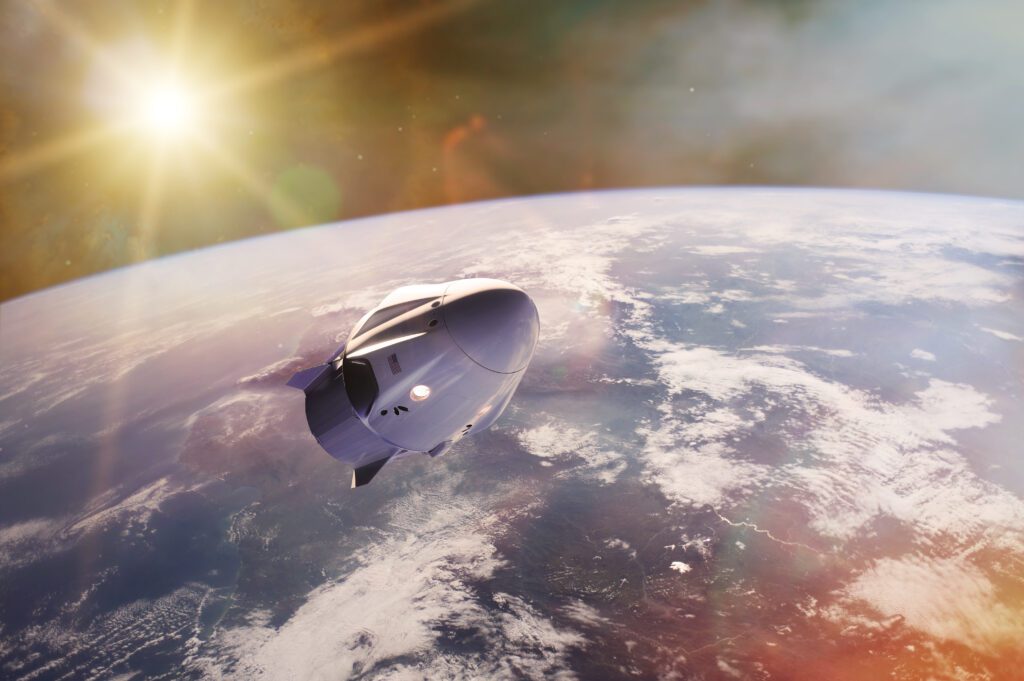
SpaceX, the private space exploration company, has made history once again. This time, it’s not for launching rockets, but for making its spacecraft available as a collectible toy. Fans of SpaceX will be thrilled to know that Matchbox has released a miniature version of the Crew Dragon spacecraft. This spacecraft has flown ten astronaut crews into Earth orbit and has now landed on toy store shelves.
The collectible toy is the first product to be released under a multi-year licensing agreement between SpaceX and Mattel, announced in July 2022. The 2.5-inch-tall (6.4 centimeters) Dragon capsule model includes both the capsule, where astronauts ride to and from space, and the “trunk,” which supports unpressurized payloads and provides power to the entire craft. Matchbox has even included the look of the solar cells that cover one side of the trunk with a metallic silver and black finish.
This collectible toy is a great way for fans to show their love for space exploration and SpaceX. It’s not just a toy for kids, but also for adults who are fascinated by the wonders of space. The Crew Dragon capsule model is perfect for collectors, enthusiasts, and anyone who appreciates the beauty of space technology.
The Matchbox SpaceX Dragon Capsule is available for purchase for $16.99 each. This collectible toy is a must-have for anyone who is interested in space exploration and the history of SpaceX. It’s a great way to inspire future generations to dream big and reach for the stars.
https://www.space.com/matchbox-spacex-dragon-die-cast-capsule
https://stmdailynews.com/category/stm-blog/blog/
Discover more from Daily News
Subscribe to get the latest posts sent to your email.
Science
First contact with aliens could end in colonization and genocide if we don’t learn from history
Last Updated on March 15, 2026 by Daily News Staff
First contact with aliens could end in colonization and genocide if we don’t learn from history
David Delgado Shorter, University of California, Los Angeles; Kim TallBear, University of Alberta, and William Lempert, Bowdoin College
We’re only halfway through 2023, and it feels already like the year of alien contact.
In February, President Joe Biden gave orders to shoot down three unidentified aerial phenomena – NASA’s title for UFOs. Then, the alleged leaked footage from a Navy pilot of a UFO, and then news of a whistleblower’s report on a possible U.S. government cover-up about UFO research. Most recently, an independent analysis published in June suggests that UFOs might have been collected by a clandestine agency of the U.S. government.
If any actual evidence of extraterrestrial life emerges, whether from whistleblower testimony or an admission of a cover-up, humans would face a historic paradigm shift.
As members of an Indigenous studies working group who were asked to lend our disciplinary expertise to a workshop affiliated with the Berkeley SETI Research Center, we have studied centuries of culture contacts and their outcomes from around the globe. Our collaborative preparations for the workshop drew from transdisciplinary research in Australia, New Zealand, Africa and across the Americas.
In its final form, our group statement illustrated the need for diverse perspectives on the ethics of listening for alien life and a broadening of what defines “intelligence” and “life.” Based on our findings, we consider first contact less as an event and more as a long process that has already begun.
Who’s in charge of first contact
The question of who is “in charge” of preparing for contact with alien life immediately comes to mind. The communities – and their interpretive lenses – most likely to engage in any contact scenario would be military, corporate and scientific.
By giving Americans the legal right to profit from space tourism and planetary resource extraction, the Commercial Space Launch Competitiveness Act of 2015 could mean that corporations will be the first to find signs of extraterrestrial societies. Otherwise, while detecting unidentified aerial phenomena is usually a military matter, and NASA takes the lead on sending messages from Earth, most activities around extraterrestrial communications and evidence fall to a program called SETI, or the search for extraterrestrial intelligence.
SETI is a collection of scientists with a variety of research endeavors, including Breakthrough Listen, which listens for “technosignatures,” or markers, like pollutants, of a designed technology.
SETI investigators are virtually always STEM – science, technology, engineering and math – scholars. Few in the social science and humanities fields have been afforded opportunities to contribute to concepts of and preparations for contact.
In a promising act of disciplinary inclusion, the Berkeley SETI Research Center in 2018 invited working groups – including our Indigenous studies working group – from outside STEM fields to craft perspective papers for SETI scientists to consider.
Ethics of listening
Neither Breakthough Listen nor SETI’s site features a current statement of ethics beyond a commitment to transparency. Our working group was not the first to raise this issue. And while the SETI Institute and certain research centers have included ethics in their event programming, it seems relevant to ask who NASA and SETI answer to, and what ethical guidelines they’re following for a potential first contact scenario.
SETI’s Post-Detection Hub – another rare exception to SETI’s STEM-centrism – seems the most likely to develop a range of contact scenarios. The possible circumstances imagined include finding ET artifacts, detecting signals from thousands of light years away, dealing with linguistic incompatibility, finding microbial organisms in space or on other planets, and biological contamination of either their or our species. Whether the U.S. government or heads of military would heed these scenarios is another matter.
SETI-affiliated scholars tend to reassure critics that the intentions of those listening for technosignatures are benevolent, since “what harm could come from simply listening?” The chair emeritus of SETI Research, Jill Tarter, defended listening because any ET civilization would perceive our listening techniques as immature or elementary.
But our working group drew upon the history of colonial contacts to show the dangers of thinking that whole civilizations are comparatively advanced or intelligent. For example, when Christopher Columbus and other European explorers came to the Americas, those relationships were shaped by the preconceived notion that the “Indians” were less advanced due to their lack of writing. This led to decades of Indigenous servitude in the Americas.
The working group statement also suggested that the act of listening is itself already within a “phase of contact.” Like colonialism itself, contact might best be thought of as a series of events that starts with planning, rather than a singular event. Seen this way, isn’t listening potentially without permission just another form of surveillance? To listen intently but indiscriminately seemed to our working group like a type of eavesdropping.
It seems contradictory that we begin our relations with aliens by listening in without their permission while actively working to stop other countries from listening to certain U.S. communications. If humans are initially perceived as disrespectful or careless, ET contact could more likely lead to their colonization of us.
Histories of contact
Throughout histories of Western colonization, even in those few cases when contactees were intended to be protected, contact has led to brutal violence, pandemics, enslavement and genocide.
James Cook’s 1768 voyage on the HMS Endeavor was initiated by the Royal Society. This prestigious British academic society charged him with calculating the solar distance between the Earth and the Sun by measuring the visible movement of Venus across the Sun from Tahiti. The society strictly forbade him from any colonial engagements.
Though he achieved his scientific goals, Cook also received orders from the Crown to map and claim as much territory as possible on the return voyage. Cook’s actions put into motion wide-scale colonization and Indigenous dispossession across Oceania, including the violent conquests of Australia and New Zealand.

The Royal Society gave Cook a “prime directive” of doing no harm and to only conduct research that would broadly benefit humanity. However, explorers are rarely independent from their funders, and their explorations reflect the political contexts of their time.
As scholars attuned to both research ethics and histories of colonialism, we wrote about Cook in our working group statement to showcase why SETI might want to explicitly disentangle their intentions from those of corporations, the military and the government.
Although separated by vast time and space, both Cook’s voyage and SETI share key qualities, including their appeal to celestial science in the service of all humanity. They also share a mismatch between their ethical protocols and the likely long-term impacts of their success. https://www.youtube.com/embed/5gZwLGrJQrM?wmode=transparent&start=0 This BBC video describes the modern ramifications of Captain James Cook’s colonial legacy in New Zealand.
The initial domino of a public ET message, or recovered bodies or ships, could initiate cascading events, including military actions, corporate resource mining and perhaps even geopolitical reorganizing. The history of imperialism and colonialism on Earth illustrates that not everyone benefits from colonization. No one can know for sure how engagement with extraterrestrials would go, though it’s better to consider cautionary tales from Earth’s own history sooner rather than later.
This article has been updated to correct the date of James Cook’s voyage.
David Delgado Shorter, Professor of World Arts and Cultures/Dance, University of California, Los Angeles; Kim TallBear, Professor of Native Studies, University of Alberta, and William Lempert, Assistant Professor of Anthropology, Bowdoin College
This article is republished from The Conversation under a Creative Commons license. Read the original article.
The science section of our news blog STM Daily News provides readers with captivating and up-to-date information on the latest scientific discoveries, breakthroughs, and innovations across various fields. We offer engaging and accessible content, ensuring that readers with different levels of scientific knowledge can stay informed. Whether it’s exploring advancements in medicine, astronomy, technology, or environmental sciences, our science section strives to shed light on the intriguing world of scientific exploration and its profound impact on our daily lives. From thought-provoking articles to informative interviews with experts in the field, STM Daily News Science offers a harmonious blend of factual reporting, analysis, and exploration, making it a go-to source for science enthusiasts and curious minds alike. https://stmdailynews.com/category/science/
Discover more from Daily News
Subscribe to get the latest posts sent to your email.
unknown
Why people tend to believe UFOs are extraterrestrial
Last Updated on March 13, 2026 by Daily News Staff
Barry Markovsky, University of South Carolina
Most of us still call them UFOs – unidentified flying objects. NASA recently adopted the term “unidentified anomalous phenomena,” or UAP. Either way, every few years popular claims resurface that these things are not of our world, or that the U.S. government has some stored away.
I’m a sociologist who focuses on the interplay between individuals and groups, especially concerning shared beliefs and misconceptions. As for why UFOs and their alleged occupants enthrall the public, I’ve found that normal human perceptual and social processes explain UFO buzz as much as anything up in the sky.
Historical context
Like political scandals and high-waisted jeans, UFOs trend in and out of collective awareness but never fully disappear. Thirty years of polling find that 25%-50% of surveyed Americans believe at least some UFOs are alien spacecraft. Today in the U.S., over 100 million adults think our galactic neighbors pay us visits.
It wasn’t always so. Linking objects in the sky with visiting extraterrestrials has risen in popularity only in the past 75 years. Some of this is probably market-driven. Early UFO stories boosted newspaper and magazine sales, and today they are reliable clickbait online.
In 1980, a popular book called “The Roswell Incident” by Charles Berlitz and William L. Moore described an alleged flying saucer crash and government cover-up 33 years prior near Roswell, New Mexico. The only evidence ever to emerge from this story was a small string of downed weather balloons. Nevertheless, the book coincided with a resurgence of interest in UFOs. From there, a steady stream of UFO-themed TV shows, films, and pseudo-documentaries has fueled public interest. Perhaps inevitably, conspiracy theories about government cover-ups have risen in parallel.
Some UFO cases inevitably remain unresolved. But despite the growing interest, multiple investigations have found no evidence that UFOs are of extraterrestrial origin – other than the occasional meteor or misidentification of Venus.
But the U.S. Navy’s 2017 Gimbal video continues to appear in the media. It shows strange objects filmed by fighter jets, often interpreted as evidence of alien spacecraft. And in June 2023, an otherwise credible Air Force veteran and former intelligence officer made the stunning claim that the U.S. government is storing numerous downed alien spacecraft and their dead occupants. https://www.youtube.com/embed/2TumprpOwHY?wmode=transparent&start=0 UFO videos released by the U.S. Navy, often taken as evidence of alien spaceships.
Human factors contributing to UFO beliefs
Only a small percentage of UFO believers are eyewitnesses. The rest base their opinions on eerie images and videos strewn across both social media and traditional mass media. There are astronomical and biological reasons to be skeptical of UFO claims. But less often discussed are the psychological and social factors that bring them to the popular forefront.
Many people would love to know whether or not we’re alone in the universe. But so far, the evidence on UFO origins is ambiguous at best. Being averse to ambiguity, people want answers. However, being highly motivated to find those answers can bias judgments. People are more likely to accept weak evidence or fall prey to optical illusions if they support preexisting beliefs.
For example, in the 2017 Navy video, the UFO appears as a cylindrical aircraft moving rapidly over the background, rotating and darting in a manner unlike any terrestrial machine. Science writer Mick West’s analysis challenged this interpretation using data displayed on the tracking screen and some basic geometry. He explained how the movements attributed to the blurry UFO are an illusion. They stem from the plane’s trajectory relative to the object, the quick adjustments of the belly-mounted camera, and misperceptions based on our tendency to assume cameras and backgrounds are stationary.
West found the UFO’s flight characteristics were more like a bird’s or a weather balloon’s than an acrobatic interstellar spacecraft. But the illusion is compelling, especially with the Navy’s still deeming the object unidentified.
West also addressed the former intelligence officer’s claim that the U.S. government possesses crashed UFOs and dead aliens. He emphasized caution, given the whistleblower’s only evidence was that people he trusted told him they’d seen the alien artifacts. West noted we’ve heard this sort of thing before, along with promises that the proof will soon be revealed. But it never comes.
Anyone, including pilots and intelligence officers, can be socially influenced to see things that aren’t there. Research shows that hearing from others who claim to have seen something extraordinary is enough to induce similar judgments. The effect is heightened when the influencers are numerous or higher in status. Even recognized experts aren’t immune from misjudging unfamiliar images obtained under unusual conditions.
Group factors contributing to UFO beliefs
“Pics or it didn’t happen” is a popular expression on social media. True to form, users are posting countless shaky images and videos of UFOs. Usually they’re nondescript lights in the sky captured on cellphone cameras. But they can go viral on social media and reach millions of users. With no higher authority or organization propelling the content, social scientists call this a bottom-up social diffusion process.
In contrast, top-down diffusion occurs when information emanates from centralized agents or organizations. In the case of UFOs, sources have included social institutions like the military, individuals with large public platforms like U.S. senators, and major media outlets like CBS.
Amateur organizations also promote active personal involvement for many thousands of members, the Mutual UFO Network being among the oldest and largest. But as Sharon A. Hill points out in her book “Scientifical Americans,” these groups apply questionable standards, spread misinformation and garner little respect within mainstream scientific communities.
Top-down and bottom-up diffusion processes can combine into self-reinforcing loops. Mass media spreads UFO content and piques worldwide interest in UFOs. More people aim their cameras at the skies, creating more opportunities to capture and share odd-looking content. Poorly documented UFO pics and videos spread on social media, leading media outlets to grab and republish the most intriguing. Whistleblowers emerge periodically, fanning the flames with claims of secret evidence.
Despite the hoopla, nothing ever comes of it.
For a scientist familiar with the issues, skepticism that UFOs carry alien beings is wholly separate from the prospect of intelligent life elsewhere in the universe. Scientists engaged in the search for extraterrestrial intelligence have a number of ongoing research projects designed to detect signs of extraterrestrial life. If intelligent life is out there, they’ll likely be the first to know.
As astronomer Carl Sagan wrote, “The universe is a pretty big place. If it’s just us, seems like an awful waste of space.”
Barry Markovsky, Distinguished Professor Emeritus of Sociology, University of South Carolina
This article is republished from The Conversation under a Creative Commons license. Read the original article.
The science section of our news blog STM Daily News provides readers with captivating and up-to-date information on the latest scientific discoveries, breakthroughs, and innovations across various fields. We offer engaging and accessible content, ensuring that readers with different levels of scientific knowledge can stay informed. Whether it’s exploring advancements in medicine, astronomy, technology, or environmental sciences, our science section strives to shed light on the intriguing world of scientific exploration and its profound impact on our daily lives. From thought-provoking articles to informative interviews with experts in the field, STM Daily News Science offers a harmonious blend of factual reporting, analysis, and exploration, making it a go-to source for science enthusiasts and curious minds alike. https://stmdailynews.com/category/science/
Discover more from Daily News
Subscribe to get the latest posts sent to your email.
The Knowledge
How Water Towers Work: The Simple System That Keeps Water Flowing in American Cities
Learn how water towers work in the United States, why they are so tall, and how gravity helps cities maintain water pressure and emergency water supplies.

How Water Towers Work
Water towers are one of the most recognizable pieces of infrastructure across the United States. Rising above towns, suburbs, and cities, these elevated tanks quietly perform a vital function every day: maintaining water pressure and storing emergency water for local communities.
Although they may look simple, water towers are an essential part of modern municipal water systems and remain one of the most reliable ways to deliver water to homes and businesses.
The Basic Science Behind Water Towers
Water towers work using a simple principle of physics: gravity.
Water from treatment plants or underground wells is pumped into a storage tank located high above the ground—typically between 100 and 200 feet tall. Because the tank is elevated, gravity naturally pushes the water downward through the city’s pipeline network.
This gravitational force creates the water pressure needed to supply homes, businesses, irrigation systems, and fire hydrants throughout the community.
Most residential plumbing systems in the United States operate best at 40 to 60 PSI (pounds per square inch), which water towers can easily provide through elevation alone.
Why Water Towers Are Built So Tall
The height of a water tower determines how much pressure it can create. Engineers use a common rule:
For example, a water tower standing 120 feet tall can generate roughly 50 PSI of pressure—perfect for delivering water throughout a residential neighborhood.
Why Cities Still Use Water Towers
While modern pumping systems could theoretically move water through pipes continuously, water towers provide several major advantages that make them a preferred design in many municipal systems.
- Stable Water Pressure – Water towers maintain consistent pressure even during peak usage times.
- Energy Efficiency – Pumps can refill towers overnight when electricity demand is lower.
- Emergency Water Supply – If power fails, gravity can continue delivering water.
- Fire Protection – Fire hydrants depend on strong, immediate water pressure.
The Daily Fill-and-Use Cycle
Water towers typically operate on a daily cycle based on community demand.
- Night: Pumps refill the tower while water demand is low.
- Morning: Water levels drop as residents shower and prepare for the day.
- Daytime: Businesses and homes continue drawing water from the tower.
- Evening: The system begins refilling the tank for the next day.
How Much Water Can a Tower Store?
Water towers come in many sizes depending on the population they serve.
- Small towns: 50,000–300,000 gallons
- Suburban communities: 500,000–1 million gallons
- Larger urban systems: up to 2 million gallons or more
Even a single tower holding one million gallons can supply thousands of homes for several hours during peak demand or emergencies.
Modern Technology Inside Water Towers
Today’s water towers are equipped with advanced monitoring systems that help utilities maintain safe and reliable water supplies.
- Digital water level sensors
- Automated pump controls
- Water quality monitoring
- Protective interior coatings
- Regular inspections and maintenance
Landmarks in the American Skyline
Many cities turn their water towers into local landmarks by painting them with city names, mascots, or community slogans. Some towns even design towers shaped like giant objects such as fruit, coffee cups, or sports balls.
Despite their distinctive appearance, water towers remain one of the simplest and most reliable engineering solutions for delivering clean water to millions of Americans every day.
Next time you see a water tower rising above a town skyline, remember: it’s not just a landmark—it’s the gravity-powered system that keeps water flowing.
Related External Coverage
For more information about how water towers and municipal water systems work, explore the following resources:
- U.S. Environmental Protection Agency – Drinking Water Regulations
- American Water Works Association – Water Storage and Water Towers
- HowStuffWorks – How Water Distribution Systems Work
- U.S. Geological Survey – Drinking Water and Groundwater Basics
- U.S. Department of Energy – How Water Towers Work
Dive into “The Knowledge,” where curiosity meets clarity. This playlist, in collaboration with STMDailyNews.com, is designed for viewers who value historical accuracy and insightful learning. Our short videos, ranging from 30 seconds to a minute and a half, make complex subjects easy to grasp in no time. Covering everything from historical events to contemporary processes and entertainment, “The Knowledge” bridges the past with the present. In a world where information is abundant yet often misused, our series aims to guide you through the noise, preserving vital knowledge and truths that shape our lives today. Perfect for curious minds eager to discover the ‘why’ and ‘how’ of everything around us. Subscribe and join in as we explore the facts that matter. https://stmdailynews.com/the-knowledge/
Discover more from Daily News
Subscribe to get the latest posts sent to your email.