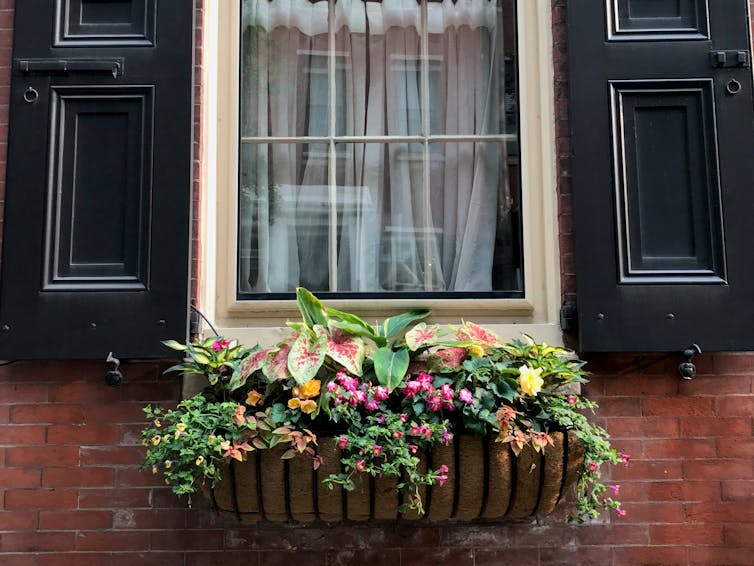
Window-box gardening has been a Philly tradition since the 1800s. Sonja Dümpelmann, CC BY-SASonja Dümpelmann, Ludwig Maximilian University of MunichIt’s that time of year when Philadelphia row home owners with a green thumb fastidiously attend to their window boxes – selecting new plants to design an artful blend of colors, shapes and textures.Sonja Dümpelmann is a historian of landscapes and the built environment who lived in Philly from 2019 to 2023. During this time, she researched how female reformers and activists in Philadelphia in the 19th and 20th centuries tended to window-box gardens both for charity and to spur urban renewal in rundown neighborhoods.Dümpelmann recently published an article on this history in the architectural journal Buildings & Landscapes. She spoke with The Conversation U.S. about what she learned.Some homeowners change out their plants throughout the year.Sonja Dümpelmann, CC BY-SA
How did you become interested in window boxes?
When I first moved to Philadelphia from Cambridge, Massachusetts, in August 2019, I was immediately struck by the window boxes. The lushness and freshness of the plants in many of the boxes, and sometimes in sidewalk planters, made walking more pleasant and interesting. This was especially the case in the hot summer months when I would often see plants from subtropical and tropical climates in the Rittenhouse Square, Fitler Square and Graduate Hospital neighborhoods. I noticed that there were three categories of window boxes. Many were visibly cared for, often freshly planted and decorated several times a year in accordance with the changing seasons. Some were derelict and had spontaneous growth of saplings and different grasses. And a third category were boxes outfitted with plastic plants, perhaps signaling absentee owners or landlords who seek to simulate care.
What makes them landscape architecture?
Window boxes – especially the planted boxes, but also painted boxes that are empty – change outdoor space and building exteriors. They make them more colorful and interesting, and they break up plain vertical walls by protruding from the facade. You could say that the window boxes “greet” passersby. They connect private indoor space with the public realm of the street. As one early window-box promoter observed in 1903, “The man in the street gets as much enjoyment out of them as its owner.” “Gardens in a box,” as they were also referred to by early promoters, can make homes and entire neighborhoods look and feel different. They forge distinct identities with their plant selection and the style and color of the boxes.Window gardens are a way to greet passersby on the street.Sonja Dümpelmann, CC BY-SA
How did window gardening begin?
Window gardening became popular in Victorian England and continental Europe in the 19th century. It began as an indoor activity and was practiced especially by women, but it soon also moved outdoors. There it became part of what American women in the late 19th century called “municipal housekeeping.” It extended their conventional female roles as housekeepers and mothers into the larger “household” of the community. Window gardening became a means of female social reform during the Progressive Era. During this period in the late 19th and early 20th centuries, when industries and cities were growing fast, women sought to improve education, public health and living conditions, especially for poor and immigrant communities. By offering plants, flowers and entire window boxes, the women supported homemakers of lesser means. However, these boxes were also a way to make sure that order in and outside of homes was maintained. Window gardens became cultural symbols of cleanliness and good housekeeping. Furthermore, reformers considered window gardening as a practice that could help immigrants assimilate into American society.
When did they become political?
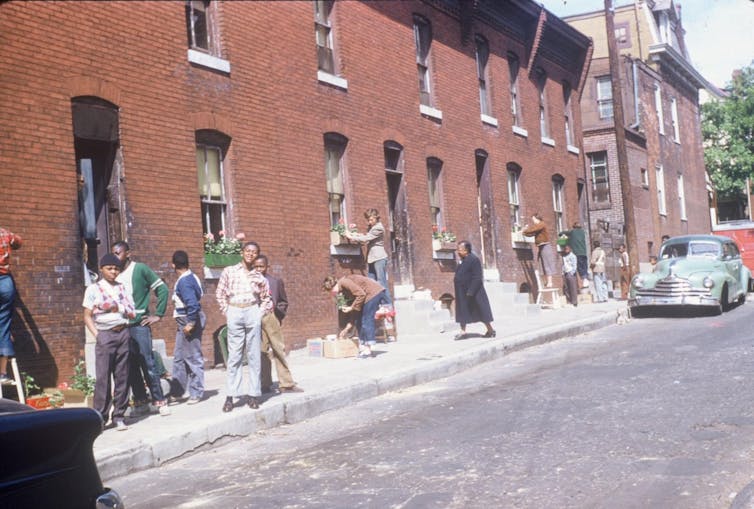
In Philadelphia there were two big window-gardening movements. The first occurred in the late 19th and early 20th centuries, and I describe it as window-box charity. The second, which I call window-box activism, began in the 1950s. Window-box charity was carried out primarily by white philanthropists and social workers who would distribute plants and goods sent from outside the city to the urban poor and sick, especially immigrants and Black Americans. Sometimes the window boxes were ready to be installed outside the windows. Other times recipients built and planted boxes themselves.The Neighborhood Garden Association, the organization that pioneered window-box activism, at work near the now-closed Alexander Wilson School in West Philadelphia in 1955.Courtesy of the McLean Library and Archives, Pennsylvania Horticultural Society, Philadelphia, Pennsylvania Several decades later, in the mid-20th-century, plants became a vehicle for white suburban garden club ladies and Black inner-city residents to counter urban decay resulting from racism and public disinvestment. On annual planting days, the garden club ladies brought plants into the city and joined residents in planting and installing window boxes to brighten up their neighborhood blocks. Plants were key in both window-box charity and window-box activism. People came together to care for plants, creating friendships among neighbors and ties between low-income and wealthy neighborhoods. The women used plants and window boxes to protect private space and increase the safety of public space. In the 1960s, the Philadelphia police reported less crime on streets with window boxes. Of course, window boxes and plants alone could not solve larger urban social problems such as poor housing conditions and racial discrimination. So while they could be catalysts of neighborhood change, they also helped to camouflage and quite literally naturalize larger social problems that required political responses.
Are they still linked to urban renewal?
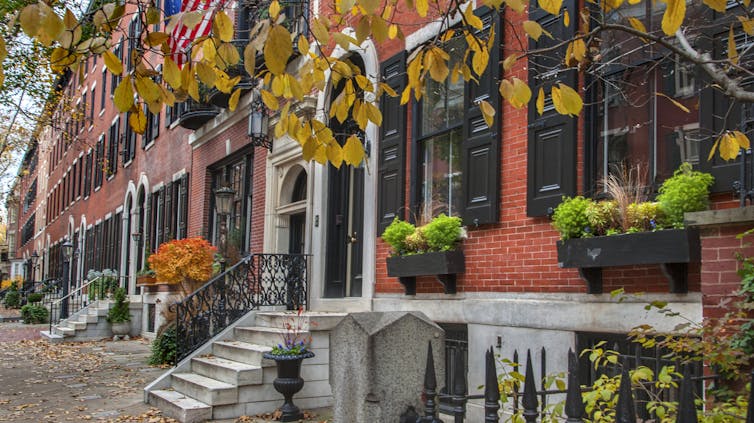
Like a smaller version of public parks, community gardens and street trees, window gardens can contribute to green gentrification. This occurs when the construction of parks or the planting of trees contributes to an increase in property values that leads to the displacement of long-term residents in low-income neighborhoods. Window gardening did help save some of Philly’s old row house neighborhoods from demolition during urban renewal beginning in the 1950s. However, quite a few of these neighborhoods – such as Washington Square West and Graduate Hospital – have since been gentrified, and families who once window gardened to turn their neighborhoods into more beautiful and safer places could no longer afford to live there. The 20th century window-box activism drew the attention of sociologists and other national and international observers, especially because it brought white and Black residents together during the tensions of the Civil Rights Movement. It also raised public awareness about unequal access to urban green spaces.Window boxes on Delancey Street in Philadelphia.Photo by R. Kennedy for Visit Philadelphia, CC BY-SA Yet despite the movement’s good intentions and positive effects, racial segregation remains a persistent problem in Philadelphia. In gentrified parts of Center City today, new and restored row houses often include fixtures and built-in irrigation pipes for window boxes. Many owners outsource window-box planting and maintenance to paid service providers. But for lower-income residents, the costs in both time and money to install and maintain window gardens can be prohibitive.Sonja Dümpelmann, Professor of Environmental Humanities, Ludwig Maximilian University of Munich This article is republished from The Conversation under a Creative Commons license. Read the original article.
The Dodger Gondola Project: A High-Flying Transit Idea Facing Heavy Headwinds
The Dodger Gondola Project, a proposed aerial transit line between Union Station and Dodger Stadium, faces major political, legal, and community opposition in 2025. Here’s where the controversial project stands now.
Imagine credit: Aerial Rapid Transit Technologies/ LA Metro
Dodger Gondola Project Faces Major Setbacks as L.A. Leaders and Residents Push Back
For years, the Los Angeles Aerial Rapid Transit (LA ART) — better known as the Dodger Gondola Project — has been pitched as a bold, futuristic connection between Union Station and Dodger Stadium, whisking riders above traffic in a six-minute aerial trip. Supporters call it L.A.’s chance to build a cleaner, faster, iconic transit link. But as 2025 winds toward its close, the project faces more turbulence than ever.
A Quick Refresher: What the Gondola Would Be
The proposed gondola line would travel about 1.2 miles, with stations at Union Station, a stop near L.A. State Historic Park, and Dodger Stadium. Private backers connected to former Dodgers owner Frank McCourt have promoted it as a zero-emission way to move more than 5,000 passengers per hour on game days — and potentially daily for tourists, residents, and park visitors.
Why the Dream Is Stalling
In November 2025, the Los Angeles City Council voted 12–1 to formally oppose the project, urging Metro to abandon it. While the vote isn’t legally binding, it signaled a major political shift. Councilmember Eunisses Hernandez, who introduced the resolution, cited environmental and community concerns — especially the impact on Chinatown, Solano Canyon, and L.A. State Historic Park.
A California Court of Appeals ruling earlier in the year also struck down Metro’s original environmental review, forcing a supplemental EIR that reopened debates about tree removal, tower placement, noise, and neighborhood impacts. The city has additionally ordered a comprehensive traffic study, pausing key permits until it’s complete.
Communities Speak Out
Local opposition has been strong and well-organized. Residents warn the gondola would remove mature trees, alter the character of the State Historic Park, and intrude over communities that have already shouldered decades of infrastructure burdens. Advocacy groups say the project favors private interests over public need, pointing to the lack of a clear long-term funding or maintenance plan.
Not Dead — But Deeply Uncertain
Despite mounting challenges, the gondola isn’t entirely grounded. Metro is still reviewing public comments on the supplemental environmental report, and state lawmakers are debating legislation that could streamline some project requirements. Whether those efforts succeed — or whether political pressure ultimately stalls the gondola indefinitely — remains to be seen.
Advertisement
The Big Picture
The Dodger Gondola Project sits at the intersection of transit innovation, environmental justice, and the future of Los Angeles mobility. For supporters, it represents a chance to modernize travel to one of the nation’s most visited stadiums. For opponents, it’s an unnecessary experiment that risks community space and public resources.
Either way, the next year will be pivotal — and L.A.’s debate over the gondola is far from over.
Sources and links for further information
Associated Press: “Los Angeles officials seek to halt proposed Dodger Stadium gondola” — apnews.com
Los Angeles Times: “Los Angeles City Council votes 12-1 to urge Metro to halt Dodgers gondola project” — latimes.com
NBC Los Angeles: “Dodger Stadium gondola should be a no-go, LA City Council says” — nbclosangeles.com
PR Newswire (project press release): “LA ART Gondola Project Takes Next Step Forward … with Release of Draft Supplemental Environmental Report” — prnewswire.com
LAist: “Controversial Dodger Stadium gondola project gets new environmental report. Here’s how you can weigh in” — laist.com
Official Metro page: “Los Angeles Aerial Rapid Transit (LA ART)” — metro.net
Site for public comment: “Stop The Gondola – Public Comment” — stopthegondola.org
CEQA Notice of Availability: “Draft Supplemental Environmental Impact Report – LA ART Project” — ceqanet.lci.ca.gov
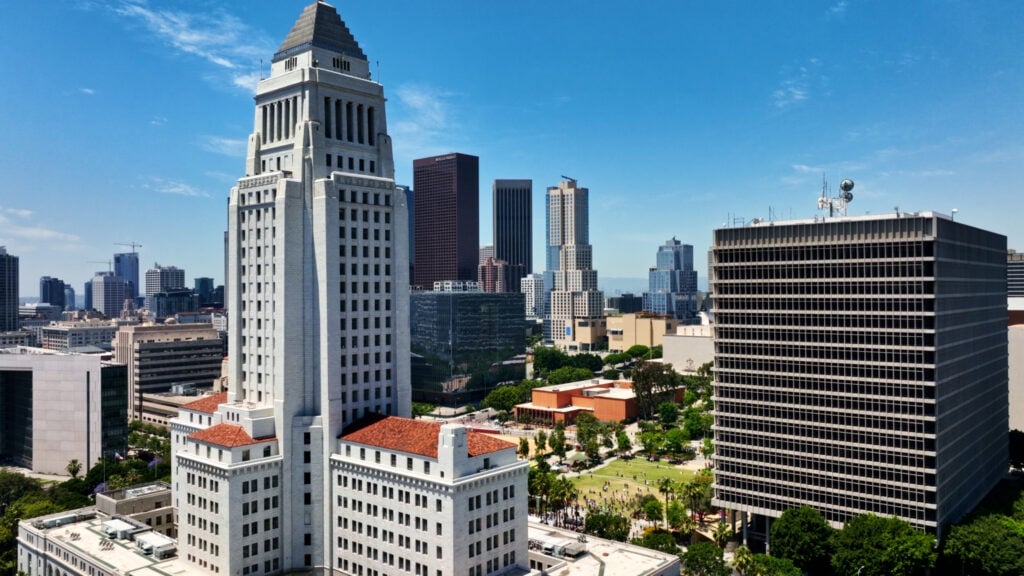
On November 8th, we commemorate World Urbanism Day, a moment to acknowledge and advocate for the significance of urban planning in shaping livable communities. Also known as World Town Planning Day, this occasion highlights the interaction between inhabitants and their built environments in urban areas.
Urban planning focuses on creating healthy and vibrant communities that offer a high quality of life. By ensuring orderly development and preserving the economy and environment, planners strive to enhance the well-being of residents. The key elements of a livable city include plentiful opportunities for a high quality of life, diverse housing options, accessible public transportation, ample green spaces, and essential amenities like schools, grocery stores, and recreational facilities.
Cities such as Osaka, Tokyo, and Zurich exemplify healthy and livable communities, while Tripoli, Algiers, and Lagos face challenges in this regard. It is essential for us to engage in urban planning discussions, attend local council meetings, and explore ways to improve our communities. Let’s celebrate World Urbanism Day by spreading awareness, connecting with public health networks, and championing the creation of livable cities through #WorldUrbanismDay.
Rod: A creative force, blending words, images, and flavors. Blogger, writer, filmmaker, and photographer. Cooking enthusiast with a sci-fi vision. Passionate about his upcoming series and dedicated to TNC Network. Partnered with Rebecca Washington for a shared journey of love and art. View all posts
Watts Towers: A Landmark of Art, History, and Resilience in Los Angeles
Discover the Watts Towers in Los Angeles, a National Historic Landmark built by Sabato Rodia. Learn about their history, cultural impact, and significance in art, film, and literature.”
Watts Towers: A Landmark of Art, History, and Resilience in Los Angeles
The Watts Towers in Los Angeles are one of the most remarkable examples of outsider art in the United States. Built singlehandedly by Italian immigrant Sabato (Simon) Rodia over a span of 33 years (1921–1954), the towers stand as a testament to perseverance, creativity, and cultural expression.
Rodia, working without formal training or blueprints, constructed 17 interconnected towers and sculptural structures, the tallest reaching 99.5 feet. Using steel, mortar, and found objects such as glass, tile, pottery shards, and seashells, he created a visionary masterpiece that has since become an iconic symbol of Los Angeles art and heritage.
Recognition and Historic Significance
The Watts Towers are more than an architectural wonder—they are a recognized cultural landmark:
National Historic Landmark (1990)
California Historical Landmark
Los Angeles Historic-Cultural Monument
Listed in the National Register of Historic Places as one of only nine folk art sites in Los Angeles
Their enduring legacy highlights the resilience of both Rodia’s vision and the Watts community, which fought to preserve the towers when demolition was once proposed.
Influence on Culture, Film, and Literature
The influence of the Watts Towers extends far beyond architecture. They have been celebrated and referenced across multiple art forms:
In music, legendary jazz musician Charles Mingus mentioned them in his autobiography.
In literature, they appear in Don DeLillo’s novel Underworld.
On film, the towers have been featured in iconic movies such as La La Land and Ricochet.
These references reflect the towers’ place in both local identity and global culture.
Community and Public Space
The site is also home to the Watts Towers Crescent Greenway, a 0.2-mile rail-with-trail pedestrian and bike path. This space allows visitors to experience the towers while enjoying outdoor recreation, blending community engagement with cultural preservation.
Why the Watts Towers Matter
The Watts Towers are more than sculptures—they are a story of human determination, creativity, and cultural pride. They remind us that art can rise from unlikely places and stand the test of time, inspiring generations.
For those interested in learning more about the rich history of South Los Angeles, we recommend checking out The South LA Recap by Eric Craig on YouTube. The channel dives into fascinating hidden details of the region’s past and offers valuable insights into the cultural landscape surrounding the Watts Towers.
Advertisement
You can also visit Eric Craig’s website for additional resources: South LA Recap
Dive into “The Knowledge,” where curiosity meets clarity. This playlist, in collaboration with STMDailyNews.com, is designed for viewers who value historical accuracy and insightful learning. Our short videos, ranging from 30 seconds to a minute and a half, make complex subjects easy to grasp in no time. Covering everything from historical events to contemporary processes and entertainment, “The Knowledge” bridges the past with the present. In a world where information is abundant yet often misused, our series aims to guide you through the noise, preserving vital knowledge and truths that shape our lives today. Perfect for curious minds eager to discover the ‘why’ and ‘how’ of everything around us. Subscribe and join in as we explore the facts that matter. https://stmdailynews.com/the-knowledge/
At STM Daily News, we’re passionate about uncovering the stories that shaped Los Angeles. Visit our YouTube channelto explore more history, culture, and hidden gems of the city—from landmarks like the Watts Towers to the people and events that defined LA’s past. Subscribe today and discover the history of Los Angeles, one story at a time. https://www.youtube.com/playlist?list=PLEhXBupt8tVyhnfS344AWOC6s7sDNHHKG
Rod: A creative force, blending words, images, and flavors. Blogger, writer, filmmaker, and photographer. Cooking enthusiast with a sci-fi vision. Passionate about his upcoming series and dedicated to TNC Network. Partnered with Rebecca Washington for a shared journey of love and art. View all posts