

Entertainment
What Amazon MGM’s creative control over the James Bond film franchise means for the future of 007
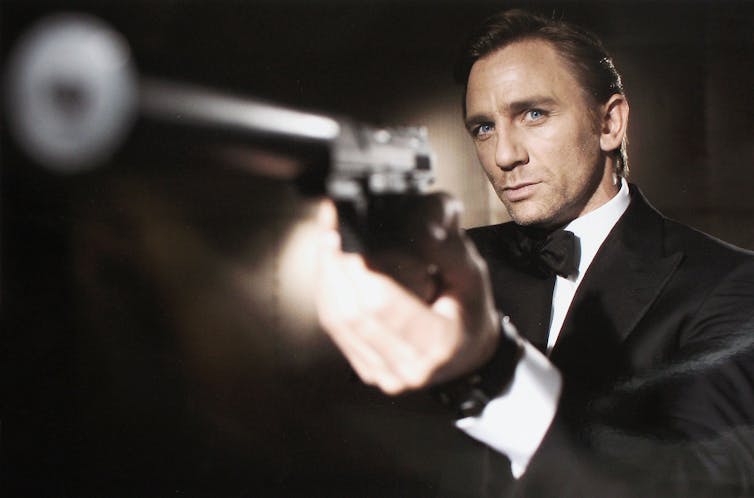
Daniel Craig portrayed James Bond from 2006 to 2021. As Amazon MGM gains control over the franchise, fans speculate on the future direction, potential “woke” storylines, and whether a unified Bond universe akin to Marvel will emerge, involving diverse media.

Colin Burnett, Washington University in St. Louis
James Bond was front and center at the 2025 Academy Awards – and in a somewhat curious way.
In a musical number, Lisa of Blackpink, Doja Cat and Raye sang the Bond theme songs “Live and Let Die,” “Diamonds Are Forever” and “Skyfall,” respectively. No Bond films had been nominated for an award, and none of these singers has a connection to the Bond franchise, though they did all recently collaborate on the single “Born Again.”
The strange exercise felt less like a celebration and more like a big flashing question mark for a screen icon whose future has never felt more uncertain.
Since the shocking news dropped on Feb. 20, 2025, that Jeff Bezos’ Amazon MGM Studios would assume creative control over the James Bond film franchise, commentators and fans have wondered why.
Why would the Broccoli family, which has long held the rights to Bond movies through their company, EON, cede control of the film series to a tech partner they’ve been at odds with?
Two possibilities have emerged.
First, EON’s Michael G. Wilson and Barbara Broccoli, the stepson and daughter of legendary EON producer Albert R. “Cubby” Broccoli, may have reached a point of creative exhaustion. There could be something to this theory. According to Puck’s Matthew Belloni, the 83-year-old Wilson and 64-year-old Broccoli were having difficulty figuring out their next step after 2021’s “No Time to Die.”
A second reason could be Amazon’s impatience with EON. In December 2024, The Wall Street Journal reported that Barbara Broccoli balked when Amazon Studios executive Jennifer Salke proposed several Bond spinoff projects, including a Bond series with a female lead, for Prime Video. Perhaps frustrated with the stalemate, Amazon may have made Wilson and Broccoli an offer they couldn’t refuse to get them out of the way and get production of Bond content rolling.
The speculation is certainly intriguing. But a more central question shouldn’t be overlooked: the “what.”
What, precisely, has Amazon MGM acquired? And what can it actually do with the Bond story?
Breaking down the Bond rights
In my research on the 007 franchise, I’ve discovered that this property has never been a traditional film series.
Long before “Star Wars” launched in 1976 and the Marvel Cinematic Universe launched in 2008, Bond relied on a range of mediums to tell its story.
The Bond franchise began in 1953, not with a film but with a novel, Ian Fleming’s “Casino Royale.” One year later, “Casino Royale” was adapted for American TV as a live anthology show. Four years after that, in 1958, a popular Bond comic strip made its debut.
It was only in 1962, with “Dr. No,” starring Sean Connery, that the now-iconic film series began.
Since then, James Bond has been spun off into a children’s animated show, choose-your-own-adventure books, a “Young Bond” novel series, video games, a reality show, radio dramas and more.
Here’s what’s crucial: With its new deal, Amazon MGM has a controlling stake only in the rights that EON holds. EON has licensed the right to produce future films and TV shows from Fleming since 1961. EON secured worldwide merchandising rights in 1964 and production rights to video games in the early 1990s.
Other 007 media – the literary, comic and audio series – are managed by the Fleming Estate and Ian Fleming Publications.
The James Bond media franchise is what I call a shared rights and licensing network.
No one company controls all of the Bond rights, and no one company produces all of Bond media. Though this arrangement is a complicated one, the sharing and licensing of rights has allowed Bond to emerge as a lucrative and fecund product line. According to my calculations, it now boasts over 330 original stories in 72 years of media production.
In other words, Bond is much more than the 25 films released by EON.
James Bond’s many lives
Until now, rights sharing and licensing have ensured that the Bond franchise remains creatively distinct from “Star Wars” and Marvel.
The companies that produce these series – LucasFilm and Marvel Studios – are owned by The Walt Disney Company. With their rights pooled under one corporate entity that also oversees all production, “Star Wars” and Marvel have been able to drive toward high levels of creative consistency and unity among their stories. Across films, TV, comics and video games, “Star Wars” and Marvel aspire to what media specialists call “transmedia storytelling.”
By sharing rights, the Bond franchise has arrived at a very different type of storytelling, one that fragments the story and multiplies the James Bonds to be experienced across distinct media. The effect isn’t transmedia storytelling, or even a Marvel-style multiverse. In Bond, characters can’t cross over to alternate realities and meet other versions of themselves.
James Bond exists in many different worlds and leads many different lives.
To name a few: There’s the Bond of Fleming’s 1950s and 1960s novels, who loses his first love, Vesper Lynd, and hunts down her killers, who are members of SMERSH, the assassination arm of Soviet intelligence agencies. Fleming’s Bond also lives on in the novels of Kingsley Amis and John Gardner, which were published in the 1970s and 1980s.
There’s EON’s silver screen Bond, who, from 1962 to 2002, never falls in love with Vesper, but loses his wife, Tracy di Vicenzo, to the crime syndicate SPECTRE and remains scarred by the loss. And in the modern era, there’s the Bond who appears in author Samantha Weinberg’s “Moneypenny Diaries.” Published from 2005 to 2008, the series depicts a version of Bond who has retired to a small Scottish isle with his lover, MI6’s Miss Moneypenny.
The effect of Bond’s shared structure is what I dub “threaded storytelling.” The novels present various versions of Bond’s life, at different points in history. The film series creates two of its own. The comic series offers yet more lives of 007.
Each version of Bond runs alongside the others in the market, focusing on a Bond character who exists only within his unique story world. This gives fans an unpredictable, ever-expanding canon of stories to follow and even compare, like one grand spot-the-difference game in time.
Where next for Bond?
The deal between Amazon MGM and EON awaits regulatory approval in the U.S. and U.K.
If it goes through, Amazon MGM will have a strong property on its hands. Over the decades, EON has reinforced certain elements to the character and the story: James Bond is a debonair hitman. MI6 chief M gives him high-stakes missions. MI6 armorer Q fits him with the latest gadgets. And Bond lives large, enjoying beautiful women, fine dining, Savile Row fashions and Omega timepieces.
Amazon MGM is unlikely to tinker with these Bondian elements. They’re also likely to preserve the movies’ “Bond formula” – the gun barrel visual that kicks off each film, elaborately designed credit sequences, film-specific theme songs, and the closing title card that reads, “James Bond Will Return.”
Yet some fans fear that Amazon MGM will develop “woke” storylines. Others foresee the product being diluted with countless streaming spinoff series.
To me, the more intriguing possibility is whether Amazon will try to create a more unified Bond universe, akin to the Marvel Cinematic Universe. Yes, the Fleming Estate will continue to manage the novels, comics and radio. But with creative control over EON’s rights, Amazon MGM could, in theory, develop an elaborate transmedia strategy never before explored in this franchise.
A relaunched film series, perhaps serving as Amazon MGM’s “mothership,” would feed into satellite series in video games and streaming shows. These games and shows, in turn, would tie into and expand the universe of the films.
Were that to happen, the Bond franchise would truly enter a new phase and risk losing much of the creative flexibility it’s possessed in the past.
Colin Burnett, Associate Professor of Film and Media Studies, Washington University in St. Louis
This article is republished from The Conversation under a Creative Commons license. Read the original article.


Jay Mohr’s long-running podcast is expanding to FAST television through an exclusive LG Channels launch in the U.S. and Canada.
Cineverse has announced the launch of Mohr Stories, a new free ad-supported streaming television channel built around comedian Jay Mohr’s long-running podcast. Unveiled during LG Electronics and LG Ad Solutions’ 2026 IAB NewFronts presentation, the channel will be available exclusively through LG Channels on LG TVs in the United States and Canada.
The new channel will feature weekly episodes alongside more than 100 hours of library content, giving the show a larger footprint in the growing FAST market. Hosted by Mohr, the series includes conversations with guests from comedy, film, sports, music, and television, including Ron Funches, Jay Leno, Joe Mantegna, Patton Oswalt, Kevin Pollak, Andy Richter, George Wallace, Flavor Flav, Michael Eric Dyson, Seth Rollins, Gene Simmons, Billy Gibbons, Byron Scott, and Jeanie Buss.
The launch is notable not only because of the talent involved, but because it reflects a broader shift in how podcast brands are being distributed. What once lived primarily as an audio product is now being packaged as a 24/7 streaming destination, built for connected TV audiences and ad-supported discovery.
Cineverse said Mohr Stories will continue to be available as a podcast through the WITZ Podcast Network, a partnership between Cineverse and The Stand Group. The company also pointed to strong audience momentum after the show expanded into video, saying consumption hours on Spotify rose 50% month over month and downloads increased 34% quarter over quarter.
That growth aligns with wider audience behavior. In the U.S., more than 150 million people listen to podcasts every month, and an increasing share of those consumers are also watching podcast content on video platforms. As those habits continue to evolve, media companies are looking for ways to extend proven shows beyond their original format.
For LG Channels, the addition of Mohr Stories strengthens a FAST lineup built around free, accessible programming across a wide range of genres. For Cineverse, it underscores a strategy centered on expanding the reach and value of entertainment properties across multiple platforms.
The result is more than a new celebrity-led channel. It is another example of how streaming, podcasting, and digital video are converging into a more flexible content ecosystem—one where recognizable brands can move fluidly from audio feeds to connected television.
Related Links
Source
Authors


Cineverse Partners With VA Media to Expand YouTube Monetization Strategy
Cineverse has announced a strategic partnership with VA Media to accelerate growth and digital monetization across its expanding portfolio of fandom-focused YouTube channels.
The agreement will bring a YouTube-first strategy to Cineverse’s channel network, including longform and shortform content planning, channel optimization, financial modeling, and broader monetization support. The partnership will begin with Dog Whisperer with Cesar Millan, which Cineverse identified as its top revenue-generating YouTube channel.
Cineverse said its owned or operated YouTube channels currently account for more than 10 million subscribers and over 200 million video views. The company’s digital portfolio spans genres including horror, anime, romance, indie film, Asian cinema, and other fandom-driven categories.
VA Media, which specializes in YouTube strategy and social video monetization, will work with Cineverse to improve discoverability, strengthen channel performance, and unlock new revenue opportunities across YouTube and adjacent platforms.
The partnership reflects the growing role of YouTube as a core distribution and monetization channel for premium entertainment content.
For more information, visit Cineverse.
External Links
STM Daily News’ Entertainment section delivers the latest on movies, television, music, pop culture, events, and industry buzz. From breaking news and trending stories to feature coverage and community-centered entertainment reporting, it keeps readers connected to what’s happening on screen, on stage, and beyond.
McDonald’s is blending fast food, fandom and Korean-inspired flavors in a new collaboration with Netflix tied to the hit film KPop Demon Hunters. Beginning March 31, the chain will roll out two limited-time adult meals inspired by the movie’s rival groups, HUNTR/X and the Saja Boys, along with collectible photocards and app-based fan experiences. The promotion will be available at participating McDonald’s restaurants nationwide.


McDonald’s KPop Demon Hunters meals
The campaign introduces two themed meals built around the film’s central rivalry. The Saja Boys Breakfast Meal includes a Spicy Saja McMuffin, hash browns and a small soft drink, while the HUNTR/X Meal features a 10-piece Chicken McNuggets, medium soft drink, Ramyeon McShaker Fries, Hunter Sauce and Demon Sauce. McDonald’s said the menu was inspired in part by flavors from its South Korea restaurants, aiming to connect fans to the movie through food as well as pop culture.
The promotion also includes collectible card packs with each meal. Customers will receive a photocard featuring either HUNTR/X or the Saja Boys, plus a Derpy access card that can be scanned and entered in the McDonald’s app by April 26 to unlock early access to exclusive content and a special reveal tied to the “Battle for the Fans.” A new Derpy McFlurry, made with vanilla soft serve, berry popping pearls and wild berry sauce, will also be sold separately during the promotion.
McDonald’s and Netflix both described the collaboration as a way to bring fans deeper into the world of KPop Demon Hunters through menu items and interactive experiences. For STM Daily News readers in the food and drink section, the release highlights how major brands are increasingly turning entertainment partnerships into immersive dining promotions that combine limited-time flavors, collectible merchandise and digital engagement.





