Why Christian clergy see risk as part of their moral calling
As clergy join protests against harsh immigration enforcement, a religious ethics scholar explains why many Christian Clergy view personal risk—arrest, backlash, even violence—as part of their vocation to protect vulnerable neighbors.
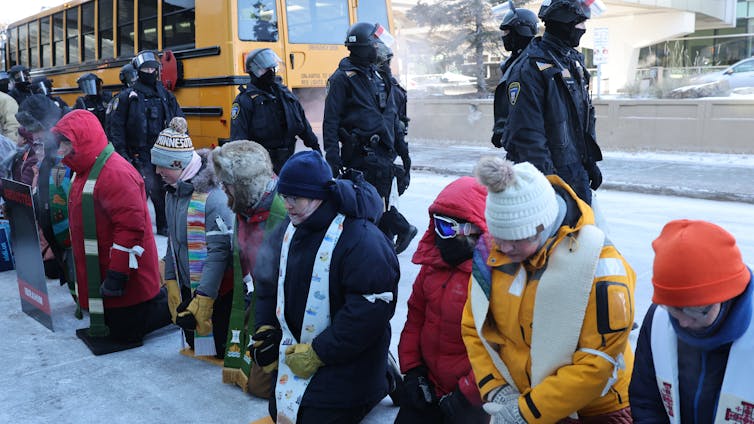
A large group of protesters, including clergy, gathered outside St. Paul International Airport in St. Paul, Minn., on Jan. 23, 2026, to demonstrate against the immigration crackdown. Elizabeth Flores/The Minnesota Star Tribune via Getty Image
As Christian clergy across the United States participate in ongoing protests against harsh immigration enforcement actions and further funding for U.S. Immigration and Customs Enforcement, many are still pondering the words of Rob Hirschfeld. On Jan. 18, 2026, Hirschfeld, Bishop of the Episcopal Diocese of New Hampshire, encouraged clergy in his diocese to “prepare for a new era of martyrdom” and put their wills and affairs in order.
He asserted that “it may be that now is no longer the time for statements, but for us with our bodies to stand between the powers of this world and the most vulnerable.”
Hirschfeld’s words attracted a lot of attention, with clergy generally responding positively, though at least one priest argued that he “did not sign up to be a martyr” and had a family and church relying on him.
Other clergy have willingly facedarrest for their advocacy on behalf of immigrants, seeing it as a moral calling. Rev. Karen Larson was arrested while protesting at the Minneapolis airport. She stated that when people are being separated from their families and taken to unknown detention centers, “this is our call” to protest on their behalf.
As a scholar of religious ethics, I am interested in how Christian clergy and thinkers consider personal risk when they feel called to engage in social action.
Most data on the risks that clergy face in their roles as religious leaders comes from studies of religious leaders in institutional settings, such as hospitals or prisons.
Questions about professional risks became particularly acute during the early years of the HIV/AIDS crisis, when researchers were uncertain exactly how the disease was spread and caregivers feared they might acquire HIV through their bedside work.
In her memoir about chaplaincy with HIV patients, Audrey Elisa Kerr notes that Riverside Church in New York continued to organize funerals, ministries and support groups for HIV/AIDS patients despite “terror” in the wider community about contagion.
As a chaplain herself, Kerr says this story of “radical hospitality” inspired her to set aside her own fears and embrace her professional role caring for people who were ill and dying.
Advertisement
Priests and nuns of the Catholic Church who cared for HIV/AIDS patients in the 1980s risked both the fear of contagion and the disapproval of their bishops and communities, since many of the people they cared for were men who had sex with men.
Some felt, however, that they must care for those at the margins as part of their role in the church or their monastic order. Sister Carol of the Hospital Sisters of Saint Francis felt that it was simply her moral duty as a sister to “go where she was needed,” despite potential risk.
Examination of the ethical obligations of chaplains and clergy ramped up during the COVID-19 pandemic when at least some priest, pastors and hospital chaplains felt an obligation to continue visiting patients for spiritual care.
Risks in other institutional settings are not such a matter of life and death. Because of their professional preaching function, however, clergy in church settings do accept the risk of alienating church members when they feel religiously called to speak about social issues. Rev. Teri McDowell Ott has written about taking risks when discussing LGBTQ+ inclusion and starting a prison ministry.
Risk-taking during social protest
For many clergy, religious and ethical obligations extend beyond their work in institutions like churches and hospitals and include their witness in public life.
Many feel an obligation to preach on issues of moral importance, even topics that are considered controversial and might elicit strong disagreement. It is common for priests and pastors in conservative churches to include messages against legalized abortion in their sermons.
Tom Ascol of the Center for Baptist Leadership urged Baptist pastors to preach about abortion in the lead-up to the 2024 presidential election.
Rev. Leah Schade, a Lutheran minister and scholar, has argued that since 2017, mainline pastors have preached more often on issues like racism, environmental justice or gun violence. Schade says pastors are inspired to speak more bluntly about social issues because of their religious concern for people who are at risk of harm from injustice or government policies.
Some clergy view their moral obligations as going beyond preaching and leading them to on-the-ground advocacy and protest. Rev. Brandy Daniels of the Disciples of Christ denomination examines these obligations in an article on her participation in a group of interfaith clergy in Portland, Oregon. The group was convened by a local rabbi and supported protesters for racial justice in Portland in 2017. In Daniels’ analysis, clergy took on the risk of staying in the middle of protests and facing a violent police response in order to “bear moral witness,” something they were both empowered and obligated to do as religious leaders.
Advertisement
Risking their lives
There are more extreme cases in which clergy who challenged government leaders or policies were killed for their words and actions of protest.The official portrait of Archbishop Oscar Romero, displayed in the Metropolitan Cathedral for a memorial service in San Salvador, El Salvador, on March 24, 2018. AP Photo/Salvador Melendez
In a well-known historical example, Bishop Oscar Romero, canonized as a martyred saint by the Roman Catholic Church in 2018, was assassinated in 1980 after speaking out against human rights violations against poor and Indigenous communities committed by the government of El Salvador. Romero viewed himself, in his priestly role, as a representative of God who was obliged to “give voice to the voiceless.”
During recent protests against ICE in Minneapolis and elsewhere, many clergy risked arrest and bodily harm. Rev. Kenny Callaghan, a Metropolitan Community Church pastor, who says that ICE agents in Minneapolis pointed a gun in his face and handcuffed him as he tried to help a woman they were questioning, said, “It’s in my DNA; I have to speak up for marginalized people.”
On Jan. 23, 2026, over 100 clergy were arrested at the Minneapolis-St. Paul airport as they protested and prayed against ICE actions. Rev. Mariah Furness Tollgaard said that she and others accepted being arrested as a way of demonstrating public support for migrants who are afraid to leave their homes.
In Chicago, ministers have been hit with projectiles and violently arrested. Presbyterian pastor David Black was shot in the head with a pepper spray projectile while protesting outside an immigration detention center in October 2025.
As I see it, for these and many Christian clergy and ethicists, the call to ministry includes an obligation to express their values of care for vulnerable neighbors precisely through a public willingness to accept personal risk.
STM Daily News is a vibrant news blog dedicated to sharing the brighter side of human experiences. Emphasizing positive, uplifting stories, the site focuses on delivering inspiring, informative, and well-researched content. With a commitment to accurate, fair, and responsible journalism, STM Daily News aims to foster a community of readers passionate about positive change and engaged in meaningful conversations. Join the movement and explore stories that celebrate the positive impacts shaping our world.
Senior Assist Day Marks Four Years of Supporting Seniors in South Phoenix
Senior Assist Day celebrates four years of serving seniors at Tanner Gardens in South Phoenix, led by Assistory Outreach Services and founder Jon Taylor.
Senior Assist Day Marks Four Years of Supporting Seniors in South Phoenix
PHOENIX, AZ — Senior Assist Day reached a meaningful milestone this year, marking four years of service to seniors living at Tanner Gardens in South Phoenix. Hosted by Assistory Outreach Services, the annual event continues to provide dignity, connection, and practical support to an often-overlooked population.
A Personal Beginning
The origins of Senior Assist Day are deeply personal for Assistory Outreach Services founder and CEO Jon Taylor.
“The origin of me going to Tanner Gardens was when I was with the 100 Black Men of Phoenix. We used to do a luncheon for seniors around December.”
That early connection took on new meaning as Taylor’s mother began showing signs of dementia, inspiring him to create an event rooted in empathy and care.
“I got a great feeling from being around those senior citizens. Senior Assist Day is roughly based on my mother.”
An Event That Continues to Grow
What began as a small gathering has grown into a full community experience. Seniors now enjoy catered meals, live music, personal care services, and gifts tailored to their needs. This year’s event included authentic Mexican food, live holiday music, haircuts provided by AJ’s Barbershop, and the donation of new shoes — a moment that stood out for many attendees.
“Seeing the excitement and how they were reacting to the new shoes was incredible,” Taylor said.
Beyond a Single Day
Senior Assist Day also helps build trust between Assistory Outreach Services and the residents of Tanner Gardens, opening the door to additional programs throughout the year. Through initiatives like the Digital Access Program for Seniors (DAPs), the organization helps seniors develop basic phone and computer skills, empowering them to stay connected and informed.
Challenges and Purpose
Keeping the event going year after year requires dedication and resources. Taylor personally raises funds and helps purchase gifts for more than 130 residents annually. Despite the challenges, his motivation remains strong.
“I do feel as though this is my ministry. I’m providing services, and I’m being fulfilled at the same time.”
Looking Ahead
Looking to the future, Taylor envisions Senior Assist Day becoming an all-day celebration, offering expanded services, entertainment, and meals — all focused exclusively on the residents of Tanner Gardens. As the event enters its fifth year, Senior Assist Day stands as a testament to what consistent community engagement and compassion can achieve. About Assistory Outreach ServicesAssistory Outreach Services is a community-based nonprofit organization dedicated to empowering seniors, low-income residents, and individuals experiencing homelessness. Assistory helps senior citizens embrace technology by teaching basic cell phone and computer skills, using a formula rooted in education, love, and patience to remove fear and build confidence. In addition to senior programming, the organization focuses on serving low-income and homeless populations by providing food boxes, holiday meals, and homeless care packages known as Assist Packs. This year, Assistory Outreach Services is expanding its impact by partnering with other nonprofits and religious organizations to coordinate food distribution through its community food pantry. Coverage by STM Daily News.
STM Daily News is a multifaceted podcast that explores a wide range of topics, from life and consumer issues to the latest in food and beverage trends. Our discussions dive into the realms of science, covering everything from space and Earth to nature, artificial intelligence, and astronomy. We also celebrate the amateur sports scene, highlighting local athletes and events, including our special segment on senior Pickleball, where we report on the latest happenings in this exciting community. With our diverse content, STM Daily News aims to inform, entertain, and engage listeners, providing a comprehensive look at the issues that matter most in our daily lives. https://stories-this-moment.castos.com/
Rod: A creative force, blending words, images, and flavors. Blogger, writer, filmmaker, and photographer. Cooking enthusiast with a sci-fi vision. Passionate about his upcoming series and dedicated to TNC Network. Partnered with Rebecca Washington for a shared journey of love and art.
Brigitte Bardot defined the modern woman and defied social norms
Ben McCann, University of Adelaide Brigitte Bardot’s death, at the age of 91, brings to a close one of the most extraordinary careers in post-war French cultural life. Best known as an actress, she was also a singer, a fashion icon, an animal rights activist and a symbol of France’s sexual liberation. Famous enough to be known by her initials, B.B. symbolised a certain vision of French femininity – rebellious and sensual, yet vulnerable. Her impact on beauty standards and French national identity was profound. At her peak, she rivalled Marilyn Monroe in global fame and recognition. Simone de Beauvoir, France’s leading feminist writer, famously wrote in 1959 that Bardot “appears as a force of nature, dangerous so long as she remains untamed”.
A star is born
Bardot was born in 1934 to a well-off Parisian family. Raised in a strict Catholic household, she studied ballet at the Conservatoire de Paris with hopes of becoming a professional dancer.Brigitte Bardot, pictured here in 1946, studied ballet as a child.Roger Viollet via Getty Images Her striking looks led her to modelling. By 14, she was appearing in Elle magazine, catching the eye of director Roger Vadim, whom she married in 1952. She began acting in the early 1950s and her appearance as Juliette in Vadim’s And God Created Woman (Et Dieu… créa la femme, 1956) put her on the map. Bardot was instantly catapulted to international stardom. Vadim presented his wife as the ultimate expression of youthful, erotic freedom that both shocked and captivated French audiences. Watching this relatively tame film today, it’s difficult to imagine just how taboo-breaking Bardot’s performance was. But in sleepy Catholic, conservative 1950s France, it set new norms for on-screen sexuality. The film became a global phenomenon. Critics loved it, but censors and religious groups grew nervous.
An 60s icon
Bardot’s lack of formal training as an actress paradoxically became part of her appeal: she adopted a spontaneous acting approach, as much physical as verbal. She was stunning in Contempt (Le Mépris, 1963), Jean-Luc Godard’s masterpiece about a crumbling marriage. Godard used her beauty and fame both as spectacle and critique. The film’s most famous sequence was a 31-minute conversation between Bardot and her co-star Michel Piccoli. Bardot was never better. In Henri-Georges Clouzot’s intense courtroom drama The Truth (La Vérité, 1960), she showcased her dramatic range playing a young woman on trial for the murder of her lover.Bardot in a poster for The Truth, 1960.LMPC via Getty Images In 1965, she co-starred with Jeanne Moreau in Louis Malle’s Long Live Maria (Viva Maria), a rare female buddy film that blended comedy and political satire. Bardot’s anarchic energy remains a dazzling feat. A Very Private Affair (Vie privée, 1962) saw her portray a woman consumed by fame and chased by the media. The plotline was eerily predictive of Bardot’s own future. She popularised fashion trends like the choucroute hairstyle and ballet flats. The Bardot neckline – off-the-shoulder tops and dresses – was named after her. She even wore pink gingham at her 1959 wedding.
Allure and provocation
Bardot’s star appeal lay in her contradictions. She appeared simultaneously natural and provocative, spontaneous and calculated. Her dishevelled glamour and effortless sexuality helped construct the archetype of the modern “sex kitten”. She famously said “it is better to be unfaithful than to be faithful without wanting to be”. Throwing off the shackles of bourgeois morality, Bardot epitomised a commitment to emotional and sexual freedom. Her turbulent love life was a case in point. She was married four times, with dozens of stormy relationships and extra-marital affairs along the way. Forever immortalised as a free-spirited ingénue, Bardot was a muse for filmmakers, artists and musicians, from Andy Warhol to Serge Gainsbourg. Later on, Kate Moss, Amy Winehouse and Elle Fanning mentioned Bardot as an inspiration. Famously, Bardot never succumbed to cosmetic surgery. As she once noted:
Women should embrace ageing because, at the end of the day, it’s much more beautiful to have a grandmother with white hair who looks like an elderly lady than to have a grandmother who’s bleached, dyed, and […] who looks much older but also really unhappy.
Life after the movies
Bardot retired from acting in 1973, aged only 39, citing disillusionment with fame. “It suffocated and destroyed me”, she said, about the film industry. She shifted her attention to animal rights, founding the Brigitte Bardot Foundation in 1986. She became an uncompromising, vocal activist, campaigning against animal cruelty, fur farming, whaling and bullfighting. But Bardot courted controversy from the mid-1990s for her far-right political views, remarks about Islam and immigration and repeated convictions for inciting racial hatred. She publicly defended disgraced actor Gérard Depardieu and pushed back on the #MeToo movement in France. Such statements damaged her reputation, especially outside France, and created a troubling image: the once-liberating sex symbol now associated with nationalist conservatism. While she never identified as a feminist, her unapologetic autonomy, early retirement and outspoken views led some to re-evaluate her as a figure of proto-feminist rebellion. France gradually began to turn against Bardot, bothered by her outspoken views. But some applauded her couldn’t-care-less attitude and unwillingness to play by the rules. Ultimately, by rejecting fame on her own terms, she parlayed her 50s free-spiritedness into a bold stand against conformity and societal norms. Late in life, she told Danièle Thompson, the writer-director of the 2023 mini-series about her career, “I don’t understand why the whole world is still talking about me”. The answer is simple – Bardot continues to fascinate us, flaws and all. Ben McCann, Associate Professor of French Studies, University of Adelaide This article is republished from The Conversation under a Creative Commons license. Read the original article.
Educators Are Being Priced Out of Their Communities—These Cities Are Building Subsidized Teacher Housing to Bring Them Back
Teacher Housing: As housing costs rise and teacher pay stagnates, cities and school districts are building education workforce housing to attract and retain educators—cutting commutes and strengthening community ties.
Developers of Wendy’s Village, an affordable housing complex planned for teachers in Colorado Springs, Colo., completed their first homes in July 2025. WeFortify
America’s educators are being priced out of their communities − these cities are building subsidized teacher housing to lure them back
Jeff Kruth, Miami University and Tammy Schwartz, Miami University For much of the 20th century, teaching was a stable, middle-class job in the U.S. Now it’s becoming a lot harder to survive on a teacher’s salary: Wages have been stagnant for decades, according to a study from the Economic Policy Institute, and teachers earn 5% less than they did a decade ago when adjusting for inflation. That’s one reason why there’s a widespread teacher shortage, with tens of thousands of positions going unfilled. At the same time, according to a 2022 report from the Annenberg Institute at Brown University, there are more than 160,000 underqualified teachers in the classroom, meaning they don’t meet full certification or credentialing standards. This issue has become particularly acute as housing costs have risen sharply across the country over the past decade. Why become a teacher if it means you’ll struggle to put a roof over your head? In response, many states and cities, from California to Cincinnati, are exploring ways to attract and retain teachers by developing education workforce housing – affordable housing built specifically for public school teachers and staff to make it easier for them to live near where they work. In doing so, they seek to address aspects of both the teacher shortage and housing crisis.
Fertile land for housing
As professors of architecture and education and as directors of an urban teaching program at Miami University in Ohio, we work to make it easier for students to pursue teaching careers – and that includes addressing affordable housing issues in communities where they work. A key element of this work involves collaborating with local education agencies to either build, subsidize or find housing for teachers. Local education agencies are tasked with the administrative functions of a school district, and they often own large tracts of land. This land can be used to build new school buildings or community health clinics. But it can also be used to build housing – a particularly attractive option in cities where land can be scarce and expensive. California has been at the forefront of these efforts. The state’s school districts own more than 75,000 acres of potentially developable land. Meanwhile, more than one-third of the state’s public school employees are rent-burdened, meaning they spend more than 30% of their income on housing costs. California’s Teacher Housing Act of 2016 set up a framework for local education agencies to build and develop housing on their land. Since then, education workforce housing complexes have been developed across the state, ranging from San Francisco’s Shirley Chisolm Village to 705 Serramonte in Daly City, California.The San Francisco Unified School District celebrated the opening of Shirley Chisolm Village, the city’s first educator housing development, in September 2025. The nuts and bolts of education workforce housing vary. It can be financed by traditional sources, such as private philanthropy and government funds. But it can also be funded through financial tools such as certificates of participation, which allow outside investors to provide funding up front and later receive a return on their investment through rental income. In some cases, teachers are offered reduced rents for just a few years as they start their careers. In others, they’re given the opportunity to purchase their home. Third party management companies often oversee the projects, since local education agencies usually aren’t interested in property management. This also reduces the potential for any direct disputes between employer and employee. Many programs require only that residents be employees of the school district when they enter the program, meaning if someone leaves their job, they will not be displaced. In April 2025, UCLA’s CITYLab and the Center for Cities and Schools published a study highlighting some of the benefits and challenges of nine educator workforce housing projects built in California. The complexes ranged in size, from 18 to 141 dwelling units, with heights that ranged from two to six stories. The researchers found that tenants were largely satisfied with their living situations: They paid rents at far below market rate, and they praised the apartment design. They also highlighted their shorter commutes.
Here in Cincinnati, our own graduates now working in schools also benefit from affordable housing options. Through a partnership between Miami University and St. Francis Seraph, early career teachers from our TEACh and Urban Cohort programs have access to affordable housing. In 2024, the Archdiocese of Cincinnati converted an old church property in Cincinnati’s Over-the-Rhine neighborhood into teacher apartments, which recent graduates can rent at a reduced rate. Most young teachers otherwise wouldn’t be able to afford living in this area.In 2024, the Archdiocese of Cincinnati collaborated with Miami University to convert the St. Francis Seraph Church building in the city’s Over-the-Rhine neighborhood into affordable housing for recent teaching graduates.Photo: Je’Von Calhoun, CC BY-SA “I wouldn’t be able to spend my beginning years as an educator in the community without access to affordable housing,” Nicholas Detzel, a graduate teacher now living in the converted space, told us in an interview. “Living in the community has been an amazing experience and helps you know your students on a completely different level,” he added. “It has also helped me relate to students about knowing what is going on in our community.” Teachers like Detzel who live in Over-the-Rhine can walk or take public transportation to the local schools where they work. Perhaps more importantly, they can better understand the world of their students. They can learn the streets that students avoid, the parks and community spaces that become popular after-school hangouts, and what community organizations offer summer programming. Ultimately, teachers grounded in the life of the community can build relationships outside of the walls of school that contribute to more trust in the classroom. Providing affordable housing for teachers and staff also helps retention rates, particularly as many younger teachers leave the profession due to low pay and burnout. Teacher housing programs are still in their infancy. There are roughly 3.2 million public school teachers nationwide, and there are probably fewer than 100 of these developments completed or in progress. Yet more andmore districtsare expressing interest, because they help alleviate two major concerns affecting so many American communities: affordable housing and a quality education. While the need for affordable housing spans both lower- and middle-class families, teachers or not, forging alliances between schools and affordable housing providers can serve as one path forward – and possibly serve as a model for other trades and professions.Jeff Kruth, Assistant Professor of Architecture, Miami University and Tammy Schwartz, Director of the Urban Cohort, Miami University This article is republished from The Conversation under a Creative Commons license. Read the original article.