

financial wellness
5 Financial Steps to Take Once You Turn 50

NEW YORK (Newswire.com) – iQuanti: As you enter your 50s, it’s important to have a long-term plan for financial stability. It won’t be long before you start living off of the retirement you’ve saved up. Some financial steps that can help you prepare for the future include paying off your debt and getting life insurance. Here are five financial steps you can take once you turn 50.
1. Boost your retirement account contributions
Make it a goal to put away as much money as you can towards your retirement. If you work for an employer that offers a traditional 401(k) plan, you might be able to contribute pretax money. Additionally, if your employer offers to match your 401(k) plan contributions, be sure to take advantage of it. Let’s say your employer offers to match 50% of your contributions up to 5% of your salary. That means if you earn $60,000 a year and contribute $3,000 to your retirement, your employer will add another $1,500. One other thing to remember is that after 50, you’re able to make annual catch-up contributions to your retirement.
2. Get a life insurance policy
As we get older, we become more at risk of developing serious health issues. Given the increased risk, it’s important to financially protect your family whenever you pass away. A life insurance policy can provide enough finances to cover the loss of your income, living expenses, and any remaining debt you have. It can also cover funeral costs, allowing your family to keep most of their attention on mourning their loss. Through life insurance protection, you can give yourself and your family peace of mind knowing that if anything happens to you, they’ll be financially taken care of.
3. Pay off your debt
Paying off your debt will allow you to save more for retirement. There are several strategies that can allow you to become debt-free. One strategy you might consider is the debt snowball strategy. With this method, you’ll focus on paying off your smallest debt first, and then gradually work your way up to the largest one.
Another idea to look into is consolidating your debts. This can help make your payments more manageable or potentially make the payoff period shorter. Getting rid of your debt will allow you to spend your retirement savings however you want.
4. Take care of your health
Having health problems may lead to costly medical bills. Taking care of yourself can help you avoid needing as much medical care. Practice good health habits such as eating healthy, exercising regularly, and getting adequate sleep.
5. Ask your parents about their financial plans
If you still have living parents, it’s important to discuss with them how they’ll continue to be financially stable. They may have enough in retirement to live independently for a long time. But it’s also possible that unexpected health issues could cause them to need your financial support.
Come to a decision about whether your parents will live with you when they can no longer take care of themselves. If it’s not possible for them to live with you, discuss the possibility of finding them a long-term care home. Knowing these things ahead of time can help you avoid being unprepared financially. Consider taking all these financial steps when you turn 50 to help ensure you have a strong financial future.
Source: iQuanti
Author










Lifestyle
Why the First Year Behind the Wheel is the Most Dangerous: Data Shows Teen Drivers 3 Times More Likely to be in Fatal Crash
Teen drivers are significantly at risk of fatal crashes, with those aged 16-19 being nearly three times more likely to be involved in accidents than older drivers. The first year of driving presents heightened dangers, but with proper preparation, including coaching, technology, and smart insurance, families can mitigate these risks and promote safety.

Why the First Year Behind the Wheel is the Most Dangerous: Data Shows Teen Drivers 3 Times More Likely to be in Fatal Crash
(Feature Impact) The driver’s license photo may be slightly awkward, but the milestone is unforgettable. For families, a newly licensed teen means independence, busy schedules and a new set of responsibilities.
Motor vehicle crashes remain one of the leading causes of death for U.S. teens, according to the Centers for Disease Control and Prevention (CDC). Data from the National Highway Traffic Safety Administration shows drivers ages 16-19 are nearly three times more likely to be involved in a fatal crash than drivers 20 and older, per mile driven.
The statistics are serious, but they’re also manageable.
“With the right preparation, teen driving doesn’t have to feel overwhelming,” said Susan Irace, manager, divisional claims at Mercury Insurance. “Experience is what young drivers are building. Parents can help shorten that learning curve with structure, technology and smart coverage decisions.”
Why the First Year Matters
Federal safety data shows crash risk is highest in a teen’s first year of independent driving. Night driving, teen passengers and distracted driving increase that risk – while seat belts, graduated licensing laws and supervised practice significantly reduce it.
In 2023, more than 2,800 teens ages 13-19 were killed in motor vehicle crashes nationwide, according to the CDC. However, teen crash rates have declined over time thanks to safer vehicles, graduated driver licensing programs and greater awareness of distracted driving.
Ways to Reduce Teen Driving Risk

The experts at Mercury Insurance encourage families to focus on preparation rather than panic.
1. Coach Early and Often
- Log supervised driving time in different conditions – highways, rain, nighttime
- Create a simple written driving agreement outlining expectations
- Limit teen passengers during the first year
- Make seatbelts non-negotiable
2. Let Technology Help
- Choose vehicles with safety features like automatic emergency braking and blind-spot monitoring
- Use telematics or safe-driving feedback tools to reinforce good habits
- Activate smartphone “Do Not Disturb While Driving” settings
3. Review Insurance Before the Keys Change Hands
- Add teens to your insurance policy promptly
- Revisit liability limits to protect family assets
- Ask about good student and driver training discounts
“Insurance is about preparation, not fear,” Irace said. “When families combine active coaching with the right coverage, they’re setting their teen up for safer miles ahead.”
Preparation Turns Risks into Confidence
The first solo drive is a milestone, but preparation determines what comes next. By pairing common-sense coaching with today’s vehicle safety technology and thoughtful insurance planning, families can support independence while managing risk responsibly.
For more teen driver safety tips and coverage guidance, visit MercuryInsurance.com/resources.
Photos courtesy of Shutterstock

SOURCE:
Our Lifestyle section on STM Daily News is a hub of inspiration and practical information, offering a range of articles that touch on various aspects of daily life. From tips on family finances to guides for maintaining health and wellness, we strive to empower our readers with knowledge and resources to enhance their lifestyles. Whether you’re seeking outdoor activity ideas, fashion trends, or travel recommendations, our lifestyle section has got you covered. Visit us today at https://stmdailynews.com/category/lifestyle/ and embark on a journey of discovery and self-improvement.
Author
Lifestyle
Preparing Students for What’s Next in Work
Preparing Students: Automation, AI and societal economic changes are affecting the workforce and making a significant impact on the employment prospects of future generations. Consider this guidance to put students on the path toward greater earning potential and economic mobility in a rapidly changing economy.

Preparing Students for What’s Next in Work
(Family Features) Automation, AI and societal economic changes are affecting the workforce and making a significant impact on the employment prospects of future generations.
More than one-third of today’s college graduates are “underemployed,” meaning they work jobs that don’t require a college degree and may pay less than a living wage, according to data from the Federal Reserve Bank of New York.
At the same time, a World Economic Forum report explored how advances in AI are threatening to negatively impact access to entry-level and even mid-level jobs for millions of Americans.
Looking ahead, research by Georgetown University indicates that by 2031, 70% of jobs will require education or training beyond high school. However, data from the National Center for Education Statistics indicate only one-third of high school graduates go on to complete a college degree with many of those being in fields that are not in high-earning, high-growth professions.
These challenges are not lost on today’s students. In a survey by Junior Achievement and Citizens, 57% of teens reported AI has negatively impacted their career outlook, raising concerns about job replacement and the need for new skills. What’s more, a strong majority (87%) expect to earn extra income through side hustles, gig work or social media content creation.
“To put students on the path toward greater earning potential and economic mobility in a rapidly changing economy, students need proactive education and exposure to transferable skills and competencies, such as creative and critical thinking, financial literacy, problem-solving, collaboration and career planning,” said Jack Harris, CEO, Junior Achievement.
This assertion is consistent with findings from the Camber Collective. This social impact consulting group identified four key life experiences students can consider and explore that positively affect lifetime earnings, including:
- Completing secondary education
- Graduating with a degree in a high-paying field of study
- Receiving mentorship during adolescence
- Obtaining a first full-time job with opportunity for advancement
Students aiming to equip themselves with the skills and experience necessary for the future workforce can seek:
- Learning opportunities that are designed with the future in mind. For example, learning experiences offered through Junior Achievement reflect the skills and competencies needed to promote economic mobility.
- Internships or apprenticeships that provide hands-on experience and exposure to a career field that can’t be found in a textbook.
- Volunteer or extracurricular roles that develop communication and leadership skills. Virtually every career field requires these soft skills for growth and greater earning potential.
- Relationships that provide insight and connection. Networking with individuals who are already excelling in a chosen field, as well as peers who share similar aspirations, offers perspective from those who are where you wish to be and potentially opens future doors for employment.
- Courses that offer introductory insight into a chosen career path. Local trade or technical schools and other training organizations may even offer certifications that align with a student’s area of interest.
To learn more about how students can pursue education for what’s next, visit JA.org.
SOURCE:
Travel
Tighter Budgets Haven’t Stopped Travel. They’ve Changed How Americans Plan
Tighter Budgets Haven’t Stopped Travel:Tighter budgets are altering American travel plans, but most still prioritize vacations despite financial concerns.

Tighter Budgets Haven’t Stopped Travel. They’ve Changed How Americans Plan
(Tiffany Miller for ALG Vacations) The flight search is open, but many travelers are pausing before they book. Prices feel higher than last year, headlines are heavy and budgets are tighter. Still, the question isn’t whether to take a vacation, but how to make it work.
A November 2025 survey from ALG Vacations of U.S. adults planning to travel in 2026 shows that financial pressure is reshaping how people approach vacations, not whether they take them. While 81% say they have at least some concern about their household finances in the months ahead, 92% say they would still travel even if tighter finances required scaling back.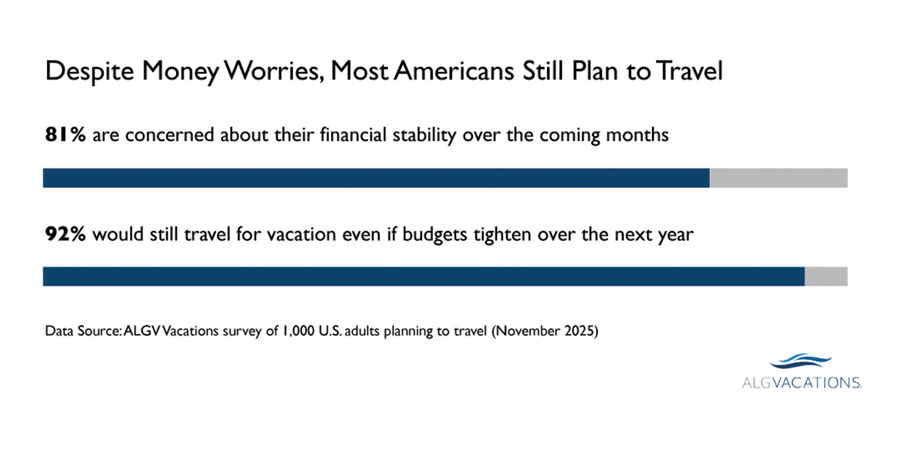
Financial pressure shapes decisions, not demand
That shift shows up in the small moments of planning. Travelers are taking longer to compare prices, reconsidering timing and adjusting expectations before they book.
Inflation and rising prices top the list of concerns, cited by 61% of respondents, reinforcing why travelers are rethinking destinations, trip length and overall costs.
Concerns about global events and safety follow at 39%, with broader political and economic instability close behind at 38%.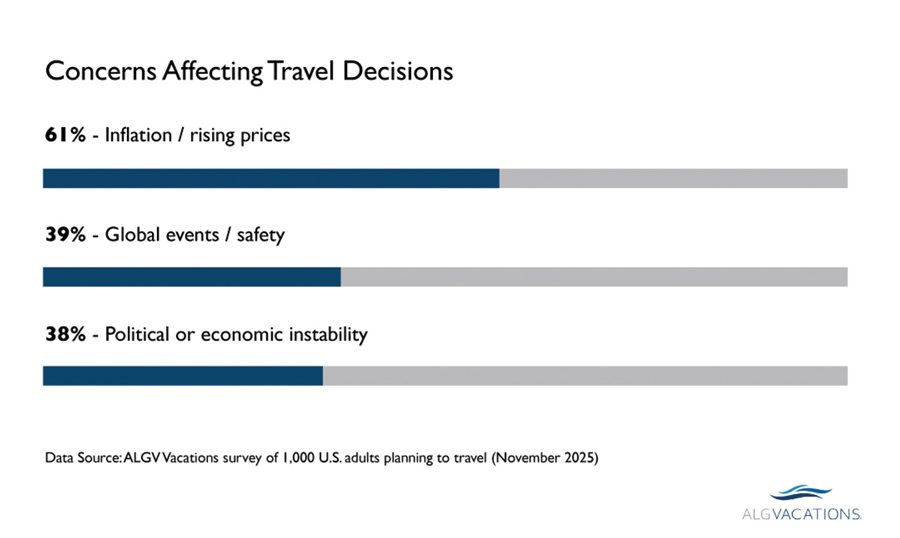
Still, those worries rarely lead travelers to walk away from travel altogether. Instead, many describe pulling back in measured ways, scaling down plans, rethinking details and making trade-offs that keep a trip possible, even if it looks different than originally imagined.
Experience changes how travelers move from planning to booking
Not all travelers navigate those trade-offs the same way. For some, uncertainty slows the process. For others, familiarity helps clear the final hurdle.
Among respondents who have previously booked a packaged vacation through a major vacation brand, 80% say they plan to take an international trip in the next year, compared with 46% of those without that experience.
That confidence carries into spending decisions as well. Sixty-seven percent of packaged-vacation travelers expect to spend more than $2,500 on their next trip, compared with 47% of those who have never booked a packaged vacation.
Taken together, the findings point to a confidence gap, with prior experience linked to greater comfort committing to international travel and higher spending.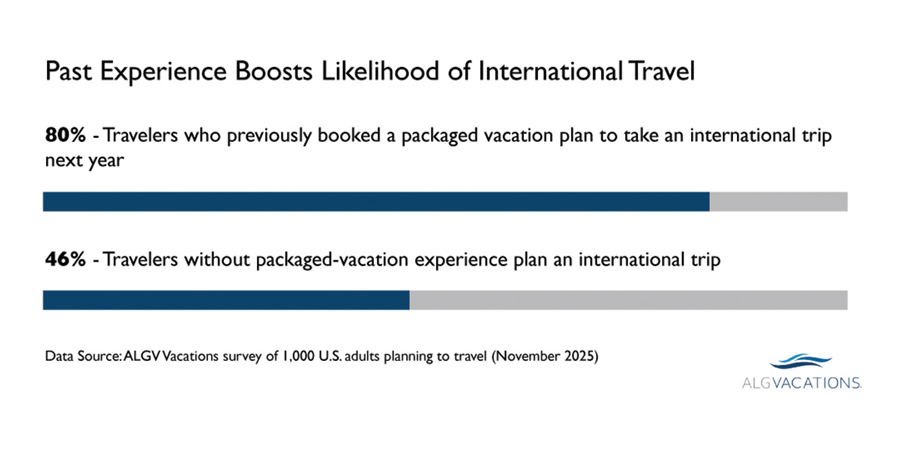
Professional guidance plays a larger role when planning gets complex
For many travelers, planning no longer stops at picking dates and destinations. Rising prices, shifting availability and higher expectations have turned vacation planning into a series of decisions that feel harder to navigate alone.
That complexity shows up most clearly among travelers with prior packaged-vacation experience. Ninety-four percent say they plan to use a travel advisor, compared with 81% of those without prior packaged-vacation experience.
The gap suggests that familiarity with structured travel planning often leads travelers to seek expert guidance. As trips become more layered, getting the details right matters as much as the destination itself.
Travel remains a priority, even as decisions slow
The findings suggest that travel is still very much on the table, even as decisions take longer to make. Travelers are weighing trade-offs, seeking guidance and leaning on experience as they plan, rather than walking away altogether.
The flight search may stay open a little longer this year. But for many Americans, the trip is still happening.
Methodology
ALG Vacations commissioned Atomik Research to conduct an online survey of U.S. adults planning to travel and travelers with prior packaged-vacation experience in the United States.
The survey included 1,000 adults planning to travel and a subsample of 502 respondents who had previously booked a packaged vacation through a major vacation brand.
The margin of error is plus or minus 3 percentage points for the full sample and 4 percentage points for the packaged vacation subsample at a 95 percent confidence level.
Fieldwork was conducted in November 2025. Atomik Research, part of 4media group, is a creative market research agency.
Photo courtesy of Shutterstock

SOURCE:





