

Community
PG&E Donates $1 Million to Local Food Banks to Help Feed Families
PG&E donates $1 million to local food banks across Northern and Central California—equivalent to about 3 million meals—supporting 38 food banks serving 47 counties.


Just in time for the holidays, Pacific Gas and Electric Company (PG&E) announced a $1 million donation to local food banks across Northern and Central California—support aimed at meeting a surge in demand as more families and seniors struggle to put food on the table.
According to PG&E, the contribution is expected to provide the equivalent of roughly 3 million meals and will support 38 food banks serving 47 counties within PG&E’s service territory.
A third major food-bank contribution since September
The $1 million gift marks the third food-bank-focused contribution since September from PG&E or The PG&E Corporation Foundation (the PG&E Foundation). Combined, those efforts bring PG&E’s total community food support in 2025 to $2.37 million.
PG&E emphasized that the funding for these charitable contributions comes from PG&E shareholders—not customers.
Food banks facing record-breaking demand
Food banks across California are reporting pressure levels not seen since the pandemic.
Officials with the California Association of Food Banks say demand has reached record highs, driven in part by an unexpected surge during the federal government shutdown this fall.
“California food banks experienced an unexpected surge with the [federal government] shutdown this fall. So, we reached out for help on their behalf and PG&E responded,” said Stacia Levenfeld, Chief Executive Officer of the California Association of Food Banks. “Their $1 million gift to food banks throughout Northern and Central California will have a meaningful impact on the lives of millions of people this holiday season and help food banks continue their critical work in our communities.”
PG&E leaders framed the donation as an extension of a longstanding partnership with food bank networks.
“We are grateful to help local food banks fulfill their mission during this time of increasing demand, especially as more families and seniors are struggling through the holiday season,” said Carla Peterman, Executive Vice President, Corporate Affairs, PG&E Corporation and Chair of The PG&E Corporation Foundation Board. “Our longstanding partnership with the California Association of Food Banks supports the safety net that is our local food banks.”
Where the 2025 food support has gone
PG&E outlined additional contributions made earlier in the year:
- September: The PG&E Foundation awarded $1.12 million to support local food banks, tribal food banks, and senior meal programs.
- November: The PG&E Foundation donated $250,000 to the California Association of Food Banks’ Emergency Response Fund.
Equity-focused grant distribution
The California Association of Food Banks notes that while California produces nearly half of the nation’s fruits and vegetables, more than one in five residents still don’t know where their next meal will come from. Food insecurity rates are even higher in many communities of color.
PG&E said grant amounts awarded to local organizations will account for county poverty and unemployment levels, using a formula from the California Department of Social Services. The goal: promote equity by directing more support to counties with higher need.
About the PG&E Corporation Foundation and PG&E
The PG&E Corporation Foundation is an independent 501(c)(3) nonprofit organization, separate from PG&E and sponsored by PG&E Corporation.
PG&E is a combined natural gas and electric utility serving more than 16 million people across 70,000 square miles in Northern and Central California. More information is available at pge.com and pge.com/news.
Why this matters
As food banks brace for sustained demand beyond the holiday season, large-scale donations like PG&E’s can help stabilize local supply—especially when distributed with an equity lens that targets the counties facing the steepest economic pressures.
For families, seniors, and individuals navigating rising costs, the impact is immediate: more meals available now, and stronger community support systems heading into the new year.
Community links:
High Demand Marks “Veggies for Veterans” Event Amid SNAP Delays
Link: https://stmdailynews.com/high-demand-marks-veggies-for-veterans-event-amid-snap-delays/
Author

Discover more from Daily News
Subscribe to get the latest posts sent to your email.






The Bridge
Hard Rock International and Coca-Cola Launch ‘Women Empower’ Series for International Women’s Month


Hard Rock International is teaming up with long-time partner Coca-Cola to spotlight women shaping the music business with a new content initiative and a month-long slate of events.
Announced Feb. 26, 2026, the collaboration introduces “Women Empower,” a micro-documentary series rolling out throughout March as part of Hard Rock’s annual International Women’s Month celebrations. Alongside the video series, Hard Rock says it’s aiming to host 1,000 live music and special events globally across its Cafes, Hotels, Casinos and Live venues.
A micro-documentary series focused on women across the industry
Rather than focusing only on performers, “Women Empower” highlights women working in a range of roles across music and media. Hard Rock notes that less than 5% of music and media creators are women, and the series is designed to put more faces—and job titles—into the public conversation.
The six featured women include:
- Janelle Abraham — Director/Film Producer
- Kat Luna — Singer/Songwriter
- Minami Minami — Composer/Dancer/Singer
- Claire Murphy — Guitar Tech
- Mayna Nevarez — CEO & Founder, Nevarez Communications
- Wendy Ong — Co-President/CMO, TaP Music
Elena Alvarez, Senior Vice President of Marketing and Brand Partnerships at Seminole Gaming and Hard Rock International, said the brand is using International Women’s Month to “lift the curtain” on the series while tying the celebration back to Hard Rock’s music-first identity and philanthropic work.
$100,000 donation to Women in Music
Hard Rock Heals Foundation®, Hard Rock’s charitable arm, is donating $100,000 to Women in Music, supporting the nonprofit’s education and empowerment efforts.
Nicole Barsalona, President of Women in Music, said the campaign highlights diversity on stage and “the wide range of roles across the music business—and the women behind the scenes whose work drives our industry forward.”
Limited-time Coca-Cola menu items at participating Hard Rock Cafes
Throughout March, participating Hard Rock Cafes will offer a limited-time Coca-Cola-inspired menu tied to the regions represented in the series.
Specialty drinks include:
- Passionfruit Splash — passionfruit beverage with Minute Maid Lemonade, Sprite and cranberry juice
- Mango Guava Chiller — mango and guava-flavored drink with Sprite, pineapple and lime juice
- Spiced Yuzu Soda — spiced brown sugar, yuzu and Coca-Cola blend
Food items include:
- Fattoush Chicken Caesar Salad — romaine with grilled chicken, mint, vegetables, fried naan and red wine Caesar dressing
- Mahi Sandwich — mahi filet with remoulade, lettuce, tomato and shoestring onions, served with seasoned fries
- Dulce de Leche Brownie — brownie with chocolate sauce, vanilla ice cream, dulce de leche and whipped cream
Hard Rock Hotels: curated listening experiences honoring female artists
Hard Rock Hotels will also highlight women in music through live performances, curated playlists and themed listening experiences using the brand’s Sound of Your Stay® program. Hard Rock says guests can expect music-themed amenities such as limited-edition vinyl, memorabilia highlights and playlists centered on female artists—both iconic names and emerging talent.
Events worldwide + Rock Shop merch
Hard Rock says it will host women-led performances, networking events, brunches and other community-driven experiences across its global footprint throughout March.
Hard Rock’s official International Women’s Month T-shirts are available at Rock Shop® retail locations and online.
For the full list of International Women’s Month activations, visit https://www.hardrock.com/women.
The Bridge is a section of the STM Daily News Blog meant for diversity, offering real news stories about bona fide community efforts to perpetuate a greater good. The purpose of The Bridge is to connect the divides that separate us, fostering understanding and empathy among different groups. By highlighting positive initiatives and inspirational actions, The Bridge aims to create a sense of unity and shared purpose. This section brings to light stories of individuals and organizations working tirelessly to promote inclusivity, equality, and mutual respect. Through these narratives, readers are encouraged to appreciate the richness of diverse perspectives and to participate actively in building stronger, more cohesive communities.
https://stmdailynews.com/the-bridge
Authors


Discover more from Daily News
Subscribe to get the latest posts sent to your email.
Community
Chick-fil-A Awards $6 Million in True Inspiration Awards Grants to 56 Nonprofits
Chick-fil-A is awarding $6 million in 2026 True Inspiration Awards grants to 56 nonprofits, including a $350,000 honoree grant to San Antonio’s Faith Kitchen.
Last Updated on February 26, 2026 by Daily News Staff
Chick-fil-A, Inc. is awarding $6 million in grants to 56 nonprofit organizations as part of its 2026 True Inspiration Awards® program, spotlighting groups the company says are making measurable, community-level impact.


The Feb. 10 announcement also marks a global milestone for the brand: Chick-fil-A is expanding the program’s footprint to include its first-ever Singapore-based grant recipient.
The big picture: a decade of community grants
Chick-fil-A launched the True Inspiration Awards in 2015 to honor the legacy of its founder, S. Truett Cathy. Since then, the company says it has awarded more than 400 grants totaling nearly $40 million to nonprofits across the U.S., Canada, Puerto Rico, the U.K. and now Singapore.
“Serving is at the heart of what we do, and the True Inspiration Awards reflect our belief that strong communities are built through consistent, caring action,” said Andrew T. Cathy, CEO of Chick-fil-A, Inc., in the release.
Faith Kitchen named 2026 S. Truett Cathy Honoree
This year’s S. Truett Cathy Honoree — the program’s top recognition and largest grant — went to Faith Kitchen, a San Antonio-based nonprofit focused on serving people experiencing homelessness.
Faith Kitchen received a $350,000 grant, which Chick-fil-A says will help:
- Support continued meal service
- Expand job training programs
- Increase operational capacity as demand rises
According to the release, Faith Kitchen serves more than 5,000 individuals each year and has operated with a mission of feeding those experiencing homelessness for 45 years, providing hot, nutritious meals three times per day.
Shared Table partnership: surplus food turned into meals
Chick-fil-A also highlighted its ongoing relationship with Faith Kitchen through the Chick-fil-A Shared Table®program, which donates surplus food from restaurants.
Since 2017, Chick-fil-A restaurants in San Antonio have partnered with Faith Kitchen to help create more than 200,000 meals, according to the company. The release also notes restaurants donate 500 boxed meals monthly to support Faith Kitchen clients.
Local Owner-Operator Greg Patterson said he nominated Faith Kitchen for the grant, citing the organization’s focus on dignity and dependable support.
Global expansion: first Singapore recipient
A notable headline for 2026 is the program’s first Singapore recipient: Fei Yue Community Services, which received $170,000 SGD.
Chick-fil-A says the organization supports socially withdrawn youth by connecting them with mental health resources and supportive relationships.
More nonprofits recognized across the U.S.
While Chick-fil-A’s full list of 2026 recipients is available through the company’s program page, the release highlights several additional grant recipients, including:
- Living and Learning Enrichment Center (Detroit, Michigan): $125,000 to support teens and young adults with disabilities transitioning to adulthood
- For Oak Cliff (North Texas): $200,000 to strengthen culturally responsive programs and expand access to education, workforce development, and community resources
- San Diego Rescue Mission (San Diego, California): $125,000 to provide trauma-informed support for individuals and families facing homelessness
- Capital City Youth Services (Tallahassee, Florida): selected to help expand emergency shelter and mental health support for at-risk youth
Chick-fil-A One members helped vote — nearly 700,000 ballots
Chick-fil-A says Chick-fil-A One® Members voted for Operator-nominated nonprofits in the Chick-fil-A App, and that voting plays a role in the final scoring. This year, the company reported a record nearly 700,000 votes cast.
2027 application window is open
Nonprofits interested in the next cycle can take note: Chick-fil-A says the 2027 True Inspiration Awards application period opens today and closes May 1.
For more information and the interactive release, visit: https://www.multivu.com/chick-fil-a/9376351-en-chick-fil-a-true-inspiration-awards-grants
Our Lifestyle section on STM Daily News is a hub of inspiration and practical information, offering a range of articles that touch on various aspects of daily life. From tips on family finances to guides for maintaining health and wellness, we strive to empower our readers with knowledge and resources to enhance their lifestyles. Whether you’re seeking outdoor activity ideas, fashion trends, or travel recommendations, our lifestyle section has got you covered. Visit us today at https://stmdailynews.com/category/lifestyle/ and embark on a journey of discovery and self-improvement.
Authors
Discover more from Daily News
Subscribe to get the latest posts sent to your email.
Community
Local governments provide proof that polarization is not inevitable
Local politics help mitigate national polarization by focusing on concrete issues like infrastructure and community needs rather than divisive symbolic debates. A survey indicates that local officials experience less partisanship, as interpersonal connections foster recognition of shared interests. This suggests that reducing polarization is possible through collaboration and changes in election laws.


Lauren Hall, Rochester Institute of Technology
When it comes to national politics, Americans are fiercely divided across a range of issues, including gun control, election security and vaccines. It’s not new for Republicans and Democrats to be at odds over issues, but things have reached a point where even the idea of compromising appears to be anathema, making it more difficult to solve thorny problems.
But things are much less heated at the local level. A survey of more than 1,400 local officials by the Carnegie Corporation and CivicPulse found that local governments are “largely insulated from the harshest effects of polarization.” Communities with fewer than 50,000 residents proved especially resilient to partisan dysfunction.
Why this difference? As a political scientist, I believe that lessons from the local level not only open a window onto how polarization works but also the dynamics and tools that can help reduce it.
Problems are more concrete
Local governments deal with concrete issues – sometimes literally, when it comes to paving roads and fixing potholes. In general, cities and counties handle day-to-day functions, such as garbage pickup, running schools and enforcing zoning rules. Addressing tangible needs keeps local leaders’ attention fixed on specific problems that call out for specific solutions, not lengthy ideological debates.
By contrast, a lot of national political conflict in the U.S. involves symbolic issues, such as debates about identity and values on topics such as race, abortion and transgender rights. These battles are often divisive, even more so than purely ideological disagreements, because they can activate tribal differences and prove more resistant to compromise.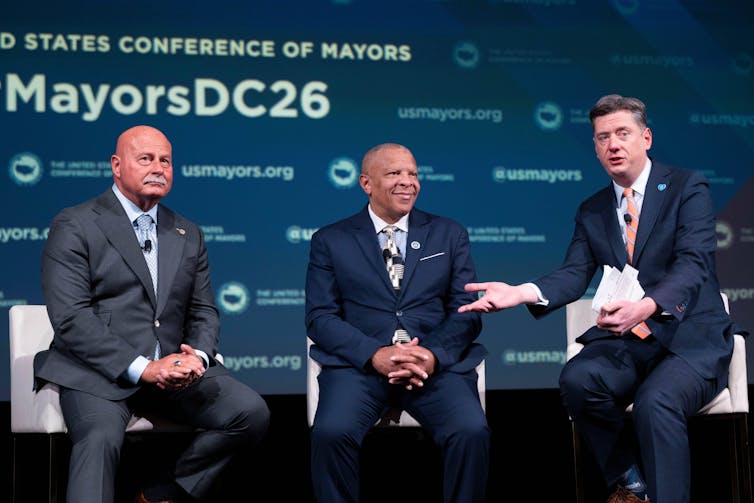
Such arguments at the national level, or on social media, can lead to wildly inaccurate stereotypes about people with opposing views. Today’s partisans often perceive their opponents as far more extreme than they actually are, or they may stereotype them – imagining that all Republicans are wealthy, evangelical culture warriors, for instance, or conversely being convinced that all Democrats are radical urban activists. In terms of ideology, the median members of both parties, in fact, look similar.
These kinds of misperceptions can fuel hostility.
Local officials, however, live among the human beings they represent, whose complexity defies caricature. Living and interacting in the same communities leads to greater recognition of shared interests and values, according to the Carnegie/CivicPulse survey.
Meaningful interaction with others, including partisans of the opposing party, reduces prejudice about them. Local government provides a natural space where identities overlap.
People are complicated
In national U.S. politics today, large groups of individuals are divided not only by party but a variety of other factors, including race, religion, geography and social networks. When these differences align with ideology, political disagreement can feel like an existential threat.
Such differences are not always as pronounced at the local level. A neighbor who disagrees about property taxes could be the coach of your child’s soccer team. Your fellow school board member might share your concerns about curriculum but vote differently in presidential elections.

These cross-cutting connections remind us that political opponents are not a monolithic enemy but complex individuals. When people discover they have commonalities outside of politics with others holding opposing views, polarization can decrease significantly.
Finally, most local elections are technically nonpartisan. Keeping party labels off ballots allows voters to judge candidates as individuals and not merely as Republicans or Democrats.
National implications
None of this means local politics are utopian.
Like water, polarization tends to run downhill, from the national level to local contests, particularly in major cities where candidates for mayor and other office are more likely to run as partisans. Local governments also see culture war debates, notably in the area of public school instruction.
Nevertheless, the relative partisan calm of local governance suggests that polarization is not inevitable. It emerges from specific conditions that can be altered.
Polarization might be reduced by creating more opportunities for cross-partisan collaboration around concrete problems. Philanthropists and even states might invest in local journalism that covers pragmatic governance rather than partisan conflict. More cities and counties could adopt changes in election law that would de-emphasize party labels where they add little information for voters.
Aside from structural changes, individual Americans can strive to recognize that their neighbors are not the cardboard cutouts they might imagine when thinking about “the other side.” Instead, Americans can recognize that even political opponents are navigating similar landscapes of community, personal challenges and time constraints, with often similar desires to see their roads paved and their children well educated.
The conditions shaping our interactions matter enormously. If conditions change, perhaps less partisan rancor will be the result.
Lauren Hall, Associate professor of Political Science, Rochester Institute of Technology
This article is republished from The Conversation under a Creative Commons license. Read the original article.
The Bridge is a section of the STM Daily News Blog meant for diversity, offering real news stories about bona fide community efforts to perpetuate a greater good. The purpose of The Bridge is to connect the divides that separate us, fostering understanding and empathy among different groups. By highlighting positive initiatives and inspirational actions, The Bridge aims to create a sense of unity and shared purpose. This section brings to light stories of individuals and organizations working tirelessly to promote inclusivity, equality, and mutual respect. Through these narratives, readers are encouraged to appreciate the richness of diverse perspectives and to participate actively in building stronger, more cohesive communities.
https://stmdailynews.com/the-bridge
Discover more from Daily News
Subscribe to get the latest posts sent to your email.





