

News
From FIFA to the LA Clippers, carbon offset scandals are exposing the gap between sports teams’ green promises and reality
Under Steve Ballmer’s ownership, the LA Clippers have made strides in reducing greenhouse gas emissions, yet concerns arise over the efficacy of their carbon offsets, especially following issues with their partner, Aspiration. Many sports organizations face scrutiny for their offset claims, highlighting a need for transparent, verified carbon reduction strategies and a reassessment of sustainability practices in the industry.


Brian P. McCullough, University of Michigan and Edward Carrington, University of Michigan
If you go to a pro sports event today, there’s a good chance the stadium or arena will be powered at least in part by renewable energy. The team likely takes steps to reduce energy and waste. Some even claim to have net-zero greenhouse gas emissions, meaning any emissions they still do produce they offset by paying for projects, such as tree-planting, that reduce greenhouse gases elsewhere.
The venue upgrades have been impressive – Seattle’s hockey and basketball arena runs on 100% renewable energy, makes its rink ice from captured rainwater, and offers free public transit for ticket holders.
But how much of the teams’ offset purchases are actually doing the good that they claim?
It’s an important question, in part because fans may ultimately pay for those offsets.
The cost of carbon offsetting in sports varies by organization, with no industry standard for who pays. Some teams and leagues absorb costs through their operational budgets, treating carbon neutrality as a core responsibility. Others pass costs to consumers: Some teams add sustainability fees to ticket prices to offset each attendee’s carbon footprint. The payment model ultimately reflects whether an organization views offsetting as an institutional obligation or a shared responsibility with fans.
Carbon offsets in sports are also in the news, with scandals erupting around them in connection with sports from FIFA’s 2022 World Cup to basketball’s LA Clippers.
As sport management researchers, we have been following offset agreements and other sustainability commitments that teams and sports leagues such as FIFA have been making to see whether they translate into measurable environmental outcomes. We see lots of good intentions but also a disturbing amount of failures and outright fraud.
Where sports teams’ emissions come from
The vast majority of a sports team’s climate footprint comes from team’s and fans’ travel, which they have little control over. Leagues can reduce teams’ travel somewhat with creative scheduling, but unlike other industries, sports teams have few ways to reduce the bulk of their emissions.
What many of them do instead is offset those travel emissions by buying carbon credits.
https://datawrapper.dwcdn.net/C9q2E/1
Carbon credits are generated by projects that reduce greenhouse gases in the atmosphere or prevent greenhouse gas emissions. Many of those projects involve planting trees to remove carbon dioxide from the atmosphere; others expand clean energy to reduce fossil fuel use. Each carbon credit is supposed to represent the reduction or prevention of one metric ton of carbon dioxide.
However, carbon offset projects have come under scrutiny in recent years. Tree-planting projects, the most common type, take time to meet their promise as the trees grow, and wildfires and logging can wipe out the benefit. Studies have found that companies tend to buy cheap, low-quality carbon credits, which run a risk of exaggerating their carbon reduction claims or providing results that would have happened anyway, leaving no real climate benefit.
Unfortunately, several teams, perhaps unknowingly, have been purchasing fraudulent or low-quality credits.
Reputations at risk
FIFA brought the sports world’s carbon offset problem into the spotlight during the 2022 Qatar World Cup.
FIFA claimed the event would be carbon neutral, but that claim relied on creative accounting that understated the event’s construction and travel emissions. Organizers also used low-quality offsets. Many of those offsets were renewable energy projects with a high likelihood of being built anyway.
A year after the tournament, FIFA had completed offset purchases for less than a third of the World Cup’s estimated emissions, the nonprofit Carbon Market Watch found. And Switzerland’s advertising regulator ordered FIFA to stop claiming the World Cup had been “carbon neutral.”
The Clippers and baseball’s Boston Red Sox ran into problems when they publicly partnered with Aspiration, a now-bankrupt finance technology company and carbon credit broker, to meet their “carbon neutral” claims.
The Clippers had a US$300 million partnership with Aspiration that included paying the company at least $56 million for carbon credits in mid-2022, The New York Times reported. Both teams also had plans with Aspiration to offer fans a way to buy carbon credits to cover their own travel when purchasing tickets.
However, Aspiration officials claimed to have supported millions more tree-plantings than what had actually happened, a ProPublica investigation found. Aspiration co-founder Joe Sanberg pleaded guilty in 2025 to wire fraud involving false statements about financing to secure loans and attract investors, who lost at least $248 million.
The Aspiration partnership is also under investigation by the NBA over an endorsement deal the company made with Clippers all-star Kawhi Leonard at about the same time and questions about whether it was used to violate the league’s salary cap. Team owner Steve Ballmer, who personally invested at least $50 million in Aspiration, told ESPN he and the team did nothing wrong. “They conned me,” he said.
While the scandal focused on financial fraud and the salary cap, it also raised questions about the team’s sustainability claim.
Without verification, who knows?
In some cases, the value of offset projects is difficult to verify, even when trees are being planted nearby.
The Seattle Sounders FC declared itself the first carbon-neutral professional soccer team in North America in 2019 by cutting its waste, water and energy use and offsetting its remaining emissions through the nonprofit organization Forterra, which plants trees in the Puget Sound region.
While the effort positioned the club as a sustainability leader, the offsets lacked what’s known as third-party verification. Similar to how organic food must be certified by reputable agencies, third-party validation of carbon credits ensures credits truly represent the removal of carbon from the atmosphere or avoided emissions.
Without verification, it’s unclear whether claimed emission reductions are permanent, accurately tracked and transparently reported.
Potential legal consequences
Even the most prominent venues are susceptible to issues with unreliable credits.
Climate Pledge Arena in Seattle has been celebrated as the world’s first “zero-carbon” certified arena, with electric Zambonis, recycled materials, renewable energy and free public transit. It represents one of the most ambitious pushes to develop sustainable sport infrastructure globally.
To offset unavoidable construction emissions, the arena’s owner relied on carbon credits tied to projects meant to reduce rainforest loss in Colombia. However, an analysis by the carbon rating company Calyx Global found that while the arena’s credits may prevent some deforestation, the numbers likely overstate the benefits.
A 2023 report suggested that over 90% of rainforest carbon credits from the leading certifier of offsets lack evidence that they reduced deforestation. The certifier disputed that conclusion but is working to revise its review process.
When credits fail to offset real emissions, that erodes public trust and can expose organizations to potential legal consequences.
Delta Air Lines, for example, is facing a lawsuit over its carbon neutrality claim. The suit alleges that Delta misled passengers by describing itself as a “carbon-neutral airline” while relying on carbon offset projects that were ineffective or “junk.”
Time for some strategic reassessment
These and other failures in the carbon credit market suggest the industry needs to fundamentally reassess how sports teams achieve their climate goals.
To provide meaningful sustainability commitments, sports organizations and facilities can start at home by lowering their fossil fuel use and increasing their energy efficiency. Many arenas do this.

https://datawrapper.dwcdn.net/O1mkr/1
Leagues can design game schedules to reduce team and fan travel. Many of the Paris Olympics venues in 2022, for example, were connected by subway or bus. The 2026 FIFA World Cup, in contrast, has venues hundreds of miles apart across North America, meaning potentially higher emissions from fan travel.
Where offsets will still play a role, teams can ensure that they partner with verified carbon credit providers that deliver measurable, transparent carbon reductions.
In a field where public trust and reputation matter as much as performance, the sports industry cannot afford foul play on climate. We believe a shift toward strategies that cut emissions first, and then use only the most credible offsets, will be the difference between striking out and leading the sustainability game.
Brian P. McCullough, Associate Professor of Sport Management, University of Michigan and Edward Carrington, Assistant in Research in Sports Management, University of Michigan
This article is republished from The Conversation under a Creative Commons license. Read the original article.
Author

Discover more from Daily News
Subscribe to get the latest posts sent to your email.


News
Children can be systematic problem-solvers at younger ages than psychologists had thought – new research
Child psychologists: Celeste Kidd’s research challenges long-standing ideas from Jean Piaget about children’s problem-solving abilities. Her findings show that children as young as four can independently utilize algorithmic strategies to solve complex tasks, contradicting the belief that systematic logical thinking develops only after age seven. This insight highlights the importance of nurturing algorithmic thinking in early education.

Celeste Kidd, University of California, Berkeley
I’m in a coffee shop when a young child dumps out his mother’s bag in search of fruit snacks. The contents spill onto the table, bench and floor. It’s a chaotic – but functional – solution to the problem.
Children have a penchant for unconventional thinking that, at first glance, can look disordered. This kind of apparently chaotic behavior served as the inspiration for developmental psychologist Jean Piaget’s best-known theory: that children construct their knowledge through experience and must pass through four sequential stages, the first two of which lack the ability to use structured logic.
Piaget remains the GOAT of developmental psychology. He fundamentally and forever changed the world’s view of children by showing that kids do not enter the world with the same conceptual building blocks as adults, but must construct them through experience. No one before or since has amassed such a catalog of quirky child behaviors that researchers even today can replicate within individual children.
While Piaget was certainly correct in observing that children engage in a host of unusual behaviors, my lab recently uncovered evidence that upends some long-standing assumptions about the limits of children’s logical capabilities that originated with his work. Our new paper in the journal Nature Human Behaviour describes how young children are capable of finding systematic solutions to complex problems without any instruction. https://www.youtube.com/embed/Qb4TPj1pxzQ?wmode=transparent&start=0 Jean Piaget describes how children of different ages tackle a sorting task, with varying success.
Putting things in order
Throughout the 1960s, Piaget observed that young children rely on clunky trial-and-error methods rather than systematic strategies when attempting to order objects according to some continuous quantitative dimension, like length. For instance, a 4-year-old child asked to organize sticks from shortest to longest will move them around randomly and usually not achieve the desired final order.
Psychologists have interpreted young children’s inefficient behavior in this kind of ordering task – what we call a seriation task – as an indicator that kids can’t use systematic strategies in problem-solving until at least age 7.
Somewhat counterintuitively, my colleagues and I found that increasing the difficulty and cognitive demands of the seriation task actually prompted young children to discover and use algorithmic solutions to solve it.
Piaget’s classic study asked children to put some visible items like wooden sticks in order by height. Huiwen Alex Yang, a psychology Ph.D. candidate who works on computational models of learning in my lab, cranked up the difficulty for our version of the task. With advice from our collaborator Bill Thompson, Yang designed a computer game that required children to use feedback clues to infer the height order of items hidden behind a wall, .
The game asked children to order bunnylike creatures from shortest to tallest by clicking on their sneakers to swap their places. The creatures only changed places if they were in the wrong order; otherwise they stayed put. Because they could only see the bunnies’ shoes and not their heights, children had to rely on logical inference rather than direct observation to solve the task. Yang tested 123 children between the ages of 4 and 10. https://www.youtube.com/embed/GlsbcE6nOxk?wmode=transparent&start=0 Researcher Huiwen Alex Yang tests 8-year-old Miro on the bunny sorting task. The bunnies are hidden behind a wall with only their sneakers visible. Miro’s selections exemplify use of selection sort, a classic efficient sorting algorithm from computer science. Kidd Lab at UC Berkeley.
Figuring out a strategy
We found that children independently discovered and applied at least two well-known sorting algorithms. These strategies – called selection sort and shaker sort – are typically studied in computer science.
More than half the children we tested demonstrated evidence of structured algorithmic thinking, and at ages as young as 4 years old. While older kids were more likely to use algorithmic strategies, our finding contrasts with Piaget’s belief that children were incapable of this kind of systematic strategizing before 7 years of age. He thought kids needed to reach what he called the concrete operational stage of development first.
Our results suggest that children are actually capable of spontaneous logical strategy discovery much earlier when circumstances require it. In our task, a trial-and-error strategy could not work because the objects to be ordered were not directly observable; children could not rely on perceptual feedback.
Explaining our results requires a more nuanced interpretation of Piaget’s original data. While children may still favor apparently less logical solutions to problems during the first two Piagetian stages, it’s not because they are incapable of doing otherwise if the situation requires it.
A systematic approach to life
Algorithmic thinking is crucial not only in high-level math classes, but also in everyday life. Imagine that you need to bake two dozen cookies, but your go-to recipe yields only one. You could go through all the steps of making the recipe twice, washing the bowl in between, but you’d never do that because you know that would be inefficient. Instead, you’d double the ingredients and perform each step only once. Algorithmic thinking allows you to identify a systematic way of approaching the need for twice as many cookies that improves the efficiency of your baking.
Algorithmic thinking is an important capacity that’s useful to children as they learn to move and operate in the world – and we now know they have access to these abilities far earlier than psychologists had believed.
That children can engage with algorithmic thinking before formal instruction has important implications for STEM – science, technology, engineering and math –education. Caregivers and educators now need to reconsider when and how they give children the opportunity to tackle more abstract problems and concepts. Knowing that children’s minds are ready for structured problems as early as preschool means we can nurture these abilities earlier in support of stronger math and computational skills.
And have some patience next time you encounter children interacting with the world in ways that are perhaps not super convenient. As you pick up your belongings from a café floor, remember that it’s all part of how children construct their knowledge. Those seemingly chaotic kids are on their way to more obviously logical behavior soon.
Celeste Kidd, Professor of Psychology, University of California, Berkeley
This article is republished from The Conversation under a Creative Commons license. Read the original article.
Dive into “The Knowledge,” where curiosity meets clarity. This playlist, in collaboration with STMDailyNews.com, is designed for viewers who value historical accuracy and insightful learning. Our short videos, ranging from 30 seconds to a minute and a half, make complex subjects easy to grasp in no time. Covering everything from historical events to contemporary processes and entertainment, “The Knowledge” bridges the past with the present. In a world where information is abundant yet often misused, our series aims to guide you through the noise, preserving vital knowledge and truths that shape our lives today. Perfect for curious minds eager to discover the ‘why’ and ‘how’ of everything around us. Subscribe and join in as we explore the facts that matter. https://stmdailynews.com/the-knowledge/
Discover more from Daily News
Subscribe to get the latest posts sent to your email.
News
Valley Metro to Exit CAPEX Capitol Extension After Phoenix Council Shifts Focus to Indian School Road Corridor
Valley Metro is shifting its focus on high-capacity transit planning in west Phoenix following a City Council vote, prioritizing a new corridor along Indian School Road while exiting the Capitol Extension project, CAPEX, and seeking community engagement.

Valley Metro is officially shifting gears on high-capacity transit planning in west Phoenix following a Phoenix City Council vote earlier this year.
In a message to the public, Valley Metro said that after the Jan. 27, 2026 City Council decision to re-evaluate high-capacity transit options and prioritize a proposed West Phoenix corridor along Indian School Road, the agency will exit project development and the Federal Transit Administration Capital Investment Grant (CIG) process for the Capitol Extension (CAPEX) project.

What the City Council voted to do
According to Valley Metro, the Phoenix City Council voted to take another look at high-capacity transit options for west Phoenix and to prioritize studying a new corridor alignment along Indian School Road.
What Valley Metro is doing next
Valley Metro emphasized it still supports expanding high-capacity transit in west Phoenix, citing demand and mobility needs in the corridor. But the agency says it will now pivot away from CAPEX and toward the new study effort.
Key next steps Valley Metro outlined include:
- Exiting the CAPEX project development process and the federal CIG pipeline
- Advancing planning for the West Phoenix study along Indian School Road
- Centering comprehensive community engagement, including outreach to residents, business owners, and stakeholders along the corridor
- Working closely with the City of Phoenix on project development
- Coordinating with the Federal Transit Administration to explore funding opportunities
How to stay engaged
Valley Metro is encouraging residents to sign up for updates as the next phase moves forward at valleymetro.org/notices.
Dive into “The Knowledge,” where curiosity meets clarity. This playlist, in collaboration with STMDailyNews.com, is designed for viewers who value historical accuracy and insightful learning. Our short videos, ranging from 30 seconds to a minute and a half, make complex subjects easy to grasp in no time. Covering everything from historical events to contemporary processes and entertainment, “The Knowledge” bridges the past with the present. In a world where information is abundant yet often misused, our series aims to guide you through the noise, preserving vital knowledge and truths that shape our lives today. Perfect for curious minds eager to discover the ‘why’ and ‘how’ of everything around us. Subscribe and join in as we explore the facts that matter. https://stmdailynews.com/the-knowledge/
Author

Discover more from Daily News
Subscribe to get the latest posts sent to your email.
News
In World War II’s dog-eat-dog struggle for resources, a Greenland mine launched a new world order
Greenland’s cryolite mine, vital for U.S. airplane production during World War II, became strategically important after Nazi invasions of Europe. President Roosevelt emphasized its significance in national security, advocating for its protection. This shifted U.S. resource access policies and shaped post-war international relations, prioritizing strategic minerals and military bases.
Thomas Robertson, Macalester College
On April 9, 1940, Nazi tanks stormed into Denmark. A month later, they blitzed into Belgium, Holland and France. As Americans grew increasingly rattled by the spreading threat, a surprising place became crucial to U.S. national security: the vast, ice-capped island of Greenland.
The island, a colony of Denmark’s at the time, was rich in mineral resources. The Nazi invasions left it and several other European colonies as international orphans.
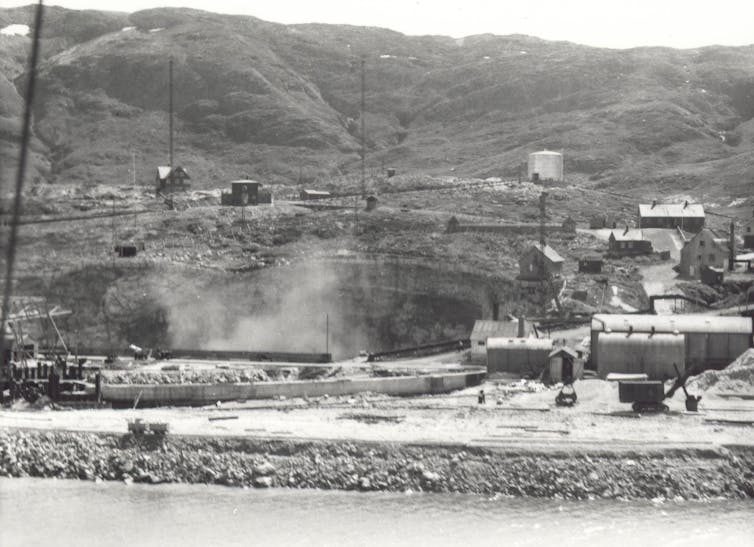
Greenland was essential for air bases as U.S. planes flew to Europe, and also for strategic minerals. Greenland’s Ivittuut (formerly Ivigtut) mine contained the world’s only reliable supply of the most important material you’ve probably never heard of: cryolite, a frosty white mineral that the U.S. and Canadian industries relied upon to refine bauxite into aluminum, and thus essential to assembling a modern air force.
A month after the Nazis seized Denmark, five American Coast Guard cutters set sail for Greenland, in part to protect the Ivittuut mine from the Nazis.
People sometimes forget that World War II was a dog-eat-dog struggle for resources – oil and uranium but also dozens of other materials, everything from rubber to copper. Without these strategic materials, no modern military could produce crucial new weapons such as tanks and airplanes. The resource struggle often started before actual fighting.
Foreign materials fueled American global power, but also raised tricky questions about access to resources and about sovereignty, just as the old European imperial order was being rethought. As in 2026, U.S. presidents had to skillfully balance force and diplomacy.
As a historian at Macalester College, I research how Americans shape environments around the world through their purchasing and national security needs, and how foreign landscapes enable and constrain American actions. Today, control of Greenland’s natural resources is again on an American president’s radar as demand for critical minerals rises and supply tightens.
During the spring of 1940, America and its European allies mapped out patterns of resource use and ideas of global interconnection that would shape the international order for decades. Greenland helped give birth to this new order.
Rethinking American vulnerability
On May 16, 1940, President Franklin Roosevelt addressed a joint session of Congress, including many “American first” isolationists wary of European entanglements. Roosevelt implored Americans to wake up to new threats in the world – to, in his words, “recast their thinking about national protection.”
New weapons, he warned, had shrunk the world, and oceans could no longer shield the United States. The nation’s fate was inextricably tied to Europe’s. Nothing showed this better than Greenland: “From the fiords of Greenland,” FDR warned, “it is four hours by air to Newfoundland; five hours to Nova Scotia, New Brunswick and to the province of Quebec; and only six hours to New England.”
But Greenland set off alarm bells for another reason. To protect itself in a dangerous world, Roosevelt famously called for the U.S. to hammer out 50,000 planes a year. But in 1938, America had produced only 1,800 planes.
To meet this ambitious goal, Roosevelt and his advisers knew that little could be done without Greenland. No Greenland, no cryolite. No cryolite, no massive American air force. Without cryolite, making 50,000 planes would be infinitely more difficult.
The age of alloys
Americans, National Geographic explained in 1942, lived in an “age of alloys.” Without aluminum alloys and other metallic mixtures, assembly lines churning out modern tanks, trucks and airplanes would grind to a halt. “More than any other struggle in history, this is a war of many metals, and the lack of a single one may be a blow far worse than the loss of a battle.”

Few materials mattered more than aluminum. Light yet strong, aluminum formed 60% of a heavy bomber’s engines, 90% of its wings and fuselage, and all of its propellers.
But there was a problem: Refining aluminum from bauxite ore required working with dangerously hot metallic mixtures, over 2,000 degrees Fahrenheit (1,100 degrees Celsius). Cryolite solved the problem by reducing the temperature to a more manageable 900 F (480 C).
The Nazis’ chemical industry had found a substitute for cryolite using fluorspar, but the U.S. preferred the more resource-efficient cryolite and wanted to prevent the Germans from having it.
After the Nazis seized Denmark
Just days after German tanks rolled into Denmark in April 1940, Allied officials huddled to devise ways to protect Ivittuut’s magical mineral. On May 3, Danish Ambassador to the U.S. Henrik de Kauffmann, risking trial for treason, requested American assistance. On May 10, the U.S. Coast Guard Cutter Comanche departed New England for Ivittuut. Four others soon followed, one with guns for the mine’s defenders.
That very week in Washington, at a meeting of the Pan American Union, Roosevelt and his advisers spoke with hundreds of geologists and other representatives from Latin America — a resource-rich region that the U.S. saw as an answer to its strategic materials shortages.
Nervous about the history of U.S. imperial high-handedness in the region, some Latin Americans thought that their countries should seal off their resources to outside control, as Mexico had in nationalizing U.S. and European oil holdings in 1938.
With European empires crumbling, Roosevelt faced a delicate diplomatic dance with Greenland. He wanted to maintain the appearance of neutrality, keep skeptical isolationists in Congress from revolting and give no provocations to Latin American anti-imperialists to cut off resources. Crucially, he also needed to avoid giving the resource-starved Japanese a legal justification to seize the oil-rich Dutch East Indies, now Indonesia – another European colony orphaned by the Nazi invasion.
Roosevelt’s solution: enlist Coast Guard “volunteers” to guard Ivittuut. By the end of the summer, long before the U.S. officially entered the war, 15 sailors resigned from their ships and took up residence near the mine.
Seeing Greenland as crucial to US security
Roosevelt also got creative with geography.
In an April 12, 1940, press conference, just days after the Nazi invasion, he began to emphasize Greenland as part of the Western Hemisphere, more American than European, and thus falling under Monroe Doctrine protections. To calm fears in Latin America, U.S. officials recast the doctrine as development-oriented hemispheric solidarity.
Maj. William S. Culbertson, a former U.S. trade official speaking before the Army Industrial College in fall 1940, noted how the scramble for resources pulled the U.S. into a form of nonmilitary warfare: “We are engaged at the present time in economic warfare with the totalitarian powers. Publicly, our politicians don’t state it quite as bluntly as that, but it is a fact.” For the rest of the century, the front line was just as likely a far-off mine as an actual battlefield.
On April 9, 1941, exactly a year after the Nazis seized Denmark, Kauffmann met with U.S. Secretary of State Cordell Hull to sign an agreement “on behalf of the King of Denmark” placing Greenland and its mines under the U.S. security blanket. At Narsarsuaq, on the island’s southern tip, the U.S. began constructing an airbase named “Bluie West One.”
During the rest of World War II and throughout the Cold War, Greenland would house several important U.S. military installations, including some that forced Inuit families to relocate.
Critical minerals today
What transpired in Greenland in the 18 months before Pearl Harbor fit into a larger emerging pattern.
As the U.S. ascended to global leadership and realized that it couldn’t maintain military dominance without wide access to foreign materials, it began to redesign the global system of resource flows and the rules for this new international order.
It rejected the Axis’ “might makes right” territorial conquest for resources, but found other ways to guarantee American access to critical resources, including loosening trade restrictions in European colonies.
The U.S. provided a lifeline to the British with the destroyers-for-bases deal in September 1940 and the Lend-Lease Act in March 1941, but it also gained strategic military bases around the world. It used aid as leverage to also pry open the British Empire’s markets.
The result was a postwar world interconnected by trade and low tariffs, but also a global network of U.S. bases and alliances of sometimes questionable legitimacy designed in part to protect U.S. access to strategic resources.
During the Cold War, these global resources helped defeat the Soviet Union. However, these security imperatives also gave the U.S. license for support of authoritarian regimes in places like Iran, Congo and Indonesia.
America’s voracious appetite for resources also often displaced local populations and Indigenous communities, justified by the old claim that they misused the resources around them. It left environmental damage from the Arctic to the Amazon.
Strategic resources have been at the center of the American-led global system for decades. But U.S. actions today are different. The cryolite mine was a working mine, rarer than today’s proposed critical mineral mines in Greenland, and the Nazi threat was imminent. Most important, Roosevelt knew how to gain what the U.S. needed without a “damn-what-the world-thinks” military takeover.
Thomas Robertson, Visiting Associate Professor of Environmental Studies, Macalester College
This article is republished from The Conversation under a Creative Commons license. Read the original article.
Dive into “The Knowledge,” where curiosity meets clarity. This playlist, in collaboration with STMDailyNews.com, is designed for viewers who value historical accuracy and insightful learning. Our short videos, ranging from 30 seconds to a minute and a half, make complex subjects easy to grasp in no time. Covering everything from historical events to contemporary processes and entertainment, “The Knowledge” bridges the past with the present. In a world where information is abundant yet often misused, our series aims to guide you through the noise, preserving vital knowledge and truths that shape our lives today. Perfect for curious minds eager to discover the ‘why’ and ‘how’ of everything around us. Subscribe and join in as we explore the facts that matter. https://stmdailynews.com/the-knowledge/
Discover more from Daily News
Subscribe to get the latest posts sent to your email.





