Connect with us

The Bridge

How bigotry crushed the dreams of an all-Black Little League team

Published

on

Last Updated on September 5, 2025 by Daily News Staff

all-Black Little League team
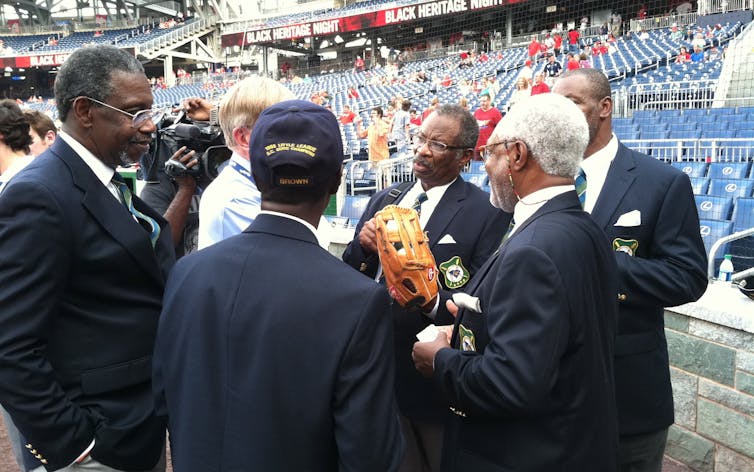
Members of the 1955 Cannon Street All-Star YMCA team chat before a game at Nationals Park in Washington, D.C., on Aug. 19, 2011. Robert E. Pierre/The Washington Post via Getty Images

How bigotry crushed the dreams of an all-Black Little League team

Chris Lamb, Indiana University John Rivers, John Bailey, David Middleton, Leroy Major and Buck Godfrey – all teammates from the 1955 Cannon Street YMCA Little League All-Star team – left Charleston, South Carolina, on a bus on Aug. 18, 2025. After a stop at the Baseball Hall of Fame in Cooperstown, New York, for a couple days – where their story is included in an exhibit on Black baseball that opened in 2024 – they’ll head to Williamsport, Pennsylvania. There, they’ll be recognized before the Little League World Series championship game on August 24, 2025 – 70 years after the players, then 11 and 12 years old, watched the championship game from the bleachers, wondering why they weren’t on the field living out their own dreams instead of watching other boys live out theirs. When the Cannon Street team registered for a baseball tournament in Charleston in July 1955, it put the team and the forces of integration on a collision course with segregation, bigotry and the Southern way of life. White teams refused to take the field with the Cannon Street team, who represented the first Black Little League in South Carolina. The team won two tournaments by forfeit. They were supposed to then go to a regional tournament in Rome, Georgia, where, if they won, they’d advance to the Little League World Series. But Little League officials ruled the team ineligible for the regional tournament because it had advanced by winning on forfeit and not on the field, as the rules stipulated.

A 4-team Black league is born

The Civil Rights Movement is often told in terms of court decisions, bus boycotts and racist demagogues. It’s rarely told from the point of view of children, who suffered in ways that left physical and emotional scars. When I was a journalism professor at the College of Charleston, I learned how the presence of a single Black all-star team was enough to cause one of the biggest crises in Little League history. In 2022, I wrote the book “Stolen Dreams: The 1955 Cannon Street All-Stars and Little League Baseball’s Civil War.” The team’s story begins in 1953. Robert Morrison, president of the Cannon Street YMCA, petitioned Little League Baseball to create a league for Black teams, and Little League Baseball granted the charter. Dozens of Black 11- and 12-year-old boys were selected for the four-team league before the 1954 season. They played on a diamond of grass and gravel at Harmon Field in Charleston, a city with a long history of racial strife. In 1861, the Civil War began in Charleston harbor, where hundreds of thousands of slaves had been brought to the U.S. from the 1600s to the 1800s. The field also wasn’t far from Emanuel AME church, where nine Black parishioners were murdered during a prayer meeting in 2015. Little League Baseball barred first-year leagues from the postseason tournaments. At some point during the 1955 season, the best players were selected for the league’s All-Star team. Cannon Street YMCA officials then registered the team for the Charleston city tournament, which included all-star teams from the city’s all-white leagues. Little League Baseball officially prohibited racial discrimination. But in South Carolina, racial discrimination was still legal.

Dixie fights back

The U.S. Supreme Court had ruled a year earlier that segregation in schools was unconstitutional in the landmark Brown v. Board of Education decision, paving the way for racial integration. Few states resisted integration as fiercely as South Carolina, and no politician fought harder against racial equality than the state’s junior U.S. senator, Strom Thurmond. So when the Cannon Street YMCA All-Stars registered for Charleston’s citywide tournament in July 1955, all the white teams withdrew. The Cannon Street team won by forfeit and advanced to the state tournament. Danny Jones, the state’s director of Little League Baseball, petitioned the organization to create a segregated state tournament. Little League Baseball’s president, Peter McGovern, denied Jones’ request. He said that any team that refused to play the Cannon Street team would be banned from the organization. Thurmond let it be known to Jones that an integrated tournament could not be permitted. In the end, Jones urged all the white teams to withdraw from the state tournament. He then resigned from Little League Baseball, created the Little Boys League and wrote the league’s charter, which prohibited Black players.
A baseball with an American flag superimposed over it, surrounded by four stars.
The official logo for Dixie Youth Baseball, which was originally established as an all-white league. Dixie Youth Baseball
The Little Boys League – which was rebranded as Dixie Youth Baseball – soon replaced Little League in other Southern states; within six years, there were 390 such leagues spanning most of the former Confederacy. It would be decades before Little League Baseball returned to South Carolina. Having won the South Carolina tournament by forfeit, the Cannon Street YMCA All-Stars prepared for the regional tournament in Rome, Georgia, where the state’s governor, Marvin Griffin, objected to integration. If youth baseball could be integrated, so, too, could schools, swimming pools and municipal parks, he said.

Let them play!

Little League rules said that teams could advance only by playing and winning, so the Cannon Street’s state championship was ruled invalid because it had come by forfeit. McGovern decided against making an exception for the Cannon Street YMCA All-Stars. Most white-owned newspapers, whether in the South or North, had long stayed silent on the topic of racial discrimination. But the story of the Cannon Street All-Stars broke through. Editors and reporters may have wanted to avoid the topic of racism, but boys being denied the opportunity to play in a baseball tournament was too objectionable to ignore. On July 31, 1955, New York Daily News columnist Dick Young asked Brooklyn Dodgers star Jackie Robinson, who had broken Major League Baseball’s color barrier eight years earlier, about the white teams that had quit the tournament rather than play against a Black team. “How stupid can they be?” Robinson said. “I had to laugh when I read the story.” Perhaps pressured by criticism, McGovern, Little League’s president, invited the team to be Little League’s guests for the championship game. So the team boarded a bus for Williamsport. They arrived the night before the championship game, which pitted Morrisville, Pennsylvania, against Delaware Township, New Jersey, an integrated team. The Cannon Street YMCA All-Stars and their coaches were introduced before the game, and the players recall hearing a loud voice from the bleachers. “Let them play!” it boomed. Others in the crowd joined in, the players said. “Let them play! Let them play!” John Rivers, who played second base for the team, told me he can still “hear it now.” After their brief moment on the field, the Cannon Street All-Stars returned to their seats and watched other boys live out their dreams. A photograph of the team in the stands reveals the disappointment on their faces.
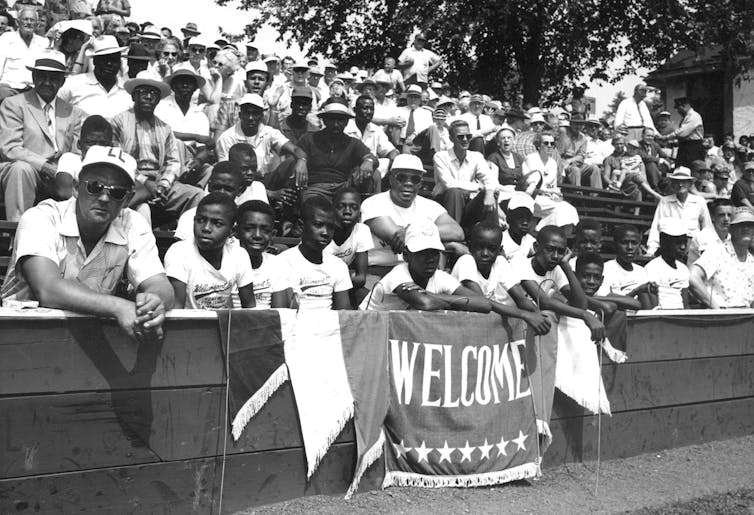
Black and white photo of Black boys and adults sitting in the stands at a baseball stadium.
The Cannon Street All-Stars watch from the stands at the 1955 Little League World Series in Williamsport, Pa. 1955 Cannon Street All-Stars/Facebook
On the following day – Aug. 28, 1955 – the team boarded its bus to return to Charleston. It was the same date that Emmett Till, not much older than the players on the team, was brutally murdered in Money, Mississippi, for reportedly whistling at a white woman. The boys and girls who play in the 2025 tournament will forever remember the experience. The surviving members of the Cannon Street All-Stars, who are all in their early 80s, never forgot what they were denied. Rivers, who went on to become a successful architect, says this is the moral of their story. “It’s a tragedy to take dreams away from a youngster,” Rivers told The Washington Post in 2022. “I knew it then. I know it now, and I’ve seen to it that no one takes dreams away from me again.” Now there are some on the political right who want to bury America’s ugly racial history. America has never fully reckoned with slavery or the decades of segregation, Rivers recently told me. “It just decided to move on from that ugly period in its history without any kind of therapy,” he said. “And now they are trying to sweep it all under the rug again.” Portions of this article first appeared in an article published on Aug. 19, 2016. Chris Lamb, Professor of Journalism, Indiana University This article is republished from The Conversation under a Creative Commons license. Read the original article.

Discover more from Daily News

Subscribe to get the latest posts sent to your email.

Continue Reading
Advertisement Sports Research

STM Daily News

Chinamaxxing: The Viral Trend Turning Geopolitics Into Aesthetic Fantasy

A viral social media trend called “Chinamaxxing” is turning geopolitics into aesthetic comparison—revealing more about generational frustration than China itself.

Published

on

Chinamaxxing: Crowded subway station with train. A deep dive into “Chinamaxxing,” the viral social media trend blending aesthetics, politics, and generational disillusionment.

At first glance, the videos seem harmless enough.

Clean subways gliding into spotless stations. Neon skylines glowing at night. Clips of high-speed trains, cashless stores, orderly crowds. Overlaid text reads something like, “Meanwhile in China…” or “They figured it out.”

This is “Chinamaxxing,” a loosely defined but increasingly visible social media trend where mostly young users frame China as a model of efficiency, stability, and modernity—often in contrast to life in the West.

What makes the trend notable isn’t just its subject, but its tone. Chinamaxxing is rarely explicit political advocacy. It’s not a manifesto. It’s a mood. Aesthetic admiration blended with subtle critique, delivered through short, visually compelling clips that invite comparison without context.

And that’s precisely why it has sparked debate.

What Is “Chinamaxxing,” Really?

Despite the provocative name, Chinamaxxing isn’t a coordinated movement or ideology. It’s better understood as an algorithm-driven pattern—a recurring style of content that rewards certain visuals and emotional cues.

Most Chinamaxxing content emphasizes:

  • Infrastructure and urban design
  • Technology embedded in daily life
  • Perceived order and efficiency
  • Implicit contrast with Western dysfunction

What it typically omits:

  • Political repression and censorship
  • State surveillance
  • Limits on speech and dissent
  • The lived diversity of Chinese experiences

The result is a highly curated portrayal—less about China as a nation, and more about what viewers want to believe is possible somewhere else.

Why It’s Gaining Traction Now

The rise of Chinamaxxing says as much about the West as it does about China.

For many young users, particularly Gen Z, the backdrop is familiar: rising housing costs, student debt, healthcare anxiety, political polarization, and a growing sense that institutions no longer function as promised.

In that environment, visually persuasive content showing order and functionality carries emotional weight. It offers relief from chaos—real or perceived.

Social platforms amplify this effect. Short-form video rewards clarity, contrast, and immediacy. A clean subway platform communicates more in five seconds than a policy analysis ever could. Nuance does not trend well. Aesthetics do.

Advertisement
Get More From A Face Cleanser And Spa-like Massage

The Social and Political Criticism

Critics argue Chinamaxxing crosses a line from curiosity into distortion.

By focusing exclusively on infrastructure and surface-level efficiency, the trend risks:

  • Normalizing authoritarian governance through lifestyle framing
  • Reducing political systems to consumer experiences
  • Ignoring the tradeoffs that make such systems possible

Supporters counter that Western media has long flattened China into a single negative narrative, and that admiration for specific aspects of another society is not the same as endorsing its government.

Both perspectives, however, miss something important.

What the Trend Actually Reveals

Chinamaxxing isn’t primarily about China. It’s about disillusionment.

It reflects a generation that:

  • Feels let down by existing systems
  • Engages politics emotionally rather than institutionally
  • Uses visual culture to express dissatisfaction indirectly

In this context, China becomes a projection surface—not because it is perfect, but because it appears functional.

That distinction matters.

Why This Matters

Chinamaxxing highlights how political understanding is evolving in the digital age. Governance is increasingly consumed not through debate or civic participation, but through comparison clips, memes, and aesthetics.

The risk isn’t admiration. It’s oversimplification.

When complex societies are reduced to visuals alone, public discourse loses depth. But when those visuals resonate, they also signal real unmet needs: stability, competence, and trust in institutions.

Ignoring that signal would be a mistake.

Advertisement
Get More From A Face Cleanser And Spa-like Massage

The STM Daily News Perspective

Chinamaxxing is not an endorsement, a conspiracy, or a joke. It is a cultural artifact—one that reflects generational anxiety, algorithmic storytelling, and the widening gap between expectations and reality.

The question it raises isn’t whether China is better.

It’s why so many people feel their own systems are no longer working.

Related Reading


More on This Topic from STM Daily News

Stay tuned to STM Daily News for more stories exploring internet culture, social media trends, and how digital platforms shape public perception. We’ll be publishing in-depth pieces that break down the societal impact of viral phenomena like Chinamaxxing, the psychology behind online political trends, and the evolving language of Gen Z culture.

Want alerts? Be sure to subscribe to our newsletter for the latest insights and analysis.

Author

  • Rod Washington

    Rod: A creative force, blending words, images, and flavors. Blogger, writer, filmmaker, and photographer. Cooking enthusiast with a sci-fi vision. Passionate about his upcoming series and dedicated to TNC Network. Partnered with Rebecca Washington for a shared journey of love and art. View all posts

Want more stories 👋
“Your morning jolt of Inspiring & Interesting Stories!”

Sign up to receive awesome articles directly to your inbox.

STM Coffee Newsletter 1

We don’t spam! Read our privacy policy for more info.


Discover more from Daily News

Subscribe to get the latest posts sent to your email.

Continue Reading

Lifestyle

A Legacy of Service: How family stories shape service

Legacy of Service: Discover how military service creates lasting family legacies across generations. Explore powerful veteran stories from the Veterans History Project, including Pearl Harbor survivors and Code Talkers, and learn how to preserve your family’s service history.

Published

on

Last Updated on February 6, 2026 by Daily News Staff

A Legacy of Service: How family stories shape service

A Legacy of Service: How family stories shape service

(Family Features) Major historical events like war or military service make a lasting impact on family identity, values and traditions, often reverberating across multiple generations. Veterans frequently speak about their military units as if they were family, given the unbreakable bonds that develop between comrades. However, for some veterans, “brothers in arms” is more than a figurative turn of phrase. Throughout the 20th century, entire families felt the firsthand effects of war, with multiple generations serving. Brothers enlisted together. A father’s military legacy inspired his children to join up. Sweethearts met and married while in uniform. These stories not only illustrate the experiences of individual veterans but also provide an intimate glimpse into family legacies of military service. Consider the Veterans History Project, a program overseen by the Library of Congress, which collects and preserves the firsthand remembrances of U.S. military veterans and makes them accessible for future generations to better understand veterans’ service and sacrifice. These personal stories encompass original correspondence, memoirs, diaries, photographs and oral history interviews, all offering deeper insight into the long-term impact of military service. Veterans’ narratives are collected by volunteers, and anyone who served from World War I to today can submit their personal story, regardless of whether or not they saw combat. The collections frequently shed light on the importance of family in military experiences. Whether expressed through heartfelt letters home, enduring family legacies of service or the experience of serving alongside loved ones, these stories reflect profound connections. 17596 detail embed2Family Identity During the Cold War, Jennifer McNeill rose from Army Dental Assistant to Command Sergeant Major at the Army Eisenhower Medical Center in Fort Gordon, Georgia. Her collection includes a poignant photograph of her mother sharing images of her four military daughters in uniform, underscoring how family identity and military service are closely connected. Values Military service makes a lasting impression on veterans, shaping the experiences and the values that guide them through life. Ray Chavez is one such example. He was the oldest known Pearl Harbor survivor before his passing in 2018. For most of his life, he remained silent about his experiences, but in 1991, his daughter, Kathleen Chavez, who served in the U.S. Navy during Desert Storm, convinced him to return to Pearl Harbor. That trip marked the first time he spoke openly about his service. Kathleen shared their family’s deep military legacy in her oral history for the Veterans History Project. Traditions Across Generations Serving in the military is a deeply personal journey, but for many veterans, it’s an experience that transcends generations. Bill Toledo enlisted in the Marine Corps in October 1942 at the age of 18. Along with his uncle, Frank Toledo, and cousin, Preston Toledo, he served as a Code Talker transmitting military messages through secret codes. In his oral history, Bill vividly recalled both the challenges of combat during the invasion of Iwo Jima in February 1945, and the treasured moments spent with his uncle. These and many other family stories of military service and remembrance are available to the public at loc.gov/vets.   Photo courtesy of Shutterstock (men looking at scrapbook) Photo courtesy of the Library of Congress (man and woman on park bench) collect?v=1&tid=UA 482330 7&cid=1955551e 1975 5e52 0cdb 8516071094cd&sc=start&t=pageview&dl=http%3A%2F%2Ftrack.familyfeatures SOURCE: Library of Congress

Author


Discover more from Daily News

Subscribe to get the latest posts sent to your email.

Continue Reading

Daily News

Bad Bunny’s Super Bowl Halftime Show Fits the NFL’s Long Game to Win Latin America

The NFL aims to expand its reach into Latin America through strategic marketing and high-profile performers like Bad Bunny at the Super Bowl halftime show. While the choice has sparked controversy, particularly among conservatives, the league sees it as a business move to attract more fans, particularly in Mexico and Brazil.

Published

on

Bad Bunny: Concert crowd with illuminated stage
Bad Bunny performs on stage on Dec. 11, 2025, in Mexico City, Mexico. Emma McIntyre/Getty Images

Jared Bahir Browsh, University of Colorado Boulder

Bad Bunny’s Super Bowl show is part of long play drawn up by NFL to score with Latin America

Donald Trump, it is fair to assume, will be switching channels during this year’s Super Bowl halftime show.

The U.S. president has already said that he won’t be attending Super Bowl LX in person, suggesting that the venue, Levi’s Stadium in Santa Clara, California, was “just too far away.” But the choice of celebrity entertainment planned for the main break – Puerto Rican reggaeton star Bad Bunny and recently announced pregame addition Green Day – didn’t appeal. “I’m anti-them. I think it’s a terrible choice. All it does is sow hatred. Terrible,” Trump told the New York Post.

National Football League Commissioner Roger Goodell likely didn’t have the sensibilities of the U.S. president in mind when the choice of Bad Bunny was made.

One of the top artists in the world, Bad Bunny performs primarily in Spanish and has been critical of immigration enforcement, which factored into the backlash in some conservative circles to the choice. Bad Bunny’s anti-ICE comments at this year’s Grammy Awards will have only stoked the ire of some conservatives.

But for the NFL hierarchy, this was likely a business decision, not a political one. The league has its eyes on expansion into Latin America; Bad Bunny, they hope, will be a ratings-winning means to an end. It has made such bets in the past. In 2020, Shakira and Jennifer Lopez were chosen to perform, with Bad Bunny making an appearance. The choice then, too, was seen as controversial.

A man dressed in silver sings while crouched over a woman.
Shakira and Bad Bunny perform during the Pepsi Super Bowl LIV Halftime Show on Feb. 2, 2020, in Miami, Fla. Al Bello/Getty Images

Raising the flag overseas

As a teacher and scholar of critical sports studies, I study the global growth of U.S.-based sports leagues overseas.

Some, like the National Basketball Association, are at an advantage. The sport is played around the globe and has large support bases in Asia – notably in the Philippines and China – as well as in Europe, Australia and Canada.

The NFL, by contrast, is largely entering markets that have comparatively little knowledge and experience with football and its players.

The league has opted for a multiprong approach to attracting international fans, including lobbying to get flag football into the 2028 Olympics in Los Angeles.

Playing the field

When it comes to the traditional tackle game, the NFL has held global aspirations for over three-quarters of a century. Between 1950-1961, before they merged, the NFL and American Football League played seven games against teams in Canada’s CFL to strengthen the relationship between the two nations’ leagues.

Developing a fan base south of the border has long been part of the plan.

Advertisement
Get More From A Face Cleanser And Spa-like Massage

The first international exhibition game between two NFL teams was supposed to take place in Mexico City in 1968. But Mexican protest over the economy and cost of staging the Olympics that year led the game, between the Detroit Lions and Philadelphia Eagles, to be canceled.

Instead, it was Montreal that staged the first international exhibition match the following year.

In 1986, the NFL added an annual international preseason game, the “American Bowl,” to reach international fans, including several games in Mexico City and one in Monterrey.

But the more concerted effort was to grow football in the potentially lucrative, and familiar, European market.

After several attempts by the NFL and other entities in the 1970s and ’80s to establish an international football league, the NFL-backed World League of Football launched in 1991. Featuring six teams from the United States, one from Canada and three from Europe, the spring league lost money but provided evidence that there was a market for American football in Europe, leading to the establishment of NFL Europe.

But NFL bosses have long had wider ambitions. The league staged 13 games in Tokyo, beginning in 1976, and planned exhibitions for 2007 and 2009 in China that were ultimately canceled. These attempts did not have the same success as in Europe.

Beyond exhibitions

The NFL’s outreach in Latin America has been decades in the making. After six exhibition matches in Mexico between 1978 and 2001, the NFL chose Mexico City as the venue of its first regular season game outside the United States.

In 2005, it pitted the Arizona Cardinals against the San Francisco 49ers at Estadio Azteca in Mexico City. Marketed as “Fútbol Americano,” it drew the largest attendance in NFL history, with over 103,000 spectators.

The following year, Goodell was named commissioner and announced that the NFL would focus future international efforts on regular-season games.

The U.K. was a safe bet due to the established stadium infrastructure and the country’s small but passionate fan base. The NFL International Series was played exclusively in London between 2007 and 2016.

Advertisement
Get More From A Face Cleanser And Spa-like Massage

But in 2016, the NFL finally returned to Mexico City, staging a regular-season game between the Oakland – now Las Vegas – Raiders and Houston Texans.

And after the completion of upgrades to Latin America’s largest stadium, Estadio Azteca, the NFL will return to Mexico City in 2026, along with games in Munich, Berlin and London. Future plans include expanding the series to include Sydney, Australia, and Rio de Janeiro, Brazil, in 2026.

The International Player Pathway program also offers players from outside the United States an opportunity to train and earn a roster spot on an NFL team. The hope is that future Latin American players could help expand the sport in their home countries, similar to how Yao Ming expanded the NBA fan base in China after joining the Houston Rockets, and Shohei Ohtani did the same for baseball in Japan while playing in Los Angeles.

Heading south of the border

The NFL’s strategy has gained the league a foothold in Latin America.

Mexico and Brazil have become the two largest international markets for the NFL, with nearly 40 million fans in each of the nations.

Although this represents a fraction of the overall sports fans in each nation, the raw numbers match the overall Latino fan base in the United States. In recent years the NFL has celebrated Latino Heritage Month through its Por La Cultura campaign, highlighting Latino players past and present.

Latin America also offers practical advantages. Mexico has long had access to NFL games as the southern neighbor to the United States, with the Dallas Cowboys among the most popular teams in Mexico.

For broadcasters, Central and South America offer less disruption in regards to time zones. Games in Europe start as early as 6:30 a.m. for West Coast fans, whereas Mexico City follows Central time, and Brasilia time is only one to two hours ahead of Eastern time.

A man in a bowtie holds three trophies.
Bad Bunny poses with the Album of the Year, Best Música Urbana Album and Best Global Music Performance awards during the 68th Grammy Awards on Feb. 1, 2026, in Los Angeles. Matt Winkelmeyer/Getty Images for The Recording Academy

The NFL’s expansion plans are not without criticism. Domestically, fans have complained that teams playing outside the U.S. borders means one less home game for season-ticket holders. And some teams have embraced international games more than others.

Another criticism is the league, which has reported revenues of over US$23 billion during the 2024-25 season – nearly double any other U.S.-based league – is using its resources to displace local sports. There are also those who see expansion of the league as a form of cultural imperialism. These criticisms often intersect with long-held ideas around the league promoting militarism, nationalism and American exceptionalism.

Bad Bunny: No Hail Mary attempt

For sure, the choice of Bad Bunny as the halftime pick is controversial, given the current political climate around immigration. The artist removed tour dates on the U.S. mainland in 2025 due to concerns about ICE targeting fans at his concerts, a concern reinforced by threats from the Department of Homeland Security that they would do just that at the Super Bowl.

Advertisement
Get More From A Face Cleanser And Spa-like Massage

But in sticking with Bad Bunny, the NFL is showing it is willing to face down a section of its traditional support and bet instead on Latin American fans not just tuning in for the halftime show but for the whole game – and falling in love with football, too.

Jared Bahir Browsh, Assistant Teaching Professor of Critical Sports Studies, University of Colorado Boulder

This article is republished from The Conversation under a Creative Commons license. Read the original article.


Discover more from Daily News

Subscribe to get the latest posts sent to your email.

Continue Reading

Trending


