The Knowledge
Metro Board Advances Sepulveda Transit Corridor as C Line South Bay Extension Remains Under Review
The Los Angeles Metro Board meeting addressed progress on two key rail projects: the approved underground Sepulveda Transit Corridor, enhancing regional connectivity, and the debated extension of the Metro C Line into the South Bay, which remains undecided.

The future of Los Angeles transit was the focus of a recent Los Angeles County Metropolitan Transportation Authority (Metro) Board meeting, where directors considered progress on two major rail projects: the Sepulveda Transit Corridor and the long-planned extension of the Metro C Line into the South Bay.
While the meeting resulted in a decisive vote on one project, the other continues to generate debate among Metro officials, local cities, and residents.
Sepulveda Transit Corridor: Underground Heavy Rail Moves Forward
The Metro Board unanimously approved the Locally Preferred Alternative (LPA) for the Sepulveda Transit Corridor, marking a major milestone for a project that has been discussed for decades.
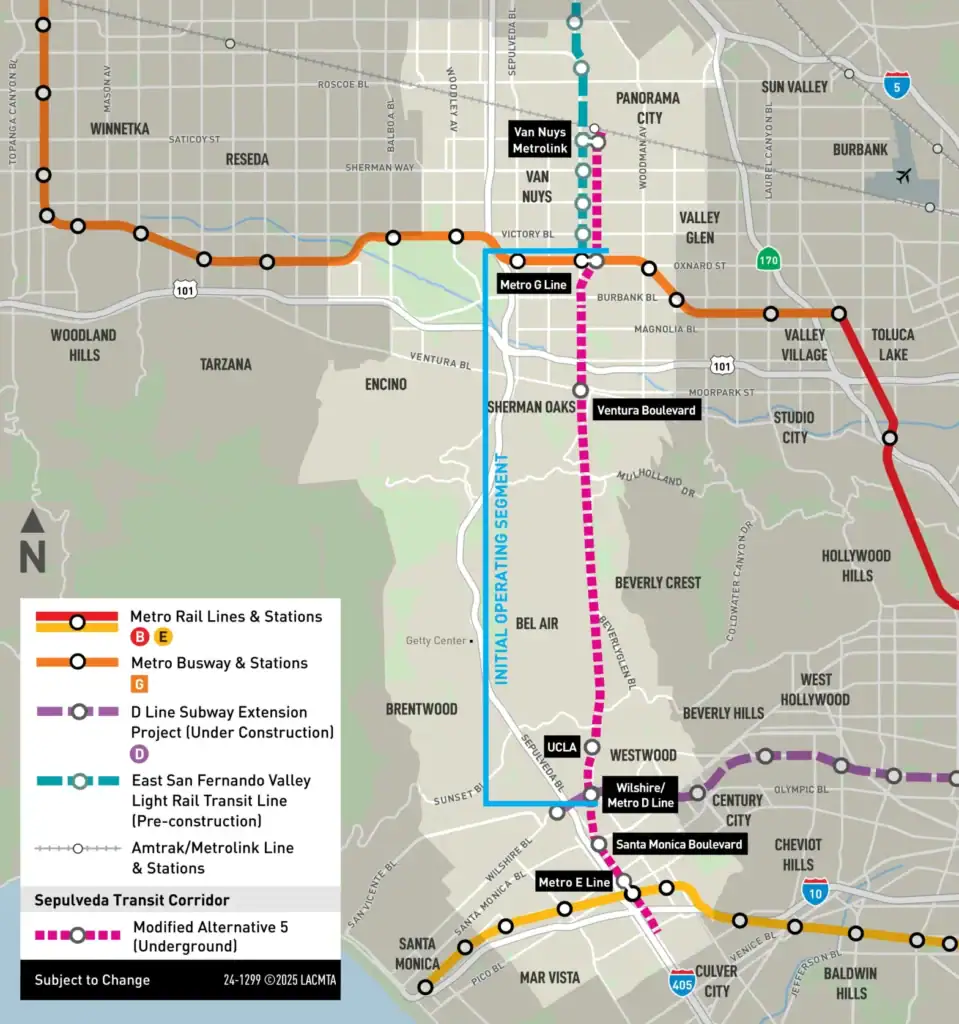
The approved alternative calls for a fully underground heavy rail subway connecting the San Fernando Valley to the Westside, running from the Van Nuys Metrolink Station to the Metro E Line’s Expo/Sepulveda Station. The line would pass beneath the Sepulveda Pass, UCLA, and other high-demand travel areas.
Metro officials emphasized that the underground alignment offers the fastest travel times, highest passenger capacity, and the fewest surface-level impacts when compared with earlier aerial or monorail alternatives. The project is expected to significantly reduce congestion along the 405 Freeway corridor and improve regional connectivity.
With the LPA now selected, the Sepulveda Transit Corridor advances toward final environmental clearance, engineering, and eventual construction — a process that will continue over the coming years.
Metro C Line Extension: South Bay Alignment Debate Continues
The Board also discussed the Metro C Line extension into the South Bay, a project intended to extend light rail service approximately 4.5 miles from the current Redondo Beach station to the Torrance Transit Center.
Metro has released the project’s Final Environmental Impact Report (FEIR), which incorporates years of technical analysis and public input. However, unlike the Sepulveda project, the Board did not take final action to certify the FEIR or formally adopt a locally preferred alignment at this meeting.
Hawthorne Boulevard vs. Metro Right-of-Way
At the center of the C Line discussion is the question of alignment.
Metro staff has identified a “hybrid” alignment using an existing Metro-owned rail right-of-way as the preferred option. This route would largely follow the historic Harbor Subdivision corridor, minimizing new street disruptions while blending at-grade, elevated, and below-grade segments.
Some South Bay cities, however, continue to advocate for a Hawthorne Boulevard alignment, which would place rail tracks within the median of the busy commercial corridor. Supporters argue it offers better street-level access, while Metro has cited higher costs, longer construction timelines, and greater traffic impacts as key concerns.
Metro officials indicated that additional coordination with local jurisdictions and further Board action will be needed before a final decision is made.
What This Means for LA Transit
The contrast between the two projects was clear at the meeting: the Sepulveda Transit Corridor is now firmly on a defined path forward, while the C Line extension remains in a critical decision-making phase.
Together, the projects highlight both the ambition and complexity of expanding transit in Los Angeles County — balancing regional mobility goals, neighborhood impacts, and long-term funding realities.
Further Reading & Official Project Information
Metro Sepulveda Transit Corridor Project Page
– Official Metro overview of the Sepulveda Pass project, including alternatives, maps, timelines, and environmental documents.
Metro Board Considers Locally Preferred Alternative for Sepulveda Corridor
– Metro’s summary of the Board action and rationale behind selecting the underground heavy rail option.
Metro C Line Extension to Torrance Project Page
– Background, station concepts, and status updates for the South Bay light rail extension.
Final Environmental Impact Report: C Line Extension
– Details on the Final EIR, public comments, and next steps toward Board certification.
Metro Project Updates – The Source
– Ongoing Metro blog updates covering major transit projects, board actions, and construction milestones.
LA Metro Board of Directors
– Information on Metro Board members, meeting schedules, agendas, and voting records.
STM Daily News will continue to follow both projects closely, providing updates as Metro moves toward final approvals, construction timelines, and funding decisions that will shape how Angelenos travel for decades to come.
For ongoing coverage of Metro projects, transportation policy, and infrastructure across Southern California, visit STM Daily News.
Discover more from Daily News
Subscribe to get the latest posts sent to your email.
Forgotten Genius Fridays
Valerie Thomas: NASA Engineer, Inventor, and STEM Trailblazer
Last Updated on February 10, 2026 by Daily News Staff![]()
Valerie Thomas is a true pioneer in the world of science and technology. A NASA engineer and physicist, she is best known for inventing the illusion transmitter, a groundbreaking device that creates 3D images using concave mirrors. This invention laid the foundation for modern 3D imaging and virtual reality technologies.
Beyond her inventions, Thomas broke barriers as an African American woman in STEM, mentoring countless young scientists and advocating for diversity in science and engineering. Her work at NASA’s Goddard Space Flight Center helped advance satellite technology and data visualization, making her contributions both innovative and enduring.
In our latest short video, we highlight Valerie Thomas’ remarkable journey—from her early passion for science to her groundbreaking work at NASA. Watch and be inspired by a true STEM pioneer whose legacy continues to shape the future of space and technology.
🎥 Watch the video here: https://youtu.be/P5XTgpcAoHw
Dive into “The Knowledge,” where curiosity meets clarity. This playlist, in collaboration with STMDailyNews.com, is designed for viewers who value historical accuracy and insightful learning. Our short videos, ranging from 30 seconds to a minute and a half, make complex subjects easy to grasp in no time. Covering everything from historical events to contemporary processes and entertainment, “The Knowledge” bridges the past with the present. In a world where information is abundant yet often misused, our series aims to guide you through the noise, preserving vital knowledge and truths that shape our lives today. Perfect for curious minds eager to discover the ‘why’ and ‘how’ of everything around us. Subscribe and join in as we explore the facts that matter. https://stmdailynews.com/the-knowledge/
Forgotten Genius Fridays
https://stmdailynews.com/the-knowledge-2/forgotten-genius-fridays/
🧠 Forgotten Genius Fridays
A Short-Form Series from The Knowledge by STM Daily News
Every Friday, STM Daily News shines a light on brilliant minds history overlooked.
Forgotten Genius Fridays is a weekly collection of short videos and articles dedicated to inventors, innovators, scientists, and creators whose impact changed the world—but whose names were often left out of the textbooks.
From life-saving inventions and cultural breakthroughs to game-changing ideas buried by bias, our series digs up the truth behind the minds that mattered.
Each episode of The Knowledge runs 30–90 seconds, designed for curious minds on the go—perfect for YouTube Shorts, TikTok, Reels, and quick reads.
Because remembering these stories isn’t just about the past—it’s about restoring credit where it’s long overdue.
🔔 New episodes every Friday
📺 Watch now at: stmdailynews.com/the-knowledge
🧠 Now you know.
Discover more from Daily News
Subscribe to get the latest posts sent to your email.
The Knowledge
🚦 Who Really Invented the Modern Traffic Light?
The modern traffic light, largely attributed to Garrett Morgan’s 1923 invention, introduced a critical yellow warning light that improved public safety. Despite his significant impact on traffic systems, Morgan’s contributions have often been overlooked due to historical racism.

When you think about the traffic light, you probably picture green for go, red for stop, and maybe a frustrated glance at the yellow. But have you ever stopped to ask: Who actually invented this system we take for granted every day?
The story of the modern traffic light isn’t just about technology—it’s about innovation, public safety, and a Black inventor named Garrett Morgan who changed the way we move through the world.
🔦 Early Traffic Signals: A Dangerous Beginning
Before cars dominated streets, early attempts at traffic control involved manual policing and hand signals. In 1868, the first gas-powered traffic signal was installed in London outside the British Houses of Parliament. Designed by J.P. Knight, a railway engineer, this early signal exploded after just a month due to a gas leak—killing a police officer and abandoning the idea for years.
As cars became more common in the early 20th century, so did traffic jams—and accidents. Cities needed a safer, more efficient solution.
🛠️ Enter Garrett Morgan
In 1923, Garrett Morgan, an African-American inventor and entrepreneur from Cleveland, Ohio, received U.S. Patent No. 1,475,024 for a traffic control device that added a crucial feature: a “warning position” between stop and go. This idea is the basis for today’s yellow light.
His signal was:
- Manually operated
- T-shaped
- Designed to be mounted on a post
- And included a buffer phase to clear intersections before switching direction
This innovation was not only about traffic flow—it was about safety and preventing collisions at a time when automobile fatalities were rapidly increasing.
Morgan sold the rights to his invention to General Electric for $40,000 (equivalent to over $700,000 today), though his contributions were overlooked for decades.
👉 View the full patent on Google Patents
⚙️ Was Morgan the
Only
Inventor?
No. Traffic signal history has multiple contributors:
- Lester Wire, a Salt Lake City policeman, created an electric traffic light prototype in 1912.
- William Ghiglieri patented an automatic signal in 1917.
- Garrett Morgan’s version stood out for its practical innovation—the transitional phase—and for being one of the first widely adopted and commercially viable versions.
In other words, Morgan helped move the traffic light from an experimental device to a nationwide safety standard.
🎥 Watch the Story in 60 Seconds
We break this story down in our latest Forgotten Genius Fridays episode from The Knowledge series on STM Daily News.
📺 Watch “Who Really Invented the Modern Traffic Light?” here: https://youtu.be/cS-emlzhjjk
✊ Why Garrett Morgan Deserves More Recognition
Garrett Morgan’s impact goes far beyond traffic lights. He also invented a gas mask used by firefighters and soldiers, and he launched one of the first Black-owned newspapers in the U.S.
He was a true innovator, working in an era where his contributions were often ignored due to racism. Today, we honor his legacy by telling his story and recognizing how his vision saved countless lives.
🧠 Now you know.
— STM Daily News
Dive into “The Knowledge,” where curiosity meets clarity. This playlist, in collaboration with STMDailyNews.com, is designed for viewers who value historical accuracy and insightful learning. Our short videos, ranging from 30 seconds to a minute and a half, make complex subjects easy to grasp in no time. Covering everything from historical events to contemporary processes and entertainment, “The Knowledge” bridges the past with the present. In a world where information is abundant yet often misused, our series aims to guide you through the noise, preserving vital knowledge and truths that shape our lives today. Perfect for curious minds eager to discover the ‘why’ and ‘how’ of everything around us. Subscribe and join in as we explore the facts that matter. https://stmdailynews.com/the-knowledge/
Discover more from Daily News
Subscribe to get the latest posts sent to your email.
The Knowledge
Beneath the Waves: The Global Push to Build Undersea Railways
Undersea railways are transforming transportation, turning oceans from barriers into gateways. Proven by tunnels like the Channel and Seikan, these innovations offer cleaner, reliable connections for passengers and freight. Ongoing projects in China and Europe, alongside future proposals, signal a new era of global mobility beneath the waves.

For most of modern history, oceans have acted as natural barriers—dividing nations, slowing trade, and shaping how cities grow. But beneath the waves, a quiet transportation revolution is underway. Infrastructure once limited by geography is now being reimagined through undersea railways.
Undersea rail tunnels—like the Channel Tunnel and Japan’s Seikan Tunnel—proved decades ago that trains could reliably travel beneath the ocean floor. Today, new projects are expanding that vision even further.
Around the world, engineers and governments are investing in undersea railways—tunnels that allow high-speed trains to travel beneath oceans and seas. Once considered science fiction, these projects are now operational, under construction, or actively being planned.

Undersea Rail Is Already a Reality
Japan’s Seikan Tunnel and the Channel Tunnel between the United Kingdom and France proved decades ago that undersea railways are not only possible, but reliable. These tunnels carry passengers and freight beneath the sea every day, reshaping regional connectivity.
Undersea railways are cleaner than short-haul flights, more resilient than bridges, and capable of lasting more than a century. As climate pressures and congestion increase, rail beneath the sea is emerging as a practical solution for future mobility.
What’s Being Built Right Now
China is currently constructing the Jintang Undersea Railway Tunnel as part of the Ningbo–Zhoushan high-speed rail line, while Europe’s Fehmarnbelt Fixed Link will soon connect Denmark and Germany beneath the Baltic Sea. These projects highlight how transportation and technology are converging to solve modern mobility challenges.
The Mega-Projects Still on the Drawing Board
Looking ahead, proposals such as the Helsinki–Tallinn Tunnel and the long-studied Strait of Gibraltar rail tunnel could reshape global affairs by linking regions—and even continents—once separated by water.
Why Undersea Rail Matters
The future of transportation may not rise above the ocean—but run quietly beneath it.
Discover more from Daily News
Subscribe to get the latest posts sent to your email.


