

Space and Tech
NASA Confirms DART Mission Impact Changed Asteroid’s Motion in Space
Analysis of data obtained over the past two weeks by NASA’s Double Asteroid Redirection Test (DART) investigation team shows the spacecraft’s kinetic impact with its target asteroid, Dimorphos, successfully altered the asteroid’s orbit.

Last Updated on May 21, 2024 by Daily News Staff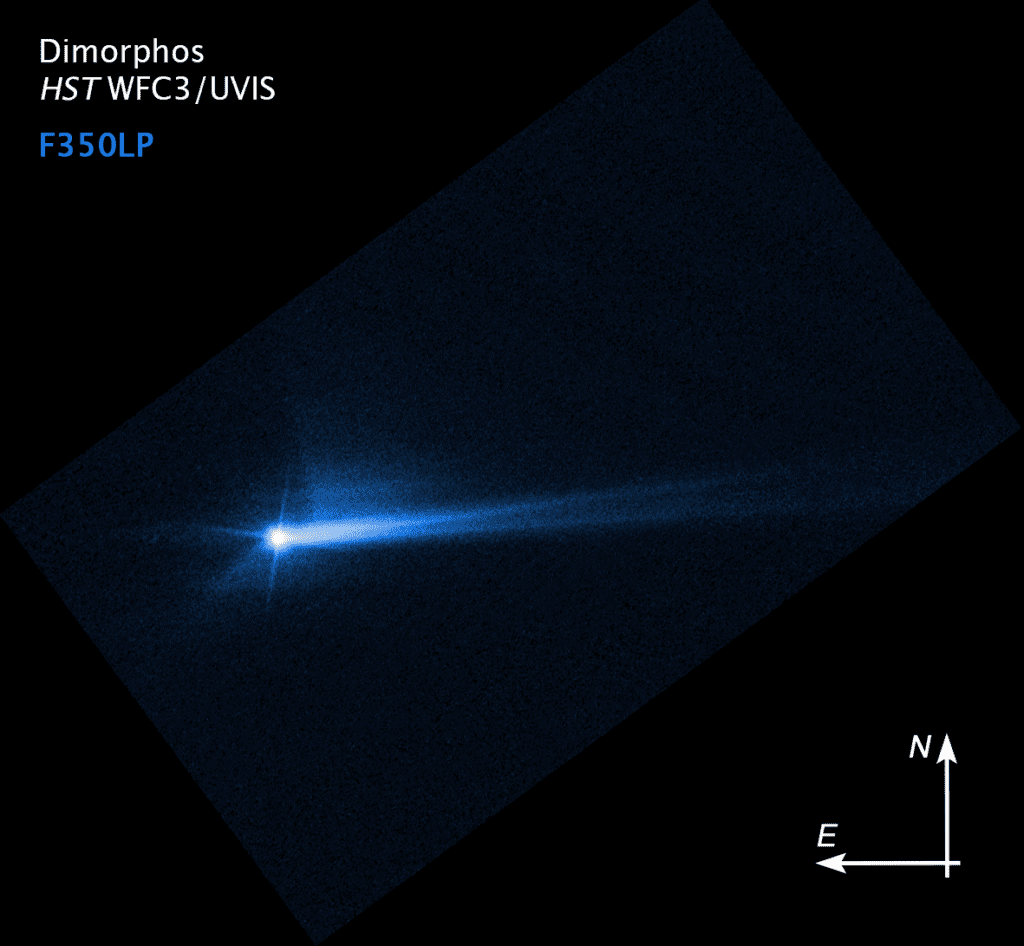
Credits: NASA/ESA/STScI/Hubble
Analysis of data obtained over the past two weeks by NASA’s Double Asteroid Redirection Test (DART) investigation team shows the spacecraft’s kinetic impact with its target asteroid, Dimorphos, successfully altered the asteroid’s orbit. This marks humanity’s first time purposely changing the motion of a celestial object and the first full-scale demonstration of asteroid deflection technology.
“All of us have a responsibility to protect our home planet. After all, it’s the only one we have,” said NASA Administrator Bill Nelson. “This mission shows that NASA is trying to be ready for whatever the universe throws at us. NASA has proven we are serious as a defender of the planet. This is a watershed moment for planetary defense and all of humanity, demonstrating commitment from NASA’s exceptional team and partners from around the world.”
Prior to DART’s impact, it took Dimorphos 11 hours and 55 minutes to orbit its larger parent asteroid, Didymos. Since DART’s intentional collision with Dimorphos on Sept. 26, astronomers have been using telescopes on Earth to measure how much that time has changed. Now, the investigation team has confirmed the spacecraft’s impact altered Dimorphos’ orbit around Didymos by 32 minutes, shortening the 11 hour and 55-minute orbit to 11 hours and 23 minutes. This measurement has a margin of uncertainty of approximately plus or minus 2 minutes.
Before its encounter, NASA had defined a minimum successful orbit period change of Dimorphos as change of 73 seconds or more. This early data show DART surpassed this minimum benchmark by more than 25 times.
“This result is one important step toward understanding the full effect of DART’s impact with its target asteroid” said Lori Glaze, director of NASA’s Planetary Science Division at NASA Headquarters in Washington. “As new data come in each day, astronomers will be able to better assess whether, and how, a mission like DART could be used in the future to help protect Earth from a collision with an asteroid if we ever discover one headed our way.”
The investigation team is still acquiring data with ground-based observatories around the world – as well as with radar facilities at NASA Jet Propulsion Laboratory’s Goldstone planetary radar in California and the National Science Foundation’s Green Bank Observatory in West Virginia. They are updating the period measurement with frequent observations to improve its precision.
Focus now is shifting toward measuring the efficiency of momentum transfer from DART’s roughly 14,000-mile (22,530-kilometer) per hour collision with its target. This includes further analysis of the “ejecta” – the many tons of asteroidal rock displaced and launched into space by the impact. The recoil from this blast of debris substantially enhanced DART’s push against Dimorphos – a little like a jet of air streaming out of a balloon sends the balloon in the opposite direction.
To successfully understand the effect of the recoil from the ejecta, more information on of the asteroid’s physical properties, such as the characteristics of its surface, and how strong or weak it is, is needed. These issues are still being investigated.
“DART has given us some fascinating data about both asteroid properties and the effectiveness of a kinetic impactor as a planetary defense technology,” said Nancy Chabot, the DART coordination lead from the Johns Hopkins Applied Physics Laboratory (APL) in Laurel, Maryland. “The DART team is continuing to work on this rich dataset to fully understand this first planetary defense test of asteroid deflection.”
For this analysis, astronomers will continue to study imagery of Dimorphos from DART’s terminal approach and from the Light Italian CubeSat for Imaging of Asteroids (LICIACube), provided by the Italian Space Agency, to approximate the asteroid’s mass and shape. Roughly four years from now, the European Space Agency’s Hera project is also planned to conduct detailed surveys of both Dimorphos and Didymos, with a particular focus on the crater left by DART’s collision and a precise measurement of Dimorphos’ mass.
Johns Hopkins APL built and operated the DART spacecraft and manages the DART mission for NASA’s Planetary Defense Coordination Office as a project of the agency’s Planetary Missions Program Office. Telescopic facilities contributing to the observations used by the DART team to determine this result include: Goldstone, Green Bank Observatory, Swope Telescope at the Las Campanas Observatory in Chile, the Danish Telescope at the La Silla Observatory in Chile, and the Las Cumbres Observatory global telescope network facilities in Chile and in South Africa.
Neither Dimorphos nor Didymos poses any hazard to Earth before or after DART’s controlled collision with Dimorphos.
For more information about the DART mission, visit:
https://stmdailynews.com/category/science
Author





Last Updated on February 10, 2026 by Daily News Staff
Valerie Thomas is a true pioneer in the world of science and technology. A NASA engineer and physicist, she is best known for inventing the illusion transmitter, a groundbreaking device that creates 3D images using concave mirrors. This invention laid the foundation for modern 3D imaging and virtual reality technologies.
Beyond her inventions, Thomas broke barriers as an African American woman in STEM, mentoring countless young scientists and advocating for diversity in science and engineering. Her work at NASA’s Goddard Space Flight Center helped advance satellite technology and data visualization, making her contributions both innovative and enduring.
In our latest short video, we highlight Valerie Thomas’ remarkable journey—from her early passion for science to her groundbreaking work at NASA. Watch and be inspired by a true STEM pioneer whose legacy continues to shape the future of space and technology.
🎥 Watch the video here: https://youtu.be/P5XTgpcAoHw
Dive into “The Knowledge,” where curiosity meets clarity. This playlist, in collaboration with STMDailyNews.com, is designed for viewers who value historical accuracy and insightful learning. Our short videos, ranging from 30 seconds to a minute and a half, make complex subjects easy to grasp in no time. Covering everything from historical events to contemporary processes and entertainment, “The Knowledge” bridges the past with the present. In a world where information is abundant yet often misused, our series aims to guide you through the noise, preserving vital knowledge and truths that shape our lives today. Perfect for curious minds eager to discover the ‘why’ and ‘how’ of everything around us. Subscribe and join in as we explore the facts that matter. https://stmdailynews.com/the-knowledge/
Forgotten Genius Fridays
https://stmdailynews.com/the-knowledge-2/forgotten-genius-fridays/
🧠 Forgotten Genius Fridays
A Short-Form Series from The Knowledge by STM Daily News
Every Friday, STM Daily News shines a light on brilliant minds history overlooked.
Forgotten Genius Fridays is a weekly collection of short videos and articles dedicated to inventors, innovators, scientists, and creators whose impact changed the world—but whose names were often left out of the textbooks.
From life-saving inventions and cultural breakthroughs to game-changing ideas buried by bias, our series digs up the truth behind the minds that mattered.
Each episode of The Knowledge runs 30–90 seconds, designed for curious minds on the go—perfect for YouTube Shorts, TikTok, Reels, and quick reads.
Because remembering these stories isn’t just about the past—it’s about restoring credit where it’s long overdue.
🔔 New episodes every Friday
📺 Watch now at: stmdailynews.com/the-knowledge
🧠 Now you know.
Author

The Knowledge
Beneath the Waves: The Global Push to Build Undersea Railways
Undersea railways are transforming transportation, turning oceans from barriers into gateways. Proven by tunnels like the Channel and Seikan, these innovations offer cleaner, reliable connections for passengers and freight. Ongoing projects in China and Europe, alongside future proposals, signal a new era of global mobility beneath the waves.


For most of modern history, oceans have acted as natural barriers—dividing nations, slowing trade, and shaping how cities grow. But beneath the waves, a quiet transportation revolution is underway. Infrastructure once limited by geography is now being reimagined through undersea railways.
Undersea rail tunnels—like the Channel Tunnel and Japan’s Seikan Tunnel—proved decades ago that trains could reliably travel beneath the ocean floor. Today, new projects are expanding that vision even further.
Around the world, engineers and governments are investing in undersea railways—tunnels that allow high-speed trains to travel beneath oceans and seas. Once considered science fiction, these projects are now operational, under construction, or actively being planned.

Undersea Rail Is Already a Reality
Japan’s Seikan Tunnel and the Channel Tunnel between the United Kingdom and France proved decades ago that undersea railways are not only possible, but reliable. These tunnels carry passengers and freight beneath the sea every day, reshaping regional connectivity.
Undersea railways are cleaner than short-haul flights, more resilient than bridges, and capable of lasting more than a century. As climate pressures and congestion increase, rail beneath the sea is emerging as a practical solution for future mobility.
What’s Being Built Right Now
China is currently constructing the Jintang Undersea Railway Tunnel as part of the Ningbo–Zhoushan high-speed rail line, while Europe’s Fehmarnbelt Fixed Link will soon connect Denmark and Germany beneath the Baltic Sea. These projects highlight how transportation and technology are converging to solve modern mobility challenges.
The Mega-Projects Still on the Drawing Board
Looking ahead, proposals such as the Helsinki–Tallinn Tunnel and the long-studied Strait of Gibraltar rail tunnel could reshape global affairs by linking regions—and even continents—once separated by water.
Why Undersea Rail Matters
The future of transportation may not rise above the ocean—but run quietly beneath it.
Space and Tech
Blue Origin Launches First Human Spaceflight of 2026 with New Shepard NS-38
Blue Origin successfully completed its first human spaceflight of 2026 with New Shepard NS-38, carrying six private astronauts and marking 98 humans flown to space.


Blue Origin has officially kicked off its 2026 flight calendar, successfully completing the 38th mission of its New Shepard program and further solidifying its role in commercial human spaceflight.
The suborbital flight, known as NS-38, carried six private astronauts beyond the Kármán line, offering several minutes of weightlessness and sweeping views of Earth before a safe return to West Texas. The mission marks the first New Shepard launch of 2026 and another milestone for Blue Origin’s reusable spaceflight system. https://stories-this-moment.castos.com/episodes/blue-origin-starts-2026-with-new-shepard-ns-38-spaceflight
The NS-38 Crew
The six-person crew aboard NS-38 included:
- Tim Drexler
- Dr. Linda Edwards
- Alain Fernandez
- Alberto Gutiérrez
- Jim Hendren
- Dr. Laura Stiles
With this flight, New Shepard has now flown 98 humans into space, representing 92 individual passengers. The growing total reflects Blue Origin’s emphasis on routine, repeatable access to space—once considered experimental, now becoming operational.
A Reliable Start to 2026
Blue Origin leadership emphasized reliability and customer trust as central priorities moving into the new year.
“As we enter 2026, we’re focused on continuing to deliver transformational experiences for our customers through the proven capability and reliability of New Shepard,” said Phil Joyce, Senior Vice President of New Shepard. “We are grateful for our astronaut customers who put their trust in our team to bring this experience into reality.”
The fully reusable New Shepard rocket and capsule system has demonstrated strong safety performance, autonomous operations, and consistent recovery—key elements in scaling human spaceflight.
Building Toward a Larger Vision
Beyond space tourism, New Shepard plays a foundational role in Blue Origin’s long-term goal of enabling millions of people to live and work in space for the benefit of Earth.
As the company’s first operational human spaceflight system, New Shepard supports:
- Reusable launch vehicle testing
- Human-rated safety system validation
- Increased launch cadence and manufacturing expertise
- Future Blue Origin programs and missions
Each successful flight expands operational confidence while helping normalize commercial access to space.
What’s Next for Aspiring Astronauts
Blue Origin continues to accept interest from future New Shepard passengers, with additional flights expected throughout 2026. The company also released commemorative merchandise from the NS-38 mission, now available through the Blue Origin Shop.
As commercial spaceflight matures, missions like NS-38 highlight the industry’s shift from novelty to normalcy—bringing space closer to scientists, explorers, and private citizens alike.
Related Articles & Information
- Blue Origin – New Shepard Program Overview
Official overview of Blue Origin’s reusable suborbital rocket and human spaceflight system. - Blue Origin – Human Spaceflight Missions
Details on past and upcoming crewed New Shepard missions. - NASA: Humans in Space
NASA’s overview of human spaceflight history and current programs. - Commercial Spaceflight: How Private Companies Are Changing Access to Space
STM Daily News coverage of the growing space tourism and commercial launch industry. - Reusable Rockets Explained: Why They Matter
An explainer on reusable rocket technology and its impact on space exploration.
For more updates, insights, and in-depth coverage of space exploration and commercial spaceflight, visit the STM Daily News blog at stmdailynews.com. From mission breakdowns to industry trends and technology explainers, STM Daily News keeps you informed about humanity’s journey beyond Earth.





