

News
How AI can improve storm surge forecasts to help save lives
storm surge forecasts: Hurricanes cause significant damage due to storm surge, which is influenced by wind and pressure. AI can enhance storm surge predictions, providing faster, more accurate information to aid evacuations and preparedness for coastal communities at risk.


Navid Tahvildari, Florida International University
Hurricanes are America’s most destructive natural hazards, causing more deaths and property damage than any other type of disaster. Since 1980, these powerful tropical storms have done more than US$1.5 trillion in damage and killed more than 7,000 people.
The No. 1 cause of the damages and deaths from hurricanes is storm surge.
Storm surge is the rise in the ocean’s water level, caused by a combination of powerful winds pushing water toward the coastline and reduced air pressure within the hurricane compared to the pressure outside of it. In addition to these factors, waves breaking close to the coast causes sea level to increase near the coastline, a phenomenon we call wave setup, which can be an important component of storm surge.
Accurate storm surge predictions are critical for giving coastal residents time to evacuate and giving emergency responders time to prepare. But storm surge forecasts at high resolution can be slow.
As a coastal engineer, I study how storm surge and waves interact with natural and human-made features on the ocean floor and coast and ways to mitigate their impact. I have used physics-based models for coastal flooding and have recently been exploring ways that artificial intelligence can improve the speed of storm surge forecasting.
How storm surge is forecast today
Today, operational storm surge forecasts rely on hydrodynamic models, which are based on the physics of water flow.
These models use current environmental conditions – such as how fast the storm is moving toward shore, its wind speed and direction, the timing of the tide, and the shape of the seafloor and the landscape – to compute the projected surge height and determine which locations are most at risk.
Hydrodynamic models have substantially improved in recent decades, and computers have become significantly more powerful, such that rapid low-resolution simulations are possible over very large areas. However, high-resolution simulation that provide neighborhood-level detail can take several hours to run.
Those hours can be critical for communities at risk to evacuate safely and for emergency responders to prepare adequately.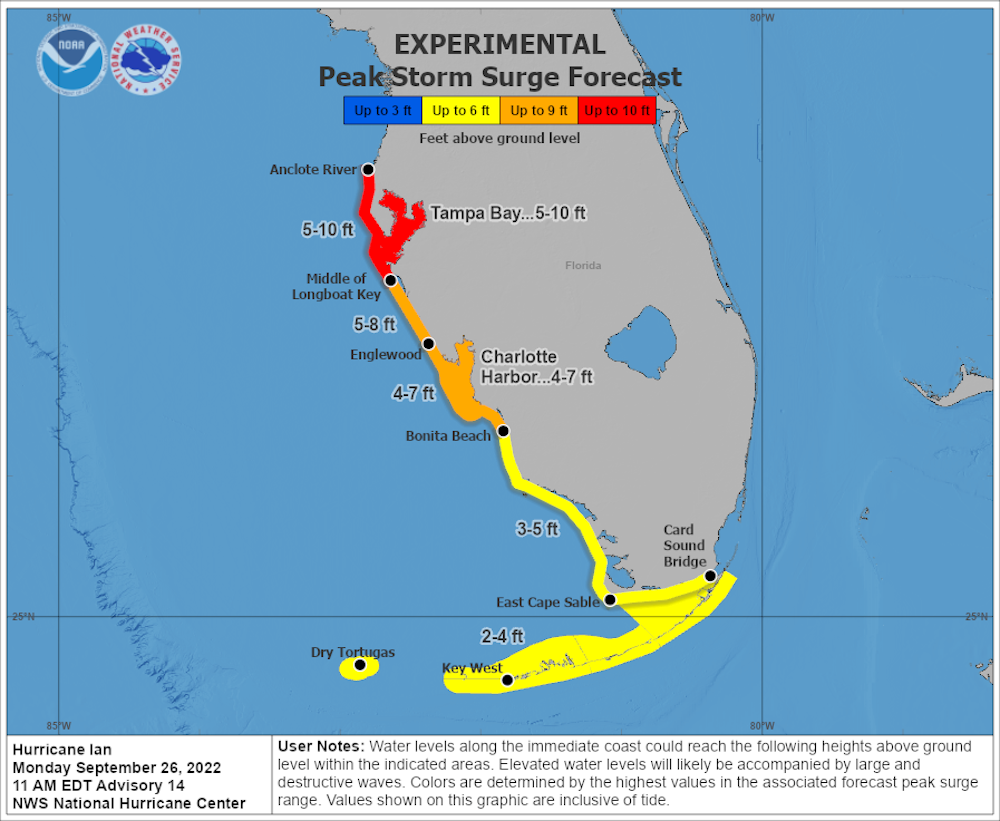
To forecast storm surge across a wide area, modelers break up the target area into many small pieces that together form a computational grid or mesh. Picture pixels in an image. The smaller the grid pieces, or cells, the higher the resolution and the more accurate the forecast. However, creating many small cells across a large area requires greater computing power, so forecasting storm surge takes longer as a result.
Forecasters can use low-resolution computer grids to speed up the process, but that reduces accuracy, leaving communities with more uncertainty about their flood risk.
AI can help speed that up.
How AI can create better forecasts
There are two main sources of uncertainty in storm surge predictions.
One involves the data fed into the computer model. A hurricane’s storm track and wind field, which determine where it will make landfall and how intense the surge will be, are still hard to forecast accurately more than a few days in advance. Changes to the coast and sea floor, such as from channel dredging or loss of salt marshes, mangroves or sand dunes, can affect the resistance that storm surge will face.
The second uncertainty involves the resolution of the computational grid, over which the mathematical equations of the surge and wave motion are solved. The resolution determines how well the model sees changes in landscape elevation and land cover and accounts for them, and at how much granularity the physics of hurricane surge and waves is solved.

AI models can produce detailed predictions faster. For example, engineers and scientists have developed AI models based on deep neural networks that can predict water levels along the coastline quickly and accurately by using data about the wind field. In some cases, these models have been more accurate than traditional hydrodynamic models.
AI can also develop forecasts for areas with little historic data, or be used to understand extreme conditions that may not have occurred there before.
For these forecasts, physics-based models can be used to generate synthetic data to train the AI on scenarios that might be possible but haven’t actually happened. Once an AI model is trained on both the historic and synthetic data, it can quickly generate surge forecasts using details about the wind and atmospheric pressure.
Training the AI on data from hydrodynamic models can also improve its ability to quickly generate inundation risk maps showing which streets or houses are likely to flood in extreme events that may not have a historical precedent but could happen in the future.
The future of AI for hurricane forecasting
AI is already being used in operational storm surge forecasts in a limited way, mainly to augment the commonly used physics-based models.
In addition to improving those methods, my team and other researchers have been developing ways to use AI for storm surge prediction using observed data, assessing the damage after hurricanes and processing camera images to deduce flood intensity. That can fill a critical gap in the data needed for validating storm surge models at granular levels.
As artificial intelligence models rapidly spread through every aspect of our lives and more data becomes available for training them, the technology offers potential to improve hurricane and storm surge forecasting in the future, giving coastal communities faster and more detailed warnings about the risks on the way.
Navid Tahvildari, Associate Professor of Civil and Environmental Engineering, Florida International University
This article is republished from The Conversation under a Creative Commons license. Read the original article.
STM Daily News is a vibrant news blog dedicated to sharing the brighter side of human experiences. Emphasizing positive, uplifting stories, the site focuses on delivering inspiring, informative, and well-researched content. With a commitment to accurate, fair, and responsible journalism, STM Daily News aims to foster a community of readers passionate about positive change and engaged in meaningful conversations. Join the movement and explore stories that celebrate the positive impacts shaping our world.
Discover more from Daily News
Subscribe to get the latest posts sent to your email.


Last Updated on March 2, 2026 by Daily News Staff
Early risers in Arizona are in for a celestial show.
On Tuesday, March 3, 2026, a total lunar eclipse will be visible across much of North America — including Phoenixand the Valley. During this event, the Moon will pass completely into Earth’s shadow, turning a deep copper-red color often called a “Blood Moon.”
Here’s what you need to know.

🌍 What Is a Total Lunar Eclipse?
A total lunar eclipse happens when the Sun, Earth, and Moon align perfectly, with Earth positioned directly between the Sun and the Moon. As the Moon moves into Earth’s darkest shadow (the umbra), it doesn’t disappear — instead, it glows red.
That reddish color comes from sunlight filtering through Earth’s atmosphere — essentially, we’re seeing all the world’s sunrises and sunsets projected onto the Moon at once.
🕒 Phoenix Viewing Times (MST)
Arizona does not observe Daylight Saving Time in March, so these times are in Mountain Standard Time (MST).
- 1:44 a.m. – Penumbral eclipse begins (subtle dimming begins)
- 2:50 a.m. – Partial eclipse begins (Earth’s shadow becomes clearly visible)
- 4:04 a.m. – Totality begins 🌕
- 4:34 a.m. – Greatest eclipse
- 5:03 a.m. – Totality ends
- 6:18 a.m. – Partial eclipse ends
- 7:20 a.m. – Penumbral eclipse ends

The most dramatic portion — totality — lasts nearly one hour.
🌅 Where to Look in Phoenix
The eclipse happens in the pre-dawn hours, so the Moon will be low in the western sky as it sets.
For the best view:
- Find a location with a clear western horizon
- Avoid city light glare if possible
- Consider desert viewpoints, parks, or elevated areas around the Valley
Because the Moon will be setting as the Sun begins to rise, the backdrop of early morning twilight could make for stunning photography.
🔭 Do You Need Special Equipment?
No.
Unlike a solar eclipse, lunar eclipses are completely safe to view with the naked eye. However:
- Binoculars enhance color detail
- A small telescope reveals subtle shadow gradients
- A tripod and DSLR or smartphone with night mode can capture impressive images
🌎 Why This Eclipse Matters
This will be one of the most accessible celestial events of 2026 for Arizona residents. Total lunar eclipses don’t happen every year in the same location, and the timing — just before sunrise — adds dramatic visual contrast.
If skies are clear, Phoenix could have a spectacular view.
📌 Quick Viewing Reminder for Phoenix
Set your alarm for around 3:45 a.m.
Step outside by 4:00 a.m.
Look west
Watch the Moon turn red
No tickets. No crowds. Just the sky putting on a show.
For more science, space, and Arizona skywatching coverage, visit STM Daily News.
Related Coverage
- NASA: What Is a Lunar Eclipse?
- Time and Date: March 3, 2026 Total Lunar Eclipse Details
- Sky & Telescope: How to Watch the March 2026 Lunar Eclipse
- Space.com: Where and When to See the 2026 Blood Moon
- STM Daily News – Science & Space Coverage
Author

Discover more from Daily News
Subscribe to get the latest posts sent to your email.
The Knowledge
Brightline West Nears Final Environmental Clearance Milestone
Brightline West’s final environmental assessment is 99% complete, clearing a major hurdle for the high-speed rail line connecting Southern California and Las Vegas.

Last Updated on March 1, 2026 by Daily News Staff
The long-awaited high-speed rail connection between Southern California and Las Vegas just hit a major milestone.
According to recent reports, the final environmental assessment for Brightline West is now 99% complete — signaling that one of the most critical regulatory hurdles for the project is nearly finished.
For a project that has been discussed for over a decade, this is significant progress.
What “99% Complete” Really Means
Before major infrastructure projects like high-speed rail can move into full construction, they must go through extensive federal environmental review under the National Environmental Policy Act (NEPA).
For Brightline West, this includes:
- Environmental impact evaluations
- Wildlife and habitat assessments
- Air quality studies
- Noise and vibration analysis
- Cultural and tribal consultations
- Traffic and community impact reviews
Reaching 99% completion means the overwhelming majority of those studies, revisions, and agency approvals are essentially done. In practical terms, the project is nearly clear of its final federal environmental review requirements.
That’s a huge step toward full-scale construction.
The Route: Southern California to Las Vegas
Brightline West will run approximately 218 miles largely within the median of Interstate 15, connecting:
- Las Vegas
- Apple Valley
- Hesperia
- Rancho Cucamonga (with connections to Metrolink toward Los Angeles)
Trains are designed to reach speeds up to 200 mph, cutting travel time between Southern California and Las Vegas to roughly 2 hours.
Instead of battling I-15 weekend traffic, travelers could board a train in Rancho Cucamonga and arrive on the Las Vegas Strip in about the time it currently takes just to get through the Cajon Pass on a busy Friday.
Construction Status
The project officially broke ground in 2024, and early work has included:
- Geotechnical testing
- Land surveying
- Utility relocation
- Pre-construction corridor preparation
While heavy civil construction has not yet fully ramped up across the entire route, completing environmental clearance removes one of the last major barriers before large-scale building accelerates.
Timeline Update
The original goal was to open before the 2028 Los Angeles Olympics. That timeline has shifted.
Current projections place passenger service around late 2029, depending on construction pace and financing milestones.
Why This Milestone Matters
High-speed rail projects in the United States often stall due to environmental review delays, funding gaps, or regulatory challenges.
Getting to 99% completion on final environmental assessment means:
- Federal review is nearly wrapped
- Legal vulnerability is reduced
- Major construction can proceed with more certainty
- Investor confidence improves
For Southern California and Nevada, it represents real forward momentum.
The Bigger Picture
Brightline West is privately developed, separate from California’s state high-speed rail system. If completed as planned, it would become one of the first true high-speed rail lines operating in the western United States.
The I-15 corridor between Los Angeles and Las Vegas is one of the most heavily traveled leisure routes in the country. A successful rail alternative could significantly reshape travel patterns between the two regions.
Final Take
The headline may sound small — “99% complete” — but in infrastructure terms, it’s a major breakthrough.
With environmental review nearly finished, Brightline West is closer than ever to turning renderings into reality.
Now the question shifts from if the train gets built… to how fast construction can move from here.
Further Reading & Outside Coverage
- Brightline West Official Project Website
- Federal Railroad Administration (FRA)
- Las Vegas Review-Journal – Brightline West Coverage
- Los Angeles Times – Transportation & Infrastructure
- Progressive Railroading – Industry Updates
- Trains Magazine – Rail Industry News
- U.S. Department of Transportation
Dive into “The Knowledge,” where curiosity meets clarity. This playlist, in collaboration with STMDailyNews.com, is designed for viewers who value historical accuracy and insightful learning. Our short videos, ranging from 30 seconds to a minute and a half, make complex subjects easy to grasp in no time. Covering everything from historical events to contemporary processes and entertainment, “The Knowledge” bridges the past with the present. In a world where information is abundant yet often misused, our series aims to guide you through the noise, preserving vital knowledge and truths that shape our lives today. Perfect for curious minds eager to discover the ‘why’ and ‘how’ of everything around us. Subscribe and join in as we explore the facts that matter. https://stmdailynews.com/the-knowledge/
Author

Discover more from Daily News
Subscribe to get the latest posts sent to your email.
Last Updated on February 28, 2026 by Daily News Staff
For decades, the idea of aliens visiting Earth has lived in a cultural no-man’s-land: too fascinating to ignore, too stigmatized to study seriously, and too easy to dismiss with a joke. But that posture has shifted in a measurable way over the past several years.
Physicist Kevin Knuth (University at Albany, SUNY) argued in a 2018 essay for The Conversation that the question of whether some UFO reports could represent something truly unknown is worthy of serious scientific study — not because we have proof of extraterrestrials, but because a small portion of cases appear to resist easy explanation and involve trained observers, multiple sensors, or unusual performance claims.
Article: https://theconversation.com/are-we-alone-the-question-is-worthy-of-serious-scientific-study-98843
That argument gained new oxygen in late 2017, when The New York Times reported that the U.S. Department of Defense had funded a program known as the Advanced Aerospace Threat Identification Program (AATIP). The reporting described roughly $22 million spent to examine military reports of unusual aerial incidents. Former Pentagon official Luis Elizondo became a central public figure in the story, saying he left his role amid frustration over secrecy and limited support for deeper investigation.
Around the same time, the Pentagon confirmed and released several now-famous military videos showing encounters recorded on forward-looking infrared (FLIR) systems from Navy aircraft — clips that reignited public debate and pushed the topic out of late-night-TV territory and into mainstream news.
What we’ve learned since (2018–2026)
The biggest “update” since your original post isn’t a single smoking gun. It’s the fact that the U.S. government and scientific institutions have increasingly treated the issue as a data and airspace-safety problem—and, potentially, a national security one.
A few key developments:
- The language changed: “UFO” has increasingly been replaced by UAP (Unidentified Anomalous Phenomena), a term meant to reduce stigma and widen the scope beyond “flying saucers.”
- Regular reporting became normalized: The Office of the Director of National Intelligence (ODNI) has issued public-facing UAP reporting in recent years, and the Department of Defense has continued formal tracking through dedicated offices.
- NASA stepped in: NASA convened an independent UAP study team, releasing a final report in 2023 that emphasized something simple but important: if you want answers, you need better data, consistent reporting standards, and transparent methods. (NASA’s stance was not “aliens confirmed,” but “this is a legitimate area for structured inquiry.”)
The Carl Sagan test still applies
Carl Sagan’s line remains the guardrail here:
“Extraordinary claims require extraordinary evidence.”
In other words: eyewitness testimony alone — even sincere testimony — isn’t enough. A personal story, a viral clip, or even a dramatic encounter doesn’t automatically equal proof of extraterrestrial visitation. If the claim is “non-human intelligence is visiting Earth,” the evidence has to be strong enough to survive serious scrutiny: repeatable analysis, multi-sensor confirmation, chain-of-custody, and independent review.
So where does that leave us?
If you strip away the hype, the most reasonable position in 2026 looks something like this:
- Something is being observed in a small percentage of cases that isn’t immediately identifiable.
- That does not automatically mean “aliens.”
- But it does mean the topic is no longer intellectually off-limits the way it once was.
After leaving AATIP-related work, Elizondo became associated with To The Stars Academy of Arts & Science, a group founded by musician Tom DeLonge that aimed to blend public interest, aerospace ideas, and advocacy for further investigation. Whether you view that effort as serious research, public outreach, or a media-adjacent project, it reflects the broader reality: the conversation has moved from fringe forums into public institutions.
The next step shouldn’t be louder claims. It should be better instrumentation, better reporting, and better science—because if there’s a prosaic explanation, rigorous study will reveal it. And if there’s something genuinely novel in the data, that’s exactly what science is for.
More STM Daily News science coverage: https://stmdailynews.com/category/science/
Authors
Discover more from Daily News
Subscribe to get the latest posts sent to your email.





