

animation
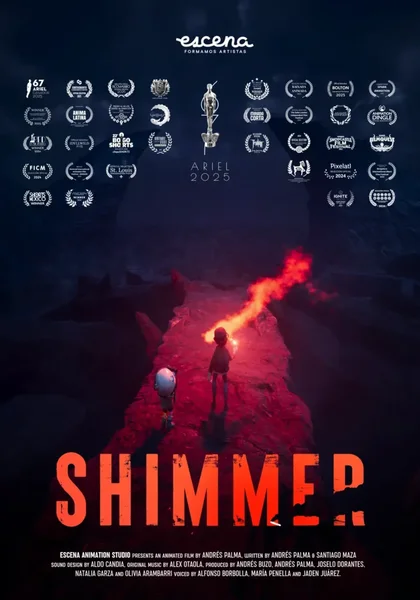
Ariel Award-Winning Animated Short ‘SHIMMER’ Makes Its Digital Debut on Short of the Week
Ariel Award-winning animated short SHIMMER by director Andrés Palma premieres on Short of the Week. A stunning exploration of fatherhood and regret created with Unreal Engine 5. Watch now.

Last Updated on December 9, 2025 by Daily News Staff

Ariel Award-Winning Animated Short ‘SHIMMER’ Makes Its Digital Debut on Short of the Week
A haunting tale of fatherhood, obsession, and redemption comes to life through groundbreaking animation technology
The world of independent animation just got a stunning new addition. Director Andrés Palma’s SHIMMER, an Ariel Award-winning animated short film, premiered December 8th on Short of the Week, the premier destination for curated short film content reaching millions of viewers worldwide.
A Father’s Dream, A Daughter’s Pain
Set against a desolate shoreline littered with the skeletal remains of forgotten shipwrecks, SHIMMER tells the emotionally charged story of Ricardo, a father whose single-minded obsession with building a towering lighthouse blinds him to the emotional wreckage he’s creating within his own family. As he chases what he believes will be salvation, his eldest daughter Lucía grows increasingly resentful—until her choices force Ricardo to face the devastating consequences of his dreams.
“Every project that matters to me comes from a place of unresolved emotion,” Palma explains. “Art is how I process pain and transform it into something meaningful. I trust the audience will resonate with that.”
This isn’t just animation—it’s personal healing rendered in light and shadow.
Link to related article: https://stmdailynews.com/gizmodo-premieres-award-winning-animated-short-shimmer/
Technical Brilliance Meets Emotional Depth
Short of the Week’s managing editor Rob Munday didn’t hold back in his praise: “A genuinely compelling, high-quality piece of 3D animation, marked by beautiful design work, strong character rigging, and impressive world-building. There’s tremendous potential here – it’s an exciting calling card for its creators.”
What sets SHIMMER apart technically is its innovative use of Unreal Engine 5, blending retro-futuristic aesthetics with cutting-edge visual design. The film’s most striking visual element—ethereal fish that shimmer across the night sky—was created using the Niagara particle system, merging procedural motion with hand-crafted animation cycles to achieve something that feels both organic and otherworldly.
A Collaborative Vision
Marking Palma’s directorial debut, SHIMMER benefits from powerhouse executive producers including celebrated Mexican animator Jorge R. Gutiérrez (The Book of Life, Maya and the Three) and Andrés Buzo. The film was developed through a groundbreaking collaboration between professionals and students at Mexico City’s Escena Animation Studio, the project-based learning arm of Escena Animation School.
The creative team includes associate producer Karla Vazquez, co-writer Santiago Maza Stern, and composer Alex Otaola—a collective effort that proves the power of mentorship and collaborative storytelling.

Why This Matters for Independent Animation
SHIMMER represents more than just another festival darling. It’s proof that independent creators with vision, backed by the right collaborators and technology, can produce work that rivals major studio productions. The film is currently being considered for FYC (For Your Consideration) in the Best Animated Short Film category—and based on its technical achievement and emotional resonance, it’s easy to see why.
For audiences hungry for animation that dares to explore complex emotional territory while pushing visual boundaries, SHIMMER delivers on both fronts. It’s a meditation on the cost of obsession, the weight of parental expectations, and the possibility of redemption—all wrapped in visuals that haunt long after the credits roll.
Watch Now
SHIMMER is now streaming exclusively on Short of the Week at ShortOfTheWeek.com/2025/12/08/shimmer
For more information about the film and its creators:
- Official Film Website: ShimmerShort.com
- Director’s Website: AndresPalma.com
- Follow the journey: @ShimmerShort, @Andres.Palma.c, @EscuelaEscena
For publicity inquiries, contact Patricia at info@ChicArt.world
PR coordination: Sophia at pr@chicart.world
Website: www.ChicArt.world
Discover more from Daily News
Subscribe to get the latest posts sent to your email.




News Brief
Gizmodo Premieres Award-Winning Animated Short Shimmer
Gizmodo premieres Shimmer, the award-winning animated short film by Andrés Palma. Winner of Mexico’s 2025 Ariel Award, the visually stunning story explores fatherhood, regret, and redemption through cutting-edge animation created in Unreal Engine 5.
Last Updated on November 10, 2025 by Daily News Staff

Los Angeles, CA – November 7, 2025 — Shimmer (also known as Fulgores), winner of Mexico’s 2025 Ariel Award for Best Animated Short Film, has launched its For Your Consideration campaign in the Oscar® race for Best Animated Short.
Directed by Andrés Palma and produced by Escena Animation Studio, the emotionally charged short explores themes of fatherhood, regret, and redemption through a visually stunning story set along a haunting, shipwrecked shore.
Now available for public viewing through an exclusive Gizmodo premiere, Shimmer blends handcrafted artistry with cutting-edge 3D animation created in Unreal Engine 5.
🎥 Watch now: Gizmodo Exclusive – Shimmer
Looking for an entertainment experience that transcends the ordinary? Look no further than STM Daily News Blog’s vibrant Entertainment section. Immerse yourself in the captivating world of indie films, streaming and podcasts, movie reviews, music, expos, venues, and theme and amusement parks. Discover hidden cinematic gems, binge-worthy series and addictive podcasts, gain insights into the latest releases with our movie reviews, explore the latest trends in music, dive into the vibrant atmosphere of expos, and embark on thrilling adventures in breathtaking venues and theme parks. Join us at STM Entertainment and let your entertainment journey begin! https://stmdailynews.com/category/entertainment/
and let your entertainment journey begin!
Dreambreaker: A Pickleball Story — A Closer Look at the Documentary and Its Uncredited Voice
Authors


Discover more from Daily News
Subscribe to get the latest posts sent to your email.
STM Blog
In Disney’s ‘Moana,’ the characters navigate using the stars, just like real Polynesian explorers − an astronomer explains how these methods work


If you have visited an island like one of the Hawaiian Islands, Tahiti or Easter Island, also known as Rapa Nui, you may have noticed how small these land masses appear against the vast Pacific Ocean. If you’re on Hawaii, the nearest island to you is more than 1,000 miles (1,600 kilometers) away, and the coast of the continental United States is more than 2,000 miles (3,200 kilometers) away. To say these islands are secluded is an understatement.
For me, watching the movie “Moana” in 2016 was eye-opening. I knew that Polynesian people traveled between a number of Pacific islands, but seeing Moana set sail on a canoe made me realize exactly how small those boats are compared with what must have seemed like an endless ocean. Yet our fictional hero went on this journey anyway, like the countless real-life Polynesian voyagers upon which she is based.
As an astronomer, I have been teaching college students and visitors to our planetarium how to find stars in our sky for more than 20 years. As part of teaching appreciation for the beauty of the sky and the stars, I want to help people understand that if you know the stars well, you can never get lost.
U.S. Navy veterans learned the stars in their navigation courses, and European cultures used the stars to navigate, but the techniques of Polynesian wayfinding shown in Moana brought these ideas to a very wide audience.
The movie Moana gave me a new hook – pun not intended – for my planetarium shows and lessons on how to locate objects in the night sky. With “Moana 2” out now, I am excited to see even more astronomy on the big screen and to figure out how I can build new lessons using the ideas in the movie.
The North Star
Have you ever found the North Star, Polaris, in your sky? I try to spot it every time I am out observing, and I teach visitors at my shows to use the “pointer stars” in the bowl of the Big Dipper to find it. These two stars in the Big Dipper point you directly to Polaris.
If you are facing Polaris, then you know you are facing north. Polaris is special because it is almost directly above Earth’s North Pole, and so everyone north of the equator can see it year-round in exactly the same spot in their sky.
It’s a key star for navigation because if you measure its height above your horizon, that tells you how far you are north of Earth’s equator. For the large number of people who live near 40 degrees north of the equator, you will see Polaris about 40 degrees above your horizon.
If you live in northern Canada, Polaris will appear higher in your sky, and if you live closer to the equator, Polaris will appear closer to the horizon. The other stars and constellations come and go with the seasons, though, so what you see opposite Polaris in the sky will change every month. https://www.youtube.com/embed/COHwfKusGbs?wmode=transparent&start=0 Look for the Big Dipper to find the North Star, Polaris.
You can use all of the stars to navigate, but to do that you need to know where to find them on every night of the year and at every hour of the night. So, navigating with stars other than Polaris is more complicated to learn.
Maui’s fishhook
At the end of June, around 11 p.m., a bright red star might catch your eye if you look directly opposite from Polaris. This is the star Antares, and it is the brightest star in the constellation Scorpius, the Scorpion.
If you are a “Moana” fan like me and the others in my family, though, you may know this group of stars by a different name – Maui’s fishhook.
If you are in the Northern Hemisphere, Scorpius may not fully appear above your horizon, but if you are on a Polynesian island, you should see all of the constellation rising in the southeast, hitting its highest point in the sky when it is due south, and setting in the southwest.
Astronomers and navigators can measure latitude using the height of the stars, which Maui and Moana did in the movie using their hands as measuring tools.
The easiest way to do this is to figure out how high Polaris is above your horizon. If you can’t see it at all, you must be south of the equator, but if you see Polaris 5 degrees (the width of three fingers at arm’s length) or 10 degrees above your horizon (the width of your full fist held at arm’s length), then you are 5 degrees or 10 degrees north of the equator.
The other stars, like those in Maui’s fishhook, will appear to rise, set and hit their highest point at different locations in the sky depending on where you are on the Earth.
Polynesian navigators memorized where these stars would appear in the sky from the different islands they sailed between, and so by looking for those stars in the sky at night, they could determine which direction to sail and for how long to travel across the ocean.
Today, most people just pull out their phones and use the built-in GPS as a guide. Ever since “Moana” was in theaters, I see a completely different reaction to my planetarium talks about using the stars for navigation. By accurately showing how Polynesian navigators used the stars to sail across the ocean, Moana helps even those of us who have never sailed at night to understand the methods of celestial navigation.
The first “Moana” movie came out when my son was 3 years old, and he took an instant liking to the songs, the story and the scenery. There are many jokes about parents who dread having to watch a child’s favorite over and over again, but in my case, I fell in love with the movie too.
Since then, I have wanted to thank the storytellers who made this movie for being so careful to show the astronomy of navigation correctly. I also appreciated that they showed how Polynesian voyagers used the stars and other clues, such as ocean currents, to sail across the huge Pacific Ocean and land safely on a very small island thousands of miles from their home.
Christopher Palma, Teaching Professor, Department of Astronomy & Astrophysics, Penn State
This article is republished from The Conversation under a Creative Commons license. Read the original article.
Looking for an entertainment experience that transcends the ordinary? Look no further than STM Daily News Blog’s vibrant Entertainment section. Immerse yourself in the captivating world of indie films, streaming and podcasts, movie reviews, music, expos, venues, and theme and amusement parks. Discover hidden cinematic gems, binge-worthy series and addictive podcasts, gain insights into the latest releases with our movie reviews, explore the latest trends in music, dive into the vibrant atmosphere of expos, and embark on thrilling adventures in breathtaking venues and theme parks. Join us at STM Entertainment and let your entertainment journey begin! https://stmdailynews.com/category/entertainment/
and let your entertainment journey begin!
Discover more from Daily News
Subscribe to get the latest posts sent to your email.


Stephen Lind, University of Southern California
It’s hard to imagine a holiday season without “A Charlie Brown Christmas.” The 1965 broadcast has become a staple – etched into traditions across generations like decorating the tree or sipping hot cocoa.
But this beloved TV special almost didn’t make it to air. CBS executives thought the 25-minute program was too slow, too serious and too different from the upbeat spectacles they imagined audiences wanted. A cartoon about a depressed kid seeking psychiatric advice? No laugh track? Humble, lo-fi animation? And was that a Bible verse? It seemed destined to fail – if not scrapped outright.
And yet, against all the odds, it became a classic. The program turned “Peanuts” from a popular comic strip into a multimedia empire – not because it was flashy or followed the rules, but because it was sincere.
As a business professor who has studied the “Peanuts” franchise, I see “A Charlie Brown Christmas” as a fascinating historical moment. It’s the true story of an unassuming comic strip character who crossed over into television and managed to voice hefty, thought-provoking ideas – without getting booted off the air.
Call from the blue
The “Peanuts” special came together out of a last-minute scramble. Somewhat out of the blue, producer Lee Mendelson got a call from advertising agency McCann-Erickson: Coca-Cola wanted to sponsor an animated Christmas special.
Mendelson had previously failed to convince the agency to sponsor a “Peanuts” documentary. This time, though, he assured McCann-Erickson that the characters would be a perfect fit.
Mendelson called up “Peanuts” comic strip creator Charles “Sparky” Schulz and told him he had just sold “A Charlie Brown Christmas” – and they would have mere months to write, animate and bring the special to air.
Schulz, Mendelson and animator Bill Melendez worked fast to piece together a storyline. The cartoonist wanted to tell a story that cut through the glitz of holiday commercialism and brought the focus back to something deeper.
While Snoopy tries to win a Christmas lights contest, and Lucy names herself “Christmas queen” in the neighborhood play, a forlorn Charlie Brown searches for “the real meaning of Christmas.” He makes his way to the local lot of aluminum trees, a fad at the time. But he’s drawn to the one real tree – a humble, scraggly little thing – inspired by Hans Christian Andersen’s fairy tale “The Fir Tree.”
Jazz – and the Bible
Those plot points would likely delight the network, but other choices Schulz made were proving controversial.
The show would use real children’s voices instead of adult actors’, giving the characters an authentic, simple charm. And Schulz refused to add a laugh track, a standard in animated TV at the time. He wanted the sincerity of the story to stand on its own, without artificial prompts for laughter.
Meanwhile, Mendelson brought in jazz musician Vince Guaraldi to compose a sophisticated soundtrack. The music was unlike anything typically heard in animated programming, blending provocative depth with the innocence of childhood. https://open.spotify.com/embed/album/2XnNY3GEkbWHor5kyvXLu4?utm_source=generator
Most alarming to the executives was Schulz’s insistence on including the heart of the Nativity story in arguably the special’s most pivotal scene.
When Charlie Brown joyfully returns to his friends with the spindly little tree, the rest of the “Peanuts” gang ridicule his choice. “I guess I really don’t know what Christmas is all about,” the utterly defeated Charlie Brown sighs.
Gently but confidently, Linus assures him, “I can tell you what Christmas is all about.” Calling for “Lights, please,” he quietly walks to the center of the stage.
In the stillness, Linus recites the Gospel of Luke, Chapter 2, with its story of an angel appearing to trembling shepherds:
And the angel said unto them, Fear not: for, behold, I bring you tidings of great joy, which shall be to all people.
For unto you is born this day in the city of David a savior, which is Christ the Lord.
https://www.youtube.com/embed/KXmGLJ0S1Bs?wmode=transparent&start=0 Leave it to Linus to deliver the ‘true meaning’ of Christmas.
“Glory to God in the highest, and on earth peace, good will toward men,” he concludes, picking up his security blanket and walking into the wings. The rest of the gang soon concludes Charlie Brown’s scrawny tree isn’t so bad, after all – it just “needs a little love.”
When Schulz discussed this idea with Mendelson and Melendez, they were hesitant. For much of U.S. history, Protestant Christianity was the default in American culture, but in the years since World War II, society had grown somewhat more mindful of making room for Catholic and Jewish Americans. Unsure how to handle the shifting norms, many mainstream entertainment companies in the 1960s tended to avoid religious topics.
“The Bible thing scares us,” CBS executives said when they saw the proofs of the special. But there was simply no time to redo the entire dramatic arc of the special, and pulling it was not an option, given that advertisements had already run.
Fun and philosophy
Fortunately for the “Peanuts” franchise, when the special aired on Dec. 9, 1965, it was an instant success. Nearly half of American households tuned in, and the program won both an Emmy and a Peabody Award. Schulz had tapped into something audiences were craving: an honest, heartfelt message that cut through the commercialism.
Millions of viewers have continued to tune in to the show’s annual rebroadcast for over 50 years on CBS and then ABC – and now Apple TV+.
When I was researching my spiritual biography of Schulz, “A Charlie Brown Religion,” one of my favorite finds was a 1965 letter from a Florida viewer, Betty Knorr. She praised the show for stressing “the true meaning of the Christmas season” at a time when “the mention of God in general (is) being hush hushed.”
The magic of Schulz’s work, though, is that it resonates across demographics and ideologies. Some fans find comfort in the show’s gentle message of faith, while others embrace it in a purely secular way.
Simple but poignant, Schulz’s art and gentle humor can do two things. They can act as safe entry points for some pretty hefty thoughts – be they psychiatric, cultural or theological. Or “Peanuts” cartoons can simply be heartwarming, festive entertainment, if that’s what you want.
Today, both the “Peanuts” empire and the Christmas industry are thriving. Back in the 1960s, commercial realities almost derailed Schulz’s special, yet those same forces ultimately ensured its broadcast. The result is a lasting touchstone of innocence, hope and belief.
Stephen Lind, Associate Professor of Clinical Business Communication, University of Southern California
This article is republished from The Conversation under a Creative Commons license. Read the original article.
Looking for an entertainment experience that transcends the ordinary? Look no further than STM Daily News Blog’s vibrant Entertainment section. Immerse yourself in the captivating world of indie films, streaming and podcasts, movie reviews, music, expos, venues, and theme and amusement parks. Discover hidden cinematic gems, binge-worthy series and addictive podcasts, gain insights into the latest releases with our movie reviews, explore the latest trends in music, dive into the vibrant atmosphere of expos, and embark on thrilling adventures in breathtaking venues and theme parks. Join us at STM Entertainment and let your entertainment journey begin! https://stmdailynews.com/category/entertainment/
and let your entertainment journey begin!
Author
Discover more from Daily News
Subscribe to get the latest posts sent to your email.





