

News
Mars rovers serve as scientists’ eyes and ears from millions of miles away – here are the tools Perseverance used to spot a potential sign of ancient life
Mars rovers: NASA’s Perseverance rover recently identified potential signs of past life on Mars at a site called Bright Angel through mineral analysis. Using five advanced instruments, scientists interpreted complex data, but uncertainty remains. Future sample analysis on Earth may confirm these intriguing findings amid looming budget cuts impacting Mars exploration.

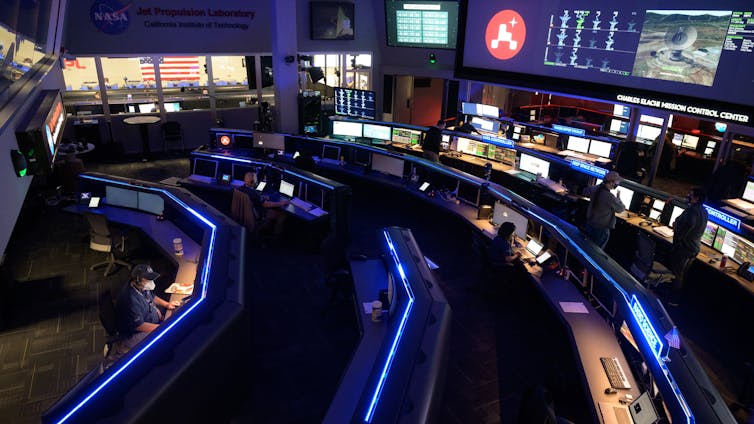
Mars rovers
Ari Koeppel, Dartmouth College
NASA’s search for evidence of past life on Mars just produced an exciting update. On Sept. 10, 2025, a team of scientists published a paper detailing the Perseverance rover’s investigation of a distinctive rock outcrop called Bright Angel on the edge of Mars’ Jezero Crater. This outcrop is notable for its light-toned rocks with striking mineral nodules and multicolored, leopard print-like splotches.
By combining data from five scientific instruments, the team determined that these nodules formed through processes that could have involved microorganisms. While this finding is not direct evidence of life, it’s a compelling discovery that planetary scientists hope to look into more closely.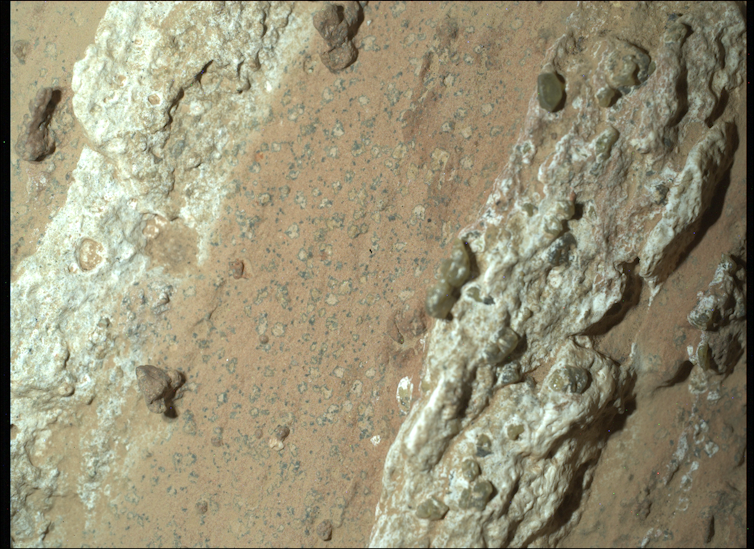
To appreciate how discoveries like this one come about, it’s helpful to understand how scientists engage with rover data — that is, how planetary scientists like me use robots like Perseverance on Mars as extensions of our own senses.
Experiencing Mars through data
When you strap on a virtual reality headset, you suddenly lose your orientation to the immediate surroundings, and your awareness is transported by light and sound to a fabricated environment. For Mars scientists working on rover mission teams, something very similar occurs when rovers send back their daily downlinks of data.
Several developers, including MarsVR, Planetary Visor and Access Mars, have actually worked to build virtual Mars environments for viewing with a virtual reality headset. However, much of Mars scientists’ daily work instead involves analyzing numerical data visualized in graphs and plots. These datasets, produced by state-of-the-art sensors on Mars rovers, extend far beyond human vision and hearing. https://www.youtube.com/embed/Wz3Nzo09qko?wmode=transparent&start=1 A virtual Mars environment developed by Planetary Visor incorporates both 3D landscape data and rover instrument data as pop-up plots. Scientists typically access data without entering a virtual reality space. However, tools like this give the public a sense for how mission scientists experience their work.
Developing an intuition for interpreting these complex datasets takes years, if not entire careers. It is through this “mind-data connection” that scientists build mental models of Martian landscapes – models they then communicate to the world through scientific publications.
The robots’ tool kit: Sensors and instruments
Five primary instruments on Perseverance, aided by machine learning algorithms, helped describe the unusual rock formations at a site called Beaver Falls and the past they record.
Robotic hands: Mounted on the rover’s robotic arm are tools for blowing dust aside and abrading rock surfaces. These ensure the rover analyzes clean samples.
Cameras: Perseverance hosts 19 cameras for navigation, self-inspection and science. Five science-focused cameras played a key role in this study. These cameras captured details unseeable by human eyes, including magnified mineral textures and light in infrared wavelengths. Their images revealed that Bright Angel is a mudstone, a type of sedimentary rock formed from fine sediments deposited in water.
Spectrometers: Instruments such as SuperCam and SHERLOC – scanning habitable environments with Raman and luminescence for organics and chemicals – analyze how rocks reflect or emit light across a range of wavelengths. Think of this as taking hundreds of flash photographs of the same tiny spot, all in different “colors.” These datasets, called spectra, revealed signs of water integrated into mineral structures in the rock and traces of organic molecules: the basic building blocks of life.
Subsurface radar: RIMFAX, the radar imager for Mars subsurface experiment, uses radio waves to peer beneath Mars’ surface and map rock layers. At Beaver Falls, this showed the rocks were layered over other ancient terrains, likely due to the activity of a flowing river. Areas with persistently present water are better habitats for microbes than dry or intermittently wet locations.
X-ray chemistry: PIXL, the planetary instrument for X-ray lithochemistry, bombards rock surfaces with X-rays and observes how the rock glows or reflects them. This technique can tell researchers which elements and minerals the rock contains at a fine scale. PIXL revealed that the leopard-like spots found at Beaver Falls differed chemically from the surrounding rock. The spots resembled patterns on Earth formed by chemical reactions that are mediated by microbes underwater.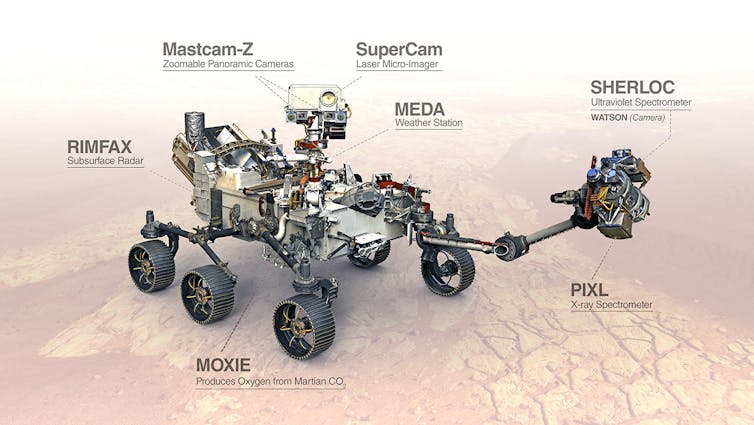
Together, these instruments produce a multifaceted picture of the Martian environment. Some datasets require significant processing, and refined machine learning algorithms help the mission teams turn that information into a more intuitive description of the Jezero Crater’s setting, past and present.
The challenge of uncertainty
Despite Perseverance’s remarkable tools and processing software, uncertainty remains in the results. Science, especially when conducted remotely on another planet, is rarely black and white. In this case, the chemical signatures and mineral formations at Beaver Falls are suggestive – but not conclusive – of past life on Mars.
There actually are tools, such as mass spectrometers, that can show definitively whether a rock sample contains evidence of biological activity. However, these instruments are currently too fragile, heavy and power-intensive for Mars missions.
Fortunately, Perseverance has collected and sealed rock core samples from Beaver Falls and other promising sites in Jezero Crater with the goal of sending them back to Earth. If the current Mars sample return plan can retrieve these samples, laboratories on Earth can scrutinize them far more thoroughly than the rover was able to.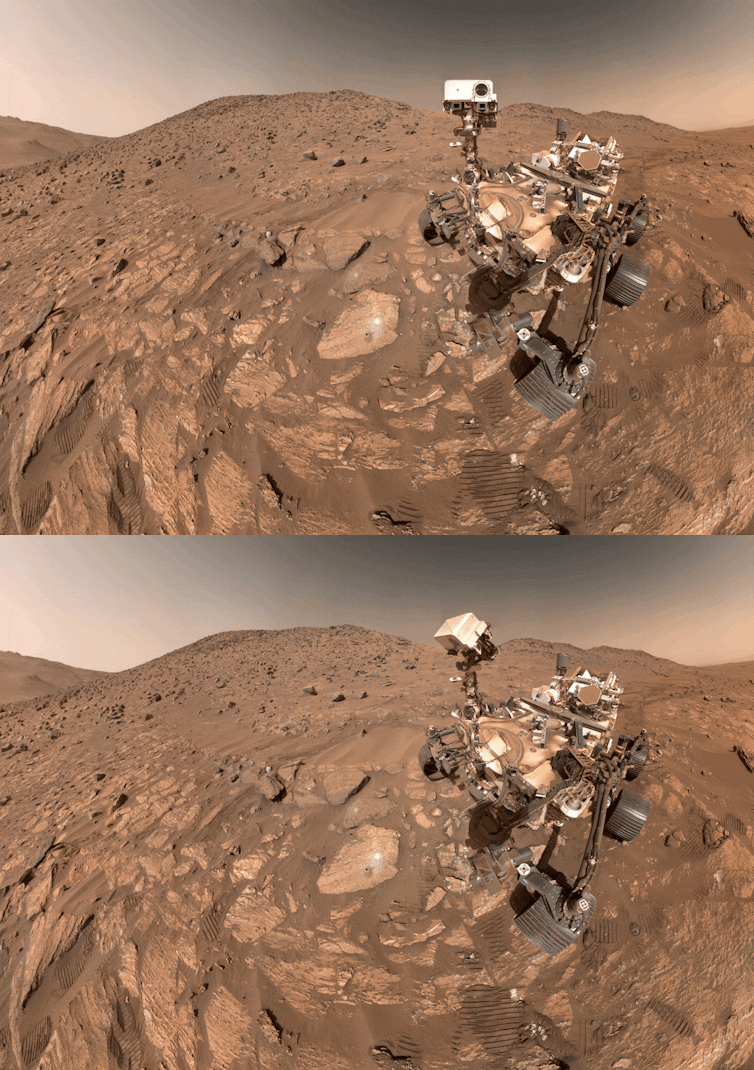
Investing in our robotic senses
This discovery is a testament to decades of NASA’s sustained investment in Mars exploration and the work of engineering teams that developed these instruments. Yet these investments face an uncertain future.
The White House’s budget office recently proposed cutting 47% of NASA’s science funding. Such reductions could curtail ongoing missions, including Perseverance’s continued operations, which are targeted for a 23% cut, and jeopardize future plans such as the Mars sample return campaign, among many other missions.
Perseverance represents more than a machine. It is a proxy extending humanity’s senses across millions of miles to an alien world. These robotic explorers and the NASA science programs behind them are a key part of the United States’ collective quest to answer profound questions about the universe and life beyond Earth.
Ari Koeppel, Earth Sciences Postdoctoral Scientist and Adjunct Associate, Dartmouth College
This article is republished from The Conversation under a Creative Commons license. Read the original article.
STM Daily News is a vibrant news blog dedicated to sharing the brighter side of human experiences. Emphasizing positive, uplifting stories, the site focuses on delivering inspiring, informative, and well-researched content. With a commitment to accurate, fair, and responsible journalism, STM Daily News aims to foster a community of readers passionate about positive change and engaged in meaningful conversations. Join the movement and explore stories that celebrate the positive impacts shaping our world.


Automotive
Hyundai Unveils All-New Tucson With Bold New Look, Smarter Hybrid Tech
Hyundai has unveiled the all-new Tucson, bringing bolder styling, a next-generation hybrid targeting up to 42 mpg, AI-powered infotainment and the rugged new XRT PRO.
Hyundai’s popular compact SUV gets a major makeover with a targeted 42 mpg hybrid, AI-powered infotainment and a more adventurous XRT PRO model.
Hyundai is preparing the Tucson for its next chapter, unveiling an all-new version of its popular SUV with a dramatically revised design, next-generation hybrid technology and a new digital experience built around artificial intelligence.
Hyundai Motor Company introduced the all-new Tucson in New York City against the Manhattan skyline, calling the redesigned model its “boldest SUV” yet.
For buyers, however, the bigger story may be what lies beneath the new styling. Hyundai is combining improved hybrid efficiency, more advanced infotainment and additional off-road capability in an effort to make the Tucson equally comfortable handling weekday commuting, family duty and weekend adventures.
A Bolder Tucson Takes Shape
The new Tucson adopts Hyundai’s “Art of Steel” design philosophy, giving the SUV a more muscular and purposeful appearance.
Rather than simply updating the outgoing Tucson, Hyundai appears to be pushing the model toward a stronger SUV identity while maintaining the everyday practicality that has helped make the Tucson one of the company’s most important global vehicles.
The new exterior is complemented by a redesigned cabin emphasizing space, storage and easier-to-use controls. Hyundai says the interior includes flexible storage solutions and available relaxation features designed to make longer trips more comfortable.
That combination could be important in a compact SUV segment where shoppers increasingly expect vehicles to serve several roles at once — commuter, family vehicle, road-trip machine and recreational vehicle.
Hybrid Targets Up to 42 MPG
One of the most significant changes is Hyundai’s Next-generation Hybrid System.
Hyundai says the new system is targeting fuel economy of up to 42 mpg, while also attempting to preserve responsive driving performance.
If that target carries through to production specifications and official fuel-economy testing, it could make the Tucson Hybrid particularly attractive to drivers who want SUV practicality without moving to a fully electric vehicle.
The strategy also reflects a broader automotive trend. Hybrids have increasingly become an important middle ground for consumers looking to reduce fuel consumption without changing their driving and charging habits.
Final EPA fuel-economy figures and U.S.-market specifications will ultimately determine how the new Tucson compares with its competitors.
Pleos Connect Brings AI Into the Cabin
Technology is another major focus of the redesign.
The Tucson introduces Hyundai’s Pleos Connect next-generation infotainment platform, which incorporates Gleo AI, an expanding app marketplace and a redesigned user interface.
Hyundai describes Pleos Connect as an evolving digital platform rather than simply a conventional infotainment system.
That could allow the Tucson’s capabilities to expand over time as software, applications and connected services develop.
The important question for drivers will be whether all that technology actually makes everyday tasks easier. Automakers continue adding increasingly sophisticated screens and software to their vehicles, but intuitive controls and minimal driver distraction remain just as important as the number of available features.
Tucson XRT PRO Heads Further Off the Pavement
Hyundai is also expanding the Tucson’s adventurous side with the introduction of the Tucson XRT PRO.
The more rugged model adds enhanced off-road technologies, including Hyundai’s first Smart Terrain Assist, or STA.
The system is designed to help the vehicle adapt to changing terrain and provide drivers with additional confidence when leaving paved roads.
The XRT PRO could broaden the Tucson’s appeal among buyers who like the practicality of a compact crossover but want more capability for camping, outdoor recreation and light off-road travel.
More detailed specifications will help determine just how far the XRT PRO moves beyond the appearance-oriented adventure packages commonly offered in the compact SUV market.
A Major Vehicle in Hyundai’s Bigger Product Push
The importance of the new Tucson extends beyond a single model.
“Millions of families around the world count on the Hyundai TUCSON, and this is the best one we have ever built,” Hyundai Motor Company President and CEO José Muñoz said during the announcement.
Muñoz also said the Tucson begins what Hyundai describes as the most ambitious product offensive in its history.
The automaker plans to introduce more than 100 new or refreshed vehicles globally by 2030, including 58 in North America.
That makes the Tucson something of an opening act for Hyundai’s next generation of vehicles.
The Tucson Enters Its Next Era
Compact SUVs remain some of the most versatile vehicles on the market, and Hyundai appears determined to keep the Tucson competitive by improving several areas simultaneously rather than relying on styling alone.
A targeted 42-mpg hybrid powertrain could appeal to fuel-conscious drivers. Pleos Connect and Gleo AI represent Hyundai’s push toward increasingly software-driven vehicles. Meanwhile, the new XRT PRO gives the Tucson lineup a more adventurous option.
There are still important details to come, including complete U.S. specifications, EPA-certified fuel economy, trim levels, pricing and availability.
But Hyundai’s message is already clear: the next Tucson is intended to be more than a routine redesign.
It is being positioned as a showcase for where Hyundai believes the modern SUV is headed — bolder in appearance, smarter inside and more efficient underneath.
Source: Hyundai Motor Company. Specifications and fuel-economy figures discussed by Hyundai are preliminary and may vary by market. Final U.S. specifications and EPA ratings may differ.
Sources & Related Links
- Hyundai Motor Company — Official All-New Tucson Announcement
Hyundai’s original newsroom announcement covering the redesign, next-generation hybrid system, Pleos Connect, Gleo AI and Tucson XRT PRO. Hyundai
Hyundai Motor: All-New Tucson Official Announcement - Hyundai — All-New Tucson Highlights
Official product page with more detail on the “Art of Steel” design, Pleos Connect, 17-inch display, app marketplace, hybrid technology and XRT PRO. Hyundai
Explore the All-New Tucson - Hyundai USA — Tucson
Hyundai’s U.S. consumer page for Tucson information, specifications, trims and future model updates.
Hyundai USA: Tucson - PR Newswire — All-New Hyundai Tucson Press Release
The syndicated release announcing the new Tucson and Hyundai’s target of up to 42 mpg for its next-generation hybrid system. PR Newswire
Read the Original PR Newswire Release - Car and Driver — 2027 Hyundai Tucson
Independent coverage with additional U.S.-market specifications, including powertrain, interior, cargo and XRT Pro information. Car and Driver
Car and Driver: 2027 Hyundai Tucson Details - Road & Track — 2027 Hyundai Tucson
Additional independent coverage of the Tucson redesign, hybrid powertrain, Pleos Connect and XRT Pro off-road features. Road & Track
Road & Track: New Hyundai Tucson Details
Consumer Corner
Jeep Goes Back to 1945 With the 2027 Wrangler JL-2A
Jeep is looking back more than 80 years with the 2027 Wrangler JL-2A, a Rubicon-based special edition inspired by the Willys CJ-2A, the first Jeep designed specifically for civilian use.
Last Updated on October 5, 2026 by Daily News Staff
The special-edition Wrangler pays tribute to the Willys CJ-2A, the vehicle that helped transform the wartime Jeep into an American civilian icon.
More than 80 years after the first civilian Jeep rolled onto farms, ranches and roads across America, Jeep is reaching deep into its history for a new special-edition Wrangler.
The 2027 Jeep Wrangler JL-2A is a modern tribute to the Willys CJ-2A, introduced in 1945 as the first Jeep vehicle developed specifically for civilian use.
Rather than simply adding a heritage badge to a modern Wrangler, Jeep has incorporated colors, wheels, interior materials and design details inspired by the vehicle that helped establish the civilian Jeep nearly eight decades ago.
The JL-2A is also the 11th installment in Jeep’s Twelve 4 Twelve series of special-edition vehicles.
From the Battlefield to Civilian America
The story behind the JL-2A begins at the end of World War II.
The military Willys MB had earned a reputation for ruggedness during the war, but Willys-Overland saw an opportunity for the basic concept beyond military service.
In July 1945, the company introduced the Willys CJ-2A.
The letters “CJ” stood for Civilian Jeep, and the CJ-2A adapted the military Jeep formula for farmers, ranchers, industrial workers and everyday civilian users.
Changes included a tailgate, larger headlights and a rear power takeoff that allowed the Jeep to operate certain agricultural and industrial equipment. The CJ-2A also helped establish the familiar seven-slot grille that would eventually become one of Jeep’s most recognizable design elements.
It wasn’t just a utilitarian machine, either.
Willys offered memorable postwar color combinations such as Harvest Tan with Sunset Red wheels and Pasture Green with Autumn Yellow wheels.
Those colorful early Jeeps provided much of the inspiration for the new JL-2A.
A 1945 Look on a Modern Wrangler
The 2027 Wrangler JL-2A is based on the modern Wrangler Rubicon, meaning the retro styling is paired with serious off-road hardware.
One of its most noticeable features is a set of exclusive 17-inch retro-style wheels finished in Joose, accompanied by orange front and rear tow hooks. The combination recalls the bright Sunset Red wheels found on some original CJ-2As.
The wheels are paired with standard 33-inch BFGoodrich KO2 All-Terrain tires.
Jeep is also bringing back Gobi exterior paint for 2027. The tan-like color is particularly appropriate for this edition because it echoes the Harvest Tan finish offered on the original CJ-2A.
Other available colors include ’41, Bright White, Sting Gray, Ghost and Joose.
Body-color fender flares and a three-piece hardtop give the JL-2A a relatively clean exterior appearance, while Dark Metallic Grey accents update the Wrangler’s familiar seven-slot grille.
Jeep Takes the Retro Theme Inside
Jeep has carried the historical theme into the cabin with a color and material combination never previously offered on a Wrangler.
The seats are covered in Nappa Heritage Tan leather, complemented by Bison Brown on the door panels, lower instrument panel and center console.
Desert Orange stitching ties the interior to the brightly colored exterior wheels and tow hooks.
There are also several details specifically aimed at Jeep history enthusiasts.
A satin-chrome Willys-Overland shifter medallion pays tribute to the company’s roots, while heritage-inspired HVAC vent graphics incorporate the seven-slot grille and a Willys silhouette.
Perhaps the most interesting detail is found at the rear.
Jeep has created a swing-gate plaque based on the dashboard data-plate artwork of the original CJ-2A. It includes farm and factory imagery recalling the original civilian Jeep’s role as a working vehicle rather than simply a recreational off-roader.
Modern conveniences haven’t been forgotten. The JL-2A includes remote start, an auto-dimming rearview mirror, universal garage-door opener and a front TrailCam with an integrated washer.
How Much Will the Wrangler JL-2A Cost?
Jeep says the JL-2A package will carry an MSRP of $4,995.
According to the automaker, that puts the special edition just $115 above a comparably equipped Wrangler Rubicon, making the package largely about choosing its unique heritage-inspired appearance and equipment rather than paying a substantial premium solely for a limited-edition name.
Orders are scheduled to open in October 2026.
Jeep has not presented the JL-2A as a recreation of the CJ-2A. Underneath the nostalgic colors and Willys-inspired details is a thoroughly modern Wrangler Rubicon.
And that may be the point.
More Than 80 Years of Civilian Jeep History
The original CJ-2A represented a turning point for Jeep.
A vehicle concept born from wartime necessity found a second life in civilian America, where Jeeps became farm equipment, work vehicles, recreational 4x4s and eventually lifestyle vehicles.
The CJ line evolved through multiple generations before eventually giving way to the Wrangler nameplate in the 1980s.
The 2027 Wrangler JL-2A connects those two ends of Jeep’s history — from the simple postwar CJ-2A built to work the back forty to today’s technology-packed Wrangler designed to tackle the trail.
More than eight decades separate them, but park the two side by side and the family resemblance would be difficult to miss.
Source: Stellantis / Jeep, September 12, 2026
A Civilian Legend Reimagined: Jeep Brand Introduces 2027 Jeep Wrangler JL-2A PR Newswire
Jeep Official Website:
Jeep Official Website
STM Daily News
Woman Charged With Felony Animal Cruelty in Santa Ana Puppy Killing
Santa Ana Puppy Killing: Prosecutors have filed felony charges against a 75-year-old Anaheim woman accused of deliberately running over and killing her puppy, Blackey, in Santa Ana.

Last Updated on October 3, 2026 by Daily News Staff
SANTA ANA, Calif. — A 75-year-old Anaheim woman accused of deliberately running over and killing her puppy on a Santa Ana street has now been formally charged with felony animal cruelty, marking a major development in a case that drew widespread attention after surveillance video was released by police.
The Orange County District Attorney’s Office announced Friday, October 2, that Hanh Minh Nguyen, 75, of Anaheim, has been charged with one felony count of animal cruelty, one felony count of animal abuse by a caretaker, and a felony enhancement alleging the personal use of a weapon — a vehicle — to kill the animal.
Nguyen was arrested by Santa Ana police on Thursday, October 1, after investigators used automated license plate reader technology to identify the green Honda Odyssey seen in surveillance footage from the September 8 incident. Police subsequently located Nguyen and found the minivan at her Anaheim residence.
According to the District Attorney’s Office, Nguyen was released from custody after posting $20,000 bail. She is scheduled to appear at the Central Justice Center in Santa Ana on November 2, 2026, in Department C55.
Surveillance video led to investigation
The case began on September 8 at approximately 9:15 a.m., when Santa Ana Animal Services officers responded to a report of a dead black-and-white male pit bull-mix puppy on West Park Lane.

Surveillance footage obtained during the investigation showed a woman removing the puppy from a minivan and placing food near the driver’s side of the vehicle. Authorities allege the woman then slowly drove forward as the puppy approached the food, running over the animal with the vehicle’s rear tire before leaving the scene.
The puppy, identified by authorities as Blackey, died.
The District Attorney’s Office describes Blackey as a 9-week-old puppy. Earlier statements and local news reports described him as approximately 9 months old.
Santa Ana police released surveillance footage of the incident on September 30 and appealed to the public for help identifying the driver.
Within a day, investigators said automated license plate reader technology helped them trace the Honda Odyssey to Nguyen. Police found the vehicle in her garage and took her into custody.
Police previously said Nguyen acknowledged owning and abandoning Blackey. According to the Los Angeles Times, a Santa Ana Police Department spokesperson said Nguyen told detectives she had left the puppy because he had been annoying her boyfriend by biting his shoes and belongings. Police said she acknowledged abandoning the dog but did not admit to intentionally running him over.
Prosecutors file felony charges
The filing of felony charges moves the case beyond the initial police investigation and into the Orange County court system.
Orange County District Attorney Todd Spitzer condemned the alleged killing in announcing the charges and said his office intends to prosecute acts of violence against animals.
Deputy District Attorney Danica Drotman of the Orange County District Attorney’s Animal Cruelty Unit is prosecuting the case.
Nguyen is accused of the offenses and has not been convicted. The allegations against her will now be addressed through the court process.
Her next scheduled court appearance is November 2.
STM Daily News will continue following the case and provide updates as additional information becomes available.
Source and Related Links
- Orange County District Attorney — October 2 charging announcement
- The DA’s release is the strongest source for this update. It provides case number 26CF4923, the exact charges, $20,000 bail, November 2 court date and the prosecutor assigned to the case. Orange County District Attorney
- For corroborating coverage, CBS Los Angeles reports the arrest, use of automated license-plate readers and the subsequent felony charges. CBS News
- CBS Los Angeles — arrest and charges update
- NBC Los Angeles — felony charges update





