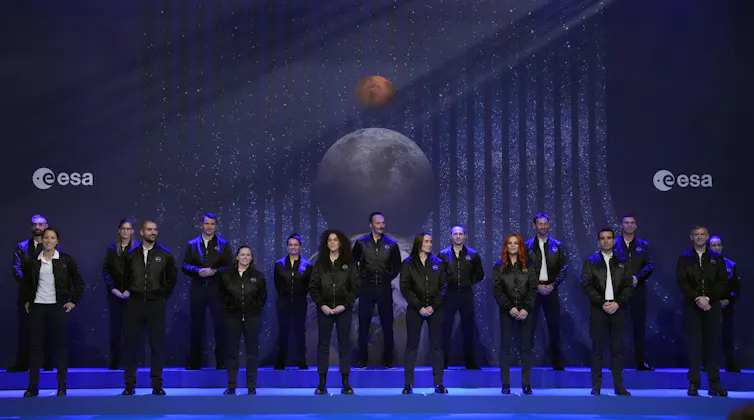
The European Space Agency’s astronaut cohort includes a parastronaut, as part of a feasibility project. AP Photo/Francois MoriJesse Rhoades, University of North Dakota and Rebecca Rhoades, University of North Dakota Humans will likely set foot on the Moon again in the coming decade. While many stories in this new chapter of lunar exploration will be reminiscent of the Apollo missions 50 years ago, others may look quite different. For instance, the European Space Agency is currently working to make space travel more accessible for people of a wide range of backgrounds and abilities. In this new era, the first footprint on the Moon could possibly be made by a prosthetic limb.NASA plans to return humans to the lunar surface in the coming decade.NASA Goddard Historically, and even still today, astronauts selected to fly to space have had to fit a long list of physical requirements. However, many professionals in the field are beginning to acknowledge that these requirements stem from outdated assumptions. Some research, including studies by our multidisciplinary team of aerospace and biomechanics researchers, has begun to explore the possibilities for people with physical disabilities to venture into space, visit the Moon and eventually travel to Mars.
Current research
NASA has previously funded and is currently funding research on restraints and mobility aids to help everyone, regardless of their ability, move around in the crew cabin. Additionally, NASA has research programs to develop functional aids for individuals with disabilities in current U.S. spacecraft. A functional aid is any device that improves someone’s independence, mobility or daily living tasks by compensating for their physical limitations. The European Space Agency, or ESA, launched its Parastronaut Feasibility Project in 2022 to assess ways to include individuals with disabilities in human spaceflight. A parastronaut is an astronaut with a physical disability who has been selected and trained to participate in space missions. At the University of North Dakota, we conducted one of the first studies focused on parastronauts. This research examined how individuals with disabilities get into and get out of two current U.S. spacecraft designed to carry crew. The first was NASA’s Orion capsule, designed by Lockheed Martin, and the second was Boeing’s CST 100 Starliner. Alongside our colleagues Pablo De León, Keith Crisman, Komal Mangle and Kavya Manyapu, we uncovered valuable insights into the accessibility challenges future parastronauts may face. Our research indicated that individuals with physical disabilities are nearly as nimble in modern U.S. spacecraft as nondisabled individuals. This work focused on testing individuals who have experienced leg amputations. Now we are looking ahead to solutions that could benefit astronauts of all abilities.
Safety and inclusion
John McFall is the ESA’s first parastronaut. At the age of 19, Mcfall lost his right leg just above the knee from a motorcycle accident. Although McFall has not been assigned to a mission yet, he is the first person with a physical disability to be medically certified for an ISS mission.John McFall stands by a mock-up of the SpaceX Dragon crew capsule.SpaceX, CC BY-NC-SA Astronaut selection criteria currently prioritize peak physical fitness, with the goal of having multiple crew members who can do the same physical tasks. Integrating parastronauts into the crew has required balancing mission security and accessibility. However, with advancements in technology, spacecraft design and assistive tools, inclusion no longer needs to come at the expense of safety. These technologies are still in their infancy, but research and efforts like the ESA’s program will help improve them. Design and development of spacecraft can cost billions of dollars. Simple adaptations, such as adding handholds onto the walls in a spacecraft, can provide vital assistance. However, adding handles to existing spacecraft will be costly. Functional aids that don’t alter the spacecraft itself – such as accessories carried by each astronaut – could be another way forward. For example, adding Velcro to certain spots in the spacecraft or on prosthetic limbs could improve a parastronaut’s traction and help them anchor to the spacecraft’s surfaces. Engineers could design new prosthetics made for particular space environments, such as zero or partial gravity, or even tailored to specific spacecraft. This approach is kind of like designing specialized prosthetics for rock climbing, running or other sports.
Accessibility can help everyone
Future space exploration, particularly missions to the Moon and Mars that will take weeks, months and even years, may prompt new standards for astronaut fitness. During these long missions, astronauts could get injured, causing what can be considered incidental disability. An astronaut with an incidental disability begins a mission without a recognized disability but acquires one from a mission mishap. An astronaut suffering a broken arm or a traumatic brain injury during a mission would have a persistent impairment.On longer missions, astronauts may need to troubleshoot issues on their own.NASA During long-duration missions, an astronaut crew will be too far away to receive outside medical help – they’ll have to deal with these issues on their own. Considering disability during mission planning goes beyond inclusion. It makes the mission safer for all astronauts by preparing them for anything that could go wrong. Any astronaut could suffer an incidental disability during their journey. Safety and inclusion in spaceflight don’t need to be at odds. Instead, agencies can reengineer systems and training processes to ensure that more people can safely participate in space missions. By addressing safety concerns through technology, innovative design and mission planning, the space industry can have inclusive and successful missions.Jesse Rhoades, Professor of Education, Heath & Behavior, University of North Dakota and Rebecca Rhoades, Researcher in Education, Health & Behavior, University of North Dakota This article is republished from The Conversation under a Creative Commons license. Read the original article.
The science section of our news blog STM Daily News provides readers with captivating and up-to-date information on the latest scientific discoveries, breakthroughs, and innovations across various fields. We offer engaging and accessible content, ensuring that readers with different levels of scientific knowledge can stay informed. Whether it’s exploring advancements in medicine, astronomy, technology, or environmental sciences, our science section strives to shed light on the intriguing world of scientific exploration and its profound impact on our daily lives. From thought-provoking articles to informative interviews with experts in the field, STM Daily News Science offers a harmonious blend of factual reporting, analysis, and exploration, making it a go-to source for science enthusiasts and curious minds alike. https://stmdailynews.com/category/science/
2025 was hotter than it should have been – 5 influences and a dirty surprise offer clues to what’s ahead
The past three years recorded unprecedented global heat, with 2025 being particularly warm. Factors such as greenhouse gas emissions and a decline in solar activity influenced temperatures and extreme weather patterns.
The past three years have been the world’s hottest on record by far, with 2025 almost tied with 2023 for second place. With that energy came extreme weather, from flash flooding to powerful hurricanes and severe droughts. Yet, by most indicators, the planet should have been cooler in 2025 than it was.
So, what happened, and what does that say about the year ahead?
As an earth and environmental scientist, I study influences that affect global temperatures year to year, such as El Niño, wildfires and solar cycles. Some make Earth hotter. Some make it cooler. And one particularly unhealthy influence has been quietly hiding a large amount of global warming – until now.The past three years have been the warmest on record. The chart compiled by the European Union’s Copernicus Climate Change Service shows the comparison to preindustrial-era temperatures in the second half of the 1800s. C3S/ECMWF
Factors that made 2025 cooler than 2024
The Earth’s climate is the result of many factors that change from year to year. Some that helped make 2025 cooler than 2024 include:
La Niña’s arrival: La Niña is part of the El Niño-Southern Oscillation, a natural climate pattern that fluctuates between warm El Niño conditions and cooler La Niña conditions. During El Niño, the Pacific Ocean heats up along the equator, influencing the atmosphere in ways that can cause intense storms, droughts and heat waves around the planet. La Niña does the opposite; it’s like putting an ice pack on the atmosphere.
Both 2023 and 2024 were El Niño years, but in 2025 conditions shifted to neutral and then to La Niña starting in September.
The solar cycle: The Sun reached its solar maximum near the end of 2024, the peak of its energy output in an approximately 11-year cycle, and began declining in 2025. So, while the sun’s output was still stronger than average in 2025, it was less than in 2024.
Fewer wildfires: Despite some destructive blazes, the world also saw fewer wildfires during 2025 than 2024, which put less carbon dioxide – a planet-warming greenhouse gas – into the atmosphere.Major warming and cooling influences from 2016 to 2025. Each graph starts at 2016. Anthropogenic warming, natural carbon sinks and sulfur dioxide (SO2) reductions start from zero in 2016 to illustrate cumulative changes to existing reservoirs; El Niño/La Niña and the solar cycle show real-time influences on the global temperature, relative to mean values. Michael Wysession. Data: Global Carbon Project (Anthropogenic Global Warming, Natural Carbon Sinks); NOAA (El Niño/La Niña, Solar Cycle); SO2 Reductions (FaIR Analysis by Carbon Brief)
Several other factors made 2025 warmer than expected, and some are likely to continue to increase in 2026. They include:
Greenhouse gas emissions: The big driver of global warming is excess greenhouse gas emissions, largely from burning fossil fuels, and 2025 had plenty.
Greenhouse gases trap heat near Earth’s surface like a blanket, raising the temperature. They also linger in the atmosphere for years to centuries, meaning gases released today will continue to warm the planet well into the future. The levels of carbon dioxide, methane and nitrous oxide in the atmosphere all increased in 2025.
Advertisement
Sources of worldwide carbon dioxide emissions that have grown the most in recent decades. Carbon Brief, CC BY
Earth’s energy imbalance: Other sources can disrupt the natural balance between the amount of sunlight that reaches Earth and the lesser amount radiated back to space. A recent study found that Earth’s energy uptake surged and temperatures rose quickly when a rare three-year La Niña in 2020-2022 shifted to El Niño in 2023-2024.
Declining polar ice, which efficiently reflects sunlight back into space, also affects the energy balance. As sea ice declines, it leaves dark ocean water that absorbs most of the sunlight that reaches it. In a spiraling feedback, warmer water melts sea ice, allowing more sunlight into the ocean, warming it faster; 2025 had the lowest winter peak of Arctic sea ice on record and the third-lowest minimum extent of Antarctic ice.
Air pollution: Sulfate aerosol pollution from coal combustion and burning heavy fuel oil in shipping has also been affecting Earth’s energy balance. It has been masking the full effects of human-caused greenhouse gases for years by reflecting sunlight back into space, creating a cooling effect. But sulfate aerosol pollution is also a serious health hazard, blamed for about 8 million human deaths per year from lung diseases.
Recent reductions in sulfate pollution – now 40% less than 20 years ago – have meant about a 0.2 F (0.13 C) increase in global temperatures. Much of the reduction was from China’s efforts to reduce its notoriously bad air pollution in recent years and international shipping rules in effect since 2020 that have reduced sulfur emissions from large ships by 85%.Sea ice levels were near record lows for both Arctic and Antarctic ice in 2025. Carbon Brief, CC BY
Taking all factors together, humans are now warming the planet at a faster rate than at any point in human history: at about 0.5 F (0.27 C) per decade. That extra heat can fuel extreme weather, including flash floods, heat waves, extended droughts, wildfires and coastal flooding, affecting human lives and economies.
Predictions for 2026
Most climate models predict 2026 will be about as hot as 2025, depending on whether a Pacific El Niño develops, which forecasters give about a 60% chance of happening. The planet is already starting the year out warm, even if it doesn’t feel like that everywhere. While January was very cold in parts of the U.S., globally, Earth saw its fifth-warmest January on record, and much of the western U.S. saw one of its warmest winters on record.
Dive into “The Knowledge,” where curiosity meets clarity. This playlist, in collaboration with STMDailyNews.com, is designed for viewers who value historical accuracy and insightful learning. Our short videos, ranging from 30 seconds to a minute and a half, make complex subjects easy to grasp in no time. Covering everything from historical events to contemporary processes and entertainment, “The Knowledge” bridges the past with the present. In a world where information is abundant yet often misused, our series aims to guide you through the noise, preserving vital knowledge and truths that shape our lives today. Perfect for curious minds eager to discover the ‘why’ and ‘how’ of everything around us. Subscribe and join in as we explore the facts that matter. https://stmdailynews.com/the-knowledge/
After the Blood Moon: Scientists and Skywatchers React to the March 3, 2026 Total Lunar Eclipse
The March 3, 2026 total lunar eclipse amazed skywatchers worldwide. Scientists and amateur astronomers share reactions and photos from the dramatic blood moon event.
Millions of people around the world looked to the sky in the early hours of March 3, 2026 to witness one of the most striking astronomical events of the year — a total lunar eclipse, often referred to as a “Blood Moon.” As the Moon passed completely into Earth’s shadow, it transformed from its familiar silver glow into a deep copper-red color, captivating observers from North America to Asia and across the Pacific.
Blood Moon Aftermath: Scientists and Skywatchers React to the March 3, 2026 Total Lunar Eclipse
For viewers in the western United States, including Arizona and California, the eclipse occurred just before sunrise. The timing created a dramatic scene as the reddish Moon hovered low in the western sky while the eastern horizon began to brighten with dawn.
A Global Skywatching Event
Total lunar eclipses occur when the Sun, Earth, and Moon align so that Earth’s shadow completely covers the Moon. During the March 3 event, the Moon spent nearly an hour fully inside the darkest part of Earth’s shadow, known as the umbra. During this phase, sunlight filtered through Earth’s atmosphere projected reddish light onto the Moon’s surface, creating the dramatic “blood moon” effect.
Astronomers noted that the event was particularly significant because total lunar eclipses are relatively infrequent. While partial eclipses occur more often, a full eclipse visible across large portions of the globe remains a memorable experience for both scientists and casual observers.
Scientists Explain the Phenomenon
According to researchers at NASA, the reddish color seen during totality occurs because Earth’s atmosphere scatters shorter wavelengths of sunlight — such as blue — while allowing longer red wavelengths to pass through. This filtered light is then bent, or refracted, into Earth’s shadow and projected onto the Moon.
Planetary scientists say lunar eclipses provide a powerful visual demonstration of the geometry of the Earth–Moon–Sun system. The curved shadow moving across the Moon also historically served as one of the earliest pieces of evidence that Earth is spherical.
Researchers also point out that lunar eclipses offer opportunities to study Earth’s atmosphere. Variations in dust, volcanic particles, and atmospheric conditions can influence how dark or red the Moon appears during totality.Taken in North Phoenix around 5 AM MST March 3, 2026
Amateur Astronomers Share Their Views
While professional observatories monitored the eclipse with precision instruments, amateur astronomers and astrophotographers helped document the event from countless locations worldwide. Social media platforms and astronomy forums quickly filled with images showing the Moon’s color shifting from pale gray to orange and deep red.
Many skywatchers in the southwestern United States described the experience as particularly dramatic because the eclipse occurred just before moonset. Observers reported seeing the Moon glowing red above desert landscapes and city skylines before gradually fading into the brightening morning sky.
Astrophotographers also emphasized that lunar eclipses are among the easiest astronomical events to capture. Unlike solar eclipses, they can be photographed safely without special filters, making them accessible to beginners using smartphones as well as professionals using telescopes and high-end cameras.
Advertisement
A Rare Pre-Dawn Sight
In parts of the western United States, some observers were able to witness a rare atmospheric phenomenon known as a selenelion, when both the eclipsed Moon and the rising Sun appear in the sky at the same time due to atmospheric refraction. The effect added an unusual visual element to an already impressive celestial event.
The combination of a deep red Moon and the approaching dawn created striking photographic opportunities and memorable moments for early-morning skywatchers.
When Is the Next Total Lunar Eclipse?
Although partial eclipses occur periodically, the next widely visible total lunar eclipse will not occur until late 2028. That makes the March 2026 eclipse one of the most notable skywatching events of the decade.
For many observers, the event served as a reminder that some of the most spectacular astronomical experiences require nothing more than stepping outside, looking up, and taking a moment to appreciate the universe above.
Rod: A creative force, blending words, images, and flavors. Blogger, writer, filmmaker, and photographer. Cooking enthusiast with a sci-fi vision. Passionate about his upcoming series and dedicated to TNC Network. Partnered with Rebecca Washington for a shared journey of love and art.
Early risers in Arizona are in for a celestial show.
On Tuesday, March 3, 2026, a total lunar eclipse will be visible across much of North America — including Phoenixand the Valley. During this event, the Moon will pass completely into Earth’s shadow, turning a deep copper-red color often called a “Blood Moon.”
Here’s what you need to know.
A schematic diagram of the shadow cast by Earth. Within the umbra, the central region, the planet totally shields direct sunlight. In contrast, within the penumbra, the outer portion, the sunlight is only partially blocked. Sun, Moon, and Earth sizes and distances between them not to scale.
🌍 What Is a Total Lunar Eclipse?
A total lunar eclipse happens when the Sun, Earth, and Moon align perfectly, with Earth positioned directly between the Sun and the Moon. As the Moon moves into Earth’s darkest shadow (the umbra), it doesn’t disappear — instead, it glows red.
That reddish color comes from sunlight filtering through Earth’s atmosphere — essentially, we’re seeing all the world’s sunrises and sunsets projected onto the Moon at once.
🕒 Phoenix Viewing Times (MST)
Arizona does not observe Daylight Saving Time in March, so these times are in Mountain Standard Time (MST).
The most dramatic portion — totality — lasts nearly one hour.
🌅 Where to Look in Phoenix
The eclipse happens in the pre-dawn hours, so the Moon will be low in the western sky as it sets.
For the best view:
Find a location with a clear western horizon
Avoid city light glare if possible
Consider desert viewpoints, parks, or elevated areas around the Valley
Because the Moon will be setting as the Sun begins to rise, the backdrop of early morning twilight could make for stunning photography.
🔭 Do You Need Special Equipment?
No.
Unlike a solar eclipse, lunar eclipses are completely safe to view with the naked eye. However:
Binoculars enhance color detail
A small telescope reveals subtle shadow gradients
A tripod and DSLR or smartphone with night mode can capture impressive images
🌎 Why This Eclipse Matters
This will be one of the most accessible celestial events of 2026 for Arizona residents. Total lunar eclipses don’t happen every year in the same location, and the timing — just before sunrise — adds dramatic visual contrast.
If skies are clear, Phoenix could have a spectacular view.
📌 Quick Viewing Reminder for Phoenix
Set your alarm for around 3:45 a.m.
Advertisement
Step outside by 4:00 a.m.
Look west
Watch the Moon turn red
No tickets. No crowds. Just the sky putting on a show.
For more science, space, and Arizona skywatching coverage, visit STM Daily News.




 Jesse Rhoades, Professor of Education, Heath & Behavior, University of North Dakota and Rebecca Rhoades, Researcher in Education, Health & Behavior, University of North Dakota This article is republished from The Conversation under a Creative Commons license. Read the original article.







