

Food and Beverage
Antioxidants help stave off a host of health problems – but figuring out how much you’re getting can be tricky
Antioxidants counteract harmful oxidants, preventing oxidative stress linked to diseases such as cancer and Alzheimer’s. Whole foods, rich in antioxidants like carotenoids and flavonoids, are more beneficial than supplements. A diverse diet featuring colorful fruits and vegetables—such as blueberries, artichokes, and dark greens—can help maintain health by providing necessary antioxidants.


Nathaniel Johnson, University of North Dakota
When it comes to describing what an antioxidant is, it’s all in the name: Antioxidants counter oxidants.
And that’s a good thing. Oxidants can damage the structure and function of the chemicals in your body critical to life – like the proteins and lipids within your cells, and your DNA, which stores genetic information. A special class of oxidants, free radicals, are even more reactive and dangerous.
As an assistant professor of nutrition, I’ve studied the long-standing research showing how the imbalances in antioxidants and oxidants lead to oxidative stress, which is linked to cancer, diabetes, cardiovascular disease and dementia and Alzheimer’s disease. In fact, a primary cause of aging is the damage accumulated across of a lifetime of oxidative stress.
Simply put: To help prevent oxidative stress, people need to eat foods with antioxidants and limit their exposure to oxidants, particularly free radicals.
The research: Food, not supplements
There’s no way for any of us to avoid some oxidative stress. Just metabolism – the processes in your body that keep you alive, such as breathing, digestion and maintaining body temperature – are a source of oxidants and free radicals. Inflammation, pollution and radiation are other sources.
As a result, everyone needs antioxidants. There are many different types: enzymes, minerals, vitamins and phytochemicals.
Two types of phytochemicals deserve special mention: carotenoids and flavonoids. Carotenoids are pigments, with the colors yellow, orange and red; they contain the antioxidants beta-carotene, lycopene and lutein. Some flavonoids, called anthocyanins, are pigments that give foods a blue, red or purple color.
Although your body produces some of these antioxidants, you can get them from the foods you eat, and they’re better for you than supplements.
In fact, researchers found that antioxidant supplements did not reduce deaths, and some supplements in excessive amounts contribute to oxidative stress, and may even increase the risk of dying.
It should be pointed out that in most of these studies, only one or two antioxidants were given, and often in amounts far greater than the recommended daily value. One study, for example, gave participants only vitamin A, and at an amount more than 60 times an adult’s recommended intake. https://www.youtube.com/embed/uqQLpXQqMGo?wmode=transparent&start=0 A synopsis of the study that measured the antioxidant content of more than 3,000 foods.
Foods rich in antioxidants
In contrast, increased antioxidant intake from whole foods is related to decreased risk of death. And although antioxidant supplementation didn’t reduce cancer rates in smokers, the antioxidants in whole foods did.
But measuring antioxidants in foods is complicated. Extensive laboratory testing is required, and too many foods exist to test them all anyway. Even individual food items that are the same exact variety of food – such as two Gala apples – can have different amounts of antioxidants. Where the food was grown and harvested, how it was processed and how it was stored during transportation and while in the supermarket are factors. The variety of the food also matters – the many different types of apples, for instance, can have different amounts of antioxidants.
Nonetheless, in 2018, researchers quantified the antioxidant content of more than 3,100 foods – the first antioxidant database. Each food’s antioxidant capacity was determined by the amount of oxidants neutralized by a given amount of food. The researchers measured this capacity in millimoles per 100 grams, or about 4 ounces.
For fruits easily found in the grocery store, the database shows blueberries have the most antioxidants – just over 9 millimoles per 4 ounces. The same serving of pomegranates and blackberries each have about 6.5 millimoles.
For common vegetables, cooked artichoke has 4.54 millimoles per 4 ounces; red kale, 4.09 millimoles; cooked red cabbage, 2.15; and orange bell pepper, 1.94.
Coffee has 2.5 millimoles per 4 ounces; green tea has 1.5; whole walnuts, just over 13; whole pecans, about 9.7; and sunflower seeds, just over 5. Herbs and spices have a lot: clove has 465 millimoles per 4 ounces; rosemary has 67; and thyme, about 64. But keep in mind that those enormous numbers are based on a quarter-pound. Still, just a normal sprinkle packs a powerful nutritional punch.
Other tips
Other ways to choose antioxidant-rich foods: Read the nutrition facts label and look for antioxidant vitamins and minerals – vitamins A, C, E, D, B2, B3 and B9, and the minerals selenium, zinc and manganese.
Just know the label has a drawback. Food producers and manufacturers are not required to list every nutrient of the food on the label. In fact, the only vitamins and minerals required by law are sodium, potassium, calcium, iron and vitamin D.
Also, focus on eating the rainbow. Colorful foods are often higher in antioxidants, like blue corn. Many darker foods are rich in antioxidants, too, like dark chocolate, black barley and dark leafy vegetables, such as kale and Swiss chard.
Although heat can degrade oxidants, that mostly occurs during the storage and transportation of the food. In some cases, cooking may increase the food’s antioxidant capacity, as with leafy green vegetables.
Keep in mind that while blueberries, red kale and pecans are great, their antioxidant profile will be different than that of other fruits, vegetables and nuts. That’s why diversity is the key: To increase the power of antioxidants, choose a variety of fresh, flavorful, colorful and, ideally, local foods.
Nathaniel Johnson, Assistant Professor of Nutrition and Dietetics, University of North Dakota
This article is republished from The Conversation under a Creative Commons license. Read the original article.
https://stmdailynews.com/the-fate-of-lucky-supermarkets-in-socal/




recipes
Lighten Up: Fresh Spring Meals That Won’t Weigh You Down
Prepare your fresh spring menu with light, flavorful dishes like shrimp pearl couscous salad and chickpea couscous—perfect for easy, satisfying meals without the heaviness.

Lighten Up: Fresh Spring Meals That Won’t Weigh You Down
(Feature Impact) Put away the heavy coats and break out the rain jackets and rubber boots – spring is here, and with it comes more than just pop-up showers and sunshine. After months of comfort foods and curling up indoors, you may be ready for lighter meals that won’t weigh you down before splashing in the puddles.
Fresh produce may first come to mind, but spring bites can also mean swapping out ingredients like regular pasta for a solution such as pearl couscous. If you’re looking to complement greens, veggies, fish or meats with light yet filling flavor, consider Success Boil-in-Bag Pearl Couscous, a small, mediterranean-style pasta that always cooks right and is ready to eat in under 7 minutes once the water boils. The BPA-free boil-in-bag simplicity makes cooking easy and foolproof: no measure, no mess, no stress.
Made with high-quality semolina wheat, it features a slightly nutty flavor on its own while absorbing the flavors of salads while retaining its density and chewy texture. It’s distinguished from traditional Moroccan couscous by its slightly larger, rounder shape and less dense, firmer consistency.
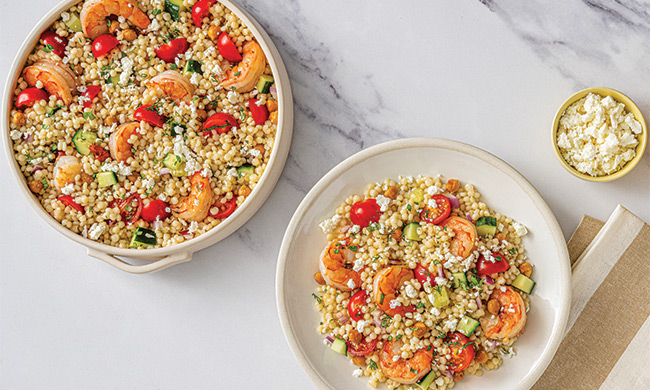
Try it with your next meal in this protein-forward Shrimp Pearl Couscous Salad, made using fresh herbs, citrus, seasoned shrimp and chickpeas for a jam-packed salad that screams spring. Never boring, the tender, seasoned couscous and shrimp, veggies and aromatic herbs can bring your family running to the kitchen after a day of play.
Or, for an even simpler dish that requires just 15 minutes in the kitchen, this Pearl Couscous and Chickpea Salad is light, bright and bursting with flavor. It brings together tender pearl couscous, crisp veggies and za’atar in every bite.
To find more light spring recipe ideas, visit SuccessRice.com.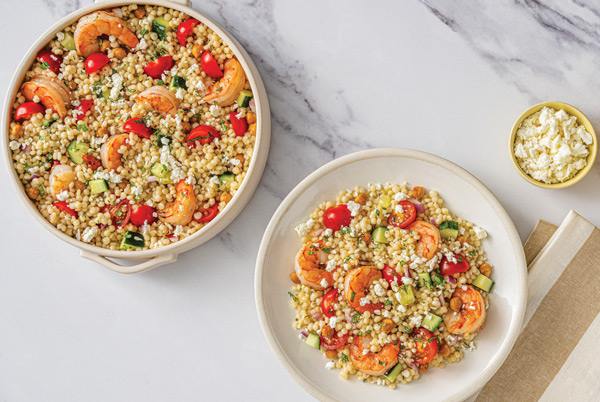
Shrimp Pearl Couscous Salad
Prep time: 10 minutes
Cook time: 15 minutes
Servings: 4
- 1 bag Success Pearl Couscous
- 1 pound large shrimp, peeled and deveined
- 1 tablespoon seasoned salt
- 4 tablespoons olive oil, divided
- 1 can (14 ounces) chickpeas, drained and rinsed
- 1/2 teaspoon garlic powder
- 1/2 teaspoon onion powder
- 1/2 teaspoon smoked paprika
- 1/4 teaspoon salt
- 1/2 English cucumber, diced
- 1 cup cherry tomatoes, halved
- 1/4 cup fresh basil, chopped
- 1/4 cup red onions, finely chopped
- 2 tablespoons fresh dill, chopped
- 1 tablespoon lemon juice
- 1/2 cup feta, crumbled
- Prepare pearl couscous according to package directions.
- In medium bowl, toss shrimp with seasoned salt.
- In large saucepan over medium-high heat, heat 1 tablespoon oil. Add shrimp and cook 5 minutes. If necessary, cook in batches to avoid overcrowding pan.
- In another large pan, heat 1 tablespoon oil over medium heat. Add chickpeas and cook 8 minutes until crispy and golden, tossing often. Add garlic powder, onion powder, paprika and salt. Toss to fully coat and cook 2 minutes.
- In large bowl, combine pearl couscous, shrimp, chickpeas, cucumbers, tomatoes, basil, red onion, dill, lemon juice and remaining olive oil. Toss to combine. Garnish with feta.
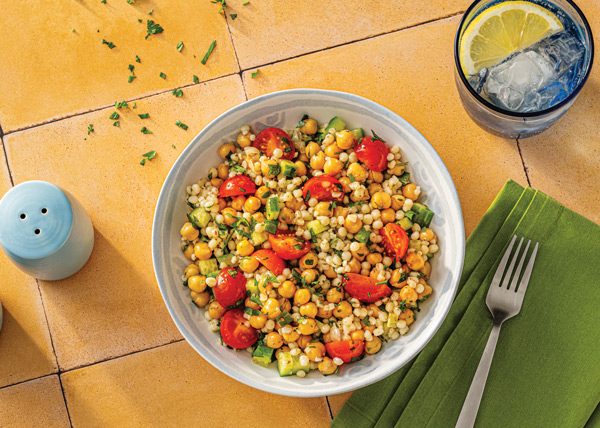
Pearl Couscous and Chickpea Salad
Prep time: 5 minutes
Cook time: 10 minutes
Servings: 4
- 1 bag Success Pearl Couscous
- 1 can (15 ounces) chickpeas, drained and rinsed
- 1 cup cherry tomatoes, halved
- 1/2 cup cucumber, diced
- 1/4 cup fresh parsley, chopped
- 1 tablespoon za’atar
- 2 tablespoons olive oil
- 1 tablespoon lemon juice, freshly squeezed
- 1/2 teaspoon salt
- 1/4 teaspoon pepper
- Prepare pearl couscous according to package directions.
- In large bowl, combine couscous, chickpeas, cherry tomatoes, cucumber, parsley and za’atar.
- Drizzle with olive oil and lemon juice. Season with salt and pepper. Toss until well combined.
- Serve warm or at room temperature.


SOURCE:
Hungry for what’s next? STM Daily News’ Food and Drink section dishes up the latest in restaurant news, beverage trends, seasonal recipes, culinary events, and food culture stories readers love to share.
Food and Beverage
Survey Finds Cooking Oil Now Influences Where Many Americans Choose to Eat
A new survey suggests cooking oil is no longer just a kitchen detail. Coast Packing found that 43% of Americans say a restaurant’s cooking oil influences where they choose to eat.

Last Updated on April 2, 2026 by Daily News Staff

New national survey data suggests cooking oil is becoming a visible factor in restaurant selection, with younger diners showing the strongest preferences.
A new national survey suggests that cooking oil is no longer just a back-of-house decision for restaurants. It is increasingly becoming part of how consumers decide where to eat.
According to new data released by Coast Packing Company, 43% of Americans say a restaurant’s cooking oil influences their dining choice. The survey, based on responses from 1,005 U.S. consumers, points to a clear shift in how ingredient decisions are perceived by the public.
The strongest signal comes from younger diners. Among adults ages 18 to 34, 52% say knowing whether a restaurant uses Beef Tallow or seed oils affects where they choose to eat. Among consumers 55 and older, that number falls to 33%.
The preference gap also shows up when diners are asked to choose between two otherwise identical restaurants. In that scenario, 31% of adults ages 18 to 34 say they would choose the restaurant using Beef Tallow, compared with 19% of adults 55 and older.
The survey also found that 24.7% of diners prefer restaurants to use traditional animal fats such as butter or Beef Tallow, while 15.6% prefer seed or vegetable oils. That suggests ingredient choices once treated mainly as operational decisions may now be influencing brand perception, menu appeal, and customer loyalty.
For restaurant operators, the findings point to a broader change in consumer behavior. Diners, especially younger ones, appear increasingly interested in how food is prepared and what ingredients are used behind the scenes. That shift aligns with wider food industry trends that emphasize transparency, flavor, and traditional preparation methods.
Coast Packing says the data builds on years of tracking consumer attitudes toward animal fats. Earlier research showed growing openness to ingredients such as Lard and Beef Tallow, particularly among younger consumers who associate them with flavor and old-school cooking. This latest survey goes a step further by suggesting those views are now influencing actual dining behavior.
The findings also match broader market signals. Whole Foods Market’s 2026 food trend forecast identified Beef Tallow as an emerging ingredient gaining visibility, while analysts continue to project growth in the global tallow sector through 2030.
Restaurants are unlikely to overhaul kitchen practices overnight. Still, the survey suggests cooking oil is becoming more than a technical ingredient choice. For a growing share of consumers, it is part of the dining experience itself.
For more information, visit Coast Packing Company.
External Links
- Back to Flavor, Back to Tallow white paper
- Email to request the full survey results
- Coast Packing Company official website
- Coast Packing TasteMap
- Healthy Fats Coalition
Visit the Food and Drink section on STM Daily News for the latest food news, beverage trends, restaurant stories, seasonal recipes, culinary events, and community-driven lifestyle coverage.
Food and Beverage
Purely Elizabeth Launches Purely Glow Granola, Its First Beauty-Inspired Limited Edition
Purely Elizabeth debuts Purely Glow Salted Vanilla Pistachio Granola, a limited-edition, beauty-inspired blend with collagen peptides and biotin, timed to New York Fashion Week.
Last Updated on April 1, 2026 by Daily News Staff
Purely Elizabeth is stepping beyond the breakfast bowl and into the “glow-from-within” conversation.
The Boulder-based natural foods brand announced the launch of Purely Glow Salted Vanilla Pistachio Granola, a limited-edition flavor that blends its signature crunchy clusters with beauty-inspired functional ingredients—including collagen peptides and biotin. The drop is timed to New York Fashion Week, signaling how quickly wellness brands are borrowing cues from beauty culture: trend-driven, ritual-focused, and built for social.
Why a “beauty granola” now?
If you’ve spent any time on TikTok lately, you’ve seen the shift: wellness content is increasingly framed like skincare—daily routines, “non-negotiables,” and ingredients people swear by.
Purely Elizabeth points to that momentum in the announcement, noting that TikTok posts featuring collagen increased by 70% over the past year compared to the previous two years. At the same time, pistachio has had its own breakout moment, with 55,000 pistachio-related TikTok posts in the most recent year—a 104% increase over the prior 24 months.
Translation: consumers aren’t just shopping for flavor anymore. They’re shopping for function, aesthetic, and ritual.
What’s inside Purely Glow Salted Vanilla Pistachio Granola
On the flavor side, Purely Glow is positioned as an elevated, dessert-leaning blend built around a salty-sweet profile:
- Organic oats
- Roasted pistachios
- Real vanilla bean
- A hint of sea salt
From a nutrition and formulation standpoint, the granola is:
- Gluten-free
- Sweetened with coconut sugar
- Baked with coconut oil
- A good source of fiber
- Enriched with collagen peptides, coconut water powder, and biotin
Founder and CEO Elizabeth Stein says the concept comes from a personal place—bringing together “nourishing food and daily beauty rituals,” and leaning into the idea that what you eat can be part of how you care for yourself.
A collab that takes it beyond the grocery aisle
To push the launch into lifestyle territory, Purely Elizabeth is partnering with Cha Cha Matcha for a limited-time “Purely Glow” menu at all locations.
The menu includes:
- Pistachio Matcha Lattes (hot or iced)
- A Purely Glow Yogurt Parfait layered with coconut yogurt, matcha chia pudding, and topped with Purely Glow Granola
The brand is also hosting “Glow Up” pop-up events to bring the product to life:
- Cha Cha Matcha Flatiron (NYC): February 12, 1:00 p.m. to 5:00 p.m., plus the weekend
- Cha Cha Matcha Beverly Hills: February 20–22
Availability and price
Purely Glow Granola launches February 12 for $7.99 and will be sold until it sells out. It’s available exclusively via:
- PurelyElizabeth.com
- TikTok Shop
- Cha Cha Matcha locations
A brand move that fits the moment
Purely Elizabeth has been around for 16 years and says it has remained the #1 granola brand in the natural channel for more than eight consecutive years—so this isn’t a reinvention as much as a strategic expansion.
The bigger takeaway: food brands are increasingly marketing like beauty brands. Limited editions. Ingredient storytelling. Collabs. Pop-ups. Social-first launches.
Purely Glow is a clean example of that playbook—built around a trending flavor (pistachio), a trending function (collagen/biotin), and a cultural moment (NYFW) that makes the product feel like more than breakfast.
For more details, visit purelyelizabeth.com.





